




Does Ashwagandha Increase Testosterone?
By Dr Rajeev Singh +2 more

Medically reviewed by Dr Rajeev Singh
Last updated: Sep 16, 2026 Published on: Apr 12, 2024


Get,

to manage your symptom
Get your,

4 Cr+ families
benefitted

OTP sent to 9988776655



You’ve successfully subscribed to receive
doctor-approved tips on
Whatsapp

Get ready to feel your best.


Register to Avail the Offer
Send OTPBy continuing, you agree with our Privacy Policy and Terms and Conditions
Hi There,
Sign up on PharmEasy now!!


Trusted by 4 crore+ families

OTP sent to 9988776655
You have unlocked 25% off on medicines


Code: NU25

By Dr Rajeev Singh +2 more
Table of Contents
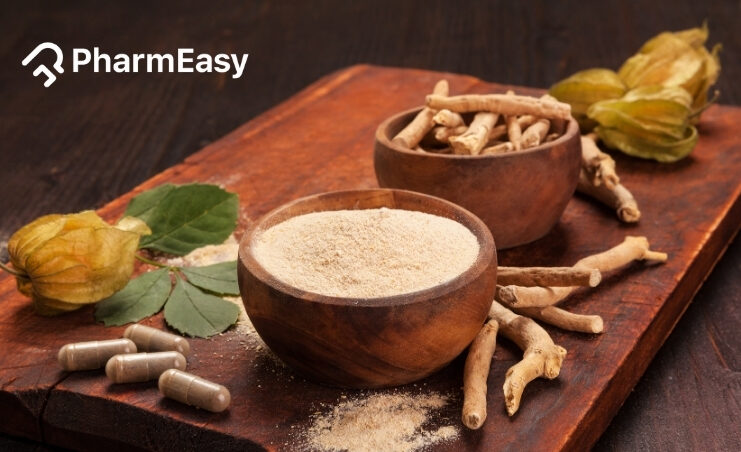
Ashwagandha is a strong herb famous in age-old Ayurvedic medicine. It’s known for its wide range of potential health benefits. In this article, we will be trying to understand the effect of ashwagandha on testosterone levels.
We’ll delve into the scientific evidence supporting this idea. We’ll highlight any shortfalls or conflicting findings in the research. We will also discuss about the safe ways to consume ashwagandha.
Did You Know?
Ashwagandha is a plant with a long list of potential health benefits used in Ayurveda since ages. To know about its association with boosting testosterone, let’s look deep into this herb’s roots.
Ashwagandha’s botanical name is Withania somnifera. It’s a small shrub with yellow flowers, native to India and Southeast Asia. The meaning of ‘ashwagandha’ in Sanskrit is the ‘smell of the horse’. This cryptic name points to the herb’s unique smell, and its reputed ability to increase strength and stamina.
Ashwagandha is used in traditional medicine for several purposes as it is believed to have a huge list of potential health benefits. These are listed below1:
Ashwagandha houses active compounds called withanolides. The top-studied amongst these is withaferin A. This compound is believed to be at the heart of the herb’s ability to fight inflammation and protect from oxidative stress2. Moreover, it is said to aid the body in reacting better to stress, which holds the key to understanding ashwagandha’s possible impact on testosterone levels.
Testosterone is a key hormone in our bodies. It governs lots of important functions in both men and women. Below we have discussed functions, what happens when testosterone is low, and why these levels might decrease.
Contrary to common belief, women need testosterone too, though in much lesser amounts. They require it for good bone health and healthy reproductive function.
Low testosterone might result in quite a few symptoms, such as4,5:
Lots of clinical trials examine possible links between ashwagandha and testosterone. While some studies back the effect on testosterone, there are others that show conflicting or unclear results.
Quite a few studies back the claim that ashwagandha may help increase testosterone levels in certain groups:
Not all studies draw a clear line between ashwagandha intake and boosting testosterone levels. Some fall short due to the small sample size, different dosages used, and different ways to measure testosterone levels. Also, a good number of the studies are male-biased, leaving questions about how ashwagandha might affect women9. Thus, there a need for further studies to confirm this association.
Also Read: Shilajit Benefits for Male: Exploring Research-Based Advantages for Men’s Health
If you’re thinking of using ashwagandha to raise your testosterone levels, it’s important to understand the right dosage to take and the measures needed for safe and efficient use.
Clinical trials commonly used doses of ashwagandha ranging from 300 mg to 5 g per day to boost testosterone10,11. Yet, it’s wise to talk to a medical expert before starting any new supplement. They will be able to guide you with the perfect dosage tailored for you.
Ashwagandha comes in various forms such as capsules, tablets, powders, and liquid extracts. Which one you choose depends on your preference and which one’s easier to use. Picking high-quality products from well-known brands and sticking to the recommended dosage is crucial.
Even though ashwagandha is usually safe for short term use, some people might experience side effects. Some of these are feeling sleepy, loose stools, or nausea12. Seeing a doctor if you have these side effects or worries about how safe the supplement is will be prudent.
Furthermore, some individuals should avoid using ashwagandha. You should avoid it if you,
Most of the research on ashwagandha focuses on short-term use (generally up to 12 weeks). Hence, the safety of long-term use remains unknown. Before using ashwagandha for an extended period, it’s vital to see a doctor to weigh the risks and benefits.
Ashwagandha has shown the potential to improve semen parameters in men. Studies show that it effectively lowers oxidative stress by reducing harmful substances and boosting protective antioxidants. It also improves hormone levels, which are crucial for semen quality in infertile individuals14.
Dr. Siddharth Gupta, B.A.M.S, M.D
Ashwagandha is a popular natural testosterone booster. However, there are other supplements too which are believed to be beneficial for the same purpose. Let’s have a look at these and if Ashwagandha can be used along with.
Other supplements that might help boost testosterone include D-aspartic acid, vitamin D, Tribulus Terrestris, fenugreek, and zinc13. It’s vital to discuss with a doctor and look at the scientific evidence backing these supplements and weigh their pros and cons according to your personal needs.
Some people might find mixing ashwagandha with other testosterone-boosting supplements helpful in terms of improved efficacy or additional benefits. However, it is important to monitor the dose and possible side effects. If you’re thinking of doing so, it’s key to talk to a doctor first.
Lastly, remember that no supplement can take the place of healthy lifestyle choices. Keeping a balanced diet, staying physically active, managing stress, and getting sufficient sleep. All these things have a vital role in maintaining healthy testosterone levels.
Ashwagandha is not just beneficial for male hormones but also for females experiencing menopause. Studies show Ashwagandha significantly helped in reducing overall menopause-related problems, including psychological, physical, and urogenital issues. It also improved overall quality of life scores, increased estrogen levels, and lowered FSH and LH hormone levels. These findings suggest that ashwagandha root extract can safely and effectively help relieve mild to moderate menopause symptoms in women15.
Dr. Rajeev Singh, BAMS
The research exploring the link between ashwagandha and testosterone levels is exciting. Although some studies suggest that ashwagandha might indeed help boost testosterone under certain circumstances, it’s important to remember that the research isn’t without its shortfalls or conflicting findings.
Keep in mind that other health and lifestyle factors also come into play when thinking about using ashwagandha to boost your testosterone. Always talk to a doctor before you start a new supplement and never forget the key to the best hormonal levels is a balanced lifestyle.
It is said to reduce stress, increase energy, clear your mind, and help with muscle growth. On top of this, studies show that ashwagandha may help boost testosterone in certain groups.
The recommended dosage for ashwagandha lies between 300 mg to 5 g per day. But it’s wise to ask a doctor for the perfect dosage for you.
Although usually safe for short-term use, ashwagandha might cause mild side effects. These include upset stomach, feeling sleepy, loose stools, or throwing up. If you have these side effects or any worries, talk to a doctor.
Some studies have shown that, ashwagandha supplements can found boost testosterone in both men and women. However, how much it increases and how quickly it affects may vary from person to person, and it might not have instant results.
How soon ashwagandha will affect your testosterone levels can differ based on things like age, lifestyle, and overall health. Some research found positive effects in as little as a few weeks, while others took a few months.
A balanced diet, regular exercise, stress management, and good quality sleep are all vital in maintaining healthy testosterone levels.
1. Guo S, Rezaei MJ. The benefits of ashwagandha (Withania somnifera) supplements on brain function and sports performance. Front Nutr. 2024;11:1439294. doi:10.3389/fnut.2024.1439294 https://pubmed.ncbi.nlm.nih.gov/39155932/
2. Behl T, Sharma A, Sharma L, et al. Exploring the Multifaceted Therapeutic Potential of Withaferin A and Its Derivatives. Biomedicines. 2020;8(12):571. doi:10.3390/biomedicines8120571 https://pubmed.ncbi.nlm.nih.gov/33291236/
3. Rojas-Zambrano JG, Rojas-Zambrano AR, Rojas-Zambrano AF, Barahona-Cueva GE. Benefits of Testosterone Hormone in the Human Body: A Systematic Review. Cureus. 17(2):e78785. doi:10.7759/cureus.78785 https://pubmed.ncbi.nlm.nih.gov/39926620/
4. Nassar GN, Leslie SW. Physiology, Testosterone. StatPearls Publishing; 2026. Accessed September 11, 2026. http://www.ncbi.nlm.nih.gov/books/NBK526128/
5. Could you have low testosterone?: MedlinePlus. Accessed September 11, 2026. https://medlineplus.gov/ency/patientinstructions/000722.htm
6. Lopresti AL, Drummond PD, Smith SJ. A Randomized, Double-Blind, Placebo-Controlled, Crossover Study Examining the Hormonal and Vitality Effects of Ashwagandha (Withania somnifera) in Aging, Overweight Males. Am J Mens Health. 2019;13(2):1557988319835985. doi:10.1177/1557988319835985 https://pubmed.ncbi.nlm.nih.gov/30854916/
7. Ambiye VR, Langade D, Dongre S, Aptikar P, Kulkarni M, Dongre A. Clinical Evaluation of the Spermatogenic Activity of the Root Extract of Ashwagandha (Withania somnifera) in Oligospermic Males: A Pilot Study. Evid-Based Complement Altern Med ECAM. 2013;2013:571420. doi:10.1155/2013/571420 https://pubmed.ncbi.nlm.nih.gov/24371462/
8. Chauhan S, Srivastava MK, Pathak AK. Effect of standardized root extract of ashwagandha (Withania somnifera) on well‐being and sexual performance in adult males: A randomized controlled trial. Health Sci Rep. 2022;5(4):e741. doi:10.1002/hsr2.741 https://pubmed.ncbi.nlm.nih.gov/35873404/
9. Smith SJ, Lopresti AL, Teo SYM, Fairchild TJ. Examining the Effects of Herbs on Testosterone Concentrations in Men: A Systematic Review. Adv Nutr. 2020;12(3):744-765. doi:10.1093/advances/nmaa134 https://pubmed.ncbi.nlm.nih.gov/33150931/
10. Mahdi AA, Shukla KK, Ahmad MK, et al. Withania somnifera Improves Semen Quality in Stress-Related Male Fertility. Evid-Based Complement Altern Med ECAM. 2011;2011:576962. doi:10.1093/ecam/nep138 https://pubmed.ncbi.nlm.nih.gov/19789214/
11. Effect of standardized root extract of ashwagandha (Withania somnifera) on well‐being and sexual performance in adult males: A randomized controlled trial – Chauhan – 2022 – Health Science Reports – Wiley Online Library. Accessed September 11, 2026. https://onlinelibrary.wiley.com/doi/full/10.1002/hsr2.741
12. Ashwagandha: Is it helpful for stress, anxiety, or sleep? Accessed September 15, 2026. https://ods.od.nih.gov/factsheets/Ashwagandha-HealthProfessional/
13. Clemesha CG, Thaker H, Samplaski MK. ‘Testosterone Boosting’ Supplements Composition and Claims Are not Supported by the Academic Literature. World J Mens Health. 2020;38(1):115-122. doi:10.5534/wjmh.190043 https://pubmed.ncbi.nlm.nih.gov/31385468/
14. Ahmad MK, Mahdi AA, Shukla KK, Islam N, Rajender S, Madhukar D, et al. Withania somnifera improves semen quality by regulating reproductive hormone levels and oxidative stress in seminal plasma of infertile males. Fertil Steril. 2010;94(3):989-96. https://pubmed.ncbi.nlm.nih.gov/19501822/
15. Gopal S, Ajgaonkar A, Kanchi P, Kaundinya A, Thakare V, Chauhan S, et al. Effect of an ashwagandha (Withania Somnifera) root extract on climacteric symptoms in women during perimenopause: a randomized, double-blind, placebo-controlled study. J Obstet Gynaecol Res. 2021;47(12):4414-25. https://obgyn.onlinelibrary.wiley.com/doi/abs/10.1111/jog.15030
Disclaimer: The information provided here is for educational/awareness purposes only and is not intended to be a substitute for medical treatment by a healthcare professional and should not be relied upon to diagnose or treat any medical condition. The reader should consult a registered medical practitioner to determine the appropriateness of the information and before consuming any medication. PharmEasy does not provide any guarantee or warranty (express or implied) regarding the accuracy, adequacy, completeness, legality, reliability or usefulness of the information; and disclaims any liability arising thereof.
Links and product recommendations in the information provided here are advertisements of third-party products available on the website. PharmEasy does not make any representation on the accuracy or suitability of such products/services. Advertisements do not influence the editorial decisions or content. The information in this blog is subject to change without notice. The authors and administrators reserve the right to modify, add, or remove content without notification. It is your responsibility to review this disclaimer regularly for any changes.
 6
6  1
1Comments

Leave your comment...
You may also like


















Comments