




Fever (High Temperature): Causes, Stages, Treatments, and Red Flags
By Dr. Avinav Gupta +2 more

Medically reviewed by Dr. Avinav Gupta
Last updated: Sep 7, 2026 Published on: Jun 19, 2026


Get,

to manage your symptom
Get your,

4 Cr+ families
benefitted

OTP sent to 9988776655



You’ve successfully subscribed to receive
doctor-approved tips on
Whatsapp

Get ready to feel your best.


Register to Avail the Offer
Send OTPBy continuing, you agree with our Privacy Policy and Terms and Conditions
Hi There,
Sign up on PharmEasy now!!


Trusted by 4 crore+ families

OTP sent to 9988776655
You have unlocked 25% off on medicines


Code: NU25

By Dr. Avinav Gupta +2 more
Table of Contents
Fever (also known as a high temperature) is one of the most common signs that the body is fighting an infection or another health condition1.
While most fevers resolve with appropriate care, some may indicate a more serious underlying problem that requires medical attention1. Therefore, understanding the causes, stages, treatment options, and warning signs of fever can help individuals manage symptoms appropriately and seek timely medical care when needed.

This blog explains what fever is, its common causes, the different stages of fever, available treatment approaches, and the red flags that should not be ignored.
A fever is a temporary rise in body temperature that occurs when the immune system responds to an infection, inflammation, or another health condition. It is important to understand that fever is not a disease itself but a sign that the body is actively working to protect and heal itself.
So, what actually happens inside the body? When germs such as viruses or bacteria enter the body, the immune system releases substances that help fight the infection. As part of this natural defence response, the body’s temperature is increased, creating an environment that can make it harder for some germs to survive and multiply1.
Interesting Fact: The hypothalamus is a small region in the brain that acts as the body’s thermostat. This regulates the increase in temperature during a fever1.
Body temperature can vary slightly from person to person and may fluctuate throughout the day. In general, a temperature above the normal range is considered a fever1,2.
| Category | Fever Temperature (°C) | Fever Temperature (°F) | Notes |
| Normal | 36.1 to 37.2°C | 97 to 99°F | Typical body temperature range |
| Low-grade Fever | 37.3 to 38.0°C | 99.1 to 100.4°F | Mild elevation |
| Moderate Fever | 38.1 to 39.0°C | 100.5 to 102.2°F | May need attention |
| High Fever | 39.1 to 41.0°C | 102.3 to 105.8°F | May cause considerable discomfort and should be monitored closely |
| Hyperpyrexia | Above 41.0°C | Above 105.8°F | Medical emergency that requires immediate medical attention |
Important points to remember:
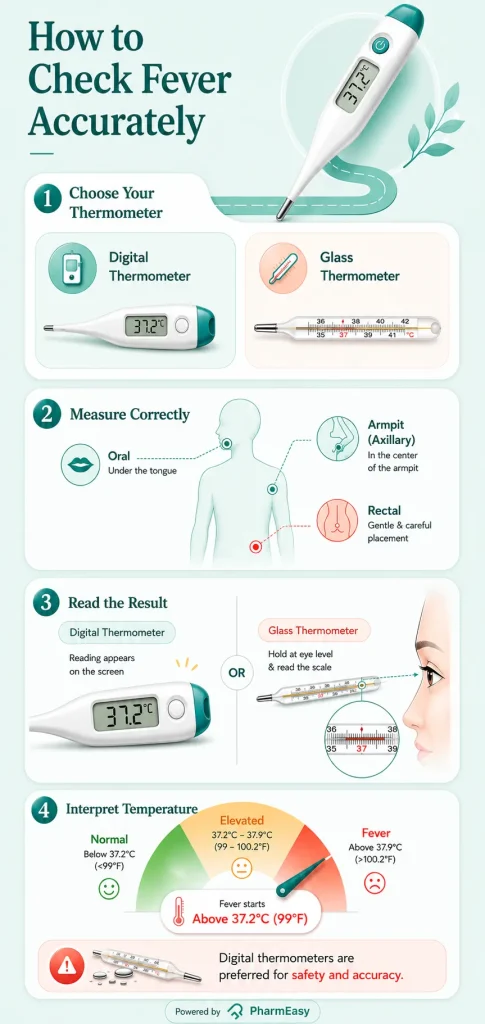
Measuring body temperature with a thermometer is the most reliable way to confirm whether a person has a fever. There are two ways to check for a fever4,5.
Steps to record temperature:
Note: Mercury-containing glass thermometers are generally not recommended because they can break and release mercury, which is toxic. Electronic (digital) thermometers are preferred as they are safer, easier to use, and provide quick and accurate temperature readings4.
The symptoms of fever can vary depending on the underlying cause, the severity of the illness, and the person’s age. While an elevated body temperature is the hallmark sign, fever is often accompanied by a range of other symptoms as the body works to fight infection. Some common fever symptoms include1,7,8:
If an infant has a fever, you may observe fever symptoms like7,9:
Fever can occur for many reasons, but it most commonly occurs as a response to some kind of infection. However, it may also result from other underlying medical conditions. Some of the common causes of fever include:
Note: A fever that continues or comes back and for which no clear cause can be identified despite proper medical evaluation is known as a fever of unknown origin13.
Fevers can be classified based on how long they last and how they occur. The duration and pattern of a fever can sometimes provide clues about its underlying cause.
Based on duration, the types include14:
Based on pattern, the types include11:
Note: Any cause of acute fever can become persistent or chronic if it is not properly diagnosed and treated under medical guidance.
Most fevers follow a predictable pattern, progressing through different stages as the body’s immune system fights an infection. The stages are as follows:
The rising stage begins when the immune system detects an infection or another trigger and signals the body to raise its temperature. During this phase, the hypothalamus increases the body’s temperature set point, causing blood vessels in the skin to constrict and reducing heat loss. As a result, a person may experience chills or shivering15.
Practical tip: Wear light layers of clothing and stay hydrated, but avoid excessive layering of too many clothes, which may increase discomfort7.
During the peak stage, the body reaches and maintains its elevated temperature while actively fighting the underlying illness. The immune system remains highly active, and symptoms such as feeling hot, fatigue, and muscle aches are common1.
Practical tip: Rest as much as possible and drink plenty of fluids to avoid dehydration8.
The recovery stage begins when the underlying illness starts to improve, and the body’s temperature begins to return to normal. The hypothalamus lowers the temperature set point, and blood vessels in the skin dilate to release excess heat. This often leads to sweating as the body cools down1,15.
Practical tip: Continue drinking fluids and avoid strenuous activity until you feel fully recovered7.
Diagnostic tests may be needed when a fever is high, persists for several days, recurs frequently, is accompanied by concerning symptoms, or when the underlying cause is unclear. Based on your symptoms, your doctor may order:
Note: The primary goal of fever diagnosis is to identify and manage the underlying cause of the fever. This helps the doctor to guide the treatment.
Fever is typically managed depending on its underlying cause. While fever-reducing medications can help relieve discomfort, addressing the condition responsible for the fever is equally important. Here are some common fever treatment/management options:
If a fever continues or returns after receiving the proper therapy for a detected infection, an underlying non-infectious cause, such as an autoimmune or inflammatory disorder, cancer, or other illnesses, may be indicated. For treatment in these situations, a thorough clinical assessment and additional diagnostic testing may be necessary to identify the underlying reason first.
Note: Avoid self-medicating, especially with antibiotics or other prescription medications. You should always consult a doctor for the appropriate fever treatment.
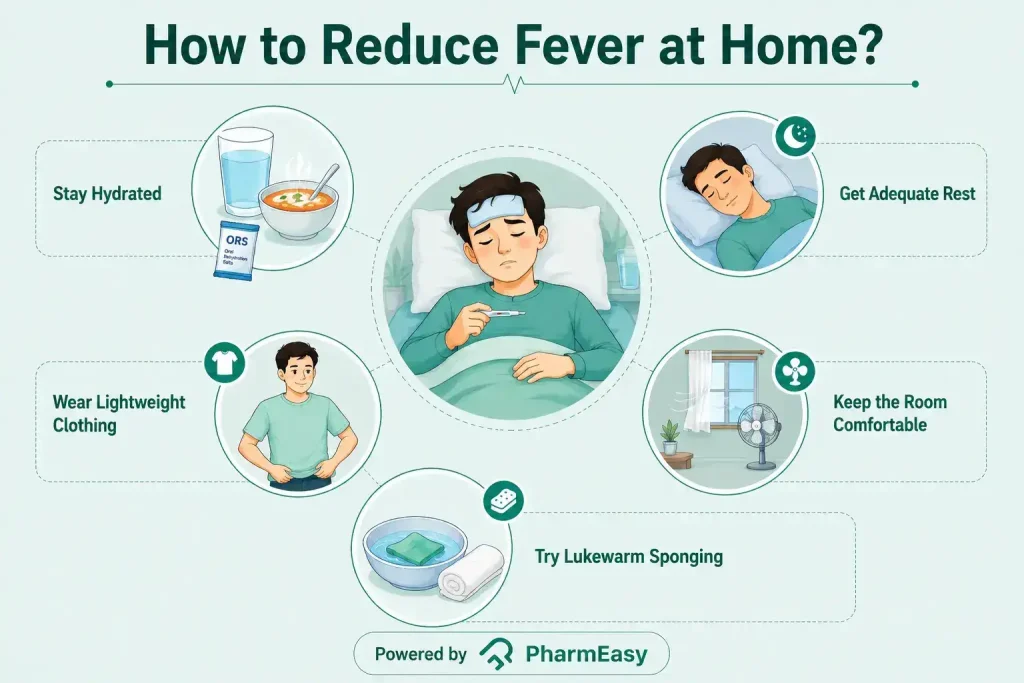
A mild fever may sometimes be managed safely at home. The goal of home care is to improve comfort, avoid dehydration, and support the body’s natural recovery process rather than eliminate the fever completely. Here’s what you can do:
Note: Home care measures help improve comfort. They should not replace appropriate medical treatment aimed at identifying and managing the underlying cause of the fever.
Also Read: Why Do Headaches Happen? Common Causes, Symptoms and Treatments
Some situations require prompt medical evaluation to identify and address potentially serious underlying conditions.
Consult a doctor if your child16:
Consult a doctor if you16:
Also Read: What Does It Mean When Fever Goes Away in a Day or Two
Fever is often a sign that the immune system is actively responding to an infection or other health challenge. In many cases, it can be monitored and managed safely at home with supportive care. However, it is important to stay alert for warning signs and seek medical attention when symptoms are severe, persistent, or concerning. This will help to recognize when to manage a fever and when to escalate care, which can help ensure timely treatment and better health outcomes.
Also Read: Types of Fever: Stages, Symptoms, Management Tips & More
Fever is typically divided into 3 stages: the rising stage, when body temperature begins to increase, and chills may occur; the peak stage, when the temperature remains elevated while the body fights the underlying illness; and the recovery stage, when the temperature returns to normal and symptoms gradually improve1,15.
Yes, a temperature of 102°F (38.9°C) is considered a moderate fever1.
A fever lasting four days is generally considered an acute fever, as it has been present for less than seven days14.
A fever becomes more concerning when it reaches very high levels (typically above 40°C or 104°F), persists despite management, or is accompanied by symptoms such as difficulty breathing, confusion, seizures, or a stiff neck1,16. In such cases, medical attention should be sought immediately.
Yes, many viral infections can cause fever for 3 to 5 days, and sometimes longer21. However, if the fever persists, worsens, or is accompanied by concerning symptoms, medical evaluation may be needed.
1. Balli S, Shumway KR, Sharan S. Physiology, Fever. In: StatPearls. StatPearls Publishing; 2026. Accessed June 12, 2026. http://www.ncbi.nlm.nih.gov/books/NBK562334/
2. Body temperature norms: MedlinePlus Medical Encyclopedia. Accessed June 12, 2026. https://medlineplus.gov/ency/article/001982.htm
3. Barbi E, Marzuillo P, Neri E, Naviglio S, Krauss BS. Fever in Children: Pearls and Pitfalls. Children. 2017;4(9):81. doi:10.3390/children4090081 https://pubmed.ncbi.nlm.nih.gov/28862659/
4. Temperature measurement: MedlinePlus Medical Encyclopedia. Accessed June 18, 2026. https://medlineplus.gov/ency/article/003400.htm
5. Australia H. Types of thermometer for fever. November 5, 2025. Accessed June 18, 2026. https://www.healthdirect.gov.au/types-of-thermometer
6. Temperature: Digital and Glass Thermometers. Accessed June 18, 2026. https://www.nationwidechildrens.org/family-resources-education/health-wellness-and-safety-resources/helping-hands/temperature-digital-and-glass-thermometers
7. Australia H. Fever. June 2, 2026. Accessed June 12, 2026. https://www.healthdirect.gov.au/fever
8. Fever in adults. NHS inform. Accessed June 12, 2026. https://www.nhsinform.scot/illnesses-and-conditions/infections-and-poisoning/fever-in-adults/
9. Fever in children. NHS inform. Accessed June 12, 2026. https://www.nhsinform.scot/illnesses-and-conditions/infections-and-poisoning/fever-in-children/
10. Abdel Wahab MF, Younis TA, Fahmy IA, el Gindy IM. Parasitic infections presenting as prolonged fevers. J Egypt Soc Parasitol. 1996;26(2):509-516. https://pubmed.ncbi.nlm.nih.gov/8754658/
11. Fever. Accessed June 12, 2026. https://medlineplus.gov/fever.html
12. Galloway J, Cope AP. The ying and yang of fever in rheumatic disease. Clin Med. 2015;15(3):288-291. doi:10.7861/clinmedicine.15-3-288 https://europepmc.org/article/pmc/4953116
13. Brown I, Finnigan NA. Fever of Unknown Origin. In: StatPearls. StatPearls Publishing; 2026. Accessed June 12, 2026. http://www.ncbi.nlm.nih.gov/books/NBK532265/
14. Ogoina D. Fever, fever patterns and diseases called ‘fever’ – A review. J Infect Public Health. 2011;4(3):108-124. doi:10.1016/j.jiph.2011.05.002 https://pubmed.ncbi.nlm.nih.gov/21843857/
15. El-Radhi AS. Pathogenesis of Fever. Clin Man Fever Child. Published online January 2, 2019:53-68. doi:10.1007/978-3-319-92336-9_3 https://pmc.ncbi.nlm.nih.gov/articles/PMC7122269/
16. Fever: MedlinePlus Medical Encyclopedia. Accessed June 15, 2026. https://medlineplus.gov/ency/article/003090.htm
17. Naito T, Mizooka M, Mitsumoto F, et al. Diagnostic workup for fever of unknown origin: a multicenter collaborative retrospective study. BMJ Open. 2013;3(12):e003971. doi:10.1136/bmjopen-2013-003971 https://pubmed.ncbi.nlm.nih.gov/24362014/
18. Świerczyńska M, Mirowska-Guzel DM, Pindelska E. Antiviral Drugs in Influenza. Int J Environ Res Public Health. 2022;19(5):3018. doi:10.3390/ijerph19053018 https://pubmed.ncbi.nlm.nih.gov/35270708/
19. Malaria. Accessed June 15, 2026. https://www.who.int/news-room/fact-sheets/detail/malaria
20. Gawronska J, Koyanagi A, López Sánchez GF, et al. The Prevalence and Indications of Intravenous Rehydration Therapy in Hospital Settings: A Systematic Review. Epidemiologia. 2022;4(1):18-32. doi:10.3390/epidemiologia4010002 https://pubmed.ncbi.nlm.nih.gov/36648776/
21. El-Radhi AS. Fever in Common Infectious Diseases. Clin Man Fever Child. Published online January 2, 2019:85-140. doi:10.1007/978-3-319-92336-9_5 https://pmc.ncbi.nlm.nih.gov/articles/PMC7122655/
Disclaimer: The information provided here is for educational/awareness purposes only and is not intended to be a substitute for medical treatment by a healthcare professional and should not be relied upon to diagnose or treat any medical condition. The reader should consult a registered medical practitioner to determine the appropriateness of the information and before consuming any medication. PharmEasy does not provide any guarantee or warranty (express or implied) regarding the accuracy, adequacy, completeness, legality, reliability or usefulness of the information and disclaims any liability arising thereof.
Links and product recommendations in the information provided here are advertisements of third-party products available on the website. PharmEasy does not make any representation on the accuracy or suitability of such products/services. Advertisements do not influence the editorial decisions or content. The information in this blog is subject to change without notice. The authors and administrators reserve the right to modify, add, or remove content without notification. It is your responsibility to review this disclaimer regularly for any changes.
 1
1 
Comments

Leave your comment...
You may also like

























Comments