




How to Identify Generic Medicines: Label Reading, Verification and Safety Tips
By Dr. Nainish Mehta +2 more

Medically reviewed by Dr. Nainish Mehta
Last updated: Sep 11, 2026 Published on: Aug 20, 2026


Get,

to manage your symptom
Get your,

4 Cr+ families
benefitted

OTP sent to 9988776655



You’ve successfully subscribed to receive
doctor-approved tips on
Whatsapp

Get ready to feel your best.


Register to Avail the Offer
Send OTPBy continuing, you agree with our Privacy Policy and Terms and Conditions
Hi There,
Sign up on PharmEasy now!!


Trusted by 4 crore+ families

OTP sent to 9988776655
You have unlocked 25% off on medicines


Code: NU25

By Dr. Nainish Mehta +2 more
Table of Contents
The rising cost of branded medicines has led many people to look for more affordable options. Generic medicines can be one such option. However, it is not always easy to recognise whether a medicine is a genuine generic medicine. A generic medicine has the same active ingredient as the branded medicine it is compared with and must meet required standards for quality, safety, strength and effectiveness1. This guide explains how to identify, read, verify, and safely buy generic medicines.
Identifying a generic medicine is an important first step in checking whether it is the right medicine for you. Here is why it matters:
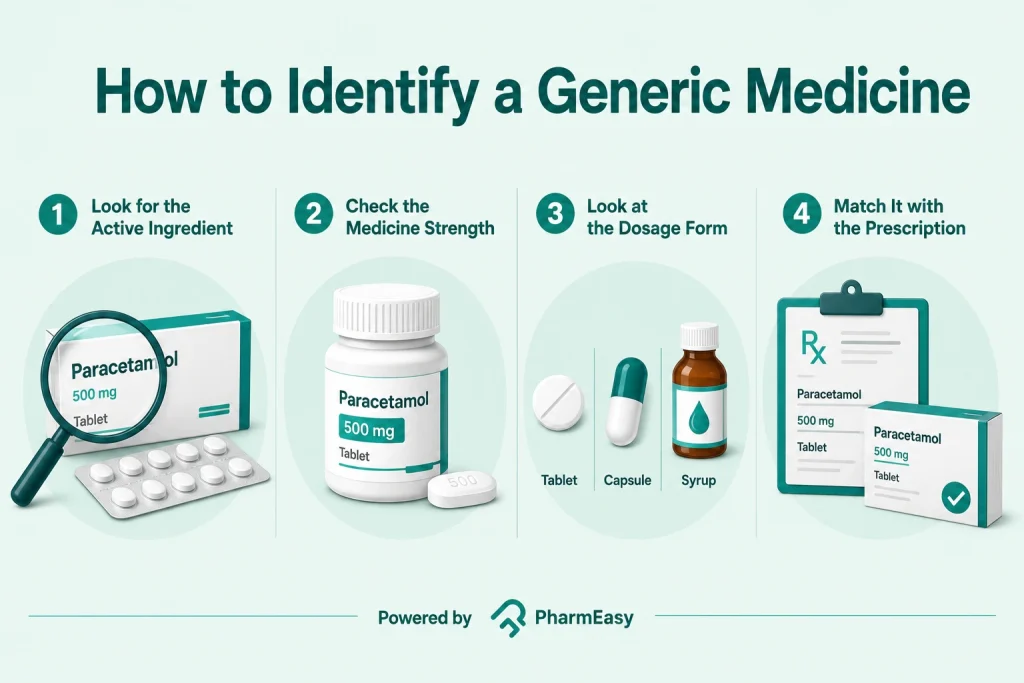
Before using a medicine, take a few moments to check its label and compare it with your prescription. These steps can help you identify a generic medicine correctly:
Start by checking the medicine strip, bottle or box for the active ingredient. The active ingredient is the substance in the medicine that gives the desired effect. Generic medicines are usually identified by their active ingredient rather than a unique brand name2.
Look at the strength mentioned next to the active ingredient, such as 500 mg or 10 mg. This helps you distinguish between medicines that contain the same ingredient but are available in different strengths1.
Check whether the medicine is a tablet, capsule, or syrup. The dosage form is important because medicines containing the same active ingredient may be available in different forms1.
If your doctor has prescribed a medicine by its generic name, compare the prescribed ingredient and strength with those printed on the medicine pack. This can help you identify whether you have received the intended medicine.
A medicine pack may show several names and details, which can make it confusing to know what you are taking. Understanding the difference between the brand name and the generic, or active ingredient, name can help you identify a medicine and compare products that contain the same ingredient. The table below explains common label details found on a medicine pack:
| Label Component | What it Means | Examples |
| Brand Name | The name under which a company markets and sells a medicine5. | Calpol |
| Generic (Salt) Name | The active ingredient present in the medicine that produces the intended effect1. | Paracetamol5 |
| Strength | Shows how much of the active ingredient is present in each dose6. | 500 mg |
| Dosage Form | Describes the form in which the medicine is supplied2,5. | Tablet1,2 |
| Manufacturer | The company responsible for manufacturing the medicine. | GlaxoSmithKline (GSK) |
Using the table as an example, Calpol is the brand name, while paracetamol is the generic or active ingredient name. The 500 mg shows the strength, and “tablet” describes the dosage form.
Quick tip: The generic name may be printed near the brand name on a medicine box or strip. Look for terms such as “Composition”, “Each tablet contains”, “Active ingredient”, or “Salt composition”. The generic name may also be displayed prominently on the package, sometimes in a larger font than the brand name7. The ingredient name and its strength6, such as paracetamol 500 mg, tell you what active ingredient the medicine contains.
Information on a medicine package can help you find the generic name and strength. The examples below show what to look for:
Do not rely only on the large name printed on the front of the pack. Always check the active ingredient, strength, and dosage form to identify the medicine correctly.
Also Read: Generic Medicines for Diabetes: Options, Safety and How Much You Can Save
After identifying a medicine by its active ingredient, strength and dosage form, check a few safety details before using it.
The table below explains key differences between generic and branded medicines in simple terms.
| Attribute | Generic Medicine | Branded Medicine |
| Name | Usually identified by its active ingredient name1. | Sold under a specific brand name chosen by the manufacturer. |
| Cost | Generally, costs less because generic manufacturers do not need to repeat all the studies already done for the original branded medicine5. | Often costs more because the price may include the cost of developing, testing, marketing, and distributing the medicine5. |
| Appearance | May have a different colour, shape, size or packaging from the branded version3. | Has its own brand-specific appearance and packaging3. |
| Manufacture | May be made by one or more licensed manufacturers after the branded medicine is eligible for generic competition14. | Usually associated with a particular brand or manufacturer. |
People may make the following mistakes when trying to identify generic medicines:
Use these tips to buy generic medicines more safely:
Also Read: Generic Medicine Quality In India: Who Regulates It And How To Spot Fakes
Knowing the generic name, strength and dosage form can help you understand the medicine you are buying. Checking the label, packaging and prescription can help you choose the right medicine more safely. If you are unsure about a generic medicine, speak with your doctor or pharmacist before buying it or switching from another medicine.
Also Read: Generic Medicines And How Safe Are They?
Neither one is stronger than the other. An approved generic medicine should have the same active ingredient, strength, dosage form, and intended effect as the brand-name medicine it is compared with. This means it is expected to work in the same way when used as directed2.
Yes, you can trust a generic medicine if it has been approved by the appropriate medicine regulator and bought from a reliable source. Approved generics must meet required standards for quality, safety and effectiveness1.
Not necessarily. If a generic medicine is properly approved, it should provide the same clinical benefit as the brand-name medicine. The two may look different because of differences in colour, shape, packaging or inactive ingredients, but these differences do not usually change how the medicine works1,2.
Generic medicines bought in India can be safe when they are approved by the relevant authorities and purchased from licensed or reliable pharmacies. Before using them, check the medicine name, active ingredient, strength, manufacturer, batch number, expiry date and whether the package is sealed and undamaged16.
Some people may hesitate to use generic medicines because they are more familiar with brand names, may believe that a higher price means better quality, or may be unsure how to read medicine labels. Clear advice from doctors and pharmacists can help patients compare the active ingredient, strength and dosage form with confidence17.
1. Generic drugs: Questions & answers. FDA. 2026. Accessed August 11, 2026. https://www.fda.gov/drugs/generic-drugs/generic-drugs-questions-answers
2. Generic drug facts. FDA. 2021. Accessed August 11, 2026. https://www.fda.gov/drugs/generic-drugs/generic-drug-facts
3. Similarities and differences between brand-Name and generic drugs. CDA-AMC. Accessed August 11, 2026. https://www.cda-amc.ca/similarities-and-differences-between-brand-name-and-generic-drugs
4. Hambrick HR, Tang Girdwood S. The importance of being generic: Avoiding brand names for safety and clarity. J Hosp Med. 2023;18(9):870-871. doi:10.1002/jhm.13177. https://pmc.ncbi.nlm.nih.gov/articles/PMC10844950/
5. Narula A, Mathur A. What’s in a name? Med J Armed Forces India. 2011;63(3):210-211. doi:10.1016/S0377-1237(07)80135-3. https://pmc.ncbi.nlm.nih.gov/articles/PMC4922393/
6. Strength conversion in drug listing. FDA. 2023. Accessed August 11, 2026. https://www.fda.gov/drugs/electronic-drug-registration-and-listing-system-edrls/strength-conversion-drug-listing
7. Labelling norms for generic drugs. 2018. Accessed August 11, 2026. https://www.pib.gov.in/newsite/PrintRelease.aspx?relid=177207®=48&lang=2
8. Paracetamol (Acetaminophen) – Pharmaceutical Drugs – NCBI Bookshelf. Accessed August 11, 2026. https://www.ncbi.nlm.nih.gov/books/NBK526213/
9. Amoxicillin. Accessed August 11, 2026. https://dailymed.nlm.nih.gov/dailymed/fda/fdaDrugXsl.cfm?setid=8fbf98c5-0e34-46ab-bcef-b7c96b29200c
10. Cetirizine hydrochloride tablets, 10 mg- hydrochloride tablet. DailyMed. 2024. Accessed August 11, 2026. https://dailymed.nlm.nih.gov/dailymed/drugInfo.cfm?setid=d78223ba-80d5-47f8-e053-2a95a90aebdb
11. Corcoran C, Jacobs TF. Metformin. NIH. In: StatPearls. StatPearls Publishing; 2023. Accessed August 11, 2026. http://www.ncbi.nlm.nih.gov/books/NBK518983/
12. Shah N, Gossman W. Omeprazole. NIH. In: StatPearls. StatPearls Publishing; 2023. Accessed August 11, 2026. http://www.ncbi.nlm.nih.gov/books/NBK539786/
13. Don’t be tempted to use expired medicines. FDA. 2024. Accessed August 11, 2026. https://www.fda.gov/drugs/safe-disposal-medicines/dont-be-tempted-use-expired-medicines
14. Nikam NR, Vakhariya RR, Magdum CS. Generic Vs. Brand Medicines: An Overview. Asian Jour Pharmac Rese. 2019;9(2):109. doi:10.5958/2231-5691.2019.00018.2. https://asianjpr.com/HTMLPaper.aspx?Journal=Asian%20Journal%20of%20Pharmaceutical%20Research;PID=2019-9-2-9
15. Mamunuwa N, Jayamanne S, Wijekoon N, et al. Duplication errors due to brand name confusion; It is not always the name—Short case series. Clin Case Rep. 2023;11(9):e7795. doi:10.1002/ccr3.7795. https://pmc.ncbi.nlm.nih.gov/articles/PMC10502196/
16. Joshi S, Shetty Y, Karande S. Generic drugs: The Indian scenario. J Postgrad Med. 2019;65(2):67-69. doi:10.4103/jpgm.JPGM_420_18. https://pmc.ncbi.nlm.nih.gov/articles/PMC6515776/
17. Manak S, Inder D. Generic drugs in India: Regulations, challenges. J Integr Med Res. 2025;3(3):140-147. doi: 10.4103/jimr.jimr_31_25 . https://www.researchgate.net/publication/394392722_Generic_drugs_in_India_Regulations_challenges_and_reforms_An_overview
Disclaimer: The information provided here is for educational/awareness purposes only and is not intended to be a substitute for medical treatment by a healthcare professional and should not be relied upon to diagnose or treat any medical condition. The reader should consult a registered medical practitioner to determine the appropriateness of the information and before consuming any medication. PharmEasy does not provide any guarantee or warranty (express or implied) regarding the accuracy, adequacy, completeness, legality, reliability or usefulness of the information; and disclaims any liability arising thereof.
Links and product recommendations in the information provided here are advertisements of third-party products available on the website. PharmEasy does not make any representation on the accuracy or suitability of such products/services. Advertisements do not influence the editorial decisions or content. The information in this blog is subject to change without notice. The authors and administrators reserve the right to modify, add, or remove content without notification. It is your responsibility to review this disclaimer regularly for any changes.


Comments

Leave your comment...
You may also like





















Comments