




What Does It Mean When Fever Goes Away in a Day or Two
By Dr. Avinav Gupta +2 more

Medically reviewed by Dr. Avinav Gupta
Last updated: Sep 8, 2026 Published on: Jun 17, 2026


Get,

to manage your symptom
Get your,

4 Cr+ families
benefitted

OTP sent to 9988776655



You’ve successfully subscribed to receive
doctor-approved tips on
Whatsapp

Get ready to feel your best.


Register to Avail the Offer
Send OTPBy continuing, you agree with our Privacy Policy and Terms and Conditions
Hi There,
Sign up on PharmEasy now!!


Trusted by 4 crore+ families

OTP sent to 9988776655
You have unlocked 25% off on medicines


Code: NU25

By Dr. Avinav Gupta +2 more
Table of Contents
The monsoon season often brings a rise in infections, making fever one of the most common symptoms experienced by people of all ages1. In many cases, fever may improve within a few days as the body’s immune system begins to control and clear the infection2. However, the disappearance of fever does not always mean that the underlying illness has completely gone, as recovery from the underlying infection may sometimes still be ongoing3.
In this blog, we will explore the possible reasons why a fever may go away within a day or two, when it is considered a reassuring sign, and when it could indicate the need for continued observation or medical evaluation. We will also discuss common monsoon-related illnesses and the warning signs that should not be ignored even after the fever has subsided.

Fever is a protective response of the body when it fights infections or other conditions that cause inflammation. When harmful microorganisms such as viruses or bacteria enter the body, immune cells release certain chemical messengers. These substances act on the region of the brain responsible for regulating body temperature, causing it to raise the temperature.
The body then tries to reach and maintain this new, higher temperature point by conserving heat through mechanisms such as shivering, narrowing of blood vessels in the skin, and increased metabolic activity. The elevated temperature creates an environment that may slow the growth and reproduction of certain pathogens while enhancing the activity of immune cells involved in fighting infection. Once the underlying cause of the fever begins to resolve, sweating occurs, the temperature falls, and the fever subsides3,4.
Therefore, fever should be viewed as an important warning sign and a protective physiological response rather than a disease in itself.
It may be normal for the fever to go away within a couple of days, especially when it is caused by a mild viral infection. As discussed above, fever is part of the body’s natural immune response, and as the immune system begins to control the infection, body temperature may return to normal relatively quickly5.
However, if the fever goes away and comes back days later, it may mean that the underlying illness hasn’t fully resolved or has recurred. Some infections may continue to cause other symptoms or progress even after the fever subsides. So, understanding when a fever goes away quickly and when it may still need medical attention can help you better assess your recovery. Let us explore these possibilities in the following sections.
There may be several reasons for improvement in fever within 1 to 2 days. These include:
Note: Although these factors can cause fever to resolve quickly, improvement in fever alone does not always indicate complete recovery from the underlying illness.
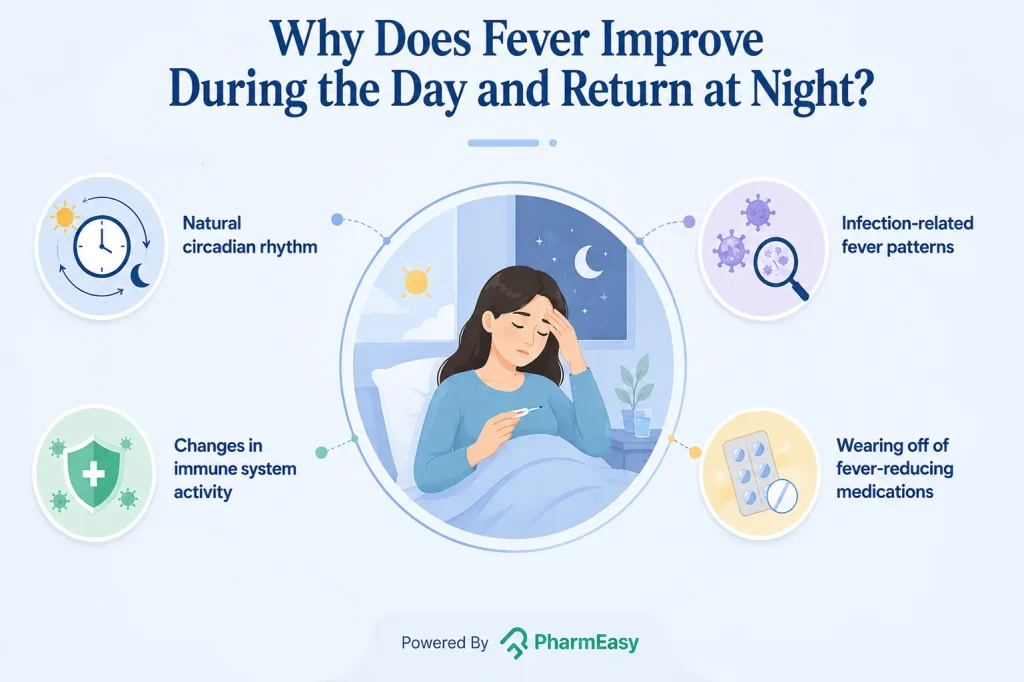
Some people notice that during the day, their fever goes away and comes back at night, making them wonder whether they are truly recovering. This pattern can occur due to several factors, such as:
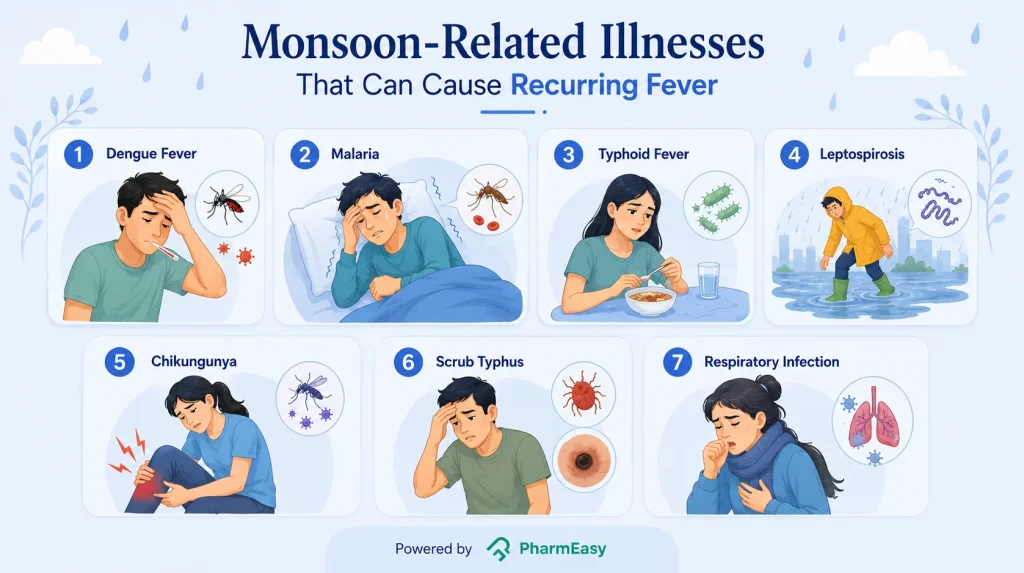
Sometimes you may notice that the fever goes away and comes back days later. This may be due to certain illnesses that become more common during the monsoon season, which can cause fluctuating or recurring fever. These include:
Note: While fever patterns may provide clues regarding an illness, they are not enough to diagnose a specific illness. Persistent, recurring, or worsening fever should always be evaluated by a doctor.
Only a doctor can help determine whether the fever is a sign of an underlying condition that needs treatment or at-home care. You should consult a doctor if15:
Also Read: Why Does Fever Keep Coming Back & What You Can Do About It
A fever that goes away within 1 to 2 days is often a sign that the body is fighting off an infection. However, the resolution of fever does not always mean complete recovery, as some illnesses can persist or return.
Therefore, monitoring your overall health and seeking medical attention if symptoms worsen, recur, or persist can help ensure timely diagnosis and appropriate treatment.
A fever may last for only one day4,15. If symptoms improve and the fever does not return, it is usually not a cause for concern. However, if the fever returns, you should consider seeing a doctor.
Fever may fluctuate over several hours and may seem to improve and return during the same night. This may occur due to natural changes in body temperature, the effects of fever-reducing medications, or the body’s ongoing response to an infection6,8.
Many fevers resolve on their own as the immune system successfully fights the underlying infection4,15. However, persistent, recurrent, or worsening symptoms should always be evaluated by a doctor.
Fevers often become more noticeable in the evening as the body temperature naturally rises around 6 p.m. as part of the body’s circadian rhythm6. However, the exact timing can vary from person to person.
1. Health NRC (US) C on the OR in H. Infectious Diseases. In: From Monsoons to Microbes: Understanding the Ocean’s Role in Human Health. National Academies Press (US); 1999. Accessed June 11, 2026. https://www.ncbi.nlm.nih.gov/books/NBK230695/
2. Overview: Fever in children. In: InformedHealth.Org [Internet]. Institute for Quality and Efficiency in Health Care (IQWiG); 2026. Accessed June 11, 2026. https://www.ncbi.nlm.nih.gov/books/NBK279455/
3. Ogoina D. Fever, fever patterns and diseases called ‘fever’ – A review. J Infect Public Health. 2011;4(3):108-124. doi:10.1016/j.jiph.2011.05.002 https://pubmed.ncbi.nlm.nih.gov/21843857/
4. Balli S, Shumway KR, Sharan S. Physiology, Fever. In: StatPearls. StatPearls Publishing; 2026. Accessed June 11, 2026. http://www.ncbi.nlm.nih.gov/books/NBK562334/
5. Belon L, Skidmore P, Mehra R, Walter E. Effect of a fever in viral infections — the ‘Goldilocks’ phenomenon? World J Clin Cases. 2021;9(2):296-307. doi:10.12998/wjcc.v9.i2.296 https://pmc.ncbi.nlm.nih.gov/articles/PMC7812885/
6. Del Bene VE. Temperature. In: Walker HK, Hall WD, Hurst JW, eds. Clinical Methods: The History, Physical, and Laboratory Examinations. 3rd ed. Butterworths; 1990. Accessed June 11, 2026. http://www.ncbi.nlm.nih.gov/books/NBK331/
7. Coiffard B, Diallo AB, Mezouar S, Leone M, Mege JL. A Tangled Threesome: Circadian Rhythm, Body Temperature Variations, and the Immune System. Biology. 2021;10(1):65. doi:10.3390/biology10010065 https://www.researchgate.net/publication/348600281_A_Tangled_Threesome_Circadian_Rhythm_Body_Temperature_Variations_and_the_Immune_System
8. Paracetamol – uses, side effects and how to take it | healthdirect. Accessed June 11, 2026. https://www.healthdirect.gov.au/paracetamol
9. Dengue. Accessed June 11, 2026. https://www.who.int/news-room/fact-sheets/detail/dengue-and-severe-dengue
10. Crutcher JM, Hoffman SL. Malaria. In: Baron S, ed. Medical Microbiology. 4th ed. University of Texas Medical Branch at Galveston; 1996. Accessed June 11, 2026. http://www.ncbi.nlm.nih.gov/books/NBK8584/
11. Bhandari J, Thada PK, Hashmi MF, DeVos E. Typhoid Fever. In: StatPearls. StatPearls Publishing; 2026. Accessed June 11, 2026. http://www.ncbi.nlm.nih.gov/books/NBK557513/
12. Haake DA, Levett PN. Leptospirosis in Humans. Curr Top Microbiol Immunol. 2015;387:65-97. doi:10.1007/978-3-662-45059-8_5 https://pubmed.ncbi.nlm.nih.gov/25388133/
13. CDC. Symptoms, Diagnosis, & Treatment. Chikungunya Virus. November 19, 2025. Accessed June 11, 2026. https://www.cdc.gov/chikungunya/symptoms-diagnosis-treatment/index.html
14. ARRUDA E, CINTRA OAL, HAYDEN FG. Respiratory Tract Viral Infections. Trop Infect Dis. Published online 2006:637-659. doi:10.1016/B978-0-443-06668-9.50064-8 https://pmc.ncbi.nlm.nih.gov/articles/PMC7152450/
15. Australia H. Fever. June 2, 2026. Accessed June 11, 2026. https://www.healthdirect.gov.au/fever
Disclaimer: The information provided here is for educational/awareness purposes only and is not intended to be a substitute for medical treatment by a healthcare professional and should not be relied upon to diagnose or treat any medical condition. The reader should consult a registered medical practitioner to determine the appropriateness of the information and before consuming any medication. PharmEasy does not provide any guarantee or warranty (express or implied) regarding the accuracy, adequacy, completeness, legality, reliability or usefulness of the information and disclaims any liability arising thereof.
Links and product recommendations in the information provided here are advertisements of third-party products available on the website. PharmEasy does not make any representation on the accuracy or suitability of such products/services. Advertisements do not influence the editorial decisions or content. The information in this blog is subject to change without notice. The authors and administrators reserve the right to modify, add, or remove content without notification. It is your responsibility to review this disclaimer regularly for any changes.


Comments

Leave your comment...
You may also like
























Comments