




Common GLP-1 Side Effects and Practical Ways to Manage Them
By Dr. Nisha Dahiya +2 more

Medically reviewed by Dr. Nisha Dahiya
Last updated: Sep 15, 2026 Published on: Jun 23, 2026


Get,

to manage your symptom
Get your,

4 Cr+ families
benefitted

OTP sent to 9988776655



You’ve successfully subscribed to receive
doctor-approved tips on
Whatsapp

Get ready to feel your best.


Register to Avail the Offer
Send OTPBy continuing, you agree with our Privacy Policy and Terms and Conditions
Hi There,
Sign up on PharmEasy now!!


Trusted by 4 crore+ families

OTP sent to 9988776655
You have unlocked 25% off on medicines


Code: NU25

By Dr. Nisha Dahiya +2 more
Table of Contents
Glucagon-like peptide-1 (GLP-1) medications are gaining popularity for their benefits for type-2-diabetes and weight management1. As their use continues to grow, there is also increasing interest in understanding potential GLP-1 side effects and how they may affect daily life. While these medicines are generally safe, many people have reported some side effects1, especially during the early stages of treatment2. Understanding what to expect may help people use these drugs more easily and confidently. In this blog, we will explore more about GLP-1 medications, such as their common GLP-1 agonist side effects, why they occur, and practical ways to manage them effectively.


Answer a few quick questions to check eligibility.
Your response has been submitted.
Our team will contact you shortly.
Glucagon-like peptide-1 (GLP-1) is a naturally occurring hormone in the intestines that regulates blood glucose levels, slows stomach emptying, and promotes a sense of fullness after eating3. GLP-1 drugs are medications that mimic the action of this hormone, such as:
Therefore, these are also called GLP-1 agonists. The common types include semaglutide, liraglutide, dulaglutide, and tirzepatide. These are commonly used to treat diabetes and to manage weight/ obesity (especially in those with diabetes)1
Most GLP-1 agonist side effects occur because these medications change how the digestive system and appetite-regulating pathways work. The causes of GLP-1 agonist side effects include:
GLP-1 side effects are more noticeable at certain times:
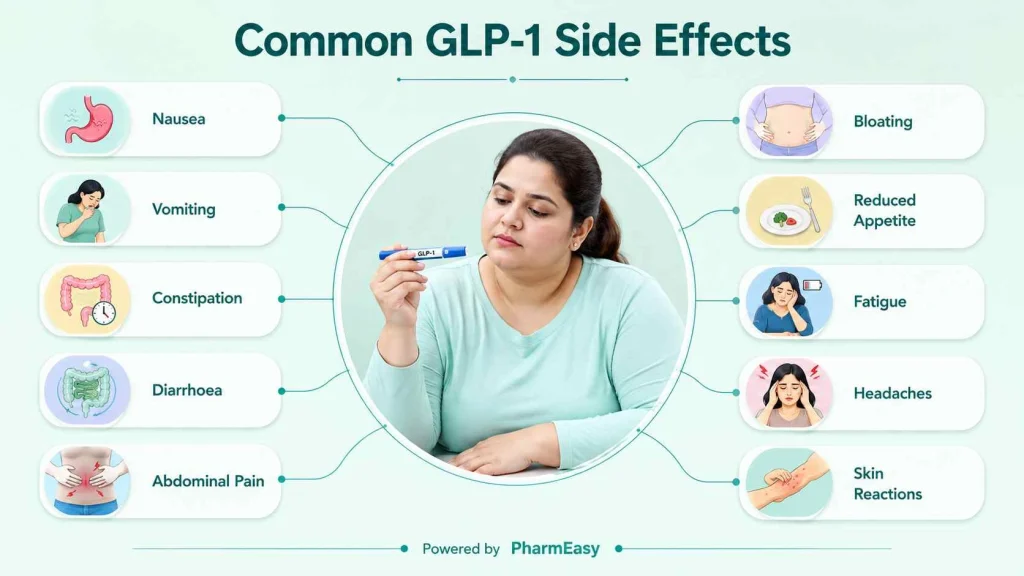
Most patients who take GLP-1 drugs tolerate them well; however, side effects might occur, particularly during the first few weeks of treatment or following a dosage increase. In most situations, these symptoms are mild to moderate and improve as the body adapts. Some common GLP-1 analogues side effects include:
A few lifestyle changes that may help you manage GLP-1 side effects include:

The drug may have side effects such as nausea and vomiting1. Try eating smaller portions spread throughout the day instead of eating large meals4. This helps reduce pressure on the stomach, making the symptoms less aggressive.

Opt for simple, easy-to-digest meals such as soups, fruits, vegetables, lean proteins, and whole grains over fatty, fried, and heavily processed foods4, as they may take longer to digest and can worsen side effects.

Diarrhoea is a GI side effect of GLP-1 medications; therefore, drinking water might help maintain proper hydration needed by the body. However, in severe cases of dehydration, expert-guided oral intravenous rehydration solutions may be needed5.

Lying down soon after meals can cause acid reflux. Eating food 2-3 hours before bed may help reduce this.

As the drug can cause constipation1, introducing foods rich in fibre such as fruits, vegetables, and wholegrains might help lower the symptoms by supporting digestion10.
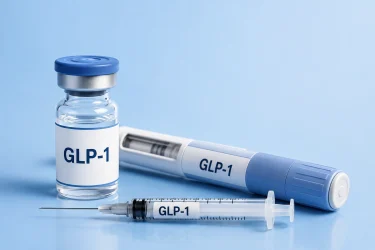
Dose changes may contribute to side effects; therefore, stick to the dosing pattern prescribed by the doctor to avoid inadvertent adverse effects of dose change4.

Always sit upright for some time after eating food to avoid side effects such as acid reflux and vomiting.
Note: The information provided here is meant for general educational purposes only and is not intended to be medical advice. GLP-1 side effects and treatment can vary from person to person. Always follow the doctor’s instructions for diet, medication use, and dose schedule. Consult a doctor right away if your symptoms worsen and are no longer manageable at home.
Weight loss and appetite reduction are the expected outcomes of GLP-1 medications3, but it is important to lose weight in a healthy manner. You can follow these precautions to achieve continued weight loss in a healthy manner.
Also Read: How to Stay Consistent With GLP-1 Medication: Tips, Challenges, Benefits & Long-Term
Seek medical attention for the following signs and symptoms:
Also Read: GLP-1 Diet Plan: Foods to Eat, Avoid, Meal Plans & More!
GLP-1 medications can help manage type 2 diabetes and obesity, but they may cause short-term mild-to-moderate side effects such as nausea, vomiting, diarrhoea, constipation, bloating, and decreased appetite, particularly at the beginning of treatment.
These symptoms typically improve as the body adjusts to the drug. Eating small and frequent meals, staying hydrated, eating well-balanced meals, and sticking to the suggested medicine dosage can all help with symptom management. However, consulting a doctor is very important in case of severe or persistent side effects.
Also Read: Oral Semaglutide vs Injection: Which Option Is Right for You?
There is no specific GLP-1 drug that has been shown to have the least adverse effects, as sensitivity varies between individuals. However, medicines such as semaglutide and liraglutide have been extensively investigated, and a majority of the adverse effects of GLP-1 medications are similar and mainly gastrointestinal1.
Most GLP-1 side effects develop within the first few days to weeks of initiating treatment or a dose increase. Many people have symptoms such as nausea, bloating, or decreased appetite that gradually improve as the body adjusts. Mild side effects may occur frequently with dose increases but become less noticeable over time5. If symptoms last more than a few weeks or become severe, it is advised to see a doctor.
All the GLP-1 drugs have similar side effects; however, semaglutide is known to show higher GI side effects compared to others12.
Many people find it useful to know the side effects of GLP-1 before taking it. These may include nausea, decreased appetite, and digestive problems that usually improve over time1,5 Staying hydrated, eating smaller meals, and avoiding high-fat foods might help make the transition smoother4.
Discontinuing GLP-1 medicines frequently results in a weight increase even if the person follows a healthy diet and lifestyle. Since obesity is considered a chronic condition, many individuals may require continued care to achieve sustained weight loss and its associated health benefits13.
1. Collins L, Costello RA. Glucagon-Like Peptide-1 Receptor Agonists. 2024. https://www.ncbi.nlm.nih.gov/books/NBK551568/
2. Kim JA, Yoo HJ. Exploring the Side Effects of GLP-1 Receptor Agonist: To Ensure Its Optimal Positioning. Diabetes Metab J. 2025;49(4):525-541. doi:10.4093/dmj.2025.0242 https://pmc.ncbi.nlm.nih.gov/articles/PMC12270588/
3. Müller TD, Finan B, Bloom SR, et al. Glucagon-like peptide 1 (GLP-1). Molecular Metabolism. 2019;30:72-130. doi:10.1016/j.molmet.2019.09.010 https://pubmed.ncbi.nlm.nih.gov/31767182/
4. Jain AB, Ali A, Gorgojo Martínez JJ, et al. Switching between GLP‐1 receptor agonists in clinical practice: Expert consensus and practical guidance. Int J Clin Pract. 2021;75(2). doi:10.1111/ijcp.13731 https://pubmed.ncbi.nlm.nih.gov/32975890/
5. Gorgojo-Martínez JJ, Mezquita-Raya P, Carretero-Gómez J, et al. Clinical Recommendations to Manage Gastrointestinal Adverse Events in Patients Treated with Glp-1 Receptor Agonists: A Multidisciplinary Expert Consensus. JCM. 2022;12(1):145. doi:10.3390/jcm12010145 https://pubmed.ncbi.nlm.nih.gov/36614945/
6. Shu Y, He X, Wu P, Liu Y, Ding Y, Zhang Q. Gastrointestinal adverse events associated with semaglutide: A pharmacovigilance study based on FDA adverse event reporting system. Front Public Health. 2022;10:996179. doi:10.3389/fpubh.2022.996179 https://pubmed.ncbi.nlm.nih.gov/36339230/
7. Medication Guide WEGOVY ® (wee-GOH-vee) (semaglutide) injection, for Subcutaneous Use. 2023. https://www.accessdata.fda.gov/drugsatfda_docs/label/2023/215256Orig1s006lbl.pdf
8. J Modestino E, Bowirrat A, Lewandrowski3 KU, et al. Hemiplegic Migraines Exacerbated using an Injectable GLP-1 Agonist for Weight Loss. Act Scie Neuro. Published online May 1, 2024:12-18. doi:10.31080/ASNE.2024.07.0731 https://pmc.ncbi.nlm.nih.gov/articles/PMC11309767/
9. Persson C, Eaton A, Mayrovitz HN. A Closer Look at the Dermatological Profile of GLP-1 Agonists. Diseases. 2025;13(5):127. doi:10.3390/diseases13050127 https://pubmed.ncbi.nlm.nih.gov/40422559/
10. Harvard T.H. Chan School of Public Health. Fiber. In: The Nutrition Source [Internet]. Boston (MA): Harvard T.H. Chan School of Public Health; [cited 2026 Jun 23]. Available from: https://nutritionsource.hsph.harvard.edu/carbohydrates/fiber/
11. Lundgren JR, Janus C, Jensen SBK, et al. Healthy Weight Loss Maintenance with Exercise, Liraglutide, or Both Combined. N Engl J Med. 2021;384(18):1719-1730. doi:10.1056/NEJMoa2028198 https://www.nejm.org/doi/full/10.1056/NEJMoa2028198
12. Xie X, Yang S, Deng S, Liu Y, Xu Z, He B. Comparative gastrointestinal adverse effects of GLP-1 receptor agonists and multi-target analogs in type 2 diabetes: a Bayesian network meta-analysis. Front Pharmacol. 2025;16:1613610. doi:10.3389/fphar.2025.1613610 https://pubmed.ncbi.nlm.nih.gov/41050409/
13. Berg S, Stickle H, Rose SJ, Nemec EC. Discontinuing glucagon‐like peptide‐1 receptor agonists and body habitus: A systematic review and meta‐analysis. Obesity Reviews. 2025;26(8):e13929. doi:10.1111/obr.13929 https://pubmed.ncbi.nlm.nih.gov/40186344/
Disclaimer: The information provided here is for educational/awareness purposes only and is not intended to be a substitute for medical treatment by a healthcare professional and should not be relied upon to diagnose or treat any medical condition. The reader should consult a registered medical practitioner to determine the appropriateness of the information and before consuming any medication. PharmEasy does not provide any guarantee or warranty (express or implied) regarding the accuracy, adequacy, completeness, legality, reliability or usefulness of the information; and disclaims any liability arising thereof.
Links and product recommendations in the information provided here are advertisements of third-party products available on the website. PharmEasy does not make any representation on the accuracy or suitability of such products/services. Advertisements do not influence the editorial decisions or content. The information in this blog is subject to change without notice. The authors and administrators reserve the right to modify, add, or remove content without notification. It is your responsibility to review this disclaimer regularly for any changes.


Comments

Leave your comment...
You may also like






















Comments