




Low Alkaline Phosphatase (ALP): Symptoms, Causes, Diagnosis & Treatment
By Dr. Nisha Dahiya +2 more

Medically reviewed by Dr. Nisha Dahiya
Last updated: Aug 19, 2026 Published on: Aug 12, 2026


Get,

to manage your symptom
Get your,

4 Cr+ families
benefitted

OTP sent to 9988776655



You’ve successfully subscribed to receive
doctor-approved tips on
Whatsapp

Get ready to feel your best.


Register to Avail the Offer
Send OTPBy continuing, you agree with our Privacy Policy and Terms and Conditions
Hi There,
Sign up on PharmEasy now!!


Trusted by 4 crore+ families

OTP sent to 9988776655
You have unlocked 25% off on medicines


Code: NU25

By Dr. Nisha Dahiya +2 more
Table of Contents
If your routine blood test shows that your alkaline phosphatase (ALP) level is below the normal range, you may wonder what it means. A low ALP result can be worrying, but it does not always mean you have a serious health problem. The result needs to be interpreted in context, including your age, symptoms, other blood test results, medicines, diet, and medical history.
This article explains what low ALP can mean, the possible causes, symptoms to watch for, how doctors investigate it, and when treatment may be needed.

ALP is an enzyme that is found in several tissues of the body, especially the liver, bile ducts, and bones1,2. Doctors often measure ALP as part of a liver panel or routine blood test. Your report may list it as ALP, ALK PHOS, Alk Phos, or alkaline phosphatase.
A low ALP level means the amount of this enzyme in your blood is below the reference range used by the laboratory. Reference ranges can vary between laboratories and may differ by age, sex, and pregnancy status. A low result should not be judged on its own; it is best reviewed alongside your symptoms and other test results1,2.
Did You Know?
The table below shows one commonly used adult reference range. Your own laboratory may use a different range, so always compare your result with the range printed on your report.
| Parameter | Normal Range |
| ALP | 45-129 U/L (Units per Litre) |
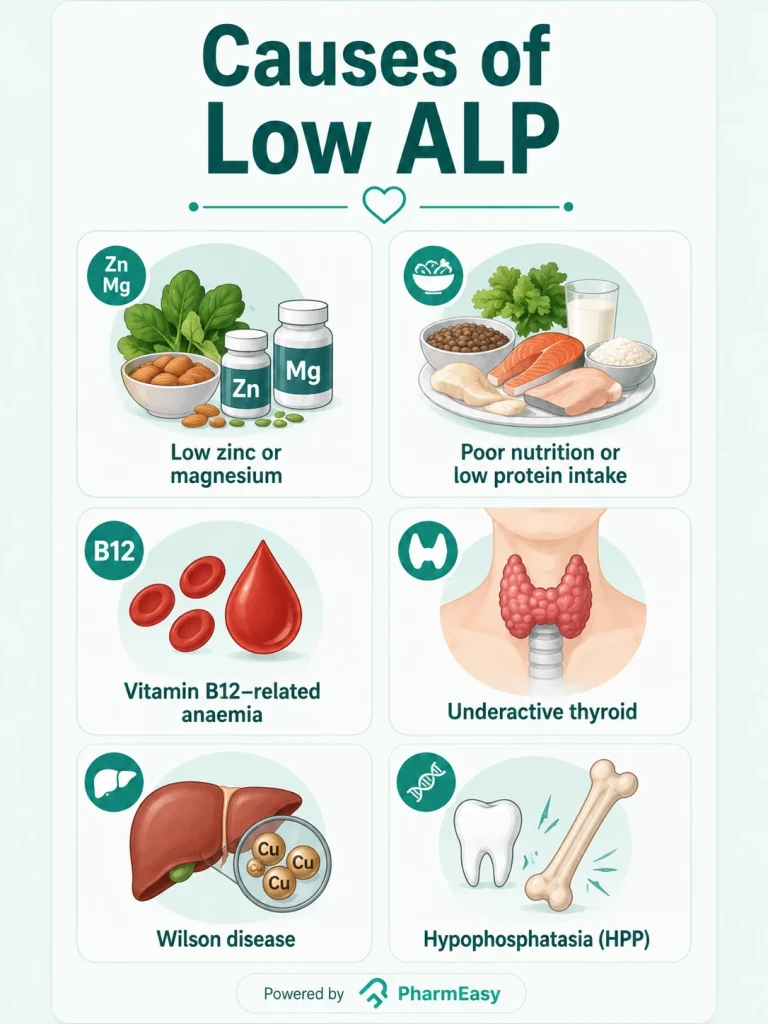
Low ALP is less common than high ALP. It may happen because of nutrition-related problems, certain medical conditions, some medicines, or, rarely, an inherited bone condition called hypophosphatasia (HPP)1,3.
Common low ALP causes include:
A low ALP level itself may not cause noticeable symptoms. Symptoms usually occur due to the underlying condition causing low ALP, especially HPP2,6,8.
Possible low ALP symptoms include:
Risk factors for developing low ALP levels include:
Low ALP is usually found on a blood test. A single low result may be temporary or related to the way the sample was taken, so doctors often repeat the test before deciding whether more investigation is needed4,8.
The diagnostic process may include:
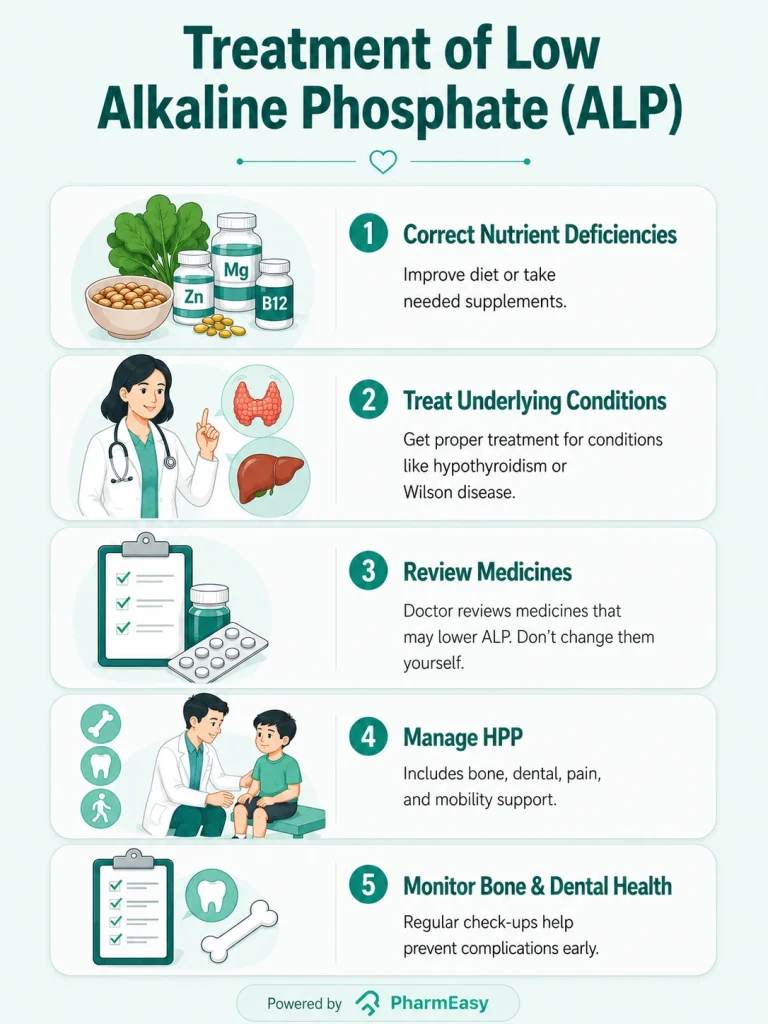
Treatment depends on the cause. Doctors usually do not treat the number itself; they look for and manage the reason ALP is low.
Low ALP treatment approaches may include:
Low ALP does not always lead to complications. The risk depends on the cause. If the low level is persistent and is due to HPP, possible complications may include9:
What can you do if your ALP levels are low is a common question that comes to mind. Tips to support healthy ALP levels include:
Speak with a doctor if your ALP is below the range on your report, especially if it remains low on repeat testing. You should also seek advice if you have unexplained tiredness, weight loss, poor appetite, bone pain, repeated fractures, early tooth loss, symptoms of thyroid disease, or a family history of HPP. Persistent low ALP levels on at least two occasions should be reviewed for any underlying causes, and HPP should be considered if clinically indicated. They can decide whether repeat testing or further investigations are needed1,2,4.
Also Read: High Alkaline Phosphatase Levels: Causes, Symptoms & Treatment
A low ALP result should be interpreted carefully. For many people, it may be a one-off finding or related to nutrition, medicines, or another treatable condition. If the result is persistently low, especially with bone pain, fractures, or dental problems, further assessment may be needed to rule out rare conditions such as HPP. The safest next step is to review your result with a doctor rather than trying to diagnose the cause yourself.
Not always. A low ALP result can happen for several reasons, including nutrient deficiencies, thyroid problems, certain medicines, or a rare inherited condition called HPP1,3. If your ALP is only slightly low or low once, your doctor may simply repeat the test. If it stays low or you have symptoms such as bone pain, repeated fractures, or early tooth loss, further evaluation is important.
It can, depending on the cause. Low ALP is sometimes linked with HPP, which can affect how bones and teeth mineralise. People with this condition may have bone pain, stress fractures, or dental problems1,2. However, low ALP does not automatically mean you have a bone disease.
Yes, some nutrition-related problems can be associated with low ALP. These include poor overall nutrition, low zinc or magnesium, and vitamin B12-related anaemia such as pernicious anaemia1,3,4. Your doctor can decide whether nutrient testing is needed.
There is no single ALP level that suggests cancer. ALP can be high for many reasons, including liver, bile duct, or bone conditions, and it must be interpreted with symptoms and other tests10. If you are worried about your result, discuss it with your healthcare provider rather than trying to interpret it on your own.
1. Alkaline Phosphatase: MedlinePlus Medical Test. Accessed August 7, 2026. https://medlineplus.gov/lab-tests/alkaline-phosphatase/
2. Lowe D, Sanvictores T, Zubair M, John S. Serum Alkaline Phosphatase: Clinical and Laboratory Perspectives. In: StatPearls. StatPearls Publishing; 2026. Accessed August 7, 2026. http://www.ncbi.nlm.nih.gov/books/NBK459201/
3. Riancho JA. Diagnostic Approach to Patients with Low Serum Alkaline Phosphatase. Calcif Tissue Int. 2023;112(3):289-296. doi:10.1007/s00223-022-01039-y https://pubmed.ncbi.nlm.nih.gov/36348061/
4. Microsoft Word – Investigation of low ALP guidance version 4. Accessed August 7, 2026. https://laboratories.newcastle-hospitals.nhs.uk/wp-content/uploads/2024/10/Low-ALP-guidance-revision-4.pdf
5. Lum G. Significance of low serum alkaline phosphatase activity in a predominantly adult male population. Clin Chem. 1995;41(4):515-518. https://pubmed.ncbi.nlm.nih.gov/7720239/
6. Microsoft Word – ALP.doc. Accessed August 7, 2026. https://pathlabs.rlbuht.nhs.uk/alkalinephosphatase.pdf
7. Alshahrani F, Alsuliman S, Alkalefah R, Almutairi S, Aleidi Y, Almohaya M. Persistently low serum alkaline phosphatase in adults: prevalence and clinical characteristics in a large tertiary care hospital. Orphanet J Rare Dis. Published online July 18, 2026. doi:10.1186/s13023-026-04493-1 https://pubmed.ncbi.nlm.nih.gov/42471651/
8. Hoff P, Mann A, Steinmüller M, Aliluev A. Clinical presentation of adults with persistently low alkaline phosphatase activity: a retrospective multicentre, cross-sectional study in Germany. BMJ Open. 2025;15(7):e097235. doi:10.1136/bmjopen-2024-097235 https://bmjopen.bmj.com/content/bmjopen/15/7/e097235.full.pdf
9. Seefried L, Genest F, Hofmann C, Brandi ML, Rush E. Diagnosis and Treatment of Hypophosphatasia. Calcif Tissue Int. 2025;116(1):46. doi:10.1007/s00223-025-01356-y https://pubmed.ncbi.nlm.nih.gov/40047955/
10. Wu Q, Wang Y, Wei X, et al. Association between alkaline phosphatase and cancer in American adults: 2003-2016 NHANES. BMC Cancer. 2025;25(1):1157. doi:10.1186/s12885-025-14533-x https://pubmed.ncbi.nlm.nih.gov/40634930/
Disclaimer: The information provided here is for educational/awareness purposes only and is not intended to be a substitute for medical treatment by a healthcare professional and should not be relied upon to diagnose or treat any medical condition. The reader should consult a registered medical practitioner to determine the appropriateness of the information and before consuming any medication. PharmEasy does not provide any guarantee or warranty (express or implied) regarding the accuracy, adequacy, completeness, legality, reliability or usefulness of the information; and disclaims any liability arising thereof.
Links and product recommendations in the information provided here are advertisements of third-party products available on the website. PharmEasy does not make any representation on the accuracy or suitability of such products/services. Advertisements do not influence the editorial decisions or content. The information in this blog is subject to change without notice. The authors and administrators reserve the right to modify, add, or remove content without notification. It is your responsibility to review this disclaimer regularly for any changes.


Comments

Leave your comment...
You may also like
























Comments