




High Alkaline Phosphatase Levels: Causes, Symptoms & Treatment
By Chetan Kalal +2 more

Medically reviewed by Chetan Kalal
Last updated: Oct 16, 2026 Published on: Jun 15, 2026


Get,

to manage your symptom
Get your,

4 Cr+ families
benefitted

OTP sent to 9988776655



You’ve successfully subscribed to receive
doctor-approved tips on
Whatsapp

Get ready to feel your best.


Register to Avail the Offer
Send OTPBy continuing, you agree with our Privacy Policy and Terms and Conditions
Hi There,
Sign up on PharmEasy now!!


Trusted by 4 crore+ families

OTP sent to 9988776655
You have unlocked 25% off on medicines


Code: NU25

By Chetan Kalal +2 more
Table of Contents
Seeing a high alkaline phosphatase (ALP) level on your test reports can be confusing and concerning, especially if you’re unsure of what it means.
Elevated ALP levels can occur due to normal physiological changes in the body. While they do not always indicate a serious health problem, at times they may signal conditions affecting the liver, bile ducts, or bones1,2.
In this article, we’ll explain what ALP is, what causes ALP levels to rise, the symptoms to watch for, how elevated levels are diagnosed, and the management options available.
ALP is an enzyme that removes phosphate groups from various molecules and plays important roles in bone formation and bile flow. It has the highest concentrations in the liver, bile ducts, and bones. Smaller amounts are also present in the intestines, kidneys, and placenta. ALP plays a key role in breaking down certain substances containing phosphate2.
Since most of the ALP circulating in the bloodstream comes from the liver and the bones, ALP levels are commonly measured as part of a Liver Function Test (LFT). However, it’s not just a liver test; this enzyme can also provide clues about bone health. So, when the liver, bile ducts, or bones are affected by disease, injury, or inflammation, ALP levels in the blood may rise.
Note: Since ALP can originate from different tissues, an alkaline phosphatase high level does not by itself identify the underlying cause. Further evaluation is often needed to determine whether the elevation is related to the liver, bones, or another factor.
ALP levels vary throughout life and are typically highest during childhood and puberty due to rapid bone growth. Temporary increases may also occur during pregnancy, particularly in the third trimester2.
If ALP levels are consistently elevated, they may indicate an underlying liver, bile duct, or bone disorder that requires medical evaluation. When left unaddressed, liver or bile duct diseases can progress to complications such as chronic liver damage, cirrhosis, liver failure, or bile duct infections. Similarly, prolonged elevation due to bone disorders may be associated with complications such as bone pain, deformities, fractures, or impaired bone health1,2.
Note: Gamma-glutamyl transferase (GGT) is another enzyme found mainly in the liver and bile ducts that is often measured alongside ALP to help determine whether an elevated ALP level is likely coming from the liver or from another source, such as bone3.
High ALP levels themselves usually do not cause symptoms. Instead, the symptoms depend on the underlying conditions. So, alkaline phosphatase high means there may be an underlying issue affecting the liver, bile ducts, or bones that requires further evaluation.
If your elevated ALP is related to a liver or bile duct condition, you might experience1:
If your elevated ALP is related to a bone condition, you might experience1:
Elevated ALP levels can occur for a variety of reasons. Since ALP is produced mainly by the liver and bones, high alkaline phosphatase levels often indicate a condition affecting one of these organs.
High ALP levels may be associated with1,2:
If ALP levels are elevated while other liver tests remain normal, the cause may be related to the bones. Some causes include1,2:
Moderately elevated ALP levels may also be seen in1,2:
Not all elevated ALP levels indicate a medical problem. ALP levels can be temporarily increased in1,4:
Since many factors can affect ALP levels, doctors interpret the results alongside your symptoms, medical history, and other laboratory tests to determine the underlying alkaline phosphatase high causes.
If you have symptoms suggestive of liver damage or a bone disorder, your doctor may recommend an ALP test along with other blood tests to determine the underlying cause. Since elevated ALP levels can result from conditions affecting different organs, additional tests are often needed to identify the source of the abnormality.
The first step is usually a blood test that measures the level of ALP in your bloodstream. If the results show alkaline phosphatase high levels, further testing may be required1.
Normal ALP levels vary by age. In adults, the typical reference range is 30 to 130 U/L, while children and adolescents may have higher levels (up to 260 or 340 U/L based on their age) due to normal growth and bone development5. Reference ranges may also vary slightly between different laboratories.
Doctors often order LFTs alongside an ALP test. If other liver enzymes are also elevated, the high ALP level is more likely to be associated with a liver or bile duct disorder1.
Your doctor may also check a related enzyme called GGT. If GGT is elevated alongside ALP, the source is more likely to be the liver or bile ducts. In contrast, a normal GGT level with elevated ALP may suggest a bone-related cause3.
A blood test that may be ordered when PBC is suspected, particularly in individuals with persistently elevated ALP levels2.
An abdominal ultrasound is often the first imaging test performed to evaluate elevated ALP levels. It may help identify gallstones, bile duct obstruction, liver abnormalities, or other conditions affecting the liver and biliary system. If bile duct disease is suspected, additional imaging such as magnetic resonance cholangiopancreatography (MRCP) may be recommended2,6.
Alkaline phosphatase high treatment depends on the underlying cause. Since elevated ALP is a sign of f, management focuses on addressing the source of an underlying condition rather than a disease itselthe elevation.
Note: High alkaline phosphatase treatment should always be guided by a doctor. Do not self-medicate based on test results alone, as the appropriate treatment depends on the underlying cause of the elevation.
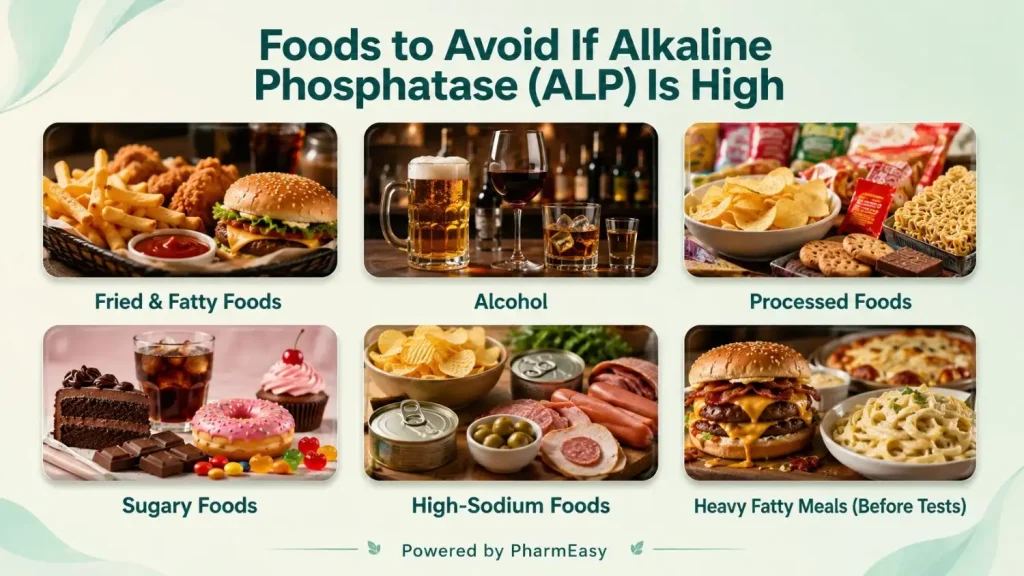
There is no specific diet to manage elevated ALP levels. However, a balanced diet that supports overall liver health may complement the management of underlying liver conditions. Some dietary recommendations include1,21,23:
Important Note: Dietary changes alone may not normalise ALP levels. Since elevated ALP can result from liver disease, bone disorders, pregnancy, growth, or other conditions, treatment and dietary recommendations should be guided by a doctor.
Also Read: High Prolactin Levels (Hyperprolactinemia): Causes, Symptoms, Diagnosis, and Treatment
You should consult a doctor if your blood test shows high ALP levels, especially if the elevation is persistent or accompanied by symptoms.
You should seek medical attention if you experience1:
Note: Even if you do not have symptoms, it is important to discuss elevated ALP results with your doctor. They can determine the underlying cause through further evaluation and recommend appropriate management if needed.
Also Read: Folate Deficiency: Meaning, Causes, Symptoms, Treatment & Prevention
High ALP levels can be a sign of various conditions affecting the liver, bile ducts, or bones. While an elevated ALP result may seem concerning, it does not always indicate a serious health problem. What’s important is identifying the underlying cause through appropriate testing, which is essential for determining whether treatment is needed.
If your ALP levels are higher than normal, you should consult a doctor for proper evaluation and guidance. Remember, early diagnosis and timely management of the underlying condition can help avoid complications and support long-term health.
Vitamin D deficiency may lead to soft bones and an increase in bone turnover15. This may cause ALP levels to rise.
High ALP levels can occur for many reasons, including normal growth in children, pregnancy, liver conditions, or bone disorders. Your doctor may recommend additional tests to determine the underlying cause1.
In many cases, ALP levels may return to normal once the underlying cause is identified and appropriately treated. You should always consult a doctor for proper evaluation, diagnosis, and management of elevated ALP levels.
Most of the alkaline phosphatase found in the bloodstream comes from the liver and bones, with smaller contributions from the intestines, kidneys, and placenta2.
Elevated ALP levels may be seen in primary liver cancers, bile duct cancers (cholangiocarcinoma), and certain blood cancers, such as Hodgkin lymphoma1,2. Other than that metastatic cancers that have spread to the bones or liver such as breast, prostate, lung, colorectal or pancreatic cancers may cause high ALP levels2,24.
1. Alkaline Phosphatase: MedlinePlus Medical Test. Accessed June 3, 2026. https://medlineplus.gov/lab-tests/alkaline-phosphatase/
2. Lowe D, Sanvictores T, Zubair M, John S. Serum Alkaline Phosphatase: Clinical and Laboratory Perspectives. In: StatPearls. StatPearls Publishing; 2026. Accessed June 3, 2026. http://www.ncbi.nlm.nih.gov/books/NBK459201/
3. Gamma-glutamyl Transferase (GGT) Test: MedlinePlus Medical Test. Accessed June 5, 2026. https://medlineplus.gov/lab-tests/gamma-glutamyl-transferase-ggt-test/
4. David S, Hamilton JP. Drug-induced Liver Injury. US Gastroenterol Hepatol Rev. 2010;6:73-80. https://pubmed.ncbi.nlm.nih.gov/21874146/
5. Alkaline phosphatase (ALP). Gloucestershire Hospitals NHS Foundation Trust. Accessed June 5, 2026. https://www.gloshospitals.nhs.uk/our-services/services-we-offer/pathology/tests-and-investigations/alkaline-phosphatase/
6. Gurusamy KS, Giljaca V, Takwoingi Y, et al. Ultrasound versus liver function tests for diagnosis of common bile duct stones. Cochrane Database Syst Rev. 2015;2015(2):CD011548. doi:10.1002/14651858.CD011548. https://pubmed.ncbi.nlm.nih.gov/25719223/
7. Cirrhosis. nhs.uk. October 20, 2017. Accessed June 3, 2026. https://www.nhs.uk/conditions/cirrhosis/
8. Premkumar M, Anand AC. Overview of Complications in Cirrhosis. J Clin Exp Hepatol. 2022;12(4):1150-1174. doi:10.1016/j.jceh.2022.04.021. https://pubmed.ncbi.nlm.nih.gov/35814522/
9. Kulkarni AV, Duvvuru NR. Management of hepatitis B and C in special population. World J Gastroenterol. 2021;27(40):6861-6873. doi:10.3748/wjg.v27.i40.6861. https://pmc.ncbi.nlm.nih.gov/articles/PMC8567468/
10. Gabrielli F, Alberti F, Russo C, et al. Treatment Options for Hepatitis A and E: A Non-Systematic Review. Viruses. 2023;15(5):1080. doi:10.3390/v15051080. https://pmc.ncbi.nlm.nih.gov/articles/PMC10221699/
11. Achufusi TGO, Safadi AO, Mahabadi N. Ursodeoxycholic Acid. In: StatPearls. StatPearls Publishing; 2026. Accessed June 5, 2026. http://www.ncbi.nlm.nih.gov/books/NBK545303/
12. Bile duct obstruction: MedlinePlus Medical Encyclopedia. Accessed June 3, 2026. https://medlineplus.gov/ency/article/000263.htm
13. Ralston SH, Corral‐Gudino L, Cooper C, et al. Diagnosis and Management of Paget’s Disease of Bone in Adults: A Clinical Guideline. J Bone Miner Res. 2019;34(4):579-604. doi:10.1002/jbmr.3657. https://pubmed.ncbi.nlm.nih.gov/30803025/
14. Treatment for bone cancer. nhs.uk. June 2, 2025. Accessed June 5, 2026. https://www.nhs.uk/conditions/bone-cancer/treatment/
15. Osteomalacia Is Not a Single Disease. Accessed June 5, 2026. https://www.mdpi.com/1422-0067/23/23/14896
16. Morrison PJ. Treatment of bacterial infections. Ulster Med J. 2009;78(2):79. https://pmc.ncbi.nlm.nih.gov/articles/PMC2699190/
17. Alemu BT, Troy SB, Beydoun HA, Akpinar-Elci M, Cunningham TD. Determinants of Elevated Alkaline Phosphatase in Patients Infected with HIV. South Med J. 2016;109(8):487-491. doi:10.14423/SMJ.0000000000000500. https://pubmed.ncbi.nlm.nih.gov/27490660/
18. Doubleday AR, Sippel RS. Hyperthyroidism. Gland Surg. 2020;9(1):124-135. doi:10.21037/gs.2019.11.01. https://gs.amegroups.org/article/view/31708/html
19. Heart failure – Treatment. nhs.uk. October 23, 2017. Accessed June 3, 2026. https://www.nhs.uk/conditions/heart-failure/treatment/
20. Radiation Therapy for Hodgkin Lymphoma. Accessed June 3, 2026. https://www.cancer.org/cancer/types/hodgkin-lymphoma/treating/radiation.html
21. The Role of Diet Therapy in the Treatment of Liver Disease – PMC. Accessed June 3, 2026. https://pmc.ncbi.nlm.nih.gov/articles/PMC7780776/
22. Liver Disease Diets: Fatty Liver Diet and More. June 15, 2022. Accessed June 3, 2026. https://liverfoundation.org/health-and-wellness/healthy-lifestyle/liver-disease-diets/
23. Diet – liver disease: MedlinePlus Medical Encyclopedia. Accessed June 3, 2026. https://medlineplus.gov/ency/article/002441.htm
24. Serum alkaline phosphatase is a prognostic marker in bone metastatic disease of the extremity – PMC. Accessed June 5, 2026. https://pmc.ncbi.nlm.nih.gov/articles/PMC7475062/
Disclaimer: The information provided here is for educational/awareness purposes only and is not intended to be a substitute for medical treatment by a healthcare professional and should not be relied upon to diagnose or treat any medical condition. The reader should consult a registered medical practitioner to determine the appropriateness of the information and before consuming any medication. PharmEasy does not provide any guarantee or warranty (express or implied) regarding the accuracy, adequacy, completeness, legality, reliability or usefulness of the information; and disclaims any liability arising thereof.
Links and product recommendations in the information provided here are advertisements of third-party products available on the website. PharmEasy does not make any representation on the accuracy or suitability of such products/services. Advertisements do not influence the editorial decisions or content. The information in this blog is subject to change without notice. The authors and administrators reserve the right to modify, add, or remove content without notification. It is your responsibility to review this disclaimer regularly for any changes.
 1
1 
Comments

Leave your comment...
You may also like

























Comments