



Can Sunscreen Cause Cancer? What the Research Says
By Dr. Raina N. Nahar +2 more

Medically reviewed by Dr. Raina N. Nahar
Last updated: Sep 10, 2026 Published on: Sep 10, 2026


Get,

to manage your symptom
Get your,

4 Cr+ families
benefitted

OTP sent to 9988776655



You’ve successfully subscribed to receive
doctor-approved tips on
Whatsapp

Get ready to feel your best.


Register to Avail the Offer
Send OTPBy continuing, you agree with our Privacy Policy and Terms and Conditions
Hi There,
Sign up on PharmEasy now!!


Trusted by 4 crore+ families

OTP sent to 9988776655
You have unlocked 25% off on medicines


Code: NU25

By Dr. Raina N. Nahar +2 more
Table of Contents
Sunscreen is widely used as an essential part of skin care to provide protection from the harmful effects of sun exposure. However, concerns about the safety of sunscreen and its ingredients have raised questions about whether regular, long-term use could have harmful effects like cancer risk. But how much truth is there to these concerns?
To address these questions, it is important to understand what research says about sunscreen safety, its ingredients, and its potential health effects. This blog will help you understand aspects such as sunscreen for skin cancer prevention, along with the benefits and correct use of sunscreen, to help you make informed choices about protecting your skin from the sun.
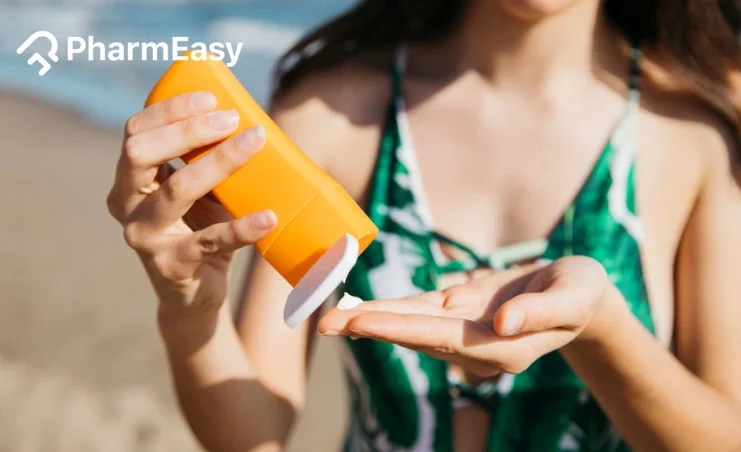
If you have wondered, ‘Does sunscreen cause skin cancer?’, understanding the available scientific evidence can help ease your mind.
Current scientific evidence does not show that using sunscreen causes cancer1. In fact, sunscreen helps protect the skin from ultraviolet (UV) radiation which is a known risk factor for skin cancer2.
Concerns about sunscreen often arise from questions about specific ingredients and their absorption into the body3. However, finding that an ingredient is absorbed does not mean that it causes cancer. The available evidence has not established sunscreen use as a cause of cancer1,3.
Overall, sunscreen is considered safe to use when applied as directed. Sunscreens are formulated in a way that helps ensure that they meet standards for safety and effectiveness4. However, safe does not mean that every ingredient has been studied equally extensively.
The Food and Drug Administration (FDA) of the United States continues to request additional safety data for some sunscreen ingredients. But the FDA has also clarified that requesting more data does not mean these ingredients have been shown to be unsafe5,6. So, based on current evidence, there is no reason to stop using sunscreen because of fears that it causes cancer.
Any side effects (if they occur) from sunscreen are generally mild7. These may include8:
Note: These reactions do not outweigh the benefits of regular sunscreen use for protecting the skin from UV damage. If you experience a reaction to a sunscreen, consult your doctor about choosing a suitable alternative rather than stopping sunscreen use altogether.
Concerns about sunscreen and cancer have led many people to question whether regular sunscreen use is safe. But the reality is different.
UV radiation can damage skin cells and increase the risk of skin cancer. Sunscreen use can help reduce the risk of skin cancer by protecting the skin from this harmful radiation7. Therefore, regular sunscreen use is an important part of a broader sun-protection strategy.
Let us understand the basics of sunscreen for skin cancer prevention7:
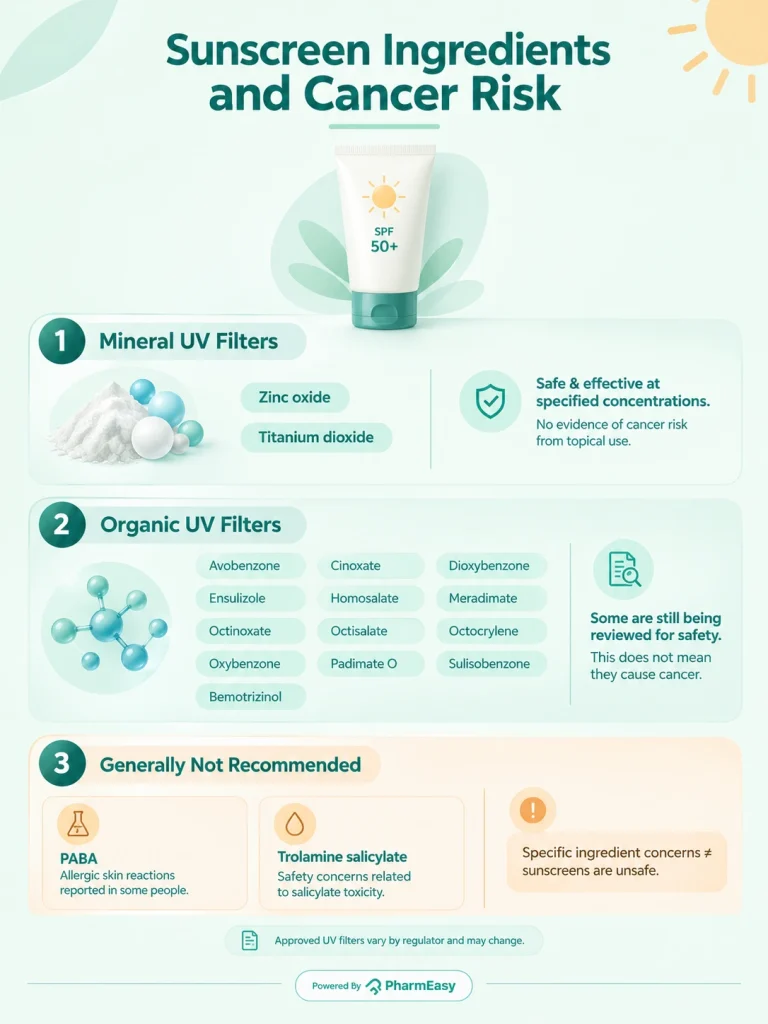
Sunscreens contain certain active UV filters that protect the skin from harmful UV radiation10. Commonly recommended sunscreen ingredients include:
Ingredients like aminobenzoic acid (PABA) and trolamine salicylate are generally not recommended. This is because:
It is important to understand that these are specific safety considerations for these ingredients and do not mean that sunscreens are harmful or unsafe when used as directed.
Important: The classification and number of approved UV filters can vary by regulatory authority and may change as new ingredients are evaluated. Therefore, always check the latest information from the relevant regulatory authority for the most up-to-date list of approved UV filters.
When choosing a sunscreen for cancer prevention, look for the following features:
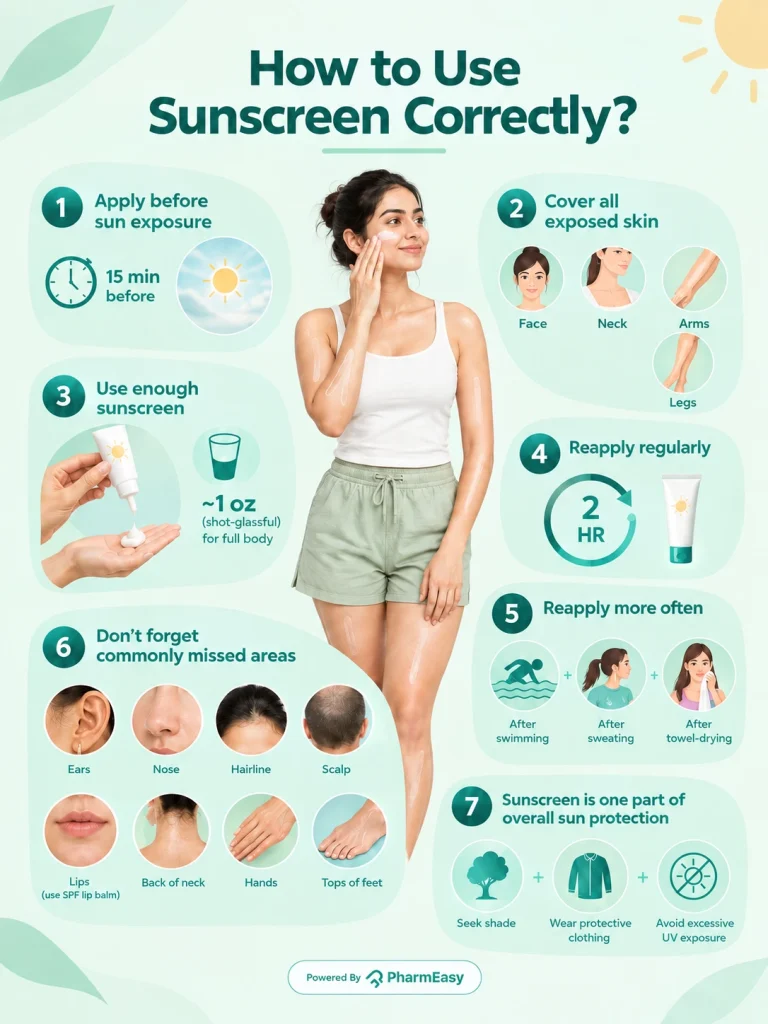
Follow these simple steps to get the most protection from your sunscreen6:
Note: Sunscreen should be used as one part of overall sun protection, along with seeking shade, wearing protective clothing, and avoiding excessive UV exposure7.
Also Read: How To Manage Hyperpigmentation in the Summer?
You should consider consulting a doctor if you have concerns about your skin or notice any unusual changes, such as14,15:
If you notice a suspicious or persistent skin change, do not assume it is related to sunscreen. Consult a doctor, as they can examine it and determine whether further evaluation is needed.
Also Read: Can Tattoos Increase Your Risk of Cancer?
Understanding the link between sunscreen and cancer can help address common concerns about sunscreen safety.
Sunscreen is an important part of protecting your skin from harmful UV radiation. Current evidence does not show that using sunscreen as directed causes cancer, while excessive UV exposure is a well-established risk factor for skin cancer. Therefore, choosing a broad-spectrum sunscreen with SPF 30 or higher, applying enough, and reapplying it regularly can help provide effective protection.
Daily sunscreen use is generally considered safe and is recommended to help protect the skin from harmful UV radiation4. There is no good evidence that regular sunscreen use causes cancer when you use it as mentioned on its label.
Mineral sunscreens typically contain zinc oxide or titanium dioxide5,7. Current evidence does not show that using these ingredients topically in sunscreen causes cancer.
There is no evidence that sunscreen itself is carcinogenic when used as directed. Some ingredients continue to be evaluated for safety, but this does not mean they have been shown to cause cancer5.
There is no evidence that expired sunscreen causes cancer. However, its effectiveness may decrease over time, meaning it may not provide the protection indicated on the label. So, in such cases, it is best to replace sunscreen after its expiration date4,6.
Studies have shown that some chemical sunscreen ingredients can be absorbed through the skin and detected in the bloodstream10,16. However, absorption does not mean that an ingredient is harmful or causes cancer. The FDA has requested additional safety data for some ingredients to better understand their effects5.
1. Xie F, Xie T, Song Q, Xia S, Li H. Analysis of association between sunscreens use and risk of malignant melanoma. Int J Clin Exp Med. 2015;8(2):2378-2384. Accessed September 2, 2026. https://pmc.ncbi.nlm.nih.gov/articles/PMC4402823/
2. Sander M, Burbidge T, Beecker J. The efficacy and safety of sunscreen use for the prevention of skin cancer. CMAJ Can Med Assoc J. 2020;192(50):E1802-E1808. doi:10.1503/cmaj.201085 https://pmc.ncbi.nlm.nih.gov/articles/PMC7759112/
3. Ruszkiewicz JA, Pinkas A, Ferrer B, Peres TV, Tsatsakis A, Aschner M. Neurotoxic effect of active ingredients in sunscreen products, a contemporary review. Toxicol Rep. 2017;4:245-259. doi:10.1016/j.toxrep.2017.05.006 https://pubmed.ncbi.nlm.nih.gov/28959646/
4. Sunscreen FAQs. American Academy of Dermatology. Accessed September 2, 2026. https://www.aad.org/media/stats-sunscreen
5. Questions and Answers: FDA posts deemed final order and proposed order for over-the-counter sunscreen. FDA. Published online November 19, 2025. Accessed September 2, 2026. https://www.fda.gov/drugs/understanding-over-counter-medicines/questions-and-answers-fda-posts-deemed-final-order-and-proposed-order-over-counter-sunscreen
6. Sunscreen: How to Help Protect Your Skin from the Sun. FDA. Published online June 9, 2026. Accessed September 2, 2026. https://www.fda.gov/drugs/understanding-over-counter-medicines/sunscreen-how-help-protect-your-skin-sun
7. Gabros S, Patel P, Zito PM. Sunscreens and Photoprotection. StatPearls Publishing. Accessed September 2, 2026. http://www.ncbi.nlm.nih.gov/books/NBK537164/
8. Salih H, Psomadakis C, George SMC. Sunscreens: A narrative review. Skin Health Dis. 2024;4(6):e432. doi:10.1002/ski2.432 https://pubmed.ncbi.nlm.nih.gov/39624735/
9. Green A, Williams G, Neale R, et al. Daily sunscreen application and betacarotene supplementation in prevention of basal-cell and squamous-cell carcinomas of the skin: a randomised controlled trial. Lancet. 1999;354(9180):723-729. doi:10.1016/S0140-6736(98)12168-2 https://pubmed.ncbi.nlm.nih.gov/10475183/
10. Over-the-Counter Monograph M020: Sunscreen Drug Products for Over-the-Counter Human Use. U.S. Food and Drug Administration. Accessed September 2, 2026. https://www.accessdata.fda.gov/drugsatfda_docs/omuf/monographs/OTCMonograph_M020-SunscreenDrugProductsforOTCHumanUse.pdf
11. Photocontact allergy to PABA in sunscreens: The need for continued vigilance. Accessed September 7, 2026. https://www.researchgate.net/publication/24176992_Photocontact_allergy_to_PABA_in_sunscreens_The_need_for_continued_vigilance
12. Osgood PJ, Moss SH, Davies DJG. The Sensitization of Near-Ultraviolet Radiation Killing of Mammalian Cells by the Sunscreen Agent Para-aminobenzoic Acid. J Invest Dermatol. 1982;79(6):354-357. doi:10.1111/1523-1747.ep12529409 https://pubmed.ncbi.nlm.nih.gov/6982950/
13. How to select a sunscreen. American Academy of Dermatology. Accessed September 2, 2026. https://www.aad.org/public/everyday-care/sun-protection/shade-clothing-sunscreen/how-to-select-sunscreen
14. Skin Diseases. National Institute of Arthritis and Musculoskeletal and Skin Diseases. April 20, 2017. Accessed September 2, 2026. https://www.niams.nih.gov/health-topics/skin-diseases
15. Symptoms of Skin Cancer. CDC. July 6, 2026. Accessed September 2, 2026. https://www.cdc.gov/skin-cancer/symptoms/index.html
16. Matta MK, Zusterzeel R, Pilli NR, et al. Effect of Sunscreen Application Under Maximal Use Conditions on Plasma Concentration of Sunscreen Active Ingredients: A Randomized Clinical Trial. JAMA. 2019;321(21):2082-2091. doi:10.1001/jama.2019.5586 https://pubmed.ncbi.nlm.nih.gov/31058986/
Disclaimer: The information provided here is for educational/awareness purposes only and is not intended to be a substitute for medical treatment by a healthcare professional and should not be relied upon to diagnose or treat any medical condition. The reader should consult a registered medical practitioner to determine the appropriateness of the information and before consuming any medication. PharmEasy does not provide any guarantee or warranty (express or implied) regarding the accuracy, adequacy, completeness, legality, reliability or usefulness of the information; and disclaims any liability arising thereof.
Links and product recommendations in the information provided here are advertisements of third-party products available on the website. PharmEasy does not make any representation on the accuracy or suitability of such products/services. Advertisements do not influence the editorial decisions or content. The information in this blog is subject to change without notice. The authors and administrators reserve the right to modify, add, or remove content without notification. It is your responsibility to review this disclaimer regularly for any changes.


Comments

Leave your comment...
You may also like















Comments