




Bowel Cancer (Colorectal Cancer): Meaning, Symptoms, Diagnosis & Treatment
By Dr. Swara Soumitra Pendse +2 more

Medically reviewed by Dr. Swara Soumitra Pendse
Last updated: Aug 28, 2026 Published on: Aug 26, 2026


Get,

to manage your symptom
Get your,

4 Cr+ families
benefitted

OTP sent to 9988776655



You’ve successfully subscribed to receive
doctor-approved tips on
Whatsapp

Get ready to feel your best.


Register to Avail the Offer
Send OTPBy continuing, you agree with our Privacy Policy and Terms and Conditions
Hi There,
Sign up on PharmEasy now!!


Trusted by 4 crore+ families

OTP sent to 9988776655
You have unlocked 25% off on medicines


Code: NU25

By Dr. Swara Soumitra Pendse +2 more
Table of Contents
Have you ever noticed changes in your bowel habits, blood in your stool, unexplained abdominal discomfort, or ongoing tiredness and wondered if it could be bowel cancer? These symptoms can have many causes and may occur with a number of benign (non-cancerous) diseases, but it is important not to ignore them when they persist1. This article explains everything you should know about bowel cancer in a simple and easy-to-understand way.
Large bowel cancer, also called colorectal cancer, is a type of cancer that develops in the large intestine1. The large intestine includes parts like the colon and rectum, which help the body process waste before it leaves the body2. Bowel cancer usually begins when abnormal cells in the inner lining of the bowel (intestine) grow and multiply in an uncontrolled manner. Over time, these cells can form a growth called a tumour and may spread to other parts of the body if not treated1.

Did You Know?
The different types of bowel or colorectal cancers include:
The stage of bowel cancer describes how far the cancer has grown or spread. Bowel cancer is generally divided into Stages 0 to IV:
Note: The exact stage is determined using test results, including examination of the tumour and lymph nodes. The stage may be further divided into Stages 2, 3 and 4 and into sub-stages based on the extent of spread.
Bowel cancer symptoms in early stages are minimal. However, symptoms can be more noticeable in the later stages and include:
Bowel cancer does not usually have one single cause. It develops when changes occur in the DNA of bowel cells, causing them to grow and divide abnormally. These changes can build up over time and may eventually lead to cancer. Important causes include:
A risk factor is something that increases the likelihood of a disease. The risk factors for bowel cancer include:
Note: Although these factors increase the risk of developing the disease, having one or more of them does not necessarily mean that a person will develop bowel cancer or that people with none of these risk factors may not develop bowel cancer. Bowel cancer may also occur in people who have no known risk factors.
Bowel cancer is diagnosed using a combination of medical history, physical examination and tests. The doctor may use the following strategies to diagnose a bowel cancer:
Bowel cancer treatment depends on factors such as the location and stage of the cancer, its size and the person’s overall health. Doctors may use one treatment or combine several approaches.
Surgery is an important treatment for many colorectal cancers, and it may be performed during different stages of the cancer as needed. The surgeon removes the cancer along with an appropriate area of surrounding tissue. Nearby lymph nodes will also be removed and examined. The healthy ends of the bowel are then joined back together.
Examples: Hemicolectomy or total colectomy. In case of polyps (which may be precancerous) polypectomy or endoscopic submucosal dissection can be performed for complete & safe removal.
This treatment uses medicines that destroy cancer cells or stop them from multiplying. It may be given in different forms, such as an injection or tablets to be taken orally. Chemotherapy may be done after surgery to reduce the risk of cancer returning, before surgery in selected cases (to shrink the tumour), or for advanced disease.
Examples of chemotherapy medicines: Leucovorin, capecitabine, and oxaliplatin.
This method uses high-energy radiation to destroy cancer cells. Radiation therapy can be external (radiation is given using a machine, outside the body, to the area where cancer is present) or internal (sending radioactive waves directly into the cancer cells or near them). It may be given before or after surgery depending on the need.
This treatment uses specific medicines that act on specific cancer cells. The doctor may choose the type of medicine based on the biomarker test. It may be given alone or with chemotherapy.
Examples of targeted therapy medicines: Encorafenib, bevacizumab, and panitumumab.
This method uses medicines that help the immune system recognise and attack cancer cells. The doctor may choose the type of medicine based on the biomarker test. It may be suitable for certain colon cancers with specific characteristics.
Examples of immunotherapy agents: Ipilimumab, nivolumab, and pembrolizumab12.
Note: When colorectal cancer has spread to the distant organs, treatment may include a combination of chemotherapy, targeted therapy, immunotherapy and surgery or other local treatments in selected patients. The treatment plan is individualised based on the area of spread of cancer.
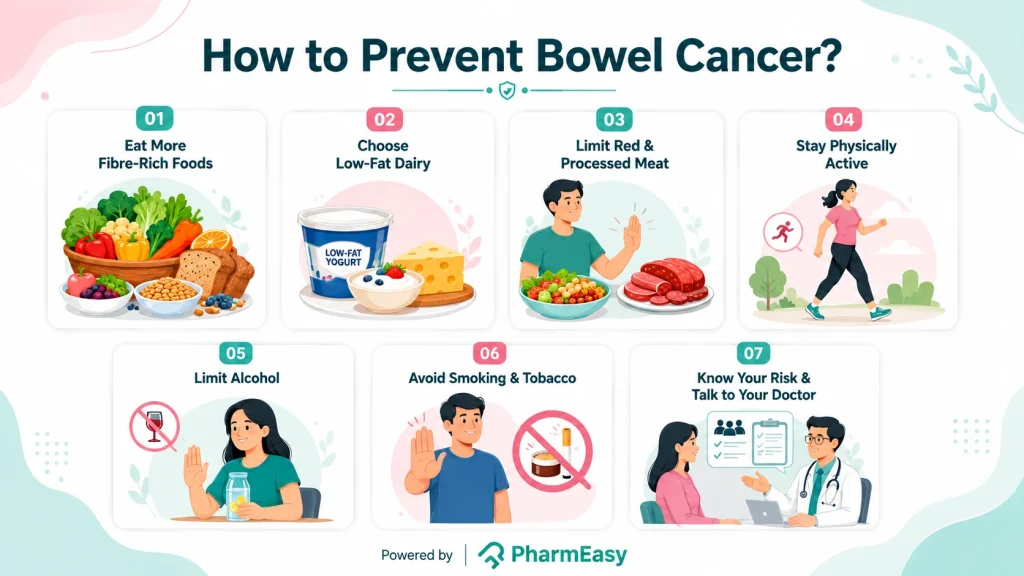
Although not all bowel cancers can be prevented, certain lifestyle changes may help reduce its risk. These include:
Note: These lifestyle measures may help lower the risk of bowel cancer, but they cannot guarantee that cancer will be prevented. Some people may develop bowel cancer even after following a healthy lifestyle.
It is important to seek medical advice if you have any of the following:
You may require urgent medical attention if you have symptoms like heavy bleeding through the rectum, bloody diarrhoea, and severe abdominal pain1,8.
Also Read: Is Bowel Leakage a Sign of Cancer?
Understanding the meaning of bowel cancer can help you recognise the disease and its warning signs early. Regular screening, a healthy lifestyle and timely medical advice can lower the risk and support early detection. If you notice ongoing changes in your bowel habits or other unusual symptoms, consult a doctor without delay.
Survival depends on how early the cancer is found. When detected before its spread, the 5-year survival rate can be around 91%13.
Yes, bowel cancer can be cured, especially when it is found and treated early. The chances of cure depend on the cancer’s stage, type and how well it responds to treatment3.
Bowel cancer can run in families, but not all bowel cancer is inherited. Having a close family member with bowel cancer may increase your risk1,3.
Increased gas or flatulence alone is usually not a sign of bowel cancer and can happen due to diet or other digestive problems. However, if it is persistent and occurs with blood in the stool or lasting changes in bowel habits, consult a doctor14.
Constipation does not always mean bowel cancer. However, constipation that is new, persistent or occurring with blood in the stool, weight loss or ongoing abdominal pain should be checked by a doctor1,8.
Yes, bowel cancer and colorectal cancer generally mean the same thing; cancer that develops in the colon or rectum, which are parts of the large intestine1.
Regular or heavy alcohol use can increase the risk of bowel cancer. The risk tends to increase further as alcohol intake increases1,10.
Yes, smoking can increase the risk of bowel cancer. Risk increases with the number of cigarettes smoked1,10.
Weight gain is not a typical sign of bowel cancer. Unexplained weight loss is more commonly associated with the disease. However, people with increased weight have a higher chance of getting bowel cancer1,8.
Back pain is not usually an early sign of bowel cancer. However, some people with bowel cancer may experience back pain if there is spread to the vertebrae/spine15.
Bowel cancer can sometimes cause pain or discomfort around the anus, particularly when the cancer affects the anus. However, conditions such as piles or anal fissures are more common causes of pain in the anus16.
Men and women may have many of the same bowel cancer symptoms, such as changes in bowel movements, blood in the stool, and stomach or abdominal pain. Women are more likely to develop cancer on the right side of the bowel, where symptoms may be less common. Signs such as anaemia and ongoing abdominal discomfort may occur, so the condition can sometimes go unnoticed until it becomes more advanced17.
1. Bowel cancer (colon and rectal cancer). Healthdirect. 2025. Accessed August 17, 2026. https://www.healthdirect.gov.au/bowel-cancer
2. Large intestine. NCI. Accessed August 17, 2026. https://www.cancer.gov/publications/dictionaries/cancer-terms/def/large-intestine
3. Colorectal cancer. WHO. Accessed August 17, 2026. https://www.who.int/news-room/fact-sheets/detail/colorectal-cancer
4. Shivshankar S, Patil PS, Deodhar K, Budukh AM. Epidemiology of colorectal cancer: A review with special emphasis on India. Indian J Gastroenterol. 2025;44(2):142-153. doi:10.1007/s12664-024-01726-8. https://pubmed.ncbi.nlm.nih.gov/39928255/
5. Grades and types of bowel cancer. Cancer Research UK. 2024. Accessed August 17, 2026. https://www.cancerresearchuk.org/about-cancer/bowel-cancer/stages-types-and-grades/grades-and-types
6. What Is Colorectal Cancer? American Cancer Society. 2024. Accessed August 17, 2026. https://www.cancer.org/cancer/types/colon-rectal-cancer/about/what-is-colorectal-cancer.html
7. Stages, types and grades of bowel cancer. Cancer Research UK. 2024. Accessed August 17, 2026. https://www.cancerresearchuk.org/about-cancer/bowel-cancer/stages-types-and-grades
8. Symptoms of bowel cancer. NHS. 2023. Accessed August 17, 2026. https://www.nhs.uk/conditions/bowel-cancer/symptoms/
9. Colorectal Cancer: An Overview. NCBI Bookshelf. Accessed August 17, 2026. https://www.ncbi.nlm.nih.gov/books/NBK586003/
10. Risks and causes of bowel cancer. Cancer Research UK. 2025. Accessed August 17, 2026. https://www.cancerresearchuk.org/about-cancer/bowel-cancer/risks-causes
11. Tests for bowel cancer. Cancer Research UK. 2024. Accessed August 17, 2026. https://www.cancerresearchuk.org/about-cancer/bowel-cancer/getting-diagnosed/tests-bowel-cancer
12. Colon cancer treatment. NCI. 2025. Accessed August 17, 2026. https://www.cancer.gov/types/colorectal/patient/colon-treatment-pdq
13. Colorectal cancer- Cancer Stat Facts. National Cancer Institute. 2026. Accessed August 17, 2026. https://seer.cancer.gov/statfacts/html/colorect.html
14. Passing wind. Cancer Research UK. 2025. Accessed August 17, 2026. https://www.cancerresearchuk.org/about-cancer/coping/physically/bowel-problems/types/passing-wind
15. Skalitzky MK, Zhou PP, Goffredo P, et al. Characteristics and symptomatology of colorectal cancer in the young. Surgery. 2023;173(5):1137-1143. doi:10.1016/j.surg.2023.01.018. https://pubmed.ncbi.nlm.nih.gov/36872174/
16. Anal pain. healthdirect. 2024. Accessed August 17, 2026. https://www.healthdirect.gov.au/anal-pain
17. Tsokkou S, Konstantinidis I, Papakonstantinou M, et al. Sex differences in colorectal cancer: Epidemiology, risk factors, and clinical outcomes. J Clin Med. 2025;14(15):5539. doi:10.3390/jcm14155539. https://pubmed.ncbi.nlm.nih.gov/40807160/
Disclaimer: The information provided here is for educational/awareness purposes only and is not intended to be a substitute for medical treatment by a healthcare professional and should not be relied upon to diagnose or treat any medical condition. The reader should consult a registered medical practitioner to determine the appropriateness of the information and before consuming any medication. PharmEasy does not provide any guarantee or warranty (express or implied) regarding the accuracy, adequacy, completeness, legality, reliability or usefulness of the information; and disclaims any liability arising thereof.
Links and product recommendations in the information provided here are advertisements of third-party products available on the website. PharmEasy does not make any representation on the accuracy or suitability of such products/services. Advertisements do not influence the editorial decisions or content. The information in this blog is subject to change without notice. The authors and administrators reserve the right to modify, add, or remove content without notification. It is your responsibility to review this disclaimer regularly for any changes.


Comments

Leave your comment...
You may also like























Comments