




Are Generic Medicines Effective for the Elderly?
By Dr. Ambika Dashrathrao Mamde +2 more

Medically reviewed by Dr. Ambika Dashrathrao Mamde
Last updated: Aug 25, 2026 Published on: Aug 25, 2026


Get,

to manage your symptom
Get your,

4 Cr+ families
benefitted

OTP sent to 9988776655



You’ve successfully subscribed to receive
doctor-approved tips on
Whatsapp

Get ready to feel your best.


Register to Avail the Offer
Send OTPBy continuing, you agree with our Privacy Policy and Terms and Conditions
Hi There,
Sign up on PharmEasy now!!


Trusted by 4 crore+ families

OTP sent to 9988776655
You have unlocked 25% off on medicines


Code: NU25

By Dr. Ambika Dashrathrao Mamde +2 more
Table of Contents
As people get older, they are more likely to take multiple medicines regularly to manage long-term conditions such as high blood pressure, diabetes, high cholesterol, or heart disease. However, more medicines would mean more money spent on overall health benefits. To cope with the increasing financial burden, many older adults may consider switching from brand-name medicines to generic alternatives. Generic medicines contain the same active ingredients as their brand-name counterparts and are generally available at a lower cost1.
This blog explains whether generic medicines are safe and effective for older adults. It also covers potential benefits and key points to discuss with a doctor before switching from a brand-name medicine.
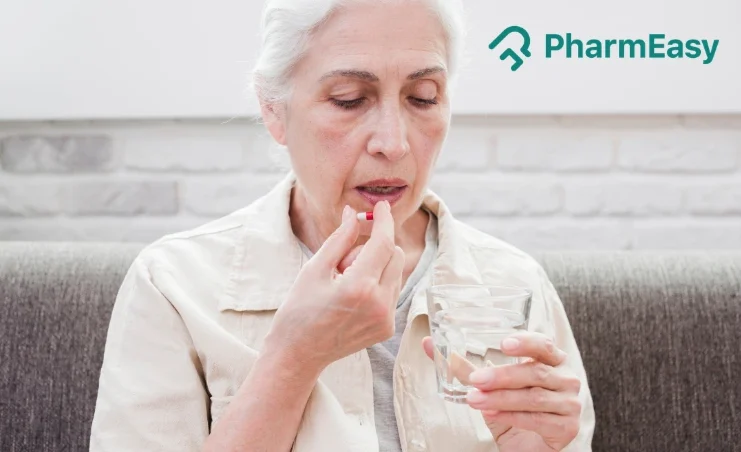
Generic medicines contain the same active ingredient as the brand-name medicine. FDA-approved generics are generally expected to work the same way and provide the same clinical benefits and risks as the brand-name version when they meet FDA standards for quality, safety, strength, and effectiveness1.
Research also supports the use of generics in most situations. Harvard Health reports that previous studies have usually found little difference between generic and brand-name medicines, with generics generally working just as well for many health conditions2. Generic medicines can therefore be an effective and more affordable option for many older adults. However, anyone who notices new symptoms, worsening symptoms, or changes in how they feel after a switch should contact their doctor1,2.
Geriatric pharmacology is the study of how medicines affect older adults. As people age, changes in the body can affect how medicines enter the bloodstream, move through the body, are broken down, and are removed. These changes can alter how well a medicine works and may increase the risk of side effects or drug interactions3,4,5.
In simple terms, this field helps healthcare professionals choose, adjust, and monitor medicines more safely for older adults3,4,5.
Medication management can be more challenging for older adults because they often have several health conditions, take multiple medicines, and may have age-related changes that affect safe medicine use. Important factors include6:
Older adults commonly use medicines for long-term conditions, so choosing the right medicine and reviewing it regularly are important parts of elderly care7. Examples of brand-name medicines and their generic names include:
| Health Condition | Branded Medicine Examples | Generic Medicine |
| High Blood Pressure | Prinivil, Zestril, Norvasc8,9 | Lisinopril, amlodipine8,9 |
| Type 2 Diabetes | Glucophage, Fortamet, Riomet10 | Metformin10 |
| High Cholesterol | Lipitor, Atorvaliq11 | Atorvastatin11 |
| Hypothyroidism | Synthroid, Levoxyl, Tirosint12 | Levothyroxine12 |
| Acid Reflux (GERD) | Prilosec13 | Omeprazole13 |
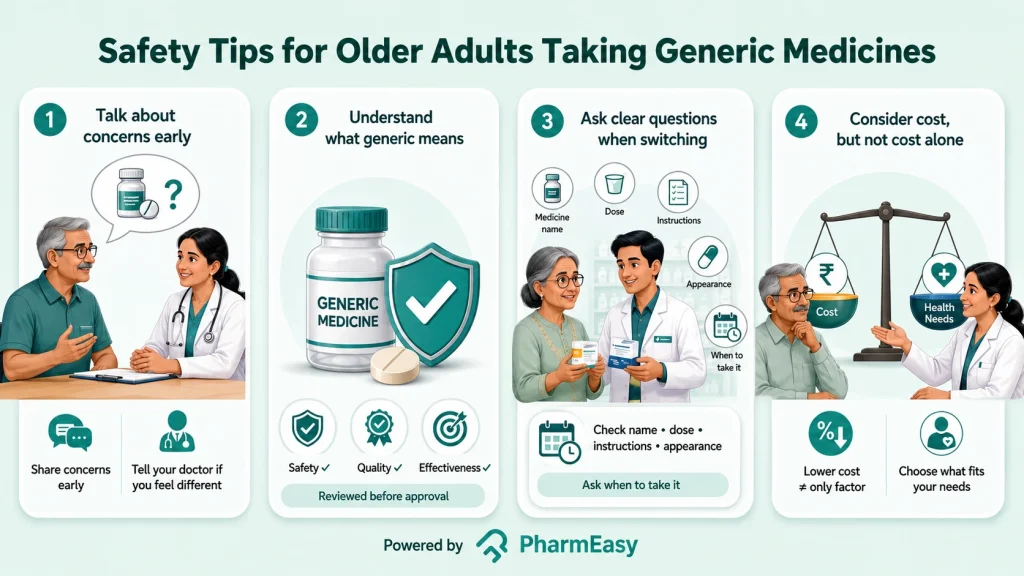
Safety tips for older adults who are taking or considering generic medicines include14:
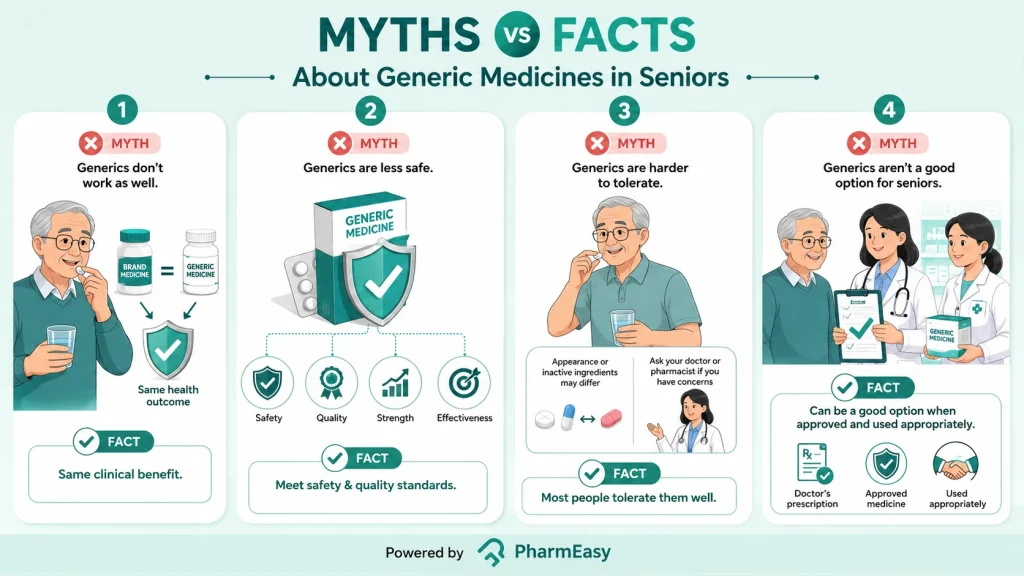
Common myths and facts about generic medicines in older adults include1,14:
1. Myth: Generic medicines do not work as well as brand-name medicines.
Fact: FDA-approved generic medicines are made to work in the same way and provide the same clinical benefit as the brand-name medicine.
2. Myth: Generic medicines are less safe than brand-name medicines.
Fact: Generic medicines must meet standards for safety, quality, strength, and effectiveness. If a person has concerns or new symptoms, they should discuss them in a timely manner with a healthcare professional.
3. Myth: Generic medicines are always harder to tolerate.
Fact: Most people tolerate generics well. Some generics may look different or contain different inactive ingredients, so patients should report any new or bothersome symptoms after a switch.
4. Myth: Generic medicines are not a good option for older adults.
Fact: Generics can be a good option for many older adults when approved and used appropriately. The best choice depends on the person’s health conditions, ongoing medicines, and advice from their doctor.
Older adults often take multiple medicines, making medication management more complex. Doctors and pharmacists work together as part of an interprofessional healthcare team to improve medicine use and reduce medication-related problems in older adults15.
Doctors prescribe medicines and make treatment decisions. Pharmacists review medicine lists, check for possible medicine-related problems and suggest ways to improve safety in such scenarios, answer questions about how to take medicines. Working together, doctors and pharmacists can help reduce problems related to multiple medicines and support safer treatment for older adults15,16.
Also Read: How to Identify Generic Medicines: Label Reading, Verification and Safety Tips
Older adults should consult a doctor if they have questions before switching to a generic medicine, if their pill looks different than expected, or if they develop new symptoms after a switch. They should also seek advice before stopping, changing, or doubling any medicine. Clear communication and accurate information from a doctor can help older adults understand their treatment and use medicines more safely and confidently14.
Generic medicines can be safe and effective for many older adults when they are approved by regulatory authorities (FDA) and used as directed. Because older adults often take several medicines and may process medicines differently as they age, regular medicine reviews and open communication with doctors are important. Understanding what generics are, asking questions during a switch, and reporting new symptoms promptly can help older adults get the benefits of treatment while reducing avoidable risks.
Older adults commonly use medicines for long-term conditions. These may include medicines for high blood pressure, heart disease, diabetes, high cholesterol, pain, and other conditions, depending on each person’s health needs7.
Some medicines can be risky for older adults and may be considered potentially inappropriate in certain situations. Examples include some antihistamines, benzodiazepines, tricyclic antidepressants, nonsteroidal anti-inflammatory drugs, and antipsychotics. These medicines are not always unsafe, but they should be used only when the benefits outweigh the risks and with appropriate medical supervision17.
Yes. Older adults can ask their doctor whether a lower-cost generic option is available. They should not change medicines on their own, because ageing, other health conditions and their related medications can affect how safely medicines work in an individual5.
Yes. FDA-approved generic medicines can be suitable for long-term conditions because they must meet standards for safety, quality, strength, effectiveness, and intended use. They contain the same active ingredient as the brand-name medicine, although patients should continue regular follow-up and report any concerns after a switch1.
1. Research C for DE and. Generic Drug Facts. FDA. Published online June 2, 2026. Accessed August 11, 2026. https://www.fda.gov/drugs/generic-drugs/generic-drug-facts
2. Do generic drugs compromise on quality? Harvard Health. January 1, 2018. Accessed August 11, 2026. https://www.health.harvard.edu/healthy-aging-and-longevity/do-generic-drugs-compromise-on-quality
3. Andres TM, McGrane T, McEvoy MD, Allen BFS. Geriatric Pharmacology: An Update. Anesthesiol Clin. 2019;37(3):475-492. doi:10.1016/j.anclin.2019.04.007. https://pubmed.ncbi.nlm.nih.gov/31337479/
4. Hilmer SN, McLachlan AJ, Le Couteur DG. Clinical pharmacology in the geriatric patient. Fundam Clin Pharmacol. 2007;21(3):217-230. doi:10.1111/j.1472-8206.2007.00473.x. https://pubmed.ncbi.nlm.nih.gov/17521291/
5. Research C for DE and. As You Age: You and Your Medicines. FDA. Published online April 3, 2026. Accessed August 11, 2026. https://www.fda.gov/drugs/information-consumers-and-patients-drugs/you-age-you-and-your-medicines
6. Marek KD, Antle L. Medication Management of the Community-Dwelling Older Adult. In: Hughes RG, ed. Patient Safety and Quality: An Evidence-Based Handbook for Nurses. Advances in Patient Safety. Agency for Healthcare Research and Quality (US); 2008. Accessed August 11, 2026. http://www.ncbi.nlm.nih.gov/books/NBK2670/
7. Garratt SM, Prasad M, Ottosen K, Manias E. Regular Medications Administered to Older Adults in Aged Care Facilities: A Retrospective Descriptive Study. J Clin Nurs. 2026;35(1):363-374. doi:10.1111/jocn.17856. https://pubmed.ncbi.nlm.nih.gov/40523868/
8. Lisinopril: MedlinePlus Drug Information. Accessed August 11, 2026. https://medlineplus.gov/druginfo/meds/a692051.html
9. Amlodipine: MedlinePlus Drug Information. Accessed August 11, 2026. https://medlineplus.gov/druginfo/meds/a692044.html
10. Metformin: MedlinePlus Drug Information. Accessed August 11, 2026. https://medlineplus.gov/druginfo/meds/a696005.html
11. Atorvastatin: MedlinePlus Drug Information. Accessed August 11, 2026. https://medlineplus.gov/druginfo/meds/a600045.html
12. Levothyroxine: MedlinePlus Drug Information. Accessed August 11, 2026. https://medlineplus.gov/druginfo/meds/a682461.html
13. Omeprazole: MedlinePlus Drug Information. Accessed August 11, 2026. https://medlineplus.gov/druginfo/meds/a693050.html
14. Iosifescu A, Halm EA, McGinn T, Siu AL, Federman AD. Beliefs about generic drugs among elderly adults in hospital-based primary care practices. Patient Educ Couns. 2008;73(2):377-383. doi:10.1016/j.pec.2008.07.012. https://pmc.ncbi.nlm.nih.gov/articles/PMC2739237/
15. Lee JK, Alshehri S, Kutbi HI, Martin JR. Optimizing pharmacotherapy in elderly patients: the role of pharmacists. Integr Pharm Res Pract. 2015;4:101-111. doi:10.2147/IPRP.S70404. https://pmc.ncbi.nlm.nih.gov/articles/PMC5741014/
16. Sadeq A, Strugaru M, Almutairi M, Stewart D, Ryan C, Grimes T. Interprofessional Interventions Involving Pharmacists and Targeting the Medicines Management Process Provided to Older People Residing in Nursing Homes: A Systematic Review and Meta-Analysis of Randomised Controlled Trials. Drugs Aging. 2022;39(10):773-794. doi:10.1007/s40266-022-00978-3. https://pubmed.ncbi.nlm.nih.gov/36194370/
17. Hanlon JT, Semla TP, Schmader KE. Alternative Medications for Medications Included in the Use of High-Risk Medications in the Elderly and Potentially Harmful Drug–Disease Interactions in the Elderly Quality Measures. J Am Geriatr Soc. 2015;63(12):e8-e18. doi:10.1111/jgs.13807. https://pmc.ncbi.nlm.nih.gov/articles/PMC4890629/
Disclaimer: The information provided here is for educational/awareness purposes only and is not intended to be a substitute for medical treatment by a healthcare professional and should not be relied upon to diagnose or treat any medical condition. The reader should consult a registered medical practitioner to determine the appropriateness of the information and before consuming any medication. PharmEasy does not provide any guarantee or warranty (express or implied) regarding the accuracy, adequacy, completeness, legality, reliability or usefulness of the information; and disclaims any liability arising thereof.
Links and product recommendations in the information provided here are advertisements of third-party products available on the website. PharmEasy does not make any representation on the accuracy or suitability of such products/services. Advertisements do not influence the editorial decisions or content. The information in this blog is subject to change without notice. The authors and administrators reserve the right to modify, add, or remove content without notification. It is your responsibility to review this disclaimer regularly for any changes.


Comments

Leave your comment...
You may also like























Comments