




Sperm Agglutination: Meaning, Causes, Symptoms, Diagnosis & Treatment
By Dr. Charmi Shah +2 more

Medically reviewed by Dr. Charmi Shah
Last updated: Oct 7, 2026 Published on: Oct 7, 2026


Get,

to manage your symptom
Get your,

4 Cr+ families
benefitted

OTP sent to 9988776655



You’ve successfully subscribed to receive
doctor-approved tips on
Whatsapp

Get ready to feel your best.


Register to Avail the Offer
Send OTPBy continuing, you agree with our Privacy Policy and Terms and Conditions
Hi There,
Sign up on PharmEasy now!!


Trusted by 4 crore+ families

OTP sent to 9988776655
You have unlocked 25% off on medicines


Code: NU25

By Dr. Charmi Shah +2 more
Table of Contents
It is natural to feel worried if your semen analysis report shows sperm agglutination1. It might also raise concerns, especially when you are trying to understand what it means for fertility.
Sperm agglutination refers to sperm sticking to each other2. However, its presence does not necessarily mean that you are infertile. In this blog, we explain sperm agglutination meaning, its causes, symptoms, diagnosis, and management options, so you can better understand your report and know when to consult a doctor.
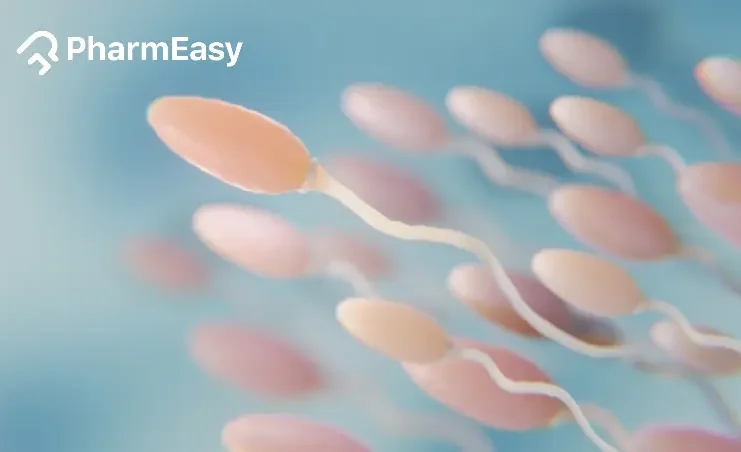
Let us first learn some basic terms to understand what is agglutination in sperm.
A sperm cell is a male reproductive cell made up of three main parts: the head (contains genetic material), the middle piece (provides energy), and the tail (helps the sperm move)3. The sperm are carried in semen, which is the fluid released during ejaculation. Semen contains sperm along with fluids from the prostate and other reproductive glands4.
Sperm agglutination or agglutination in sperm means that motile sperm stick to one another instead of moving freely. They may stick head-to-head, tail-to-tail, or in a mixed pattern2.
Note: A few small clumps of sperm may not significantly affect fertility, but marked agglutination may interfere with sperm movement and might make it harder for sperm to travel toward the egg5.
Did You Know?
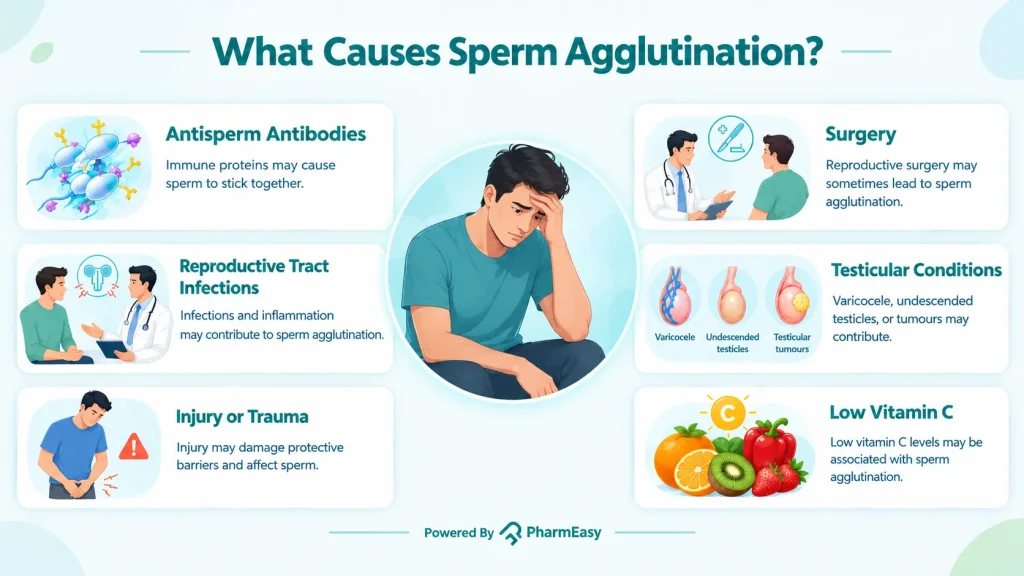
Agglutination in sperm can occur for several reasons. Possible causes and associated factors include:
Agglutination in sperm usually does not cause noticeable symptoms on its own.
It is most often discovered during a semen analysis, particularly when a couple is being evaluated for infertility2,5. This may be considered5:
Note: If agglutination is associated with an infection or inflammation of the reproductive tract, symptoms such as testicular pain/swelling, pain during urination, unusual penile discharge, or fever may occur13.
Sperm agglutination and sperm aggregation may sound similar. However, both of these terms describe different types of sperm clumping (see table below)14,15.
| Feature | Sperm Agglutination | Sperm Aggregation |
| Definition | Motile sperm stick to other motile sperm | Sperm stick to mucus, cells, debris, or other non-sperm material |
| Pattern | May occur head-to-head, tail-to-tail, or in mixed patterns | Usually appears as non-specific clumps |
| Possible significance | May be associated with antisperm antibodies or other factors | Generally considered non-specific and does not indicate true sperm agglutination |
| How it is identified | Observed during microscopic examination of semen | Also identified during microscopic examination |
Sperm agglutination is usually identified during a semen analysis. This test examines a semen sample under a microscope to check whether motile sperm are sticking to one another. The extent of sperm agglutination can be graded according to the percentage of sperm involved in clumping2:
This grading helps describe how extensive the agglutination is in the semen sample. Consult your doctor to learn more about sperm agglutination normal range.
Further, depending on the semen analysis findings and suspected cause, your doctor may recommend additional tests, such as:
Important: Sperm agglutination is a semen-analysis finding, not a disease. Therefore, finding agglutination does not by itself establish the cause or mean that a person is infertile.
Agglutination itself does not require treatment. Management depends on the underlying factors contributing to agglutination. Some common management/treatment for sperm agglutination options include:
Note: The choice of treatment depends on sperm count and motility, the extent of agglutination, the duration of infertility, and the fertility status of both partners.
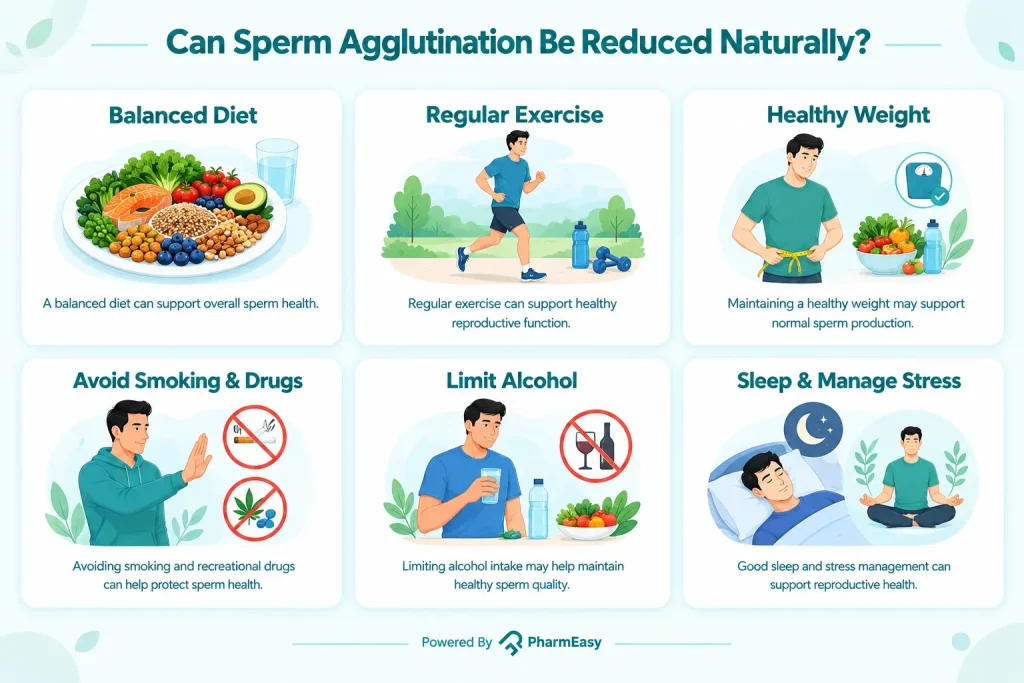
There is no proven natural treatment that directly removes sperm agglutination. However, maintaining healthy lifestyle habits such as the ones mentioned below may support overall sperm health and reproductive function19.
Remember: These measures may support overall sperm health, but they should not be presented as agglutination sperm treatment itself. If agglutination is persistent or associated with difficulty conceiving, medical evaluation is recommended.
There is no guaranteed way to prevent sperm agglutination because some causes may not be avoidable. However, the following steps could help support sperm health and reduce the risk of factors that may contribute to it.
Also Read: Male Infertility: Causes, Symptoms, Treatment and More
You should consult a doctor if:
Sperm agglutination refers to motile sperm sticking to one another and is usually identified during a semen analysis. While it can sometimes be associated with antisperm antibodies, infections, inflammation, or other factors, its presence alone does not mean that a man is infertile. The significance depends on the extent of agglutination and the overall semen-analysis findings.
If conception is taking longer than expected or an abnormal semen report raises concerns, consulting a fertility specialist can help identify the underlying cause and guide appropriate treatment.
Sperm agglutination does not directly cause infertility. However, very marked agglutination may interfere with sperm movement and can contribute to difficulty conceiving in some cases2.
It may be temporary in some cases that are associated with a condition such as an infection or inflammation that later resolves with appropriate treatment7,12. However, persistent agglutination should be evaluated by a doctor.
It may improve when the underlying contributing factor resolves, but there is no guarantee that it will disappear on its own. So, if it persists or conception is difficult, you should consult a doctor.
Sperm agglutination may affect the selection and handling of sperm during assisted reproductive procedures. However, techniques used during IVF or ICSI can help fertility specialists select suitable sperm, so agglutination does not necessarily prevent these treatments7,17.
1. Berger GK, Smith-Harrison LI, Sandlow JI. Sperm agglutination: Prevalence and contributory factors. Andrologia. 2019;51(5):e13254. doi:10.1111/and.13254 https://pubmed.ncbi.nlm.nih.gov/30761575/
2. Allow AK. Sperm Agglutination, Sperm Shaky Head Movement and Sperm-Cervical Interaction Tests could be enough for Diagnosis of Immunological Infertility? J Gynecol Womens Health. 2017;3(1). doi:10.19080/JGWH.2017.03.555603 https://www.researchgate.net/publication/321028859_Sperm_Agglutination_Sperm_Shaky_Head_Movement_and_Sperm-Cervical_Interaction_Tests_could_be_enough_for_Diagnosis_of_Immunological_Infertility
3. Alberts B, Johnson A, Lewis J, Raff M, Roberts K, Walter P. Sperm. In: Molecular Biology of the Cell. 4th Edition. Garland Science; 2002. Accessed September 30, 2026. https://www.ncbi.nlm.nih.gov/books/NBK26914/
4. Definition of semen. NCI. February 2, 2011. Accessed September 30, 2026. https://www.cancer.gov/publications/dictionaries/cancer-terms/def/semen
5. Malhotra J, Devi MG, Patil M. Best Practice Recommendations for Infertility Management. J Hum Reprod Sci. 2024;17(Suppl 1):S1-S240. doi:10.4103/jhrs.JHRS_ISAR_IFS https://pubmed.ncbi.nlm.nih.gov/38495807/
6. Griswold MD. Spermatogenesis: The Commitment to Meiosis. Physiol Rev. 2016;96(1):1-17. doi:10.1152/physrev.00013.2015 https://pubmed.ncbi.nlm.nih.gov/26537427/
7. Gupta S, Sharma R, Agarwal A, et al. Antisperm Antibody Testing: A Comprehensive Review of Its Role in the Management of Immunological Male Infertility and Results of a Global Survey of Clinical Practices. World J Mens Health. 2022;40(3):380-398. doi:10.5534/wjmh.210164 https://pubmed.ncbi.nlm.nih.gov/35021297/
8. Testicular torsion. Healthdirect. Accessed September 30, 2026. https://www.healthdirect.gov.au/testicular-torsion
9. Falcone M, Bocu K, Keskin H, et al. Anti-sperm Antibody Positivity in Men with Varicocele: A Systematic Review and Meta-Analysis. World J Mens Health. 2025;43(1):60-69. doi:10.5534/wjmh.240003 https://pubmed.ncbi.nlm.nih.gov/38606868/
10. Sinisi AA, Pasquali D, Papparella A, et al. Antisperm antibodies in cryptorchidism before and after surgery. J Urol. 1998;160(5):1834-1837. https://pubmed.ncbi.nlm.nih.gov/9783970/
11. Haratian K, Faegh A, Mehrpoor G, Doustmohammadi M, Rezaeinasab R, MomeniAmjadi A. Potential causes and associated conditions with anti-sperm antibody production among infertile males: a systematic literature review. BMC Immunol. 2025;26:58. doi:10.1186/s12865-025-00740-5 https://pubmed.ncbi.nlm.nih.gov/40770285/
12. Schuppe HC, Pilatz A, Hossain H, Diemer T, Wagenlehner F, Weidner W. Urogenital Infection as a Risk Factor for Male Infertility. Dtsch Ärztebl Int. 2017;114(19):339-346. doi:10.3238/arztebl.2017.0339 https://pubmed.ncbi.nlm.nih.gov/28597829/
13. Guiton R, Drevet JR. Viruses, bacteria and parasites: infection of the male genital tract and fertility. Basic Clin Androl. 2023;33:19. doi:10.1186/s12610-023-00193-z https://pubmed.ncbi.nlm.nih.gov/37468865/
14. Krausz C, Farnetani G. Clinical Interpretation of Semen Analysis. In: Bettocchi C, Busetto GM, Carrieri G, Cormio L, eds. Practical Clinical Andrology. Springer International Publishing; 2023:173-184. doi:10.1007/978-3-031-11701-5_13 https://www.researchgate.net/publication/364581695_Clinical_Interpretation_of_Semen_Analysis
15. WHO Laboratory Manual for the Examination and Processing of Human Semen. 6th ed. World Health Organization; 2010. Accessed September 30, 2026. https://iris.who.int/server/api/core/bitstreams/4038e736-37b3-4064-a39a-60475e0ccecc/content
16. Baldini D, Ferri D, Baldini GM, et al. Sperm Selection for ICSI: Do We Have a Winner? Cells. 2021;10(12):3566. doi:10.3390/cells10123566 https://pubmed.ncbi.nlm.nih.gov/34944074/
17. Zhang H, Mi DQ, Jiang Y, et al. The Positive Rate of Antisperm Antibody and Its Impact on in vitro Fertilization/Intracytoplasmic Sperm Injection Embryo Culture. Urol Int. 2026;110(1):11-17. doi:10.1159/000545912 https://pubmed.ncbi.nlm.nih.gov/40267896/
18. Fleming S, Morroll D, Nijs M. Sperm Separation and Selection Techniques to Mitigate Sperm DNA Damage. Life. 2025;15(2):302. doi:10.3390/life15020302 https://pubmed.ncbi.nlm.nih.gov/40003711/
19. Bocu K, Boeri L, Mahmutoglu AM, Vogiatzi P. Can lifestyle changes significantly improve male fertility: A narrative review? Arab J Urol Int J. 23(3):190-200. doi:10.1080/20905998.2024.2421626 https://pmc.ncbi.nlm.nih.gov/articles/PMC12308861/
20. How to Prevent STIs. Sexually Transmitted Infections (STIs). CDC. March 3, 2026. Accessed September 30, 2026. https://www.cdc.gov/sti/prevention/index.html
21. Bieniek JM, Sumfest JM. Sports-related testicular injuries and the use of protective equipment among young male athletes. Urology. 2014;84(6):1485-1489. doi:10.1016/j.urology.2014.09.007 https://pubmed.ncbi.nlm.nih.gov/25432843/
Disclaimer: The information provided here is for educational/awareness purposes only and is not intended to be a substitute for medical treatment by a healthcare professional and should not be relied upon to diagnose or treat any medical condition. The reader should consult a registered medical practitioner to determine the appropriateness of the information and before consuming any medication. PharmEasy does not provide any guarantee or warranty (express or implied) regarding the accuracy, adequacy, completeness, legality, reliability or usefulness of the information; and disclaims any liability arising thereof.
Links and product recommendations in the information provided here are advertisements of third-party products available on the website. PharmEasy does not make any representation on the accuracy or suitability of such products/services. Advertisements do not influence the editorial decisions or content. The information in this blog is subject to change without notice. The authors and administrators reserve the right to modify, add, or remove content without notification. It is your responsibility to review this disclaimer regularly for any changes.


Comments

Leave your comment...
You may also like
























Comments