




STDs in Men: Symptoms, Causes, Diagnosis & Treatment
By Dr. Charmi Shah +2 more

Medically reviewed by Dr. Charmi Shah
Last updated: Aug 21, 2026 Published on: Jun 12, 2026


Get,

to manage your symptom
Get your,

4 Cr+ families
benefitted

OTP sent to 9988776655



You’ve successfully subscribed to receive
doctor-approved tips on
Whatsapp

Get ready to feel your best.


Register to Avail the Offer
Send OTPBy continuing, you agree with our Privacy Policy and Terms and Conditions
Hi There,
Sign up on PharmEasy now!!


Trusted by 4 crore+ families

OTP sent to 9988776655
You have unlocked 25% off on medicines


Code: NU25

By Dr. Charmi Shah +2 more
Table of Contents
Sexually transmitted diseases (STDs), also known as sexually transmitted, are common worldwide, affecting millions of people every year1. In cases, symptoms are mild and hence go unnoticed. This can often lead to delayed diagnosis2. The good news is that most STDs are treatable, and many can be effectively managed when detected early3. This article will help understand the causes, symptoms, diagnostic methods, prevention and treatment of STDs in men in a simple way.
STDs are infections spread through sexual contact, including vaginal, anal, or oral sex. They can be caused by bacteria, viruses, fungus, or parasites2. These infections commonly spread through unprotected sex with an infected partner3. Some infections, such as genital herpes and human papillomavirus (HPV), can spread through skin contact even when there are no visible sores or symptoms4.

While STIs affect both men and women, the risk of complications is higher in women, however awareness in men is crucial. Men may carry and transmit these infections even without showing clear symptoms1, especially during the early stages, which is why regular screening is important. Recognising STI risks also encourages men to get testing when needed, even if they are not feeling sick. Early detection allows for timely treatment, which can help avoid complications like infertility, pelvic inflammatory disease (PID) in female partners, certain cancers, and long-term reproductive health issues5. Regular screening, practising safer sex, limiting exposure to risk factors (multiple partners, prostitution, etc.), and staying informed about vaccinations such as HPV and hepatitis B can greatly reduce the spread and impact of STIs3.
STIs are infections caused by bacteria, viruses, or parasites. The following describe the common causes of STDs in males:
STIs in men may be asymptomatic or they may show some certain signs and symptoms depending upon the type of infection. It is important to understand these for timely diagnosis and medical care.
Common early signs of STDs in males include:
Some other signs and symptoms of STDs seen in males could be:
Note: The male STD warning signs and symptoms mentioned above are general and can differ from person to person. Having these do not always indicate an STI; they can also be a result of other medical conditions. If you observe any of these or are worried, it is recommended to see a doctor for proper testing and diagnosis.
There are different types of STIs that can occur in men. The common types of male STDs are:
STIs in men are diagnosed using specific laboratory tests that detect infections caused by bacteria, viruses, or parasites. The common types which the doctors recommend include:
Early diagnosis helps prevent complications and reduces the spread of infection. For easy testing and early detection, STI panels are available that can look for several infections at the same time.
Treatment for STDs in males usually involves different types of medicines depending on the infection, along with supportive care to manage symptoms and avoid complications. The following are some common approaches that doctors use:
Note: This information is provided for general knowledge only and should not be taken as medical advice. Treatment options may differ based on the exact infection and individual health status. For an accurate diagnosis and treatment, please contact a qualified doctor (urologist or venereologist).
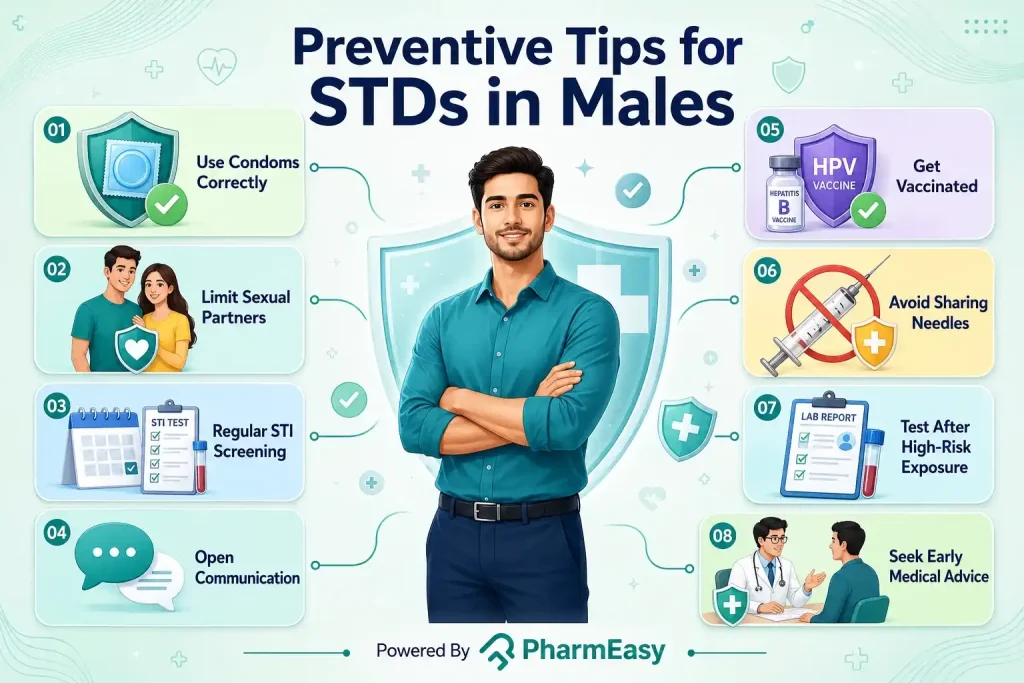
The following are the ways by which an STI can be avoided:
Note: Medications should only be taken under the guidance of a qualified doctor.
Consult a doctor right away if symptoms like painful urination, unusual penile discharge, genital sores, blisters, warts, testicular pain or swelling, persistent itching, or unexplained rashes occur. Medical attention is also required if a fever or flu-like symptoms develop following a sexual contact. Even if no symptoms are there, being tested is recommended following unprotected intercourse, having several sexual partners, or knowing that a partner has been diagnosed with an STI, as many infections go undetected in the beginning3.
Also Read: STD in Women: Symptoms, Causes, Diagnosis, Treatment & Prevention Guide
STIs in males are common infections that can develop without visible symptoms; therefore, awareness and regular testing are essential. Early detection and treatment can help avoid complications and limit the risk of spreading the infection to others. Practising safe sex, getting screened when needed, and seeking medical advice for any concerning symptoms are key steps in maintaining good sexual and overall health.
Many STIs are treatable, particularly when detected early. Bacterial infections such as chlamydia, gonorrhoea, and syphilis are frequently treatable with appropriate drugs, but viral infections such as HIV and herpes are not completely curable. However, they can be effectively controlled to lessen symptoms and problems. Early diagnosis and treatment are critical to attaining the best results10.
Yes, men can have STIs and not show symptoms. Many infections, including chlamydia, HPV, and HIV, can go undetected for a long time while still being transmitted to sexual partners3.
How long an STI last depends on the type of infection and whether treatment is received. Symptoms of some bacterial STIs can be reduced within days to weeks with medication, while viral STIs may persist long-term and require ongoing management3.
Yes, many STIs can cause pain or a burning sensation during urination in men. This symptom is commonly seen with infections such as chlamydia, gonorrhoea, etc10.
STIs such as genital herpes and syphilis can cause sores, ulcers, or blisters on the penis. These lesions may be painful or painless, depending on the infection and its stage10.
1. Sexually transmitted infections (STIs). 2025. Doi: https://www.who.int/news-room/fact-sheets/detail/sexually-transmitted-infections-(stis)
2. About Sexually Transmitted Infections (STIs). 2024. Doi: https://www.cdc.gov/sti/about/index.html
3. Garcia MR, Leslie SW, Wray AA. Sexually Transmitted Infections. 2024. Doi: https://www.ncbi.nlm.nih.gov/books/NBK560808/
4. About Genital HPV Infection. 2025. Doi: https://www.cdc.gov/sti/about/about-genital-hpv-infection.html
5. Kodner C. Sexually transmitted infections in men. Primary Care: Clinics in Office Practice. 2003;30(1):173-191. doi:10.1016/S0095-4543(02)00073-8. https://pubmed.ncbi.nlm.nih.gov/12825255/
6. Condom Use: An Overview. 2024. Doi: https://www.cdc.gov/condom-use/index.html
7. Lytle-Barnaby R. Sexually Transmitted Diseases: An Overview. Delaware Journal of Public Health. 2016;2(2):26-31. doi:10.32481/djph.2016.04.009. https://pubmed.ncbi.nlm.nih.gov/34466839/
8. HIV and Opportunistic Infections, Coinfections, and Conditions. 2025. Doi: https://hivinfo.nih.gov/understanding-hiv/fact-sheets/hiv-and-sexually-transmitted-infections-stis
9. What causes sexually transmitted diseases (STDs) or sexually transmitted infections (STIs)? 2017. Doi: https://www.nichd.nih.gov/health/topics/stds/conditioninfo/causes
10. What are Sexually Transmitted Infections (STIs) or Diseases (STDs)? 2024. Doi: https://www.urologyhealth.org/urology-a-z/s/sexually-transmitted-infections
11. Trichomoniasis. 2024. Doi: https://medlineplus.gov/ency/article/001331.htm
Disclaimer: The information provided here is for educational/awareness purposes only and is not intended to be a substitute for medical treatment by a healthcare professional and should not be relied upon to diagnose or treat any medical condition. The reader should consult a registered medical practitioner to determine the appropriateness of the information and before consuming any medication. PharmEasy does not provide any guarantee or warranty (express or implied) regarding the accuracy, adequacy, completeness, legality, reliability or usefulness of the information; and disclaims any liability arising thereof.
Links and product recommendations in the information provided here are advertisements of third-party products available on the website. PharmEasy does not make any representation on the accuracy or suitability of such products/services. Advertisements do not influence the editorial decisions or content. The information in this blog is subject to change without notice. The authors and administrators reserve the right to modify, add, or remove content without notification. It is your responsibility to review this disclaimer regularly for any changes.


Comments

Leave your comment...
You may also like























Comments