




Can a CT Scan Detect Cancer? Accuracy, Types, and Limitations Explained
By Dr. Vishesh Bharucha +2 more

Medically reviewed by Dr. Vishesh Bharucha
Last updated: Oct 8, 2026 Published on: Oct 8, 2026


Get,

to manage your symptom
Get your,

4 Cr+ families
benefitted

OTP sent to 9988776655



You’ve successfully subscribed to receive
doctor-approved tips on
Whatsapp

Get ready to feel your best.


Register to Avail the Offer
Send OTPBy continuing, you agree with our Privacy Policy and Terms and Conditions
Hi There,
Sign up on PharmEasy now!!


Trusted by 4 crore+ families

OTP sent to 9988776655
You have unlocked 25% off on medicines


Code: NU25

By Dr. Vishesh Bharucha +2 more
Table of Contents
When a doctor recommends a computed tomography (CT) scan, people often wonder, Can cancer be detected in a CT scan? A CT scan is commonly recommended when doctors need to get a detailed view inside the body to identify unusual symptoms or findings. It can also help identify abnormal growths1. In this article, we will discuss CT scans, their uses, limitations, and more.
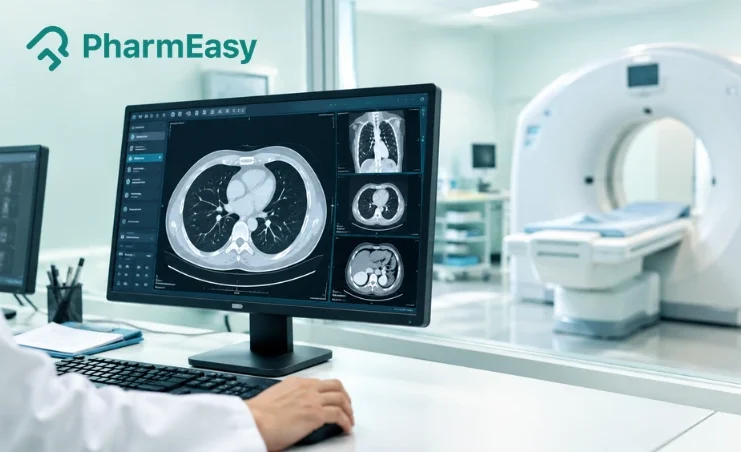
A CT scan is an imaging test that uses X-rays and computer technology to produce detailed, cross-sectional images of the inside of your body. Unlike a regular X-ray, which gives a single flat picture, a CT scan captures several images from different angles. A computer then combines these images to show detailed views of your organs, tissues, and other body structures. These images can be reconstructed to 3D images later, if needed.
In some cases, doctors may use a contrast dye or material to make certain organs, blood vessels or unusual areas easier to see. Depending on the part of the body to be examined, the contrast may be given orally or through a vein. CT scans are commonly used to detect internal bleeding, infections, etc1.
Yes, a CT scan can help doctors detect cancer by showing unusual changes inside the body. It can show abnormal growths, masses or tumours that may not be visible on a regular X-ray. CT images can also show the size, shape and location of a suspicious area, helping doctors understand where the abnormality is located2.
CT scans can examine different parts of the body, including the chest, abdomen, and pelvis. They may also help doctors check whether a tumour has affected nearby blood vessels or tissues, involved nearby lymph nodes, or metastasised (spread) to other areas or organs2,3. However, getting an abnormal finding on a CT scan does not always mean it is cancer. Doctors may need other tests to determine the cause of the abnormality4.
A CT scan can help identify different types of cancer, such as:
Note: A CT scan can help doctors spot areas that may need further checking, but it cannot always confirm whether a growth or abnormal area is cancer. Depending on the findings, doctors may recommend other tests, such as an MRI, a PET scan, blood tests, or a biopsy, to make an accurate diagnosis.
Although CT scans are useful for detecting many cancers, they may not always provide clear results for every type of cancer. They can be less effective in certain situations, such as:
There is no single accuracy percentage for every CT scan. Its ability to detect cancer depends on several factors, including the type and stage of cancer, tumour size, location, scan quality and whether contrast dye is used1,10,17. Very small cancers may be difficult to identify, while larger or more developed tumours may be easier to detect10. The use of contrast material can also improve the visibility of abnormalities in certain organs1.
A CT scan alone usually cannot confirm that an abnormal area is cancerous. Depending on the findings, a doctor may recommend additional tests such as an MRI, PET scan, blood tests, or a biopsy. These added tests can provide more information and, in the case of a biopsy, help confirm the diagnosis by examining cells or tissue under a microscope18.
CT scans offer valuable information, but they also have some limitations which you should know about:
Getting ready for a CT scan depends on the area being examined and whether contrast material will be used. Your doctor or scanning centre may give you instructions based on the type of scan you are having.
Note: You might hear certain sounds during the scan, which is totally normal and shouldn’t be worried about. The procedure is usually painless. You can drink more fluid in case you were subjected to any dyes during the procedure, to flush them out.
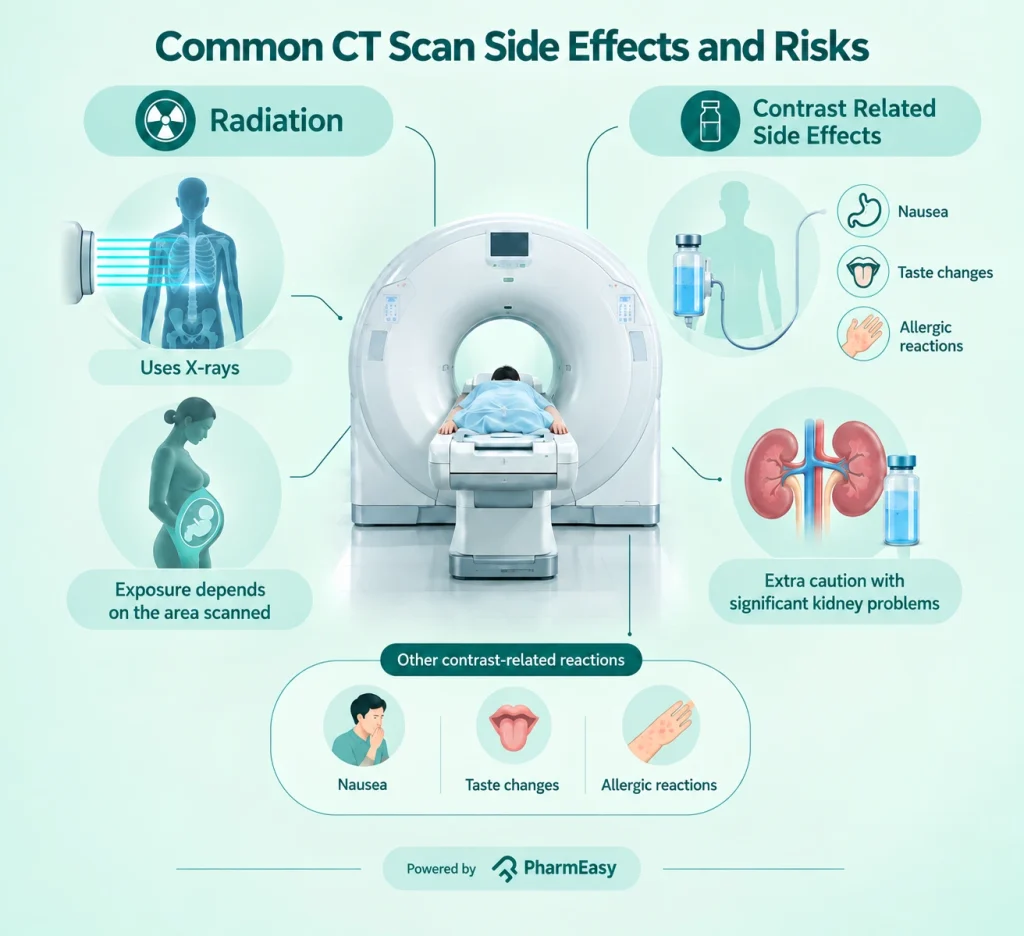
Most people tolerate CT scans well. However, some possible risks or side effects that should be considered include the following:
A CT scan can be an important tool for cancer detection. It offers the following advantages:
Also Read: Can Vitamin B12 Deficiency Be a Sign of Cancer?
A CT scan can show abnormal masses or growths and help assess their size and location. It can also help doctors check for lymph node involvement and determine whether cancer has metastasised to other organs. However, it cannot always confirm whether a growth is cancerous. Its ability to detect cancer depends on factors such as the cancer type, tumour size, location, and the person’s individual situation. Although CT scans provide detailed images, they have limitations, including radiation exposure and the possibility of inaccurate results. Your doctor may recommend additional tests and combine their results with the CT scan to confirm the diagnosis.
Yes, a CT scan can help identify colon or colorectal tumours and other abnormal growths. However, further evaluation, such as a standard colonoscopy, may be needed to examine the colon more closely and determine the appropriate diagnosis and treatment4.
Yes, a CT scan can help identify stomach tumours and show whether the cancer has affected nearby tissues, lymph nodes, or other parts of the body. However, additional tests, such as an endoscopy and biopsy, may be needed to confirm stomach cancer8.
CT scans are particularly useful for detecting cancers such as lung, liver, kidney, pancreatic, stomach and colorectal cancers because they can provide detailed images of these organs2,3,6,7,8.
A CT scan can show a suspicious mass, such as tumours or other changes that may suggest cancer, but it cannot always confirm cancer without examining tissue. A biopsy is often needed to determine whether the abnormal cells are cancerous and confirm a diagnosis4.
Yes, cancer can sometimes be present even when a CT scan looks normal. Some cancers or changes, especially very small lesions or changes in soft tissues, may be difficult to spot on a CT scan9,19.
Yes, a CT scan can show some tumours without contrast, but contrast may make certain cancers and abnormal areas easier to identify. The usefulness of a non-contrast CT depends on the type and location of the suspected cancer2.
1. Facts about computed tomography (CT) scans. CDC. 2026. Available from: https://www.cdc.gov/radiation-health/data-research/facts-stats/ct-scans.html
2. CT scan for cancer. American Cancer Society. 2026.Available from: https://www.cancer.org/cancer/diagnosis-staging/tests/imaging-tests/ct-scan-for-cancer.html
3. Tests for pancreatic cancer. American Cancer Society. 2024. Available from: https://www.cancer.org/cancer/types/pancreatic-cancer/detection-diagnosis-staging/how-diagnosed.html
4. Computed tomography (CT) scans and cancer. NCI. 2024. Available from: https://www.cancer.gov/about-cancer/diagnosis-staging/ct-scans-fact-sheet
5. Lung nodules (pulmonary nodules). American Lung Association. 2026. Available from: https://www.lung.org/lung-health-diseases/warning-signs-of-lung-disease/nodules
6. Liver cancer diagnosis. NCI. 2024. Available from: https://www.cancer.gov/types/liver/what-is-liver-cancer/diagnosis
7. Aganovic L, Cohan RH. Renal Tumors. In: Hodler J, Kubik-Huch RA, von Schulthess GK, eds. Diseases of the Abdomen and Pelvis 2018-2021: Diagnostic Imaging – IDKD Book. IDKD Springer Series. Springer; 2018. Available from: http://www.ncbi.nlm.nih.gov/books/NBK543811/
8. Tests for stomach cancer. American Cancer Society. 2026. Available from: https://www.cancer.org/cancer/types/stomach-cancer/detection-diagnosis-staging/how-diagnosed.html
9. Ovarian cancer early detection, diagnosis, and staging. American Cancer Society. 2026. Available from: https://www.cancer.org/cancer/types/ovarian-cancer/detection-diagnosis-staging.html
10. Khoroushi F, Moeini M, Jarahi L, Hassannejad E, Kharghani F, Moodi Ghalibaf A. Assessing the significance and progression of too small to characterize lesions in hepatic CT scans of patients with a cancer history: A two‐center cross‐sectional study. Health Sci Rep. 2025;8(3):e70374. doi:10.1002/hsr2.70374 https://pmc.ncbi.nlm.nih.gov/articles/PMC11872801/
11. Subhawong TK, Fishman EK, Swart JE, Carrino JA, Attar S, Fayad LM. Soft-tissue masses and masslike conditions: What does CT add to diagnosis and management? AJR Am J Roentgenol. 2010;194(6):1559-1567. doi:10.2214/AJR.09.3736 https://pubmed.ncbi.nlm.nih.gov/20489097/
12. ACR–ASNR–SPR Practice Parameter for the Performance of Computed Tomography (CT) of the Brain. Available from: https://www.asnr.org/wp-content/uploads/2019/06/CT-Brain_tomography.pdf
13. ASNR Neuroradiology Patient Information. Available from: https://www.asnr.org/patientinfo/conditions/brain_tumor.shtml
14. Zhao Z, Hu Y, Li J, Zhou Y, Zhang B, Deng S. Applications of PET in Diagnosis and Prognosis of Leukemia – PMC. doi:10.1177/1533033820956993 https://pmc.ncbi.nlm.nih.gov/articles/PMC7476341/
15. You X, Sun X, Yang C, Fang Y. CT diagnosis and differentiation of benign and malignant varieties of solitary fibrous tumor of the pleura. Medicine (Baltimore). 2017;96(49):e9058. doi:10.1097/MD.0000000000009058 https://pubmed.ncbi.nlm.nih.gov/29245313/
16. Snoeckx A, Dendooven A, Carp L, et al. Wolf in sheep’s clothing: primary lung cancer mimicking benign entities. Lung Cancer. 2017;112:109-117. doi:10.1016/j.lungcan.2017.07.037 https://research-repository.uwa.edu.au/en/publications/wolf-in-sheeps-clothing-primary-lung-cancer-mimicking-benign-enti/
17. Alhammami QS. Assessment of the diagnostic accuracy of CT as compared to MRI in detecting metastases in patients with colorectal cancer. Cureus. 16(8):e66125. doi:10.7759/cureus.66125 https://pubmed.ncbi.nlm.nih.gov/39229423/
18. How cancer is diagnosed. NCI. 2023. Available from: https://www.cancer.gov/about-cancer/diagnosis-staging/diagnosis
19. Rodríguez-Laval V, Lumbreras-Fernández B, Aguado-Bueno B, Gómez-León N. Imaging of multiple myeloma: Present and future. J Clin Med. 2024;13(1):264. doi:10.3390/jcm13010264 https://pubmed.ncbi.nlm.nih.gov/38202271/
20. Boujelb Z, Idrissi A, Benba A, Chakir EM. Motion detection for patient safety in CT scanner. Results in Engineering. 2025;25:103938. doi:10.1016/j.rineng.2025.103938 https://www.sciencedirect.com/science/article/pii/S259012302500026X
21. CT scans. MedlinePlus. 2026. Available from: https://medlineplus.gov/ctscans.html
22. Lowe S. Diagnostic imaging in pregnancy: Making informed decisions. Obstet Med. 2019;12(3):116-122. doi:10.1177/1753495X19838658 https://pubmed.ncbi.nlm.nih.gov/31523267/
Disclaimer: The information provided here is for educational/awareness purposes only and is not intended to be a substitute for medical treatment by a healthcare professional and should not be relied upon to diagnose or treat any medical condition. The reader should consult a registered medical practitioner to determine the appropriateness of the information and before consuming any medication. PharmEasy does not provide any guarantee or warranty (express or implied) regarding the accuracy, adequacy, completeness, legality, reliability or usefulness of the information; and disclaims any liability arising thereof.
Links and product recommendations in the information provided here are advertisements of third-party products available on the website. PharmEasy does not make any representation on the accuracy or suitability of such products/services. Advertisements do not influence the editorial decisions or content. The information in this blog is subject to change without notice. The authors and administrators reserve the right to modify, add, or remove content without notification. It is your responsibility to review this disclaimer regularly for any changes.


Comments

Leave your comment...
You may also like
























Comments