




Itching During Pregnancy: Causes, Symptoms, Treatment and More
By Dr. Charmi Shah +2 more

Medically reviewed by Dr. Charmi Shah
Last updated: Sep 29, 2026 Published on: Sep 29, 2026


Get,

to manage your symptom
Get your,

4 Cr+ families
benefitted

OTP sent to 9988776655



You’ve successfully subscribed to receive
doctor-approved tips on
Whatsapp

Get ready to feel your best.


Register to Avail the Offer
Send OTPBy continuing, you agree with our Privacy Policy and Terms and Conditions
Hi There,
Sign up on PharmEasy now!!


Trusted by 4 crore+ families

OTP sent to 9988776655
You have unlocked 25% off on medicines


Code: NU25

By Dr. Charmi Shah +2 more
Table of Contents
Pregnancy brings many changes to your body. This includes changes to your skin. In fact, more than 90% of pregnant women experience one or more skin changes during pregnancy. Itching (also known as pruritus) is common during this phase. It affects about 23% to 38% of women during pregnancy1.
While mild itching is common during pregnancy, you may need to see a doctor for persistent or severe itching. In this blog, we will explore the common causes of itching in pregnancy, the symptoms to watch for, and how to control itching during pregnancy.

During pregnancy, you may often have the urge to scratch your belly or other parts of the body2,3. This type of itching during pregnancy is very common. It usually happens when your skin stretches around your growing baby3.
However, body itching during pregnancy can also be linked to hormonal changes, pre-existing skin conditions, or pregnancy-specific conditions like intrahepatic cholestasis of pregnancy (ICP)1. We will discuss these causes of itching in pregnancy in detail in the next section.
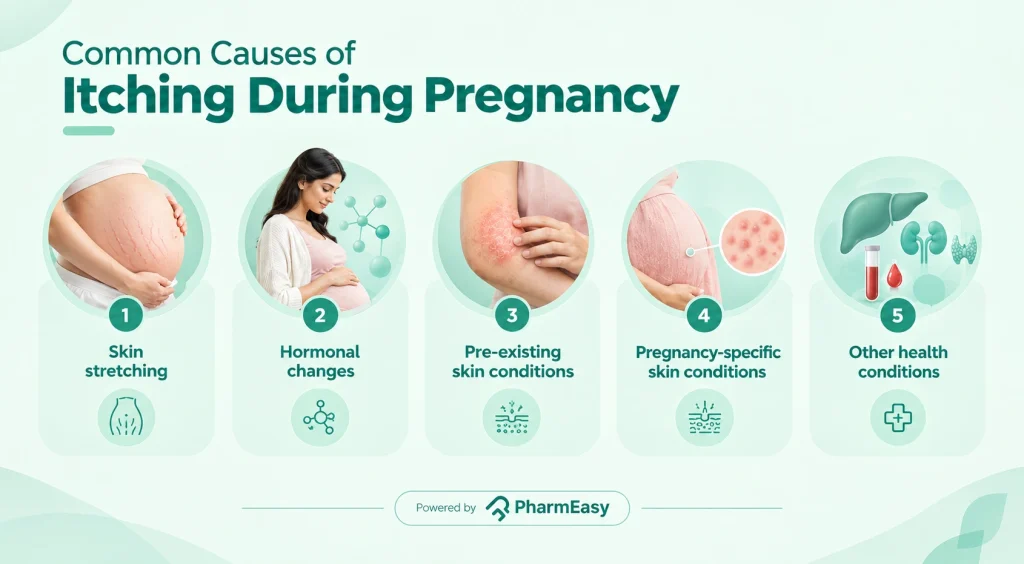
Itching during pregnancy can have several causes. Some common causes of itching in pregnancy include1:
You may notice itching in whole body during pregnancy, or itching on different parts of your body. The intensity and frequency of wanting to itch may vary from person to person. Some common symptoms include1:
Important: Severe or ongoing itching without a rash should not be considered a normal part of pregnancy. Talk to your doctor, as it may need further evaluation.
Some other conditions common in pregnancy may also lead to itching in specific areas, such as4:
Certain factors may make itching during pregnancy worse, including:
Generally, most cases of itching during pregnancy are not harmful. However, some pregnancy-specific conditions that cause itching may affect your health or your baby’s health. These include1,4:
Note: Any possible complications depend on the underlying cause of the itching. This is why you should always consult a doctor for persistent or severe itching during pregnancy.
Your doctor will first examine your skin and ask about your symptoms. This may include where the itching occurs, when it started, and what makes it better or worse. They may also check your skin for any rash or any other changes. And if needed, a skin biopsy (a small sample of skin examined under a microscope) may be done to identify the cause of an itchy rash1,4.
Depending on your symptoms and the suspected cause, blood tests (such as liver function tests, complete blood count, basic metabolic panel, thyroid-stimulating hormone, etc.) may be needed. If ICP is suspected, your doctor may recommend blood tests such as serum bile acid levels1. It may also be repeated if itching continues to persist.
Management depends on the cause and severity of itching. The main goals are to relieve itching, protect the skin, and manage any underlying condition. Itching in pregnancy treatment/management options may include:
Important: Consult your doctor first regarding how to control itching during pregnancy. Do not start any medicine, including creams or antihistamines, during pregnancy without consulting your doctor.
Also Read: Your Best Guide on How to Increase Haemoglobin Naturally During Pregnancy
You may not be able to prevent all itching during pregnancy, but some simple measures can help reduce irritation and keep your skin comfortable. A few itching during pregnancy home remedies include:
Itching during pregnancy is often mild and harmless, but you should speak to your doctor if:
Also Read: High Alkaline Phosphatase (ALP) in Pregnancy: Causes, Symptoms, Diagnosis and Treatment
Itching is a common part of pregnancy and is often caused by normal changes in your body, such as skin stretching and hormonal changes. You can easily manage mild cases with simple measures such as keeping your skin moisturised, avoiding heat and skin irritants, and wearing loose, comfortable clothing.
However, severe or persistent itching, particularly without a rash or on the palms and soles, should not be ignored. If you are concerned about your symptoms, speak to your doctor for appropriate evaluation and treatment.
Itching may occur at any stage of pregnancy. Mild itching may develop during the months when your skin stretches, and your body undergoes hormonal changes1. However, ICP is more common in the late second and third trimesters9. Therefore, any persistent or severe itching should be checked by your doctor.
Coconut oil may help moisturise dry skin and provide temporary relief from mild itching10. However, it does not treat the underlying cause of itching, so speak to your doctor if the itching is severe or persistent.
Breast itching during pregnancy may be observed. This happens as the breasts also grow and the skin stretches11.
Normal leukorrhea (increased vaginal discharge during pregnancy) does not usually cause itching. If the discharge is accompanied by itching, an unusual smell, or a change in colour or consistency, it may indicate an infection and should be checked by your doctor12.
1. Carlson K, Khan MA. Pruritus in Pregnancy. StatPearls Publishing; 2026. Accessed September 14, 2026. http://www.ncbi.nlm.nih.gov/books/NBK560820/
2. Itching. Medline. Accessed September 14, 2026. https://medlineplus.gov/ency/article/003217.htm
3. Itching in pregnancy. NHA. December 8, 2020. Accessed September 14, 2026. https://www.nhs.uk/pregnancy/complications/itching-and-intrahepatic-cholestasis/
4. Itching during pregnancy. Pregnancy, Birth and Baby. Accessed September 14, 2026. https://www.pregnancybirthbaby.org.au/pregnancy/health-conditions-and-complications/itching-during-pregnancy
5. Tarikci N, Kocatürk E, Güngör Ş, Oğuz Topal I, Ülkümen Can P, Singer R. Pruritus in Systemic Diseases: A Review of Etiological Factors and New Treatment Modalities. Sci World J. 2015;2015:803752. doi:10.1155/2015/803752 https://onlinelibrary.wiley.com/doi/full/10.1155/2015/803752
6. Nowak D, Yeung J. Diagnosis and treatment of pruritus. Can Fam Physician. 2017;63(12):918-924. Accessed September 14, 2026. https://pmc.ncbi.nlm.nih.gov/articles/PMC5729138/
7. Itching and Intrahepatic Cholestasis of Pregnancy. Tommy’s. Accessed September 14, 2026. https://www.tommys.org/pregnancy-information/pregnancy-symptom-checker/itching-pregnancy
8. Intrahepatic Cholestasis of Pregnancy (ICP). Tommy’s. Accessed September 23, 2026. https://www.tommys.org/pregnancy-information/pregnancy-complications/obstetric-cholestasis
9. Crites K, Shanks AL, Maines J. Pregnancy Intrahepatic Cholestasis. StatPearls Publishing; 2026. Accessed September 23, 2026. http://www.ncbi.nlm.nih.gov/books/NBK551503/
10. Varma SR, Sivaprakasam TO, Arumugam I, et al. In vitro anti-inflammatory and skin protective properties of Virgin coconut oil. J Tradit Complement Med. 2018;9(1):5-14. doi:10.1016/j.jtcme.2017.06.012 https://pubmed.ncbi.nlm.nih.gov/30671361/
11. Gupta SN, Madke B, Ganjre S, Jawade S, Kondalkar A. Cutaneous Changes During Pregnancy: A Comprehensive Review. Cureus. 16(9):e69986. doi:10.7759/cureus.69986 https://pubmed.ncbi.nlm.nih.gov/39445254/
12. Vaginal discharge. NHS. December 3, 2020. Accessed September 14, 2026. https://www.nhs.uk/pregnancy/common-symptoms/vaginal-discharge/
13. Dry skin: Signs and symptoms. AAD. Accessed September 14, 2026. https://www.aad.org/public/diseases/a-z/dry-skin-symptoms
14. Seol JE, Cho GJ, Jang SH, et al. Effect of Amount of Daily Water Intake and Use of Moisturizer on Skin Barrier Function in Healthy Female Participants. Ann Dermatol. 2024;36(3):145-150. doi:10.5021/ad.23.067 https://pubmed.ncbi.nlm.nih.gov/38816975/
Disclaimer: The information provided here is for educational/awareness purposes only and is not intended to be a substitute for medical treatment by a healthcare professional and should not be relied upon to diagnose or treat any medical condition. The reader should consult a registered medical practitioner to determine the appropriateness of the information and before consuming any medication. PharmEasy does not provide any guarantee or warranty (express or implied) regarding the accuracy, adequacy, completeness, legality, reliability or usefulness of the information; and disclaims any liability arising thereof.
Links and product recommendations in the information provided here are advertisements of third-party products available on the website. PharmEasy does not make any representation on the accuracy or suitability of such products/services. Advertisements do not influence the editorial decisions or content. The information in this blog is subject to change without notice. The authors and administrators reserve the right to modify, add, or remove content without notification. It is your responsibility to review this disclaimer regularly for any changes.
 1
1 
Comments

Leave your comment...
You may also like


















Comments