




Vaginal Cancer: Symptoms, Causes, Types, Diagnosis and Treatment
By Dr. Charmi Shah +2 more

Medically reviewed by Dr. Charmi Shah
Last updated: Sep 24, 2026 Published on: Sep 24, 2026


Get,

to manage your symptom
Get your,

4 Cr+ families
benefitted

OTP sent to 9988776655



You’ve successfully subscribed to receive
doctor-approved tips on
Whatsapp

Get ready to feel your best.


Register to Avail the Offer
Send OTPBy continuing, you agree with our Privacy Policy and Terms and Conditions
Hi There,
Sign up on PharmEasy now!!


Trusted by 4 crore+ families

OTP sent to 9988776655
You have unlocked 25% off on medicines


Code: NU25

By Dr. Charmi Shah +2 more
Table of Contents
Vaginal cancer refers to cancer that starts in the cells of the vagina1. It contributes to 1%-2% of all cancers affecting the female reproductive system and mostly affects women in their later life2.
Vaginal cancer often does not show any symptoms in its early stages. However, an awareness of its signs and symptoms and adopting certain preventive measures can help in early detection and thereby curing the disease3. In this blog, we will cover what vaginal cancer is, its types, causes, signs and symptoms, and treatment.

Vagina is a part of the female reproductive system that connects the cervix (opening of the uterus) to the outside of the body1. Vaginal cancer is a rare form of cancer that develops in the vagina and more commonly seen with advancing age. It may cause abnormal vaginal bleeding or discharge, a lump in the vagina, pelvic pain, or pain during sex4.
Vaginal cancer can be primary, meaning that the cancer starts in the cells of the vagina, or secondary (metastatic), meaning that cancer that started in another part of the body has spread to the vagina5.
Vaginal cancer is included under gynaecologic cancers along with cervical, ovarian, uterine and vulvar cancers. The name of cancer is determined by the organ the cancer has developed from. Cervical cancer develops from the cervix, which is the opening of the uterus; ovarian cancer from the ovaries, which are situated on each side of the uterus; uterine cancer from the uterus; and vulvar cancer from the vulva, which is the outer part of the female sex organs6.
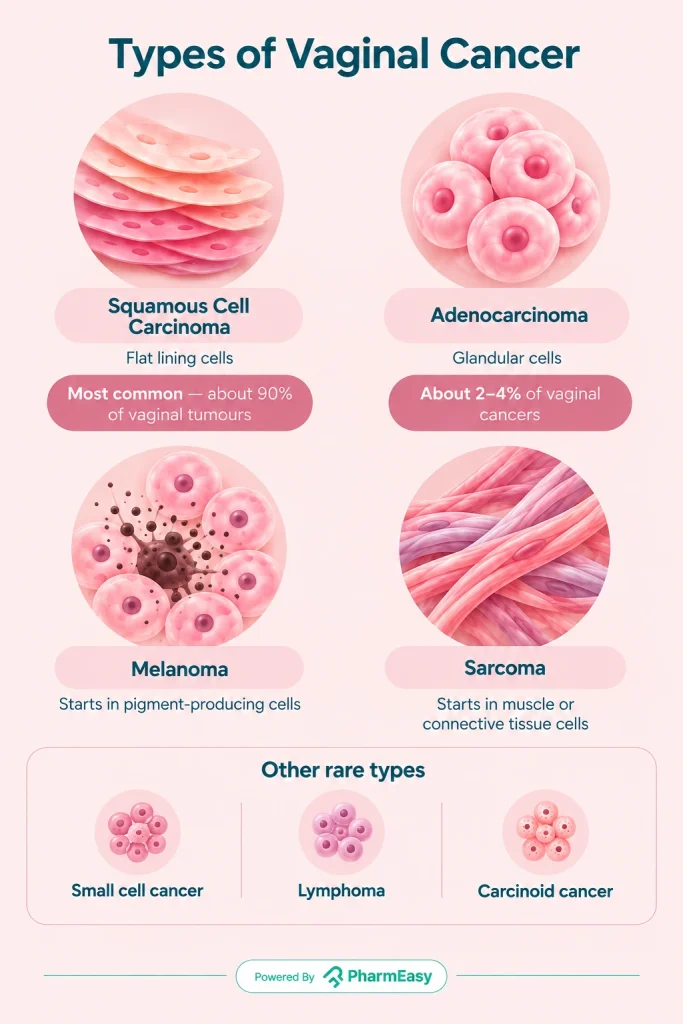
Vaginal cancers are divided into mainly four types based on the type of cells from which they originate and can be7:
In addition to these, there are some other types of vaginal cancers which are extremely rare. These include small cell cancer (oat cell cancer), vaginal lymphoma, and carcinoid cancer, which develop from different types of cells in and around the vagina8.
When vaginal cancer is in its early stages and only involves the cells of the vagina, signs and symptoms may not be seen.
Some signs and symptoms, if present in early stages, include9,10:
Vaginal cancer symptoms and signs may be more commonly observed once the cancer has spread. These include9:
Note: These signs and symptoms are not characteristic and might not point towards vaginal cancer in every situation. If you suspect any of these symptoms, please consult your doctor.
The causes of vaginal cancer can be certain infections or other environmental factors, which include2,4,11:
Long-term use of certain devices such as pessaries may cause chronic irritation and might be associated with a possible increased risk.
While the above-mentioned may not be the direct causes of vaginal cancer, they can act as cofactors which, when present along with other contributing factors, might induce/increase the risk of cancer development. People with these risk factors, along with an increased age might have a higher chance of getting cancer4.
Appearance of vaginal cancers can vary based on the type of cancer and the cells which are involved. Squamous cell carcinoma, being the most common, often present as small lumps or sores on the affected area. Verrucous type of vaginal cancer often presents as a wart (a small outgrowth visible on your skin). Some of the cancers, such as adenocarcinoma, might be difficult to recognise as they may be present deep inside the vaginal canal8. However, vaginal cancer cannot be diagnosed by its physical appearance alone. Instead, a correlation between the clinical symptoms along with the possible histories needs to be assessed by a doctor, and further diagnostic measures can only determine the condition.
Diagnosis of vaginal cancer initially consists of taking a personal and family history, followed by some of the procedures. These can be4,12:
Additional tests may be needed if cancer is confirmed. Please consult your doctor for the appropriate diagnostic tests for you.
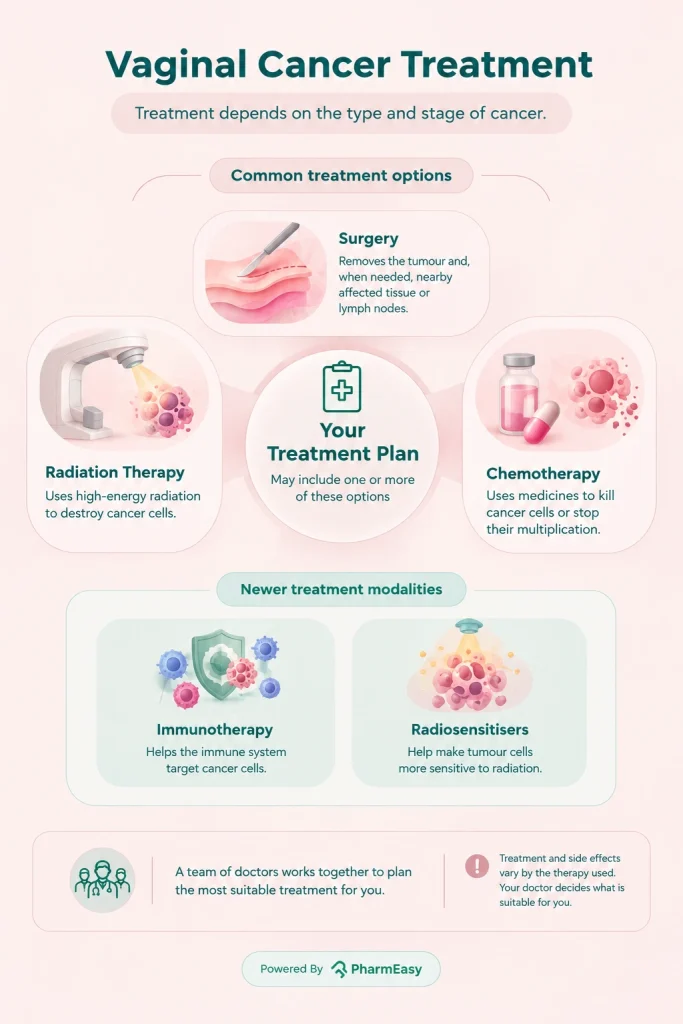
Management and treatment for vaginal cancer depends on the stage and type of cancer and may involve a combination of any of the options mentioned below. Common management options include12:
Note: Choosing any option over the other depends upon the type and stage of the cancer. A team of different doctors works together to plan the most suitable treatment plan for you.
Important: The vaginal cancer treatments might have some side effects and are determined by the type of treatment that is adopted. Only your doctor can decide which treatment is suitable for you based on your individualised health concerns.
While cancers are usually a combination of genetic and epigenetic factors, it may be difficult to prevent them all together. However, certain preventive measures taken early on may help in lowering the risk of vaginal cancer in some cases13. These are11,14:
Also Read: Ovarian Cancer: Symptoms, Causes, Types, Stages, and Treatment Options
Certain factors are involved in the higher chances of occurrence of vaginal cancer. Women with these factors are advised to consult their doctor to check for any associated symptoms and the need for further tests. These factors are14:
Though early stages of vaginal cancer do not show any symptoms, advanced stages might exhibit abnormal vaginal bleeding or discharges, painful episodes while peeing or during intercourse, constipation, and presence of blood in the stool or urine. The presence of any of these symptoms needs to be assessed by a doctor. However, these symptoms need not be present in every vaginal cancer case. Understanding your body can be helpful in identifying the changes that happen and thereby timely detection of whatever caused these symptoms. It need not be caused by cancer every time, and your doctor is the best person who can evaluate this.
A regular check-up with your doctor can also be beneficial in finding the early changes associated with it and thereby taking appropriate measures14.
Also Read: Does Anal Sex Increase the Risk of Colon Cancer?
Abnormal growth of cells in the vagina is termed vaginal cancer. Though it is a rare type of cancer, it can affect the quality of life of women, especially women in their older ages. Early symptoms might not be that pronounced in vaginal cancer; however, in advanced stages, certain symptoms can be seen. Understanding what is normal for your body and getting regular screenings done can help in detecting the changes earlier and taking appropriate measures faster.
No. Cervical cancer develops from the cervix, which is the opening of the uterus15. However, vaginal cancer starts from the vagina, which connects the cervix to the outside of the body1.
A regular check-up involving a pelvic examination by your doctor might help identify a vaginal cancer. Some of the symptoms linked with vaginal cancer are abnormal vaginal discharge or bleeding, the presence of blood in urine or stool, pain while peeing or during sex and constipation. However, these symptoms might not need to be present in every situation. Your doctor can identify if these symptoms can be linked to vaginal cancer and thereby help in adopting further measures14.
When vaginal cancers are detected early, they can be cured in certain cases. The treatments can include surgery, radiation therapies and chemotherapy1. Vaginal cancer recurrence can happen in some cases14.
Abnormal vaginal discharge or vaginal bleeding are seen in advanced cases of vaginal cancer. Along with these, the presence of blood in urine or stools, pain during sex or urinating and abnormal bowel movements can also happen. These symptoms can also be caused by other conditions. Only your doctor can evaluate the underlying causes for the specific symptoms14.
No. Abnormal vaginal bleeding can be associated with hormonal imbalances, the presence of fibroids or polyps in the uterus, infections or other reproductive disorders16. Abnormal vaginal bleeding along with other symptoms such as blood in urine or stools, pain during sex, and constipation can be linked with advanced cases of vaginal cancers14. Only your doctor can decide the underlying causes of bleeding.
Hysterectomy is the surgery for removing the uterus, including the cervix12. A previous history of hysterectomy for any benign lesions can also be considered a contributing factor in vaginal cancer occurrence2,12.
A vaginal biopsy is the removal of tissues from the vagina or cervix to examine under a microscope. It is beneficial in detecting any abnormal signs of cancer12. Some discomfort and slight bleeding can be expected during the procedure, and usually a numbing injection is given before the procedure. Some pain-relieving medicines can be considered if needed after discussing with your doctor.
1. Vaginal Cancer. Accessed August 25, 2026. https://medlineplus.gov/vaginalcancer.html
2. Merino MJ. Vaginal cancer: the role of infectious and environmental factors. Am J Obstet Gynecol. 1991;165(4 Pt 2):1255-1262. doi:10.1016/s0002-9378(12)90738-3 https://pubmed.ncbi.nlm.nih.gov/1659200/
3. Vaginal Cancer—Patient Version – NCI. Accessed August 25, 2026. https://www.cancer.gov/types/vaginal
4. Vaginal Cancer – StatPearls – NCBI Bookshelf. Accessed August 25, 2026. https://www.ncbi.nlm.nih.gov/books/NBK559126/
5. Adams TS, Maluleke JC, Cuello MA. Cancer of the vagina: 2025 update. Int J Gynecol Obstet. 2025;171(S1):48-59. doi:10.1002/ijgo.70325 https://pubmed.ncbi.nlm.nih.gov/40631450/
6. CDC. Gynecologic Cancers Basics. Gynecologic Cancers. February 3, 2025. Accessed August 26, 2026. https://www.cdc.gov/gynecologic-cancer/about/index.html
7. Loeser C. Vaginal Cancer | Foundation For Women’s Cancer. October 12, 2022. Accessed August 25, 2026. https://foundationforwomenscancer.org/gynecologic-cancers/gynecologic-cancer-types/vaginal-cancer/
8. Types of vaginal cancer. Accessed August 25, 2026. https://www.cancerresearchuk.org/about-cancer/vaginal-cancer/types-grades
9. Signs and Symptoms of Vaginal Cancer. Accessed August 25, 2026. https://www.cancer.org/cancer/types/vaginal-cancer/detection-diagnosis-staging/signs-symptoms.html
10. Symptoms of vaginal cancer. nhs.uk. December 9, 2021. Accessed August 27, 2026. https://www.nhs.uk/conditions/vaginal-cancer/symptoms/
11. Causes of vaginal cancer. nhs.uk. December 9, 2021. Accessed August 31, 2026. https://www.nhs.uk/conditions/vaginal-cancer/causes/
12. Vaginal Cancer Treatment – NCI. February 10, 2026. Accessed August 25, 2026. https://www.cancer.gov/types/vaginal/patient/vaginal-treatment-pdq
13. Vaginal cancer | nidirect. December 17, 2018. Accessed August 25, 2026. https://www.nidirect.gov.uk/conditions/vaginal-cancer
14. Vaginal and vulvar cancers. https://www.govinfo.gov/content/pkg/GOVPUB-HE20_7000-PURL-LPS125355/pdf/GOVPUB-HE20_7000-PURL-LPS125355.pdf
15. Cervical cancer: MedlinePlus Medical Encyclopedia. Accessed August 26, 2026. https://medlineplus.gov/ency/article/000893.htm
16. Jeanmonod R, Skelly CL, Jenkins SM, Agresti D. Vaginal Bleeding. In: StatPearls. StatPearls Publishing; 2026. Accessed August 26, 2026. http://www.ncbi.nlm.nih.gov/books/NBK470230/
17. Biopsy of the Vulva or Vagina. North Tees and Hartlepool NHS Foundation Trust. August 6, 2026. Accessed August 26, 2026. https://www.nth.nhs.uk/resources/biopsy-of-the-vulva-or-vagina/
Disclaimer: The information provided here is for educational/awareness purposes only and is not intended to be a substitute for medical treatment by a healthcare professional and should not be relied upon to diagnose or treat any medical condition. The reader should consult a registered medical practitioner to determine the appropriateness of the information and before consuming any medication. PharmEasy does not provide any guarantee or warranty (express or implied) regarding the accuracy, adequacy, completeness, legality, reliability or usefulness of the information; and disclaims any liability arising thereof.
Links and product recommendations in the information provided here are advertisements of third-party products available on the website. PharmEasy does not make any representation on the accuracy or suitability of such products/services. Advertisements do not influence the editorial decisions or content. The information in this blog is subject to change without notice. The authors and administrators reserve the right to modify, add, or remove content without notification. It is your responsibility to review this disclaimer regularly for any changes.


Comments

Leave your comment...
You may also like

























Comments