




Does Anal Sex Increase the Risk of Colon Cancer?
By Dr. Swara Soumitra Pendse +2 more

Medically reviewed by Dr. Swara Soumitra Pendse
Last updated: Sep 8, 2026 Published on: Sep 8, 2026


Get,

to manage your symptom
Get your,

4 Cr+ families
benefitted

OTP sent to 9988776655



You’ve successfully subscribed to receive
doctor-approved tips on
Whatsapp

Get ready to feel your best.


Register to Avail the Offer
Send OTPBy continuing, you agree with our Privacy Policy and Terms and Conditions
Hi There,
Sign up on PharmEasy now!!


Trusted by 4 crore+ families

OTP sent to 9988776655
You have unlocked 25% off on medicines


Code: NU25

By Dr. Swara Soumitra Pendse +2 more
Table of Contents
Many people wonder if anal sex can lead to colon cancer. Currently, anal sex itself is not considered a direct cause of colon cancer1. However, certain infections from anal intercourse may affect the anal area and increase the risk of anal cancer2. In this article, we will discuss colon cancer, whether it is associated with anal sex, risk factors for colon cancer, symptoms that shouldn’t be ignored, and when to seek medical attention.

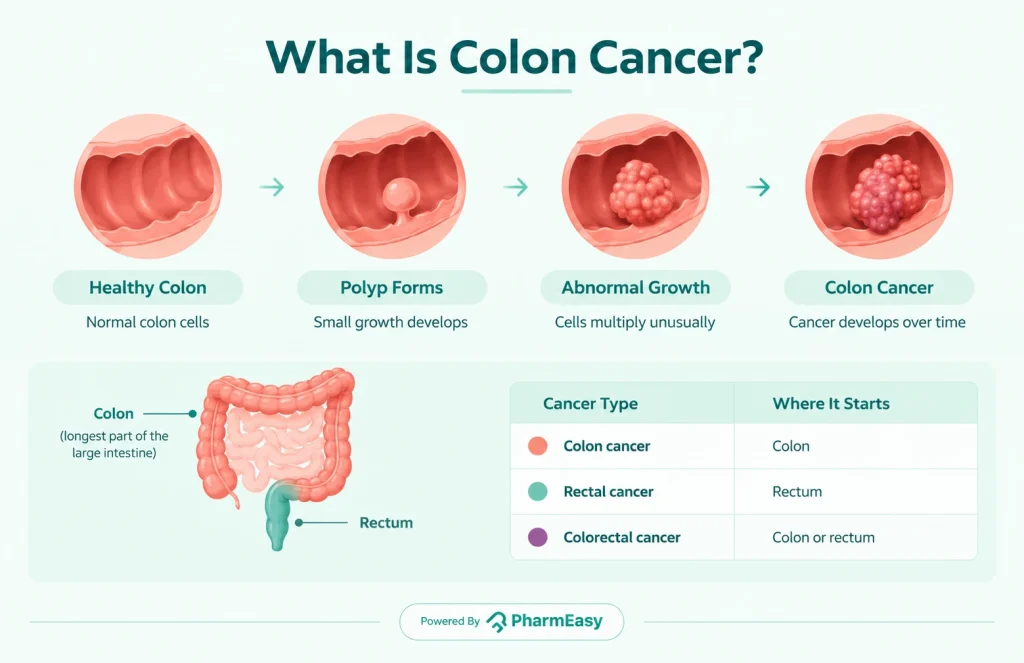
Colon cancer is a type of cancer that starts in the colon, which is the longest part of the large intestine. It usually begins when colon cells grow and divide unusually, forming a small growth called a polyp. Some polyps are harmless, while others may gradually develop into cancer over time. Colon cancer specifically affects the colon, while rectal cancer starts in the rectum, the final part of the large intestine. When cancer affects either the colon or rectum, it can be called colorectal cancer3.
Anal sex is not an established direct cause of colon cancer. Current evidence does not show that having anal sex causes cancer to develop in the colon1. Colon cancer usually develops because of changes in the cells of the colon and is influenced by factors such as age, family history, lifestyle, and certain medical conditions4. Therefore, anal sex should not be considered a direct cause of colon cancer.
Human papillomavirus (HPV) is a very common virus that can spread through intimate skin-to-skin contact, including sexual contact (vaginal, anal or oral sex)5. Some types of HPV can cause changes in cells that may eventually lead to cancer. HPV is strongly linked to anal cancer, which begins in the tissues around or inside the anus2.
However, anal cancer and colon cancer are different diseases because they develop in different parts of the digestive tract. A link between HPV and anal cancer does not mean that HPV or anal sex directly causes colon cancer1. Although some studies have found a possible link between HPV infection and colorectal cancer, more research is needed to confirm whether HPV directly contributes to its development6.
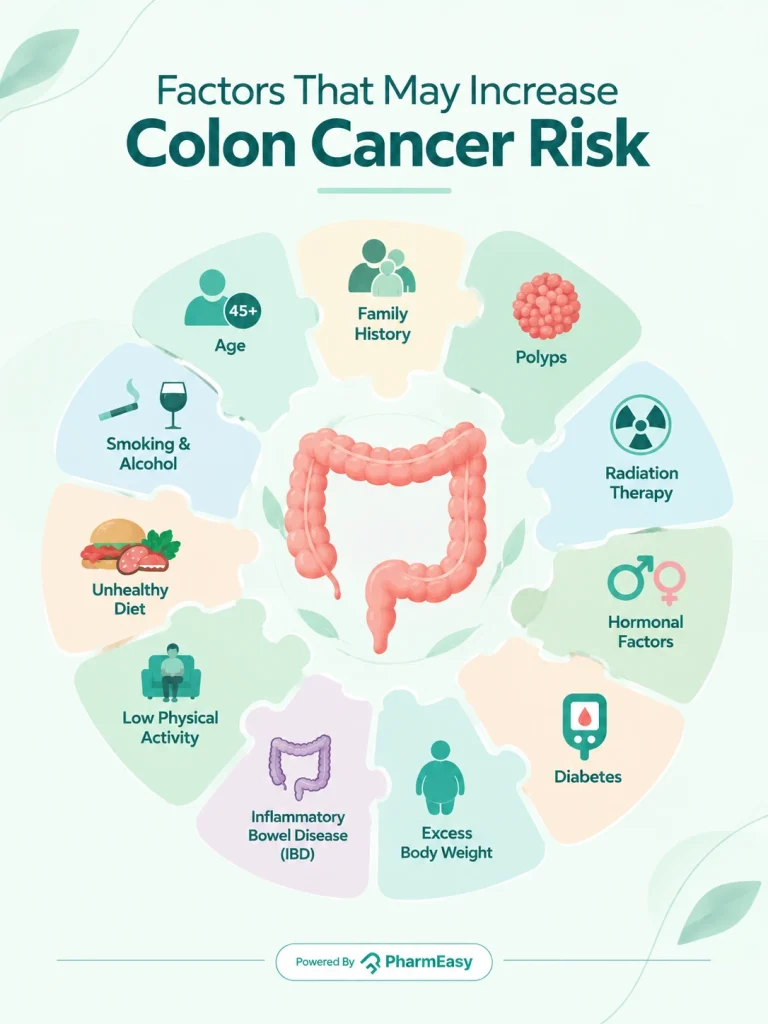
Several factors can increase the risk of colon cancer. These include:
Note: Having one or two risk factors doesn’t mean that you’ll get colon cancer, and one can get colon cancer even if one does not have a risk factor. It is important to consult a doctor if you are experiencing persistent symptoms of colon (or colorectal) cancer.
Also Read: Does Masturbating Increase Risk of Prostate Cancer or Vice Versa?
The risk of colon cancer may be reduced by following these tips:
Note: Although these tips may help reduce the risk of colon cancer, they cannot guarantee that you will not develop the disease. While some risk factors can be addressed, others, such as family history, cannot be changed.
Colon or related cancers can bring about many symptoms, which include common symptoms like:
See a doctor if you experience symptoms like blood in your stool, lasting changes in bowel habits, ongoing stomach discomfort, unexplained weight loss, or unusual tiredness9. Do not ignore repeated bleeding by assuming it is only due to haemorrhoids. Seek urgent care if you have heavy bleeding, severe abdominal pain, repeated vomiting, or difficulty passing stool or gas9,10. If you have a family history of colorectal cancer, previous high-risk polyps, IBD, or an inherited condition linked to colorectal cancer, speak with your doctor about the right screening schedule for you4,7.
Also Read: Is Bowel Leakage a Sign of Cancer?
Anal sex itself is not known to cause colon cancer. Although HPV can be linked to anal cancer, this does not mean that anal sex or HPV causes cancer in the colon. Factors such as age, family history, lifestyle, and certain health conditions can affect the risk of colon cancer. Knowing the warning signs and following recommended screening can help with early detection and timely treatment.
Anal sex does not necessarily cause bowel problems, but factors like the frequency of anal intercourse may affect the muscles that control bowel movements and increase the risk of stool incontinence or pain with intercourse. However, more research is needed to fully understand this association11.
No, colon cancer begins in the colon, which is the longest part of the large intestine, while anal cancer develops in the tissues of the anus, the opening through which stool leaves the body. Although both affect the lower digestive system, they are separate types of cancer3,12.
No, there is no way to guarantee the prevention of colon cancer. However, healthy lifestyle choices may help lower the risk and appropriate screening may help with early diagnosis and treatment of the cancer8.
Doctors may use different tests to check for colon cancer, depending on your symptoms and risk factors. These may include stool tests, blood tests, and a colonoscopy to look inside the colon. If an abnormal area is found, the doctor may take a small tissue sample, called a biopsy, to confirm whether cancer cells are present3.
Treatment can be effective, particularly if cancer is found at an early stage. Treatment options depend on factors such as the age, cancer stage and location, and overall health of the individual. Common treatment options include chemotherapy, radiation therapy, surgery, immunotherapy, and targeted therapy.
1. Diaz JA, Goldman R, Arellano N, Borkan J, Eaton CB. Brief report: Exploration of colorectal cancer risk perceptions among Latinos. J Immigr Minor Health. 2011;13(1):188-192. doi:10.1007/s10903-009-9312-1 https://pubmed.ncbi.nlm.nih.gov/20063065/
2. Anal cancer causes and risk factors. NCI. 2025. Available from: https://www.cancer.gov/types/anal/causes-risk-factors
3. Colorectal cancer. MedlinePlus. 2024. Available from: https://medlineplus.gov/colorectalcancer.html
4. Colorectal cancer risk factors. CDC. 2026. Available from: https://www.cdc.gov/colorectal-cancer/risk-factors/index.html
5. HPV and cancer. NCI. 2025. Accessed August 28, 2026. https://www.cancer.gov/about-cancer/causes-prevention/risk/infectious-agents/hpv-and-cancer
6. Hsu CH, Lin YJ, Chen YC, et al. Human Papillomavirus and Risk of Colorectal Cancer: An Analysis of Nationwide Claims Data. Medicina (Kaunas). 2022;58(10):1461. doi:10.3390/medicina58101461 https://pubmed.ncbi.nlm.nih.gov/36295621/
7. Colorectal cancer risk factors. American Cancer Society. 2025. Available from: https://www.cancer.org/cancer/types/colon-rectal-cancer/causes-risks-prevention/risk-factors.html
8. Can colorectal cancer be prevented? American Cancer Society. 2025. Available from: https://www.cancer.org/cancer/types/colon-rectal-cancer/causes-risks-prevention/prevention.html
9. Symptoms of colorectal cancer. CDC. 2026. Available from: https://www.cdc.gov/colorectal-cancer/symptoms/index.html
10. Songtanin B, Chu VM, Deb A, Islam S, Islam E, Nugent K. Vomiting and profound weight loss as a clue to the diagnosis of malignant coloduodenal fistula. Proc (Bayl Univ Med Cent). 2022;35(2):237-238. doi:10.1080/08998280.2021.2008220. https://pubmed.ncbi.nlm.nih.gov/35261464/
11. Chen AB, Kalichman L. Pelvic floor disorders due to anal sexual activity in men and women: A narrative review. Arch Sex Behav. 2024;53(10):4089-4098. doi:10.1007/s10508-024-02995-2 https://pubmed.ncbi.nlm.nih.gov/39287780/
12. Anal cancer. MedlinePlus. 2025. Available from: https://medlineplus.gov/analcancer.html
Disclaimer: The information provided here is for educational/awareness purposes only and is not intended to be a substitute for medical treatment by a healthcare professional and should not be relied upon to diagnose or treat any medical condition. The reader should consult a registered medical practitioner to determine the appropriateness of the information and before consuming any medication. PharmEasy does not provide any guarantee or warranty (express or implied) regarding the accuracy, adequacy, completeness, legality, reliability or usefulness of the information; and disclaims any liability arising thereof.
Links and product recommendations in the information provided here are advertisements of third-party products available on the website. PharmEasy does not make any representation on the accuracy or suitability of such products/services. Advertisements do not influence the editorial decisions or content. The information in this blog is subject to change without notice. The authors and administrators reserve the right to modify, add, or remove content without notification. It is your responsibility to review this disclaimer regularly for any changes.


Comments

Leave your comment...
You may also like




















Comments