




Anal Cancer: Symptoms, Causes, Types, Stages, Treatment and Prevention
By Dr. Swara Soumitra Pendse +2 more

Medically reviewed by Dr. Swara Soumitra Pendse
Last updated: Oct 16, 2026 Published on: Sep 28, 2026


Get,

to manage your symptom
Get your,

4 Cr+ families
benefitted

OTP sent to 9988776655



You’ve successfully subscribed to receive
doctor-approved tips on
Whatsapp

Get ready to feel your best.


Register to Avail the Offer
Send OTPBy continuing, you agree with our Privacy Policy and Terms and Conditions
Hi There,
Sign up on PharmEasy now!!


Trusted by 4 crore+ families

OTP sent to 9988776655
You have unlocked 25% off on medicines


Code: NU25


By Dr. Swara Soumitra Pendse +2 more
Table of Contents
Noticing rectal bleeding, persistent anal discomfort, or changes in your bowel habits can be concerning. However, these symptoms do not always mean that something is wrong, as they can have several causes. In some cases, though, they may point to a rare type of cancer, the anal cancer1.
This blog will discuss anal cancer in detail. It will cover the anal cancer symptoms, causes, types, stages, management options, and prevention of anal cancer.

Anal cancer is a type of cancer that develops in the tissues of the anus (which is the external opening through which stool is excreted from the body). The anus is located at the end of the digestive tract and connects to the rectum (the last part of the large intestine). It is surrounded by ring-like muscles called sphincters that help control the passage of stool2.
Anal cancer can develop in different types of cells in and around the anus. Most cases begin in the cells (mucosa) of the lining of the anal canal or the skin around the anus (perianal skin)2. The type and location of the cancer can help doctors determine an appropriate treatment plan.
Did You Know?
Anal cancer can be classified based on where it develops and the type of cells involved. The main types include6:
Anal cancer may not cause any noticeable symptoms in its early stages. When anal cancer symptoms do occur, they may include1,7:
Important: Many of these anal cancer symptoms can also occur with common conditions such as haemorrhoids (piles), fistulae or anal fissures7. Therefore, if you have any concerning symptoms, consult a doctor.
Anal cancer develops when changes in the DNA of cells in or around the anus cause them to grow and divide abnormally8. Although the exact anal cancer causes are not always known, most anal cancers are linked to infection with HPV9.
HPV is a common infection that can spread through skin-to-skin contact in the genital area and through sexual contact, including vaginal, anal, or oral sex. It can also be transmitted through sharing sex toys9. HPV may cause benign warts (non-cancerous growths on skin) in most individuals, but persistent infection with certain high-risk types (like types 16 and 18) can lead to cell changes that may eventually develop into anal cancer10.
Certain factors could increase a person’s risk of developing anal cancer. These include1,9:
If anal cancer is suspected based on symptoms or a physical examination, your doctor may recommend several tests to examine the anus and rectum. These tests help identify abnormal areas and confirm whether cancer is present. Common tests used to diagnose anal cancer include1,11:
The stage of anal cancer describes how large the tumour is and whether the cancer has spread to nearby lymph nodes, organs, or other parts of the body. Doctors usually use the following staging system to determine the stage, which is then classified from Stage 0 to Stage IV (mentioned below)12.
If you are wondering if anal cancer is curable, the answer depends on factors such as its stage, type, and response to treatment.
Depending on your overall health, your doctor may involve one or more approaches, such as surgery, radiation therapy, or chemotherapy. The main anal cancer treatment/management options include13:
Anal cancer can lead to complications, particularly when it is diagnosed at an advanced stage or spreads to nearby tissues or other parts of the body. Possible complications include14:
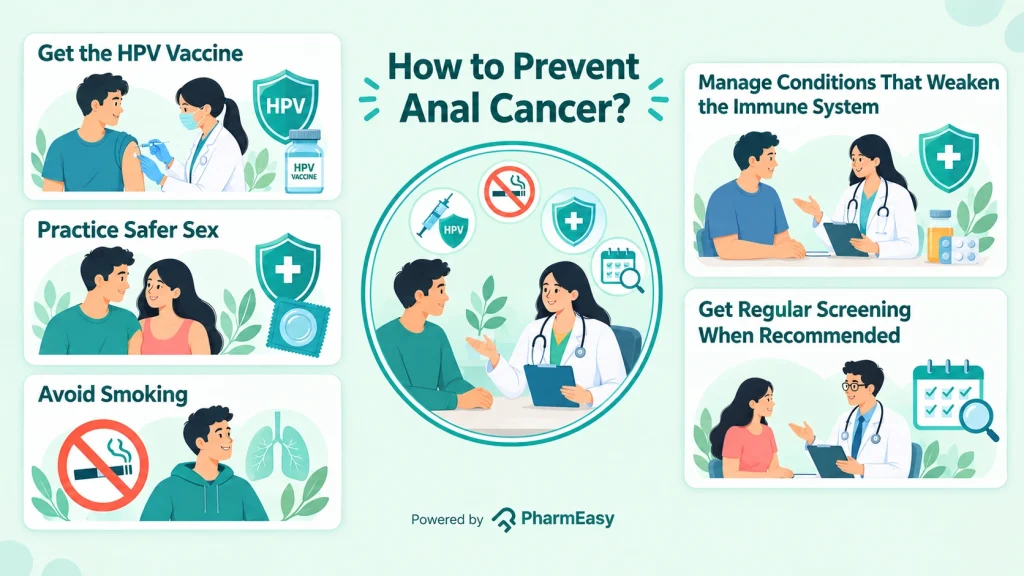
Anal cancer cannot always be prevented, but you can lower your risk with healthy lifestyle choices and HPV prevention. Common anal cancer prevention steps include1,9:
Also Read: Vaginal Cancer: Symptoms, Causes, Types, Diagnosis and Treatment
You should see a doctor if1,7:
Also Read: Prostate Cancer: Causes, Early Signs, Treatment Options & How to Lower Your Risk
Anal cancer is rare, but recognising its symptoms and understanding its risk factors can help with early detection and timely treatment. Since most cases are linked to high-risk HPV infection, HPV vaccination is an important preventive measure.
If you notice persistent bleeding, pain, itching, a lump, or other unusual changes around the anus, consult a doctor for evaluation. Anal cancer can often be managed effectively, especially when detected early, with appropriate diagnosis and treatment.
The growth rate of anal cancer varies from person to person and depends on factors such as the type and stage of the cancer. Therefore, regular evaluation can help detect changes and determine how quickly the cancer is progressing.
Surgery may not always be needed. Many anal cancers, particularly stages I to III, may be managed with a combination of surgery along with chemotherapy and radiation therapy. Surgery may be considered by your doctor for certain small tumours or when cancer remains or returns after other treatments13.
Whether anal cancer can be cured depends on factors such as its stage, type, and how well it responds to treatment. You should consult your doctor if you have been diagnosed with anal cancer to understand your management options and prognosis.
Anal cancer is relatively rare compared with many other cancers. In India, an estimated 5,168 cases were reported in 20225.
Anal cancer can cause pain or discomfort around the anus, but not everyone may experience pain. Other symptoms may include bleeding, itching, a lump, or changes in bowel habits1,7.
Anal cancer is not usually linked to inherited genetic factors. Most cases are associated with acquired risk factors, particularly persistent high-risk HPV infection3.
Yes, haemorrhoids (piles) can cause symptoms such as anal bleeding, itching, and discomfort that may also occur with anal cancer1,15. If symptoms are persistent, unusual, or worsening, it is important to see a doctor.
Yes, HPV can increase the risk of anal cancer even when anal warts are not present. High-risk HPV infections may cause abnormal cell changes without causing visible warts16.
There is no routine anal cancer screening test recommended for everyone. However, people at higher risk may be advised to undergo screening. This may include a digital rectal examination and, when needed, anoscopy or high-resolution anoscopy1.
1. Anal Cancer. Medline. Accessed August 28, 2026. https://medlineplus.gov/analcancer.html
2. What Is Anal Cancer? NCI. March 9, 2026. Accessed August 28, 2026. https://www.cancer.gov/types/anal/what-is-anal-cancer
3. Gondal TA, Chaudhary N, Bajwa H, Rauf A, Le D, Ahmed S. Anal Cancer: The Past, Present and Future. Curr Oncol. 2023;30(3):3232-3250. doi:10.3390/curroncol30030246. https://pubmed.ncbi.nlm.nih.gov/36975459/
4. Siegel R, Niklas Werner R, Koswig S, Gaskins M, Rödel C, Aigner F. Anal Cancer—Diagnosis, Treatment and Follow-Up. Dtsch Ärztebl Int. 2021;118(13):217-224. doi:10.3238/arztebl.m2021.0027. https://pmc.ncbi.nlm.nih.gov/articles/PMC8572542/
5. Sathishkumar K, Chaturvedi M, Das P, Stephen S, Mathur P. Cancer incidence estimates for 2022 & projection for 2025: Result from National Cancer Registry Programme, India. Indian J Med Res. 2022;156(4-5):598-607. doi:10.4103/ijmr.ijmr_1821_22. https://pubmed.ncbi.nlm.nih.gov/36510887/
6. Anal Cancer. American Cancer Society. Accessed August 28, 2026. https://www.cancer.org/cancer/types/anal-cancer.html
7. Symptoms of anal cancer. NHS. March 28, 2024. Accessed August 28, 2026. https://www.nhs.uk/conditions/anal-cancer/symptoms/
8. Causes & Risk Factors. NCI. March 9, 2026. Accessed August 28, 2026. https://www.cancer.gov/types/anal/causes-risk-factors
9. Causes of anal cancer. NHS. March 28, 2024. Accessed August 28, 2026. https://www.nhs.uk/conditions/anal-cancer/causes/
10. Ebrahimi F, Rasizadeh R, Jafari S, Baghi HB. Prevalence of HPV in anal cancer: exploring the role of infection and inflammation. Infect Agent Cancer. 2024;19:63. doi:10.1186/s13027-024-00624-0. https://pubmed.ncbi.nlm.nih.gov/39696546/
11. Diagnosis & Prognosis. NCI. March 19, 2026. Accessed August 28, 2026. https://www.cancer.gov/types/anal/diagnosis-prognosis
12. Stages of Anal Cancer. NCI. March 9, 2026. Accessed August 28, 2026. https://www.cancer.gov/types/anal/stages
13. Treatment for Anal Cancer. NCI. March 9, 2026. Accessed August 28, 2026. https://www.cancer.gov/types/anal/treatment
14. Ramos Santillan V, Kaur A, Menon G, Babiker HM, Cagir B. Anal Carcinoma. In: StatPearls. StatPearls Publishing; 2026. Accessed August 28, 2026. http://www.ncbi.nlm.nih.gov/books/NBK441891/
15. Piles (haemorrhoids). NHS. Accessed August 28, 2026. https://www.nhs.uk/conditions/piles-haemorrhoids/
16. Anal Cancer Causes, Risk Factors, and Prevention. American Cancer Society. Accessed August 28, 2026. https://www.cancer.org/cancer/types/anal-cancer/causes-risks-prevention.html
Disclaimer: The information provided here is for educational/awareness purposes only and is not intended to be a substitute for medical treatment by a healthcare professional and should not be relied upon to diagnose or treat any medical condition. The reader should consult a registered medical practitioner to determine the appropriateness of the information and before consuming any medication. PharmEasy does not provide any guarantee or warranty (express or implied) regarding the accuracy, adequacy, completeness, legality, reliability or usefulness of the information; and disclaims any liability arising thereof.
Links and product recommendations in the information provided here are advertisements of third-party products available on the website. PharmEasy does not make any representation on the accuracy or suitability of such products/services. Advertisements do not influence the editorial decisions or content. The information in this blog is subject to change without notice. The authors and administrators reserve the right to modify, add, or remove content without notification. It is your responsibility to review this disclaimer regularly for any changes.


Comments

Leave your comment...
You may also like






















Comments