




Tonsil Cancer: Symptoms, Causes, Stages, Diagnosis and Treatment
By Dr Partha Sohoni +2 more

Medically reviewed by Dr Partha Sohoni
Last updated: Sep 24, 2026 Published on: Sep 24, 2026


Get,

to manage your symptom
Get your,

4 Cr+ families
benefitted

OTP sent to 9988776655



You’ve successfully subscribed to receive
doctor-approved tips on
Whatsapp

Get ready to feel your best.


Register to Avail the Offer
Send OTPBy continuing, you agree with our Privacy Policy and Terms and Conditions
Hi There,
Sign up on PharmEasy now!!


Trusted by 4 crore+ families

OTP sent to 9988776655
You have unlocked 25% off on medicines


Code: NU25

By Dr Partha Sohoni +2 more
Table of Contents
Have you noticed a persistent sore throat, trouble swallowing, ear pain, a lump in your neck, or changes around your tonsils, and wondered if it could be tonsil cancer1,2? These symptoms may have many causes, but knowing the warning signs of cancer can help you understand when to seek medical advice. This blog explains tonsil cancer in simple terms, including its symptoms, causes, stages, and diagnosis. It also covers the available treatment options and what can be done to reduce the risk of tonsil cancer.
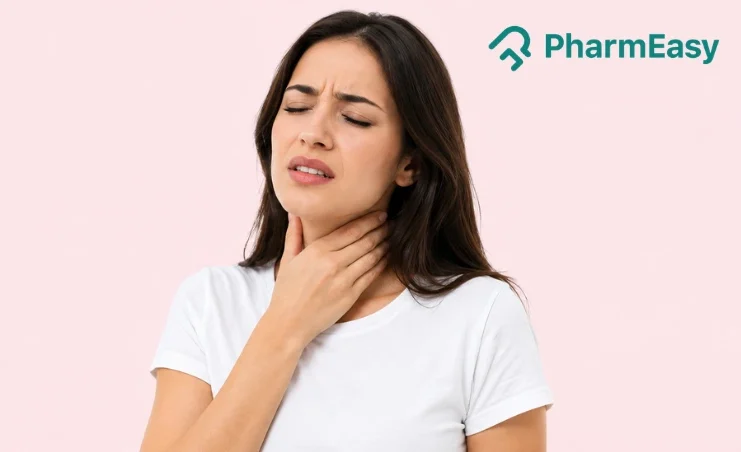
The tonsils are small areas of lymphoid tissue found at the back of the throat that play a role in the body’s defence against infections. Tonsil cancer develops when cells in the tonsils start multiplying abnormally and continue to grow without control, eventually forming a cancerous tumour3.
Did You Know?
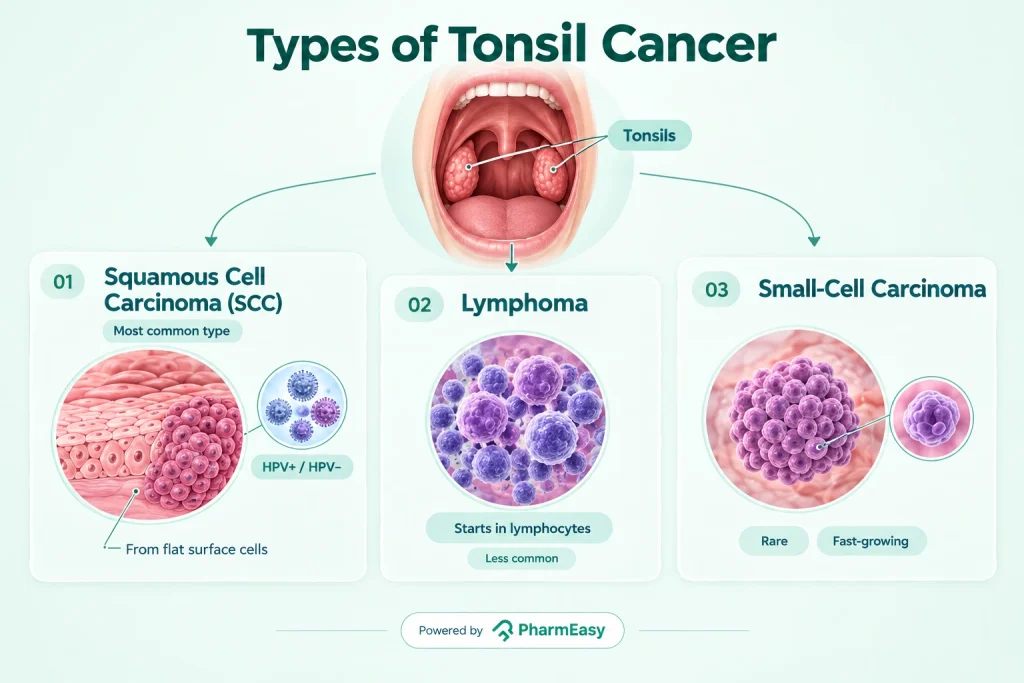
Tonsil cancer can develop from different types of cells found in or around the tonsils. The type of cancer depends on the cells in which the cancer starts. The common types of tonsil cancers include:
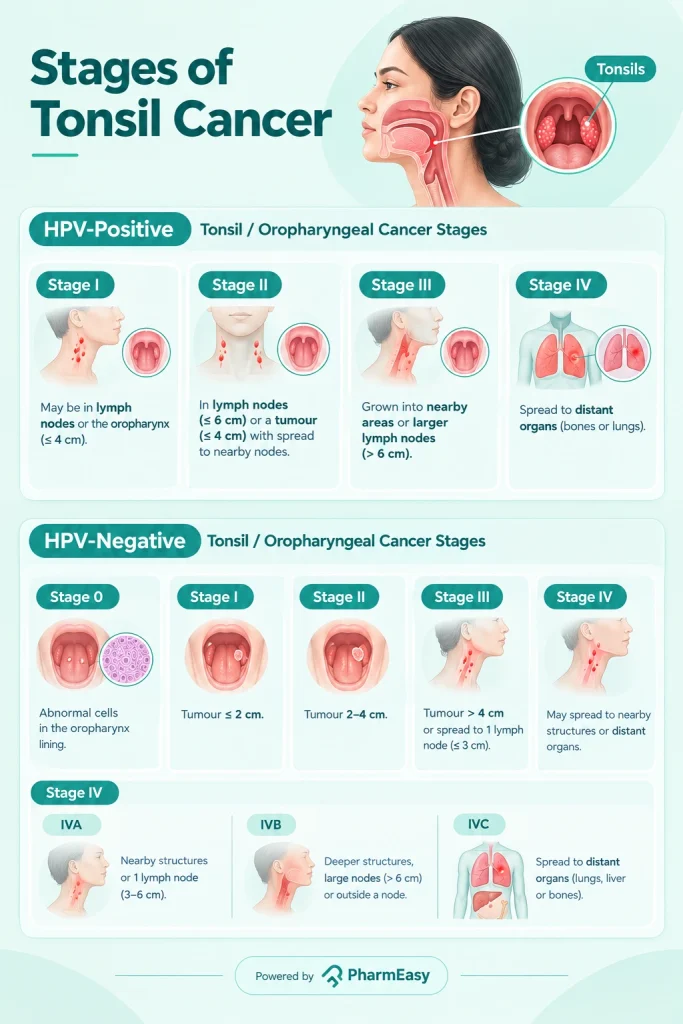
Tonsil cancer is staged as oropharyngeal cancer because the tonsils are located in the oropharynx. Doctors assess the tumour’s size, check whether nearby lymph nodes are involved, and look for any spread to distant parts of the body. The staging system also considers whether the cancer is HPV-related or HPV-negative, as this can affect the stage3.
Note: Tonsil cancer staging can vary based on HPV status and individual test results. Only an experienced doctor can confirm the exact stage and treatment plan.
The symptoms of tonsil cancer include:
Note: Some people may have no symptoms, and the cancer may be noticed when one tonsil looks larger than the other. However, having one or two of these symptoms doesn’t mean that you have tonsil cancer. Any doubts should always be cleared by a qualified doctor.
Tonsil cancer causes can vary between individuals. Some of the main causes include:
Certain factors can make a person more likely to develop tonsil cancer. The common risk factors of tonsil cancer include:
Note: Having one or two of these risk factors doesn’t necessarily cause tonsil cancer. People without any risk factors may also develop cancer. However, people with risk factors should always be cautious and try to reduce their risk.
Also Read: Early Signs of Mouth Cancer You Should Know
It’s very important to identify the early warning signs of tonsil cancer to avoid its complications. The common complications of tonsil cancer include:
Several checks may be needed to find out whether a person has tonsil cancer, such as:
Note: Depending on the findings, the doctor might recommend further tests to assess the patient’s overall health.
Also Read: Throat Cancer: Symptoms, Causes, Diagnosis & Treatment
Tonsil cancer treatment depends on factors such as the stage of cancer, tumour size, HPV status, overall health, and whether the cancer has spread. The most common treatment methods suggested by doctors include:
Note: Tonsil cancer can affect each person differently, so diagnosis and treatment should always be discussed with a qualified doctor. Not everyone will need all the treatments mentioned above. Depending on the individual condition, doctors may also combine different treatment approaches.
Although tonsil cancer cannot always be avoided, we can take certain measures to reduce its occurrence. Some of these measures include:
Note: Tonsil cancer cannot always be prevented, even when a person follows healthy habits. These measures may help reduce the risk, but they cannot guarantee that cancer will not occur. If you notice any persistent changes in your mouth or throat, speak with a qualified doctor for proper evaluation.
Consult a doctor in case of a persistent sore throat, swallowing problems, a lump in the neck, unexplained ear pain, unusual changes around the tonsil, bleeding from the mouth or throat, lasting voice changes, or unexplained weight loss1,2,3 Getting checked does not mean you have cancer. It simply helps determine whether further testing is needed and, if cancer is suspected or confirmed, can guide further diagnosis and treatment.
Also Read: How to Prevent Cancer: Effective Ways to Reduce Your Cancer Risk
A sore throat or swollen tonsils may usually be caused by some common conditions like an infection. However, symptoms that last for several weeks should not be ignored. See a doctor if you have ongoing symptoms like throat pain or swallowing problems, a lump in the neck, unexplained ear pain, and unusual changes around the tonsils. Seeing a doctor can help you with proper diagnosis, and treatment for the exact cause of your symptoms.
Tonsil cancer can be treated with surgery, radiotherapy, or chemotherapy depending on the stage and other factors. The chances of recovery can also vary depending on the individual’s HPV status and how advanced the cancer is1.
Tonsil cancer may appear as an unusual lump, sore, swelling, or unusual changes around the tonsil1,2, 3. However, these changes may also occur with common infections, so any unusual or persistent changes should be checked with a doctor.
Tonsil cancer is relatively less common than other types of cancer. It has been reported to occur in around 24%10. However, among oropharyngeal cancers, tonsil cancer is the most common type1.
Tonsil cancer is a type of throat cancer that develops in the tonsils, which are located at the back of the throat3. However, throat cancer is a broader term that includes cancers affecting different areas of the throat.
There is no clear evidence that vaping directly causes any type of cancer, but e-cigarette vapour can contain harmful chemicals that may damage cells. The long-term effects of vaping on cancer risk are still being studied11.
Yes, smoking can increase the risk of tonsil cancer1,3. Tobacco smoke contains harmful substances that can damage cells in the throat and contribute to cancer development.
Yes, certain types of HPV, such as HPV-16, can increase the risk of tonsil cancer1.
Tonsil cancer can occur in children, but it is very rare12. Most cases are diagnosed in adults; however, persistent or unusual symptoms in a child should be checked by a doctor.
Yes, a CT scan can help detect tonsil cancer by showing abnormal growths and whether the cancer has spread to nearby tissues or lymph nodes. However, a biopsy is usually needed to confirm the diagnosis1,3.
Tonsil cancer does not usually cause tonsil stones, as both are different conditions. Tonsil stones are tiny, hard lumps which form in the tiny pockets of the tonsils. These usually occur from poor hygiene or due to frequent tonsil infections13.
1. Williamson AJ, Mullangi S, Gajra A. Tonsil Cancer. In: StatPearls. StatPearls Publishing; 2023. Accessed September 2, 2026. https://www.ncbi.nlm.nih.gov/books/NBK537238/
2. Head and neck cancers – NCI. 2021. Accessed September 2, 2026. https://www.cancer.gov/types/head-and-neck/head-neck-fact-sheet
3. Tonsil cancer. Cancer Research UK. 2025. Accessed September 2, 2026. https://www.cancerresearchuk.org/about-cancer/head-neck-cancer/tonsil
4. Lymphoma. MedlinePlus. 2024. Accessed September 2, 2026. https://medlineplus.gov/lymphoma.html
5. Sen R, Bhutani N, Saini R, Jashanpreet. Primary small cell carcinoma of tonsil: An extreme rarity. Ann Med Surg (Lond). 2019;44:29-32. doi:10.1016/j.amsu.2019.06.010 https://pmc.ncbi.nlm.nih.gov/articles/PMC6598600/
6. Oropharyngeal cancer treatment. NCI. 2025. Accessed September 2, 2026. https://www.cancer.gov/types/head-and-neck/patient/adult/oropharyngeal-treatment-pdq
7. Assessment of the mutation profile of tonsillar squamous cell carcinomas using targeted next-generation sequencing. PMC. Accessed September 2, 2026. https://pmc.ncbi.nlm.nih.gov/articles/PMC10045642/
8. Throat or larynx cancer. MedlinePlus. 2025. Accessed September 2, 2026. https://medlineplus.gov/ency/article/001042.htm
9. HPV and oropharyngeal cancer. CDC. 2024. Accessed September 2, 2026. https://www.cdc.gov/cancer/hpv/oropharyngeal-cancer.html
10. Oral cavity, oropharynx, hypopharynx, & larynx cancer prevention. NCI. 2025. Accessed September 2, 2026. https://www.cancer.gov/types/head-and-neck/hp/oral-prevention-pdq
11. Is vaping harmful? Cancer Research UK. 2026. Accessed September 2, 2026. https://www.cancerresearchuk.org/about-cancer/causes-of-cancer/smoking-and-cancer/is-vaping-harmful
12. Adil EA, Medina G, Cunningham MJ. Pediatric tonsil cancer: A national and institutional perspective. J Pediatr. 2018;197:255-261.e1. doi:10.1016/j.jpeds.2018.01.022 https://pubmed.ncbi.nlm.nih.gov/29571929/
13. Tonsil stones – symptoms, treatments and causes. healthdirect. 2024. Accessed September 2, 2026. https://www.healthdirect.gov.au/tonsil-stones
Disclaimer: The information provided here is for educational/awareness purposes only and is not intended to be a substitute for medical treatment by a healthcare professional and should not be relied upon to diagnose or treat any medical condition. The reader should consult a registered medical practitioner to determine the appropriateness of the information and before consuming any medication. PharmEasy does not provide any guarantee or warranty (express or implied) regarding the accuracy, adequacy, completeness, legality, reliability or usefulness of the information; and disclaims any liability arising thereof.
Links and product recommendations in the information provided here are advertisements of third-party products available on the website. PharmEasy does not make any representation on the accuracy or suitability of such products/services. Advertisements do not influence the editorial decisions or content. The information in this blog is subject to change without notice. The authors and administrators reserve the right to modify, add, or remove content without notification. It is your responsibility to review this disclaimer regularly for any changes.


Comments

Leave your comment...
You may also like






















Comments