




Can Vitamin B12 Deficiency Be a Sign of Cancer?
By Dr. Vishesh Bharucha +2 more

Medically reviewed by Dr. Vishesh Bharucha
Last updated: Sep 21, 2026 Published on: Sep 21, 2026


Get,

to manage your symptom
Get your,

4 Cr+ families
benefitted

OTP sent to 9988776655



You’ve successfully subscribed to receive
doctor-approved tips on
Whatsapp

Get ready to feel your best.


Register to Avail the Offer
Send OTPBy continuing, you agree with our Privacy Policy and Terms and Conditions
Hi There,
Sign up on PharmEasy now!!


Trusted by 4 crore+ families

OTP sent to 9988776655
You have unlocked 25% off on medicines


Code: NU25

By Dr. Vishesh Bharucha +2 more
Table of Contents
Feeling unusually tired, weak, or experiencing numbness and tingling can sometimes be linked to vitamin B12 deficiency, a condition that occurs when the body does not get enough vitamin B12 or cannot absorb enough of it from the diet.
Vitamin B12 is a water-soluble vitamin that helps with red blood cell formation and maintenance of a healthy nervous system1.
This blog will explain what is vitamin B12 deficiency, its causes and symptoms, how it is diagnosed, vitamin B12 deficiency treatment guidelines, and how long recovery may take, which could help in making informed decisions and better recovery.
Vitamin B12, also known as cobalamin, is a vitamin that the body needs for several important functions. It is required for the development, myelination, insulation of the nerves, and normal neurological function of the central nervous system (which includes the brain and spinal cord). Vitamin B12 is also needed for the production of new red blood cells (erythropoiesis) and for DNA synthesis (an essential process involved in making and maintaining the body’s cells)2,3.
Vitamin B12 also acts as a cofactor for enzymes involved in important metabolic reactions in the body. When vitamin B12 deficiency occurs, it can cause ineffective erythropoiesis, megaloblastic anaemia, and neurological changes such as numbness, tingling in the hands and feet, etc. (discussed in detail in the symptom section). Hence, vitamin B12 is vital for normal nerve function, red blood cell formation, and DNA synthesis2.
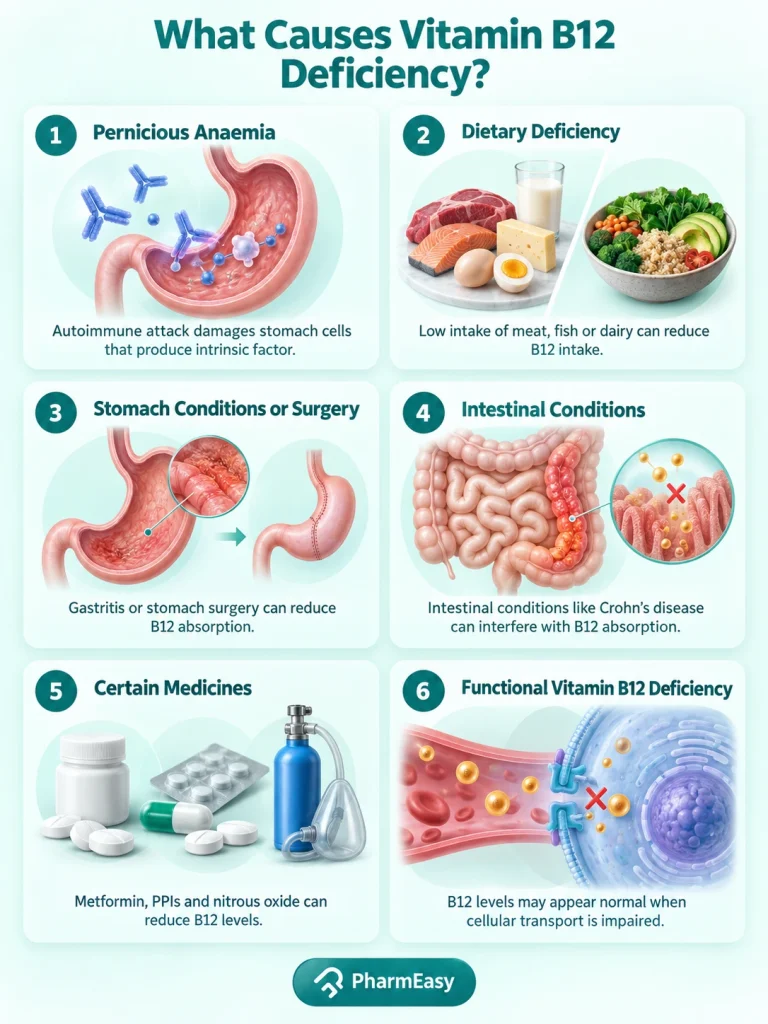
Vitamin B12 deficiency causes could be various, including not getting enough vitamin B12 from the diet, conditions affecting its absorption, certain medical conditions, and some medicines. Vitamin B12 deficiency causes include:
Vitamin B12 deficiency symptoms can include a wide range of problems that develop gradually but may worsen if the condition is left untreated. These may comprise of both, general body symptoms and problems affecting the brain and nervous system, such as:
Vitamin B12 levels show complex links to cancer risk, and the relationship between vitamin B12 status and cancer is not fully understood yet. Rather than identifying it as a specific sign of cancer, Vitamin B12 deficiency in cancer patients is a multifactorial issue. Cancers involving parts of the digestive system, including the stomach and terminal ileum, may lead to B12 deficiency because these areas are involved in vitamin B12 absorption8. Conversely, pernicious anaemia, that can cause Vitamin B12 deficiency, is associated with an increased risk of stomach cancers9.
Vitamin B12 may also occur as a result of cancer treatments as they can damage the cells of digestive system causing impairment in absorption. Treatment side effects such nausea, vomiting and loss of appetite may also affect dietary intake and lead to Vitamin B12 deficinecy8.
Thus, vitamin B12 deficiency in people with cancer may happen because of poor diet, stomach or intestinal surgery, problems absorbing vitamin B12, side effects of treatment, or other stomach or intestinal conditions, rather than the cancer itself.
Some medical conditions can cause symptoms like those seen with vitamin B12 deficiency, so doctors may consider them when evaluating a person with suspected vitamin B12 deficiency:
Vitamin B12 deficiency is diagnosed using a combination of symptoms, medical history, physical examination, and blood tests rather than relying on symptoms alone. The following tests are commonly used11.
Note: Any test results should be interpreted along with symptoms and other clinical findings. A normal vitamin B12 level or a negative antibody test does not always rule out vitamin B12 deficiency or pernicious anaemia. Consult a doctor if your symptoms persist even when your test results are normal.
Vitamin B12 deficiency treatment guidelines involve the following treatments based on the individual condition15,16:

People with significant blood related or neurological effects from vitamin B12 deficiency and very low levels may need vitamin B12 replacement by intramuscular injection. Talk to your doctor about the right dose and duration of treatment before starting any treatment.

For some people with vitamin B12 deficiency, oral vitamin B12 supplements may be needed. Generally, your doctor will prescribe at least 1 mg per day for a specific duration when supplements are given in certain situations involving malabsorption. You may need to get blood count checks after 1 to 2 months, with follow-up blood tests. However, you should always consult with your doctor for the exact dosage before starting any medication for the ideal treatment.

Vitamin B12 is found naturally in animal-based foods such as milk, cheese, yoghurt, and eggs. The dietary B12 deficiency occurs in people following a strict vegan diet.
Also Read: Top Vitamin B12 Foods to Include in Your Diet Today!

The cause of the deficiency should be investigated, including possible malabsorption, dietary deficiency, medicines, or pernicious anaemia, so that treatment can be appropriately selected.

People receiving oral vitamin B12 replacement should have their response checked with vitamin B12 testing after about 2 to 3 months, followed by further monitoring as advised.

People with conditions that cause ongoing B12 absorption problems, such as pernicious anaemia, may need long term or lifelong vitamin B12 injections.
Important: The type, dose, and duration of vitamin B12 treatment depend on the cause and severity of the deficiency and whether the body can absorb vitamin B12 properly. Only your doctor can recommend the most suitable treatment for you.
Recovery from vitamin B12 deficiency varies depending on its cause, severity and individual’s response to treatment. Failure to respond should first prompt assessment of adherence, adequacy of dose, diagnosis, ongoing malabsorption, continued exposure to a causative factor, and alternative diagnoses.
Follow-up blood tests may be done to check whether vitamin B12 levels and blood counts are improving. If symptoms or test results do not improve, the doctor may review the treatment, dose, vitamin B12 absorption, or other possible causes17.
People with severe deficiency or neurological symptoms may need vitamin B12 injections initially, followed by regular maintenance treatment. In some cases, long-term or lifelong treatment may be needed if the underlying cause continues17.
Note: The type and duration of treatment and the need for follow-up tests depend on the cause and severity of the deficiency as well as treatment response.
Also Read: 10 Foods to Include in Your Diet for Lowering Your Cancer Risk
You should see a doctor if you think you may have vitamin B12 deficiency, especially if you have symptoms such as extreme tiredness, lack of energy, pins and needles, a sore or red tongue, muscle weakness, vision problems, or changes in memory, understanding, or judgement. Prompt treatment is particularly important when vitamin B12 deficiency is accompanied by significant blood abnormalities or neurological symptoms.
People at higher risk, including strict vegans, people with pernicious anaemia, those taking certain long term medications that include proton pump inhibitors, biguanides, contraceptive pills, people with gastric conditions like coeliac disease or inflammatory bowel disease, and those who have had gastric surgery, should be cautious and evaluate regularly for this condition15.
It is important to seek medical evaluation because vitamin B12 deficiency can often be diagnosed with symptoms and a blood test, and treatment should begin as soon as possible for a better outcome. Although many symptoms improve with treatment, some problems caused by vitamin B12 deficiency, particularly nervous system problems, can sometimes be irreversible18.
Also Read: What Level of Eosinophils Indicates Cancer?
Recognising vitamin B12 deficiency early is important because prompt diagnosis and treatment can help prevent complications such as anaemia, nerve damage, and neuropsychiatric problems. Identifying the underlying cause is also important because different causes, such as dietary deficiency or problems with B12 absorption, may require different treatment approaches. Following the recommended treatment and continuing it when necessary, can help restore B12 levels and control symptoms. Seeking medical evaluation when symptoms are noticed can therefore help ensure timely diagnosis and appropriate management.
Vitamin B12 is naturally found in fish, meat, poultry, eggs, milk, and other dairy products. Plant foods do not naturally contain vitamin B12 unless they are fortified; fortified breakfast cereals and some nutritional yeast products provide B121.
Yes. Vitamin B12 deficiency can cause nerve related problems, including numbness or tingling in the arms and legs, weakness, and loss of balance1.
People who are treated promptly for vitamin B12 deficiency generally have a better treatment outcome, and neurological symptoms may partially improve after treatment. However, recovery can take months or even years, and the best response is seen in people without severe neurological problems11.
Vitamin B12 deficiency has been reported in association with certain cancers, particularly gastrointestinal cancers, that include cancers of the stomach, pancreas, and terminal ileum, where disease or treatment may interfere with vitamin B12 absorption8.
Yes. Vitamin B12 deficiency can occur in people undergoing cancer treatment, with the risk influenced by the type of cancer and its treatment, particularly when the digestive system or vitamin B12 absorption is affected8.
Yes, vitamin B12 deficiency is more common in older adults. Factors like higher incidence of atrophic gastric in elderly that impacts vitamin B12 absorption and poor nutrition may contribute. Treatment outcomes are also generally better in younger patients than in older individuals11,16.
Vitamin D and vitamin B12 levels may be related as some underlying conditions can lead to deficiencies of both. These include poor nutrition, malabsorption syndromes, atrophic gastritis or certain autoimmune diseases17. However, further evidence is needed to prove any direct link.
1. Vitamin B12. MedlinePlus. Accessed August 25, 2026. https://medlineplus.gov/ency/article/002403.htm
2. Office of Dietary Supplements – Vitamin B12. Accessed August 25, 2026. https://ods.od.nih.gov/factsheets/VitaminB12-HealthProfessional/
3. Vitamin B12. The Nutrition Source. June 4, 2019. Accessed August 25, 2026. https://nutritionsource.hsph.harvard.edu/vitamin-b12/
4. Vitamin B12 or folate deficiency anaemia – Causes. NHS. October 20, 2017. Accessed August 25, 2026. https://www.nhs.uk/conditions/vitamin-b12-or-folate-deficiency-anaemia/causes/
5. Taylor L, McCaddon A, Wolffenbuttel BHR. Creating a Framework for Treating Autoimmune Gastritis—The Case for Replacing Lost Acid. Nutrients. 2024;16(5):662. doi:10.3390/nu16050662 https://pubmed.ncbi.nlm.nih.gov/38474790/
6. Vitamin B12 or folate deficiency anaemia – Symptoms. NHS. October 20, 2017. Accessed August 25, 2026. https://www.nhs.uk/conditions/vitamin-b12-or-folate-deficiency-anaemia/symptoms/
7. Ata F, Bint I Bilal A, Javed S, et al. Optic neuropathy as a presenting feature of vitamin B-12 deficiency: A systematic review of literature and a case report. Ann Med Surg. 2020;60:316-322. doi:10.1016/j.amsu.2020.11.010 https://pmc.ncbi.nlm.nih.gov/articles/PMC7653199/
8. Osmola M, Tyszka M, Jirka A, et al. Vitamin B12 in Cancer Patients: Clinical Insights into Deficiency, Excess, Diagnosis, and Management. Nutrients. 2025;17(20):3272. doi:10.3390/nu17203272 https://pubmed.ncbi.nlm.nih.gov/41156524/
9. Evidence Review for Monitoring for Gastric Cancer in People with Vitamin B12 Deficiency Due to Autoimmune Gastritis: Vitamin B12 Deficiency in over 16s: Diagnosis and Management: Evidence Review G. National Institute for Health and Care Excellence (NICE); 2024. Accessed August 28, 2026. http://www.ncbi.nlm.nih.gov/books/NBK603289/
10. Halmo L, Nappe TM. Lead Toxicity. StatPearls Publishing; 2026. Accessed August 28, 2026. http://www.ncbi.nlm.nih.gov/books/NBK541097/
11. Ankar A, Kumar A. Vitamin B12 Deficiency. StatPearls Publishing; 2026. Accessed August 25, 2026. http://www.ncbi.nlm.nih.gov/books/NBK441923/
12. Tudor ME, Al Aboud AM, Leslie SW, Gossman W. Syphilis. StatPearls Publishing; 2026. Accessed August 28, 2026. http://www.ncbi.nlm.nih.gov/books/NBK534780/
13. Wuliji N, Mandell MJ, Lunt JM, Merando A. HIV-Associated Vacuolar Myelopathy and HIV-Associated Dementia as the Initial Manifestation of HIV/AIDS. Case Rep Infect Dis. 2019;2019:3842425. doi:10.1155/2019/3842425 https://onlinelibrary.wiley.com/doi/10.1155/2019/3842425
14. Sejersen K, Larsson AO. Longitudinal Trends and Analytical Consistency of Folate and Vitamin B12 Biomarkers: Two Decades of Population-Based Data and Diagnostic Implications. Biomedicines. 2026;14(1):140. doi:10.3390/biomedicines14010140 https://pubmed.ncbi.nlm.nih.gov/41595673/
15. Vitamin B12 – advice on investigation management. NHS. Accessed August 25, 2026. https://nhssomerset.nhs.uk/wp-content/uploads/sites/2/B12_-_advice_on_investigation_management.pdf
16. Sands T, Jawed A, Stevenson E, Smith M, Jawaid I. Vitamin B12 deficiency: NICE guideline summary. BMJ. Published online June 13, 2024:q1019. doi:10.1136/bmj.q1019 https://pubmed.ncbi.nlm.nih.gov/38871397/
17. Bedz D, Forsyth C. Vitamin B12 deficiency: testing and treatment. Aust Prescr. 49(2):55-60. doi:10.18773/austprescr.2026.012 https://pubmed.ncbi.nlm.nih.gov/42022258/
18. Vitamin B12 or folate deficiency anaemia. NHS. October 20, 2017. Accessed August 25, 2026. https://www.nhs.uk/conditions/vitamin-b12-or-folate-deficiency-anaemia/
Disclaimer: The information provided here is for educational/awareness purposes only and is not intended to be a substitute for medical treatment by a healthcare professional and should not be relied upon to diagnose or treat any medical condition. The reader should consult a registered medical practitioner to determine the appropriateness of the information and before consuming any medication. PharmEasy does not provide any guarantee or warranty (express or implied) regarding the accuracy, adequacy, completeness, legality, reliability or usefulness of the information; and disclaims any liability arising thereof.
Links and product recommendations in the information provided here are advertisements of third-party products available on the website. PharmEasy does not make any representation on the accuracy or suitability of such products/services. Advertisements do not influence the editorial decisions or content. The information in this blog is subject to change without notice. The authors and administrators reserve the right to modify, add, or remove content without notification. It is your responsibility to review this disclaimer regularly for any changes.


Comments

Leave your comment...
You may also like
























Comments