




What Level of Eosinophils Indicates Cancer?
By Dr. Vishesh Bharucha +2 more

Medically reviewed by Dr. Vishesh Bharucha
Last updated: Sep 29, 2026 Published on: Aug 28, 2026


Get,

to manage your symptom
Get your,

4 Cr+ families
benefitted

OTP sent to 9988776655



You’ve successfully subscribed to receive
doctor-approved tips on
Whatsapp

Get ready to feel your best.


Register to Avail the Offer
Send OTPBy continuing, you agree with our Privacy Policy and Terms and Conditions
Hi There,
Sign up on PharmEasy now!!


Trusted by 4 crore+ families

OTP sent to 9988776655
You have unlocked 25% off on medicines


Code: NU25

By Dr. Vishesh Bharucha +2 more
Table of Contents
Seeing a high eosinophil count on a blood test can feel worrying, especially if you are unsure what it means. A raised eosinophil count is not always dangerous, but it can be a clue that something else is happening in the body. Common causes include allergies, asthma, some infections, reactions to medicines, and, less often, certain cancers. Understanding what eosinophils do, what counts as a normal or high level, why levels can rise, how doctors investigate the cause, and when to seek medical care can help reduce unnecessary worry and support informed decisions.
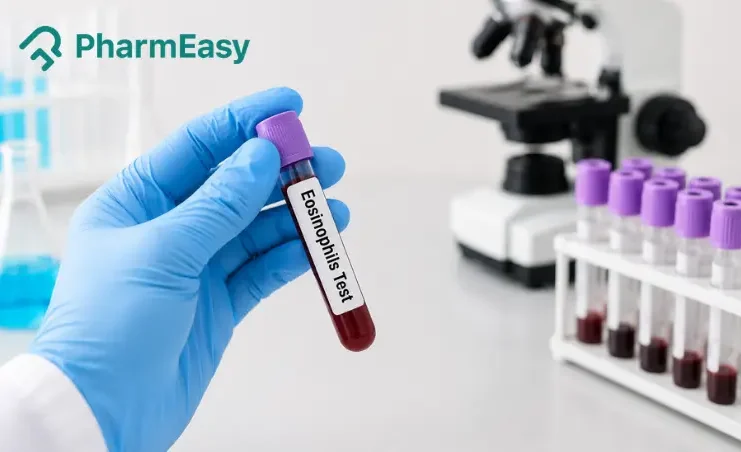
Eosinophils are a type of white blood cell that helps the immune system respond to allergies, asthma-related inflammation, and some infections, especially parasitic infections. White blood cells include several groups. Eosinophils belong to a group called granulocytes because they contain tiny enzyme-filled granules that help them take part in immune responses1.
Did You Know?
The absolute eosinophil count is the number of eosinophils in a specific volume of blood. It is usually calculated from a complete blood count by combining the total white blood cell count with the percentage of eosinophils.
A typical normal eosinophil range is about 0–500 cells per microlitre of blood. The exact reference range may vary slightly by laboratory, so it is important to interpret the result using the range printed on your own report4.
Eosinophilia means that eosinophil levels are higher than expected in the blood. Many sources define eosinophilia as an absolute eosinophil count above about 450–550 cells per microlitre, although the exact cut-off can vary by laboratory2.
Based on the counts of eosinophils, eosinophilia can be divided into mild, moderate, and severe:
A persistently high absolute eosinophil count above 1,500 cells/microlitre, especially when confirmed on repeat testing, requires a thorough medical evaluation. If doctors rule out common secondary triggers, such as allergies or infections, and find evidence of organ or tissue damage, this pattern may point to hypereosinophilic syndrome (HES). Doctors use clinical findings and additional tests to decide whether this diagnosis applies5. Earlier, HES was suspected only if these symptoms lasted for at least 6 months. However, HES is now considered a valid diagnosis if there is clear evidence of organ injury, regardless of how long the symptoms have lasted.
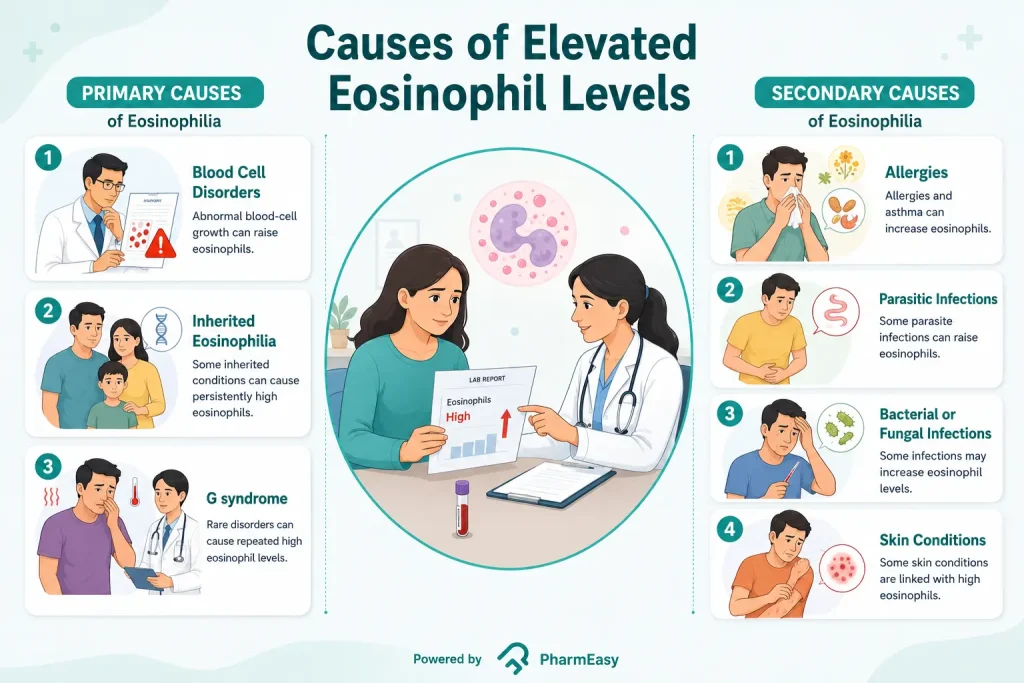
Eosinophilia may be because of primary or secondary factors.
When high eosinophil levels are because of abnormal growth of blood-forming cells in the bone marrow, doctors identify the condition as primary (or intrinsic) eosinophilia. Such primary causes include:
When any other underlying conditions or diseases cause eosinophilia, they are referred to as secondary causes:
While eosinophilia itself does not cause any symptoms, they may be because of the underlying causes8:
Eosinophilia itself can show symptoms when it invades tissues or causes any organ injuries, especially in cases of HES.
There is no single eosinophil number that automatically means cancer. Doctors consider cancer only when eosinophilia is persistent, common causes have been ruled out, the count does not improve after treating a likely cause, or other warning signs are present. Eosinophilia can occur with some blood cancers, such as leukaemia and lymphoma, but these are more likely to be suspected when there are additional findings, such as abnormal white blood cell counts, low haemoglobin, low platelets, swollen lymph nodes, or an enlarged spleen or liver. Eosinophilia has also been reported with some solid tumours, including cancers of the lung, breast, cervix, kidney, ovary, prostate, and melanoma, but this is less common9.
However, cancers can be considered in the presence of certain symptoms such as enlarged lymph nodes (lymphadenopathy) and spleen (splenomegaly), abnormal blood counts10, unexplained weight loss, general symptoms, or persistent eosinophilia.
Eosinophilia linked with cancer can happen in two broad ways. In rare cases, the cancer arises from eosinophil-producing blood cells, such as eosinophilic leukaemia. In other cases, eosinophils rise as part of the body’s response to another cancer. Cancers associated with eosinophilia may be grouped as blood-related cancers or solid-organ cancers2.
The extent of diagnostic tests to find the cause of high eosinophils depends on the severity of the symptoms, any suspected causes, and whether there is any organ involvement.
If these steps do not identify a clear cause, or if the results raise concern for a blood disorder or cancer, doctors may recommend more specialised tests.
Treatment for high eosinophils depends on the cause, the level of the count, symptoms, and whether any organs are affected. The goal is usually to treat the underlying condition and prevent organ damage.
Also Read: CRP Blood Test Cancer: Understanding its Significance in Diagnosis and Treatment
Speak with a healthcare professional if your eosinophil count is repeatedly high, if you have symptoms such as fever, weight loss, night sweats, breathing problems, rash, swelling, diarrhoea, or chest symptoms, or if you recently travelled to an area where parasitic infections are common. You should also seek medical advice if the result is new and you are unsure whether it needs follow-up.
Also Read: Burkitt Lymphoma: What It Is, Symptoms, Causes and Treatment
A high eosinophil count can have many causes, including allergies, asthma, infections, autoimmune or immune-related diseases, reactions to medicines, and, less commonly, cancer. The count alone does not usually identify the cause. Doctors interpret eosinophil levels alongside symptoms, medical history, examination findings, and other test results. Knowing what high eosinophils mean can help you understand your report, ask informed questions, and seek timely medical advice when needed.
Also Read: What Type of Cancer Causes Low Hemoglobin Levels?
Eosinophilia can happen for many reasons, including allergies, asthma, infections, some autoimmune or immune-related diseases, certain skin conditions, medicine reactions, and, less commonly, cancer. The cause can usually be identified only by comparing the blood test result with your symptoms, medical history, examination findings, and other test results5. Your healthcare professional can help determine the most likely cause in your case.
Mild cases of eosinophilia might not produce any symptoms, and only conservative management might be enough. However, more severe cases of eosinophilia or those associated with any organ damage might need to be evaluated by a healthcare professional5.
Eosinophils related to liver diseases might be a result of some protective mechanism following some conditions. They can include viral or parasitic infections, drug-induced liver injuries, or other immunity-related liver diseases17.
Eosinophilia might not be a typical feature of skin cancers. However, in some cases of skin cancers such as melanomas9, eosinophilia can be seen.
No. A high eosinophil count does not automatically mean cancer. Cancer is only one possible cause, and many non-cancer causes are more common. Doctors may investigate for cancer if eosinophilia is persistent, common causes have been excluded, the count does not improve after treatment for a likely cause, or other warning signs are present9.
Eosinophilic oesophagitis is an inflammatory condition of the oesophagus. Current evidence does not show a strong link between eosinophilic oesophagitis and cancer, although rare cases of oesophageal cancer have been reported in people with this condition18.
1. Definition of eosinophil – NCI Dictionary of Cancer Terms – NCI. February 2, 2011. Accessed August 13, 2026. https://www.cancer.gov/publications/dictionaries/cancer-terms/def/eosinophil
2. Kovalszki A, Weller PF. Eosinophilia. Prim Care. 2016;43(4):607-617. doi:10.1016/j.pop.2016.07.010 https://pubmed.ncbi.nlm.nih.gov/27866580/
3. Kuang FL. Approach to the patient with eosinophilia. Med Clin North Am. 2020;104(1):1-14. doi:10.1016/j.mcna.2019.08.005 https://pubmed.ncbi.nlm.nih.gov/31757229/
4. Eosinophil count – absolute: MedlinePlus Medical Encyclopedia. Accessed August 13, 2026. https://medlineplus.gov/ency/article/003649.htm
5. Kanuru S, Sapra A. Eosinophilia. In: StatPearls [Internet]. StatPearls Publishing; 2023. Accessed August 13, 2026. https://www.ncbi.nlm.nih.gov/sites/books/NBK560929/
6. Vidyadharan S, Joseph B, Nair SP. Chronic Eosinophilic Leukemia Presenting Predominantly with Cutaneous Manifestations. Indian J Dermatol. 2016;61(4):437-439. doi:10.4103/0019-5154.185716 https://www.researchgate.net/publication/305219767_Chronic_Eosinophilic_Leukemia_Presenting_Predominantly_with_Cutaneous_Manifestations
7. Naiman JL, Oski FA, Allen FH, Diamond LK. Hereditary Eosinophilia: Report of a Family and Review of the Literature. Am J Hum Genet. 1964;16(2):195-203. https://pubmed.ncbi.nlm.nih.gov/14176021/
8. Falchi L, Verstovsek S. Eosinophilia in hematologic disorders. Immunol Allergy Clin North Am. 2015;35(3):439-452. doi:10.1016/j.iac.2015.04.004 https://pmc.ncbi.nlm.nih.gov/articles/PMC4515577/
9. Eosinophil Levels and Cancer. Accessed August 13, 2026. https://www.cancer.org/cancer/latest-news/eosinophil-levels-and-cancer.html
10. Morales-Camacho RM, Caballero-Velázquez T, Borrero JJ, Bernal R, Prats-Martín C. Hematological Neoplasms with Eosinophilia. Cancers. 2024;16(2):337. doi:10.3390/cancers16020337 https://pubmed.ncbi.nlm.nih.gov/38254826/
11. Valent P, Klion AD, Roufosse F, et al. Proposed refined diagnostic criteria and classification of eosinophil disorders and related syndromes. Allergy. 2023;78(1):47-59. doi:10.1111/all.15544 https://pubmed.ncbi.nlm.nih.gov/36207764/
12. Danielson DT, Aguilera NS, Auerbach A. Head and Neck Classic Hodgkin, T and NK Lymphomas with Eosinophilia. Head Neck Pathol. 2025;19(1):10. doi:10.1007/s12105-025-01751-9 https://pubmed.ncbi.nlm.nih.gov/39873807/
13. Larsen RL, Savage NM. How I investigate Eosinophilia. Int J Lab Hematol. 2019;41(2):153-161. doi:10.1111/ijlh.12955 https://pubmed.ncbi.nlm.nih.gov/30499630/
14. CDC. Post-Travel Parasitic Disease Including Evaluation of Eosinophilia. CDC Yellow BookTM. July 16, 2026. Accessed August 13, 2026. https://www.cdc.gov/yellow-book/hcp/post-travel-evaluation/post-travel-parasitic-disease.html
15. Salvador F, Sulleiro E, Sánchez-Montalvá A, et al. Usefulness of Strongyloides stercoralis Serology in the Management of Patients with Eosinophilia. Am J Trop Med Hyg. 2014;90(5):830-834. doi:10.4269/ajtmh.13-0678 https://pubmed.ncbi.nlm.nih.gov/24615124/
16. Baaten GG, Sonder GJ, van Gool T, Kint JA, van den Hoek A. Travel-related schistosomiasis, strongyloidiasis, filariasis, and toxocariasis: the risk of infection and the diagnostic relevance of blood eosinophilia. BMC Infect Dis. 2011;11:84. doi:10.1186/1471-2334-11-84 https://pmc.ncbi.nlm.nih.gov/articles/PMC3079652/
17. Xie L, Zhang H, Xu L. The Role of Eosinophils in Liver Disease. Cell Mol Gastroenterol Hepatol. 2024;19(2):101413. doi:10.1016/j.jcmgh.2024.101413 https://pubmed.ncbi.nlm.nih.gov/39349246/
18. Uchida AM, Schuman SS, Pyne A, et al. Risk of Cancer Diagnosis in Patients With Eosinophilic Esophagitis Using a Nationwide Swedish Population Cohort. United Eur Gastroenterol J. 2024;12(10):1378-1387. doi:10.1002/ueg2.12713 https://pubmed.ncbi.nlm.nih.gov/39565026/


Comments

Leave your comment...
You may also like























Comments