




VDRL Positive: What It Means, Symptoms, Causes & Treatment
By Dr. Raina N. Nahar +2 more

Medically reviewed by Dr. Raina N. Nahar
Last updated: Sep 1, 2026 Published on: Jun 15, 2026


Get,

to manage your symptom
Get your,

4 Cr+ families
benefitted

OTP sent to 9988776655



You’ve successfully subscribed to receive
doctor-approved tips on
Whatsapp

Get ready to feel your best.


Register to Avail the Offer
Send OTPBy continuing, you agree with our Privacy Policy and Terms and Conditions
Hi There,
Sign up on PharmEasy now!!


Trusted by 4 crore+ families

OTP sent to 9988776655
You have unlocked 25% off on medicines


Code: NU25

By Dr. Raina N. Nahar +2 more
Table of Contents
Receiving a ‘VDRL positive’ test result can feel alarming, especially when you are unsure what it means or what happens next. Many people immediately worry about serious infections, relationships, or long-term health consequences. However, a positive result does not always confirm a disease on its own, and further evaluation is often needed. Therefore, understanding the report, its possible causes, and available management options can help reduce anxiety and guide your next steps.
In this blog, we will explain what a VDRL-positive result means, the possible symptoms and causes associated with it, how doctors confirm the diagnosis, and the treatment and management options available.
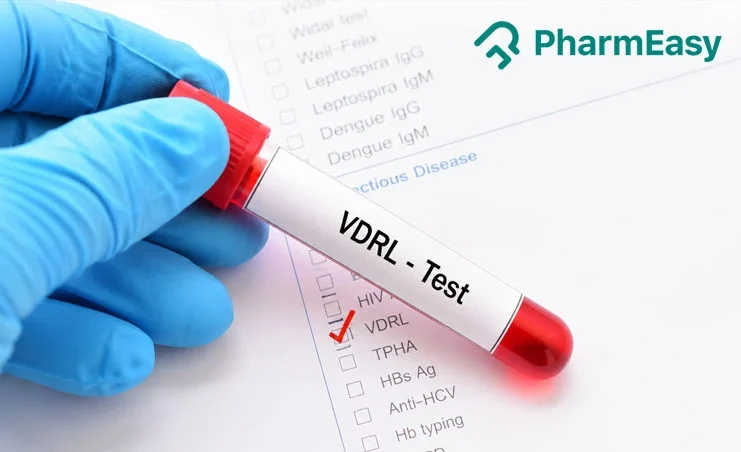
VDRL meaning/full form is venereal disease research laboratory. This test is a screening tool used to detect syphilis. It checks for antibodies, which are proteins produced by the body in response to infection with the syphilis-causing bacteria1,2.
Syphilis is a bacterial sexually transmitted infection (STI) that could lead to serious health complications affecting the brain, heart, nerves, and other organs if it is unaddressed3.
Many people with syphilis may not experience noticeable symptoms, especially in the early stages3. Therefore, if your doctor suspects a possible risk based on your symptoms, medical history, or sexual health evaluation, getting a VDRL test becomes very important.
A doctor may recommend a VDRL test if you have symptoms suggestive of an STI or if there is a possibility of exposure to syphilis1,4.
The VDRL test is also routinely performed during pregnancy as part of prenatal screening. This is because early detection and management of syphilis in pregnant individuals are important to help avoid complications such as stillbirth or congenital syphilis in the baby1,4.
In addition to helping with the diagnosis of syphilis, the VDRL test is also used to monitor the effectiveness of syphilis treatment. After successful antibiotic therapy, antibody levels detected by the VDRL test usually decrease over time. If the levels remain unchanged or increase, it may indicate an ongoing or recurrent infection that requires further medical evaluation1.
The following table will help you understand your VDRL test report1,2.
| Result | Interpretation | Meaning |
| VDRL Normal Range | Non-reactive/Negative | No syphilis antibodies were detected in the blood sample. |
| VDRL Positive | Reactive | Antibodies linked to syphilis may be present, suggesting a possible current or past infection. Further confirmatory testing is required. |
| VDRL Negative | Non-reactive | Usually indicates no evidence of syphilis infection, although very early infections may not always be detected. |
Note: A reactive VDRL result means the test has detected antibodies that may be associated with syphilis, while a non-reactive result means these antibodies were not detected. Since VDRL is a screening test, a positive/reactive result must be confirmed with other more specific tests before any diagnosis is made.
A VDRL positive result suggests that your body may have been exposed to the bacteria that cause syphilis. However, this result alone does not confirm that you currently have the infection. Since the VDRL is a screening test, other conditions can sometimes produce a positive result as well.
If your test comes back positive, your doctor will usually suggest getting confirmatory tests such as the treponema pallidum hemagglutination assay (TPHA) or the fluorescent treponemal antibody absorption test (FTA-ABS). These tests help confirm whether the positive result is truly due to syphilis1,2.
If you receive a positive VDRL test, your next step should be to consult a doctor for proper evaluation, additional testing, and guidance on treatment if needed. Remember, never delay follow-up, especially if you are pregnant or have symptoms suggestive of syphilis, as early diagnosis and management can help avoid serious complications and transmission to others.
A false-positive VDRL result means the test appears positive even though the person may not actually have syphilis. Some conditions that can cause a false-positive result include1,2:
A VDRL negative or non-reactive result means that the test did not detect antibodies commonly associated with syphilis infection. In most cases, this indicates that there is no evidence of syphilis1.
A false-negative VDRL result means the test appears negative even though a person may have syphilis. This can happen because the test is less sensitive during the very early and late stages of the infection.
The VDRL test is most likely to detect syphilis during the secondary and latent (no current symptoms) stages1. If your symptoms or exposure history strongly suggest syphilis despite a negative result, your doctor may recommend getting tested again or additional confirmatory blood tests.
Many people with syphilis may not notice symptoms in the early stages. Symptoms can vary depending on the stage of infection3.
The chancre may heal on its own within a few weeks, but the infection can still progress to the next stage if left unaddressed.
A VDRL positive result is most commonly caused by infection with Treponema pallidum, the bacterium that causes syphilis. The infection can spread through different types of exposure. Common risk factors include4:
Note: Syphilis does not spread through casual day-to-day contact or by sharing objects. You cannot get syphilis from toilet seats, doorknobs, swimming pools, hot tubs, bathtubs, shared clothing, or shared utensils5.
Management options for a VDRL-positive result depend on whether confirmatory tests diagnose syphilis and on the stage of the infection. Syphilis is usually managed effectively with antibiotics, most commonly penicillin. However, it is important to note that these medications should always be prescribed and monitored by a qualified doctor, and self-medication should be avoided4
Note: After treatment, regular follow-up with repeat VDRL testing is important to ensure that antibody levels decrease appropriately and the infection has been successfully cleared.
Also Read: Dermatitis Herpetiformis: Causes, Symptoms, Treatment, and Prevention Tips
Syphilis is a preventable STI. Taking the right precautions can help reduce the risk of infection and avoid transmission to others3,5.
Also Read: Chlamydia: Symptoms, Causes, Treatment and Prevention in Men and Women
You should consult a doctor if you4:
Also Read: HIV Cure: Is it possible? Know the Symptoms and Treatment Options
A VDRL positive result can be concerning, but it is important to remember that it is a screening result and not a confirmed diagnosis of syphilis.
With timely confirmatory testing, proper medical evaluation, and appropriate management, syphilis can usually be managed effectively, and serious complications can be avoided. In addition to this, regular STI screening (with tests such as the VDRL test), safe sexual practices, and early medical care play a key role in protecting both individual and public health.
A false-positive VDRL result can occur due to health conditions other than syphilis. These include conditions such as lupus, pregnancy, TB, HIV, hepatitis, malaria, or certain autoimmune and viral infections1,2.
Yes. Since the VDRL is a screening test, it may sometimes produce false-positive or false-negative results. This is why confirmatory tests such as TPHA or FTA-ABS are usually recommended1,2.
VDRL antibody levels usually decrease gradually after successful treatment, but the test may remain positive for months or even years in some individuals1. That is why regular follow-up testing helps doctors monitor treatment response.
In most cases, breastfeeding is considered safe if there are no syphilitic sores or lesions on the breasts6. However, a doctor should evaluate and guide treatment to reduce the risk of transmission and protect the baby’s health.
A VDRL positive result itself is not necessarily dangerous, but it may indicate a possible syphilis infection that requires medical attention. If left untreated, syphilis can lead to serious complications affecting the brain, heart, nerves, and pregnancy outcome4.
1. VDRL test: MedlinePlus Medical Encyclopedia. Accessed May 26, 2026. https://medlineplus.gov/ency/article/003515.htm
2. VDRL Test and its Interpretation – PMC. Accessed May 26, 2026. https://pmc.ncbi.nlm.nih.gov/articles/PMC3312652/
3. Syphilis. Accessed May 26, 2026. https://www.who.int/news-room/fact-sheets/detail/syphilis
4. Tudor ME, Al Aboud AM, Leslie SW, Gossman W. Syphilis. In: StatPearls. StatPearls Publishing; 2026. Accessed May 26, 2026. https://www.ncbi.nlm.nih.gov/books/NBK534780/
5. CDC. About Syphilis. Syphilis. February 23, 2026. Accessed May 26, 2026. https://www.cdc.gov/syphilis/about/index.html
6. Syphilis. In: MotherToBaby | Fact Sheets. Organization of Teratology Information Specialists (OTIS); 1994. Accessed May 26, 2026. http://www.ncbi.nlm.nih.gov/books/NBK603252/
Disclaimer: The information provided here is for educational/awareness purposes only and is not intended to be a substitute for medical treatment by a healthcare professional and should not be relied upon to diagnose or treat any medical condition. The reader should consult a registered medical practitioner to determine the appropriateness of the information and before consuming any medication. PharmEasy does not provide any guarantee or warranty (express or implied) regarding the accuracy, adequacy, completeness, legality, reliability or usefulness of the information; and disclaims any liability arising thereof.
Links and product recommendations in the information provided here are advertisements of third-party products available on the website. PharmEasy does not make any representation on the accuracy or suitability of such products/services. Advertisements do not influence the editorial decisions or content. The information in this blog is subject to change without notice. The authors and administrators reserve the right to modify, add, or remove content without notification. It is your responsibility to review this disclaimer regularly for any changes.
 1
1 
Comments

Leave your comment...
You may also like























Comments