




Neuroendocrine Tumours (NETs): Symptoms, Causes, Stages, Diagnosis and Treatment
By Dr. Akash N. Shah +2 more

Medically reviewed by Dr. Akash N. Shah
Last updated: Oct 9, 2026 Published on: Oct 9, 2026


Get,

to manage your symptom
Get your,

4 Cr+ families
benefitted

OTP sent to 9988776655



You’ve successfully subscribed to receive
doctor-approved tips on
Whatsapp

Get ready to feel your best.


Register to Avail the Offer
Send OTPBy continuing, you agree with our Privacy Policy and Terms and Conditions
Hi There,
Sign up on PharmEasy now!!


Trusted by 4 crore+ families

OTP sent to 9988776655
You have unlocked 25% off on medicines


Code: NU25

By Dr. Akash N. Shah +2 more
Table of Contents
Persistent digestive problems, unexplained abdominal discomfort or pain, changes in bowel habits, flushing, weight changes, or ongoing tiredness can leave you wondering what might be causing them. In some cases, these symptoms may be linked to neuroendocrine tumours (NETs), which can develop in different parts of the body1. This article covers everything you need to know about NET, including its causes, symptoms, types, risk factors, diagnosis, treatment options, and when to seek medical attention.

A neuroendocrine tumour (NET) is an abnormal growth that develops from neuroendocrine cells2. Neuroendocrine cells have features of both nerve cells and hormone-producing cells and they release hormones in response to signals from the nervous system3. NETs have variable malignant potential and can occur in different parts of the body such as the stomach, intestine, lungs, and pancreas3. Some NETs produce excess hormones and can cause different symptoms2.
Did You Know?
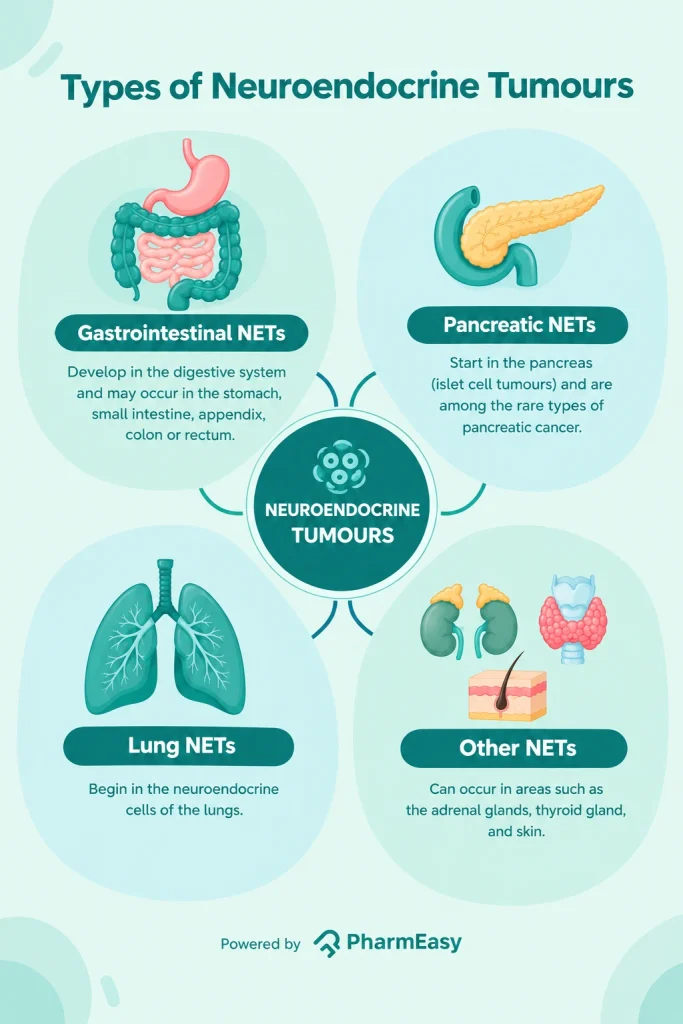
There are different types of neuroendocrine tumours based on where they grow. These include:
The grade and stage of a neuroendocrine tumour (NET) describe two aspects. Grade helps doctors understand how quickly the tumour cells are growing and how aggressive they look under a microscope. Stage describes how large the tumour is and whether it has spread to nearby lymph nodes or other parts of the body.
Grading of a tumour can be determined by different factors such as:
Well-differentiated tumours are less aggressive than poorly differentiated ones.
Based on these, grades of NETs are:
The stages of NETs include:
NETs are generally staged using the TNM system, which considers:
Neuroendocrine tumour symptoms can vary based on the type and grade. Some people may not even notice any symptoms in the early stages. The possible symptoms of NETs are mentioned below.
Note: The symptoms listed above can occur with many different health conditions and do not necessarily indicate a neuroendocrine tumour. Some NETs may cause no noticeable symptoms, especially in the early stages. If you have persistent, unusual, or worsening symptoms, consult a qualified doctor for proper evaluation and diagnosis. It is wiser to avoid self medications and undergoing multiple investigations without seeking an opinion from an expert doctor.
NETs can occur for different reasons. The following are the possible causes of neuroendocrine tumours:
Factors which increase the risk of getting a disease are called a risk factors. The following are some risk factors of NETs:
Note: Having one or more of these risk factors does not mean that a person will develop a NET. NETs can occur in people without any known risk factors, and the level of risk may vary depending on the type and location of the tumour. If you are concerned about your risk, speak with a qualified doctor.
Diagnosing a NET may involve several tests. The following are the methods usually used by doctors to diagnose NETs:
Note: Not everyone with possible NET symptoms will need the same tests. The doctor might choose the tests based on your symptoms, overall health and where the tumour may be located. Only a qualified doctor can decide which tests are appropriate for you.
The treatment option for NET depends on the type, stage, and grade. The following are some common treatments suggested by doctors for NET:
An NET cannot always be prevented. However, maintaining a healthy lifestyle and being aware of personal risk factors may support overall health. The following are some ways which may help reduce the risk:
Note: NETs cannot always be prevented, and these tips do not guarantee that you can avoid them. If you have ongoing symptoms or concerns about your risk, speak with a qualified doctor for personalised advice and appropriate screening.
Consulting a doctor is very important if you have ongoing stomach pain, diarrhoea, unexplained weight loss, repeated flushing, tiredness, breathing problems, or unusual hormone-related symptoms1. It is also important to seek medical advice if you have a strong family history of NETs or related genetic conditions10. Getting checked can help with the proper diagnosis and treatment, if needed.
Also Read: Stomach Cancer: Symptoms, Causes, Stages, Types & Treatment
NETs are uncommon cancers that can start in different parts of the body and may affect each person differently. Their symptoms and treatment depend on where the tumour develops, how fast it grows, and whether it makes hormones. Most NETs cannot be prevented, but knowing the risk factors and getting persistent symptoms checked can help with early diagnosis and proper care.
The severity of a NET depends on factors such as its location, grade, growth rate and whether it has spread. Some NETs grow slowly and can be managed for many years, while others may be more aggressive4,9.
Life expectancy with NETs varies widely depending on the tumour’s grade, stage, location, overall health and response to treatment. Many people with tumours detected in initial stages respond very well to treatment and can live for years, so a diagnosis does not automatically mean a short life expectancy15.
There is no fixed survival rate for neuroendocrine tumours because it depends on the tumour’s type, stage, grade and spread. Slow-growing tumours may have a better outlook, while fast-growing tumours can be more serious15.
Yes, an insulinoma is a type of pancreatic NETs that develops from insulin-producing cells in the pancreas. It usually produces too much insulin, which can cause abnormally low blood sugar levels7.
A neuroendocrine tumour has variable malignant potential, depending on its type and behaviour. Some NETs grow slowly and remain confined , while others can grow quickly and spread to other parts of the body2.
Yes, a CT scan can detect many NETs by showing their size and location. However, smaller tumours may be difficult to see, so doctors may use other tests, such as MRI, specialised scans or a biopsy, when needed12.
Rarely do gastrointestinal NETs contribute to weight gain through hormone changes (Cushing syndrome)16. However, unexplained weight loss is more commonly associated with NETs1, and weight gain can have many other causes.
Yes, some NETs can cause diarrhoea, particularly when they release excess hormones1. However, diarrhoea can have many other causes and does not necessarily mean a person has a NET.
1. What are the symptoms of neuroendocrine tumours? Cancer Australia. 2024. Available from: https://www.canceraustralia.gov.au/cancer-types/neuroendocrine-tumours/what-are-symptoms-neuroendocrine-tumours
2. Definition of neuroendocrine tumor. NCI. Available from: https://www.cancer.gov/publications/dictionaries/cancer-terms/def/neuroendocrine-tumor
3. Neuroendocrine tumors and carcinoid Tumors. American Cancer Society. 2025. Available from: https://www.cancer.org/cancer/types/carcinoid-neuroendocrine-tumors.html
4. Neuroendocrine spore. NCI. 2025. Available from: https://dctd.cancer.gov/research/spores/focus-area/neuroendocrine
5. Raphael MJ, Chan DL, Law C, Singh S. Principles of diagnosis and management of neuroendocrine tumours. CMAJ. 2017;189(10):E398-E404. doi:10.1503/cmaj.160771. Available from: https://www.cmaj.ca/content/189/10/e398
6. Gastrointestinal neuroendocrine tumors treatment. NCI. 2025. Available from: https://www.cancer.gov/types/gi-neuroendocrine-tumors/patient/gi-neuroendocrine-treatment-pdq
7. What is a pancreatic neuroendocrine tumor? American Cancer Society. 2025. Available from: https://www.cancer.org/cancer/types/pancreatic-neuroendocrine-tumor/about/what-is-pnet.html
8. Lung neuroendocrine tumor. American Cancer Society. 2025. Available from: https://www.cancer.org/cancer/types/lung-carcinoid-tumor.html
9. Grading & staging. Neuroendocrine Cancer Australia. Available from: https://neuroendocrine.org.au/understanding-neuroendocrine-cancer/what-are-neuroendocrine-cancers/grading-staging/
10. Risks and causes of neuroendocrine cancer. Cancer Research UK. 2025. Available from: https://www.cancerresearchuk.org/about-cancer/neuroendocrine-tumours-nets/risks-causes
11. Oncogenes, tumor suppressor genes, and DNA repair genes. American Cancer Society. 2026. Available from: https://www.cancer.org/cancer/understanding-cancer/genes-and-cancer/oncogenes-tumor-suppressor-genes.html
12. Tests to diagnose neuroendocrine cancer. Cancer Research UK. 2025. Available from: https://www.cancerresearchuk.org/about-cancer/neuroendocrine-tumours-nets/getting-diagnosed/tests-diagnose
13. Maratta MG, Chiloiro S, Raia S, et al. Somatostatin analogs versus active surveillance in small pancreatic neuroendocrine tumors. Pancreas. 2024;54(6):e524-e529. doi:10.1097/MPA.0000000000002425. Available from: https://pmc.ncbi.nlm.nih.gov/articles/PMC12175780/
14. Treatment options for neuroendocrine cancer. Cancer Research UK. Available from: https://www.cancerresearchuk.org/about-cancer/neuroendocrine-tumours-nets/treatment/options#treatment-for-neuroendocrine-tumours-(nets)
15. Life Expectancy with neuroendocrine cancer: Survival rates. Available from: https://neuroendocrine.org.au/resources/net-information/life-expectancy/
16. Signs and symptoms of gastrointestinal neuroendocrine tumors. American Cancer Society. 2025. Available from: https://www.cancer.org/cancer/types/gastrointestinal-carcinoid-tumor/detection-diagnosis-staging/signs-symptoms.html
Disclaimer: The information provided here is for educational/awareness purposes only and is not intended to be a substitute for medical treatment by a healthcare professional and should not be relied upon to diagnose or treat any medical condition. The reader should consult a registered medical practitioner to determine the appropriateness of the information and before consuming any medication. PharmEasy does not provide any guarantee or warranty (express or implied) regarding the accuracy, adequacy, completeness, legality, reliability or usefulness of the information; and disclaims any liability arising thereof.
Links and product recommendations in the information provided here are advertisements of third-party products available on the website. PharmEasy does not make any representation on the accuracy or suitability of such products/services. Advertisements do not influence the editorial decisions or content. The information in this blog is subject to change without notice. The authors and administrators reserve the right to modify, add, or remove content without notification. It is your responsibility to review this disclaimer regularly for any changes.


Comments

Leave your comment...
You may also like
























Comments