



Early Signs of Kidney Disease You Should Know
By Dr. Aniket Hase +2 more

Medically reviewed by Dr. Aniket Hase
Last updated: Aug 26, 2026 Published on: Jul 14, 2026


Get,

to manage your symptom
Get your,

4 Cr+ families
benefitted

OTP sent to 9988776655



You’ve successfully subscribed to receive
doctor-approved tips on
Whatsapp

Get ready to feel your best.


Register to Avail the Offer
Send OTPBy continuing, you agree with our Privacy Policy and Terms and Conditions
Hi There,
Sign up on PharmEasy now!!


Trusted by 4 crore+ families

OTP sent to 9988776655
You have unlocked 25% off on medicines


Code: NU25

By Dr. Aniket Hase +2 more
Table of Contents
Kidney disease often develops quietly, with little or no warning in its early stages. That is why many individuals do not realise there is a problem until the condition has progressed to an advanced stage1.
However, recognising the early signs of kidney disease and seeking timely medical care can help slow or even avoid further kidney damage.
In this blog, we will explore the early kidney disease symptoms, types and causes, lifestyle and prevention tips, and when it is important to consult a doctor.
Healthy kidneys filter waste products, excess fluid, and toxins from the blood. They also help regulate blood pressure, maintain the body’s fluid and mineral balance, and produce hormones that support bone health and red blood cell production2. Kidney disease occurs when the structure or function of the kidney is impaired. This can cause waste and fluid to build up in the body3,4.
Did You Know?
Depending on the rate at which the symptoms have developed, kidney disease can be of two main types4:
The seriousness of your kidney disease is primarily determined by your eGFR (estimated glomerular filtration rate), which measures how effectively your kidneys filter waste from your blood, and your uACR (urine albumin-to-creatinine ratio), which assesses kidney damage and protein leakage.
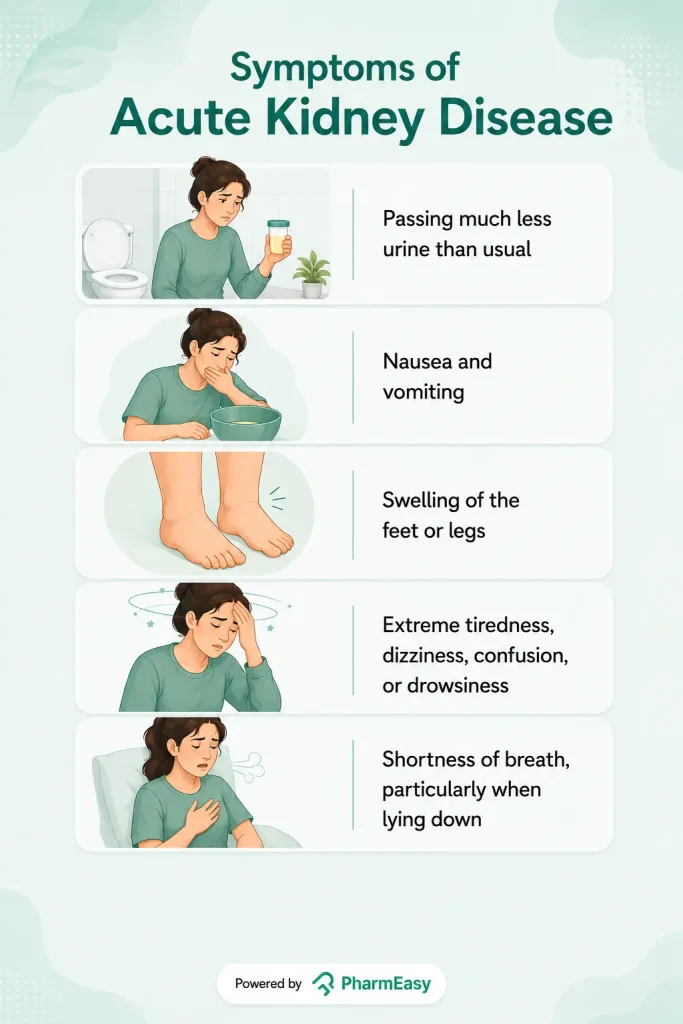
AKI develops suddenly over hours or days. A sudden drop in kidney function, suggesting AKI, would typically be associated with one or more of the following kidney disease symptoms6:
Important: AKI is a medical emergency and requires prompt evaluation and treatment. Early intervention can often restore kidney function and help avoid long-term damage4,6.
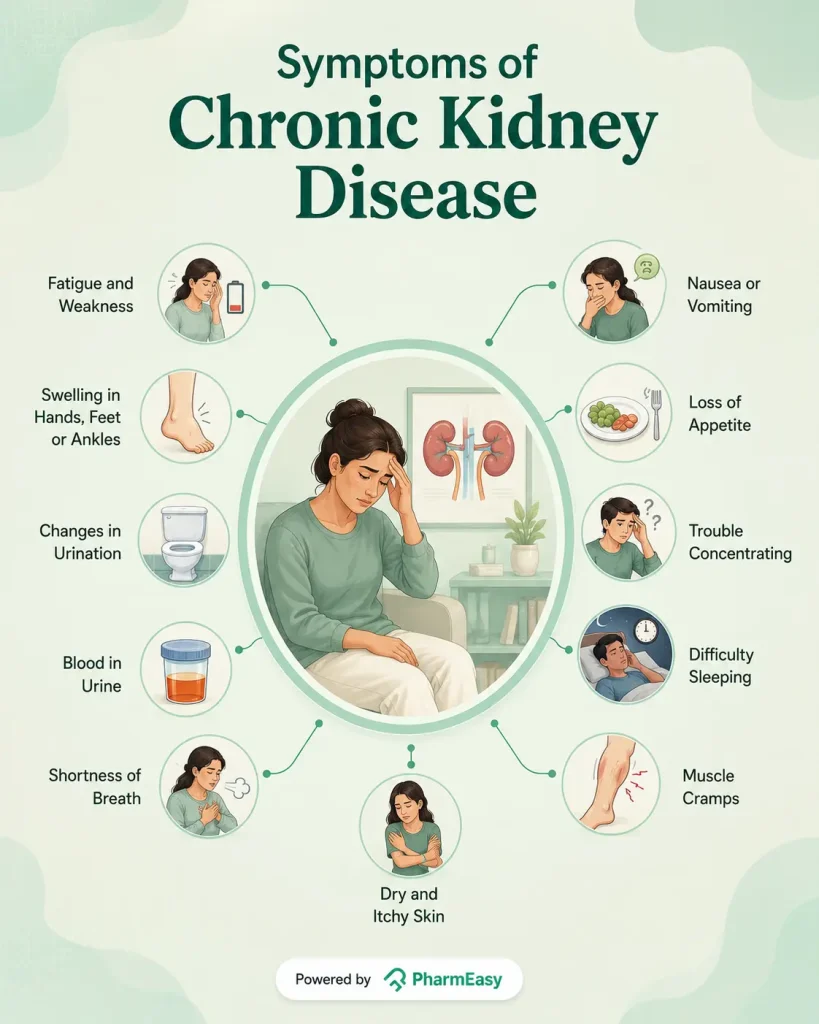
Some early signs and symptoms of CKD include:
Note: Many individuals with early CKD have no symptoms at all. Kidney disease is often detected during routine blood or urine tests performed for conditions such as diabetes or high blood pressure10.
The causes of kidney disease depend on whether it develops suddenly (AKI) or gradually (CKD).
AKI occurs when the kidneys suddenly stop working properly, often due to an illness, injury, or reduced blood flow to the kidneys. Common causes include6:
Note: The iodinated contrast dye used in some imaging tests, such as CT scans and angiography, may increase the risk of AKI in individuals with existing kidney disease or other risk factors. However, for most individuals with healthy kidneys, the risk is low6,11.
CKD develops gradually and is usually caused by long-term conditions that damage the kidneys over time. Common causes include12:
Recognising signs of kidney disease early can make a substantial difference in protecting your kidney health and overall well-being. Early detection is important for several reasons1,13:
If your doctor suspects kidney disease, they may recommend one or more of the following tests to assess how well your kidneys are working and identify the underlying cause6,14:
Note: In cases of AKI, doctors may also monitor urine output closely and perform additional tests, such as an ECG or imaging studies, depending on the suspected cause.
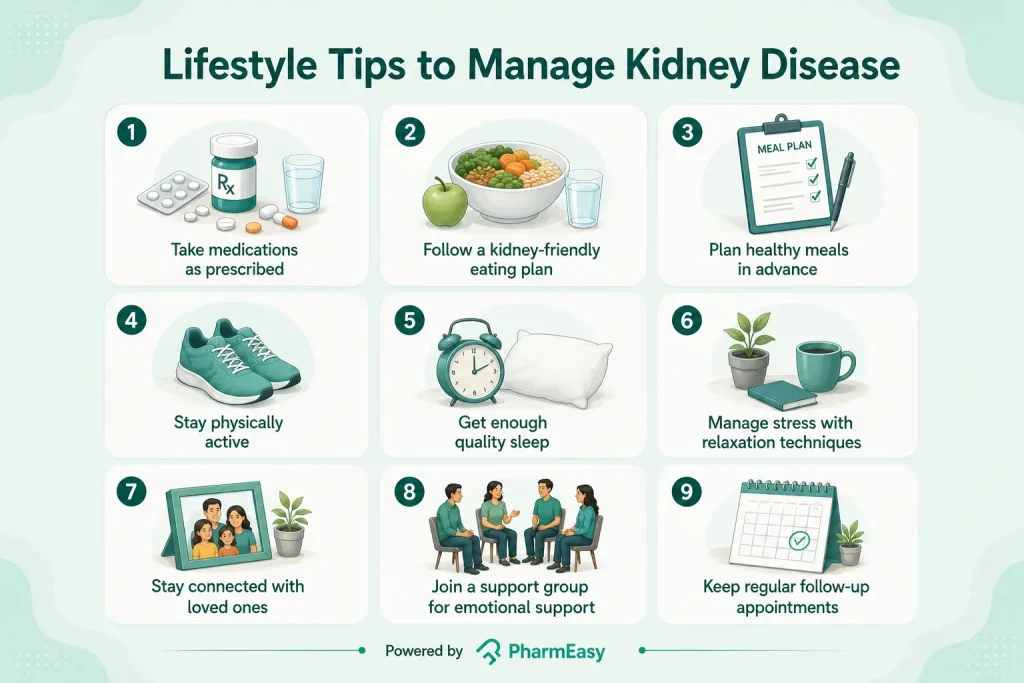
Living with kidney disease involves more than taking medications. There are several lifestyle habits that you can follow to slow disease progression, improve your quality of life, and support your overall well-being:
Also Read: Diet Chart for Kidney Patients Along with Helpful Tips
While not all kidney diseases can be prevented, healthy lifestyle habits can significantly reduce your risk. Prevention is especially important if you have diabetes, high blood pressure, heart disease, or a family history of kidney disease. Some tips for preventing kidney disease include16:
Note: Excessive water intake does not prevent CKD and can even be harmful for individuals who have been advised to restrict their fluid intake.
Also Read: High Uric Acid Level: Causes, Risks, Treatment, Prevention
Do not ignore persistent symptoms of kidney disease that could indicate a kidney problem. Early medical attention can help identify kidney disease before it becomes more serious. Consult a doctor if you6,10:
Also Read: High Creatinine: Symptoms, Causes, Diagnosis & Treatment
Kidney disease is a common but often overlooked condition that can have serious health consequences if left untreated. Therefore, knowing the early signs of kidney disease and understanding your risk can help you act before significant kidney damage occurs.
Remember, with timely medical care and healthy lifestyle choices, it is possible to protect your kidney function and maintain your overall health for years to come.
CKD is divided into five stages based on the eGFR and UACR, which measure how well the kidneys are filtering blood. Stage 1 involves mild kidney damage with normal kidney function, Stage 2 is characterised by mild to moderate loss of kidney function, Stage 3 involves moderate loss of kidney function, Stage 4 indicates severe loss of kidney function, and Stage 5 indicates kidney failure13.
Advanced kidney disease can cause unintended weight loss due to poor appetite, nausea, vomiting, and the buildup of waste products in the body. However, some individuals may initially gain weight because of fluid retention10,17.
If left untreated, kidney disease can lead to kidney failure and increase the risk of serious complications, including high blood pressure, heart disease, anaemia, and bone disorders3. Therefore, early diagnosis and management are important to help slow disease progression and reduce these risks.
1. Whaley-Connell A, Nistala R, Chaudhary K. The Importance of Early Identification of Chronic Kidney Disease. Mo Med. 2011;108(1):25-28. https://pubmed.ncbi.nlm.nih.gov/21462606/
2. Your Kidneys & How They Work – NIDDK. National Institute of Diabetes and Digestive and Kidney Diseases. Accessed July 3, 2026. https://www.niddk.nih.gov/health-information/kidney-disease/kidneys-how-they-work
3. Vaidya SR, Aeddula NR. Chronic Kidney Disease. In: StatPearls. StatPearls Publishing; 2026. Accessed July 3, 2026. http://www.ncbi.nlm.nih.gov/books/NBK535404/
4. Kidney disease. Accessed July 3, 2026. https://www.who.int/news-room/fact-sheets/detail/kidney-disease
5. Global Facts: About Kidney Disease | National Kidney Foundation. Accessed July 3, 2026. https://www.kidney.org/global-facts-about-kidney-disease
6. Acute kidney injury (AKI). nhs.uk. October 3, 2018. Accessed July 3, 2026. https://www.nhs.uk/conditions/acute-kidney-injury/
7. Khitan ZJ, Glassock RJ. Foamy Urine. Clin J Am Soc Nephrol CJASN. 2019;14(11):1664-1666. doi:10.2215/CJN.06840619 https://pubmed.ncbi.nlm.nih.gov/31575619/
8. 10 Signs You May Have Kidney Disease | National Kidney Foundation. Accessed July 3, 2026. https://www.kidney.org/news-stories/10-signs-you-may-have-kidney-disease
9. Hematuria (Blood in the Urine) – NIDDK. Accessed July 6, 2026. https://www.niddk.nih.gov/health-information/urologic-diseases/hematuria-blood-urine
10. Chronic kidney disease – Symptoms. nhs.uk. October 3, 2018. Accessed July 3, 2026. https://www.nhs.uk/conditions/kidney-disease/symptoms/
11. Wang KC, Lin LC, Pan SY, et al. Use of iodinated and gadolinium-based contrast media in patients with chronic kidney disease: Consensus statements from nephrologists, cardiologists, and radiologists at National Taiwan University Hospital. J Formos Med Assoc. 2026;125(3):261-267. doi:10.1016/j.jfma.2025.01.019 https://pubmed.ncbi.nlm.nih.gov/39870554/
12. Chronic kidney disease. nhs.uk. October 20, 2017. Accessed July 3, 2026. https://www.nhs.uk/conditions/kidney-disease/
13. KDIGO 2024 Clinical Practice Guideline for the Evaluation and Management of Chronic Kidney Disease – PubMed. Accessed July 3, 2026. https://pubmed.ncbi.nlm.nih.gov/38490803/
14. Chronic kidney disease – Diagnosis. nhs.uk. October 20, 2017. Accessed July 3, 2026. https://www.nhs.uk/conditions/kidney-disease/diagnosis/
15. 8 Self-Care Ideas for People With Chronic Kidney Disease (CKD) | National Kidney Foundation. Accessed July 3, 2026. https://www.kidney.org/news-stories/8-self-care-ideas-people-kidney-disease
16. Preventing Chronic Kidney Disease – NIDDK. National Institute of Diabetes and Digestive and Kidney Diseases. Accessed July 3, 2026. https://www.niddk.nih.gov/health-information/kidney-disease/chronic-kidney-disease-ckd/prevention
17. Singer R, Huang H. Weight change in chronic kidney disease: Association with mortality and kidney function. Obes Sci Pract. 2023;10(1):e723. doi:10.1002/osp4.723 https://pubmed.ncbi.nlm.nih.gov/38264010/
Disclaimer: The information provided here is for educational/awareness purposes only and is not intended to be a substitute for medical treatment by a healthcare professional and should not be relied upon to diagnose or treat any medical condition. The reader should consult a registered medical practitioner to determine the appropriateness of the information and before consuming any medication. PharmEasy does not provide any guarantee or warranty (express or implied) regarding the accuracy, adequacy, completeness, legality, reliability or usefulness of the information; and disclaims any liability arising thereof.
Links and product recommendations in the information provided here are advertisements of third-party products available on the website. PharmEasy does not make any representation on the accuracy or suitability of such products/services. Advertisements do not influence the editorial decisions or content. The information in this blog is subject to change without notice. The authors and administrators reserve the right to modify, add, or remove content without notification. It is your responsibility to review this disclaimer regularly for any changes.
 7
7 
Comments

Leave your comment...
You may also like

























Comments