




Salam Panja (Dactylorhiza hatagirea): Benefits, Uses, Side Effects & More
By Dr. Raghuveer +2 more

Medically reviewed by Dr. Raghuveer
Last updated: Sep 7, 2026 Published on: Jul 10, 2026


Get,

to manage your symptom
Get your,

4 Cr+ families
benefitted

OTP sent to 9988776655



You’ve successfully subscribed to receive
doctor-approved tips on
Whatsapp

Get ready to feel your best.


Register to Avail the Offer
Send OTPBy continuing, you agree with our Privacy Policy and Terms and Conditions
Hi There,
Sign up on PharmEasy now!!


Trusted by 4 crore+ families

OTP sent to 9988776655
You have unlocked 25% off on medicines


Code: NU25

By Dr. Raghuveer +2 more
Table of Contents
Salam panja (Dactylorhiza hatagirea) is a medicinal herb that has long been used in different traditional medicine systems because of its potential health benefits. Also known as Salep, Hatta Haddi, or Panja, this herb is native to the Himalayan regions of India, Nepal, Afghanistan, Pakistan, Tibet and Bhutan1,2. This blog highlights the nutritional value, potential health benefits, possible side effects and precautions, and medicinal applications of salam panja.
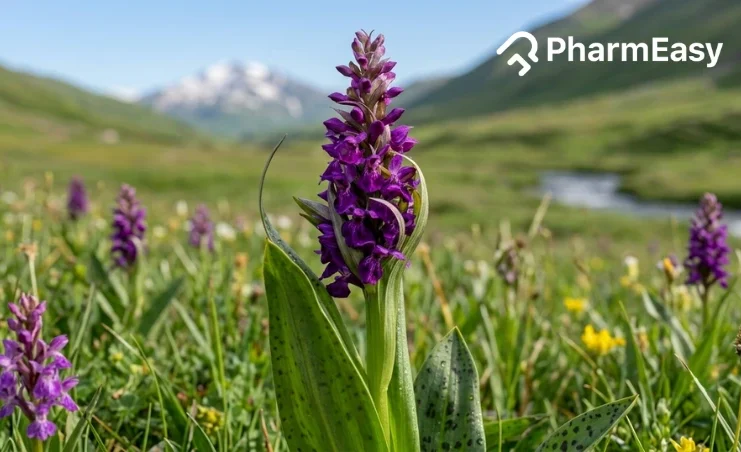
Salam panja (Dactylorhiza hatagirea) is a rare orchid species mainly found in the Himalayan mountains. Its tubers are cream-coloured and finger-shaped, resembling the shape of a hand, which is why the herb is called salam panja. Traditionally, it has been used in Ayurveda, Siddha, Unani, and folk medicine as an overall health supplement, but more specifically as a potential immunity booster1.
Salam panja contains various nutritional and bioactive ingredients that are thought to contribute to the medicinal properties of the herb.
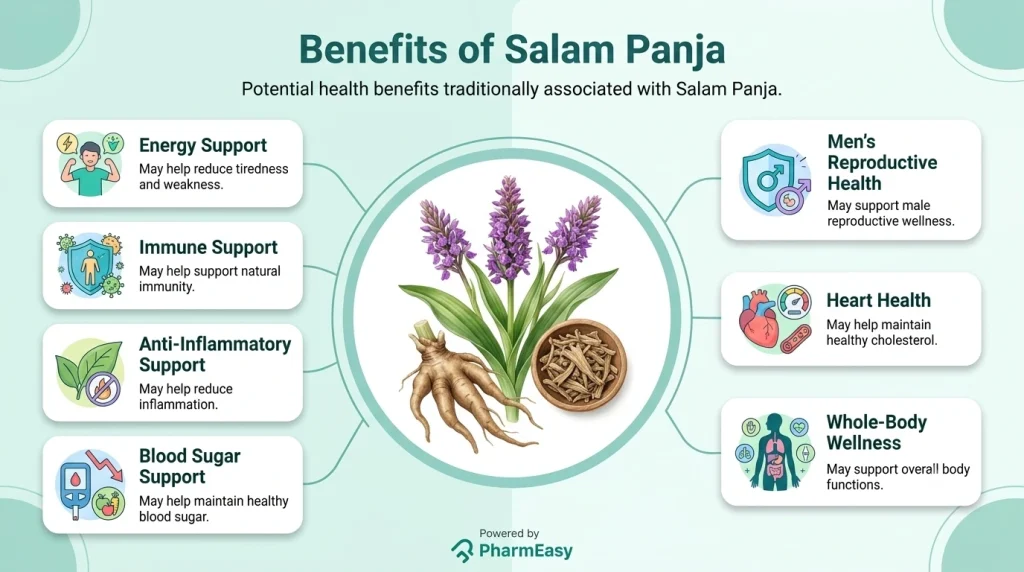
Some of the potential health benefits of Salam panja are as follows:
Note: Most of the potential benefits of salam panja are based mainly on traditional use and findings from laboratory and animal studies. More well-designed human studies may be needed to confirm these effects in humans.
Like any herbal medicine, salam panja may also cause some side effects, ranging from digestive discomfort to allergic reaction to some components of the herb. However, available reports are based on anecdotal evidence and findings from animal studies1. Pregnant and breastfeeding women should avoid using salam panja unless advised by a healthcare professional, as some components from this herb can pass into breast milk and may cause unwanted side effects in the baby6.
Salam panja is available in different forms. The common ways by which they can be taken include:
Note: More research is needed to confirm the benefits of herbs like salam panja. It is best to use salam panja under the guidance of a qualified healthcare professional or a trained traditional medicine practitioner to avoid potential side effects.
Despite its potential health benefits, the use of salam panja is also known to cause several side effects, as mentioned earlier. Some precautions to avoid such side effects include:
As salam panja is known to have blood sugar-lowering, anti-inflammatory, cholesterol-lowering, immune-supporting, and hormone-related effects in animal studies and traditional use, it may have effects similar to some medications, including diabetes medicines, anti-inflammatory medicines, cholesterol-lowering medicines, etc1,4. Since taking two products with similar effects together may increase the risk of side effects10, it is best to consult a doctor before using salam panja along with any ongoing medications.
Salam panja does not have a universally accepted dosage due to a lack of high-quality clinical trials or studies1. However, some traditional dosage recommendations are available in Ayurveda, and an Ayurvedic practitioner may suggest an appropriate dose based on an individual’s needs:
Note: Salam panja should be used only under the guidance of a qualified healthcare professional or Ayurvedic practitioner, especially by individuals also taking other medications.
Also Read: Medohar Guggulu: Uses, Benefits, Side Effects & More
Because there is a possibility of untoward interactions when using salam panja, seek medical advice:
Also Read: Achyranthes Aspera (Chaff Flower): Uses, Benefits & Side Effects
The traditional medicinal herb salam panja has long been valued for its potential health benefits, including boosting energy levels and immunity, as well as supporting overall well-being. However, clinical evidence is limited, making it necessary to use the herb with caution, in the recommended amounts, and under the guidance of a qualified healthcare professional.
Salam panja has traditionally been used in males to improve testosterone levels. Some studies in animals and a few studies in people have shown similar results, suggesting that it may support this traditional use1,4,11.
According to some studies, salam panja is known to increase testosterone levels4,11. However, more research is needed to support and confirm this1.
Yes, salam panja is a vegetarian preparation because it is obtained from the underground tubers of the plant Dactylorhiza hatagirea. It is a plant-based herbal ingredient and does not contain any animal-derived components1,12.
Yes, women can take salam panja if recommended by a qualified healthcare professional. However, pregnant and breastfeeding women should avoid using it unless advised by their healthcare provider, as there is limited safety evidence6.
Salam panja may help reduce tiredness and promote overall wellbeing. It may also provide antioxidant benefits and support digestive and reproductive health, although more clinical evidence is needed to confirm these effects1.
1. Wani IA, Kumar V, Verma S, Tasleem Jan A, Rather IA. Dactylorhiza hatagirea (D. Don) Soo: A Critically Endangered Perennial Orchid from the North-West Himalayas. Plants. 2020;9(12):1644. doi:10.3390/plants9121644 Available from: https://pubmed.ncbi.nlm.nih.gov/33255646/
2. Shreekar Pant. Dactylorhiza hatagirea: A high value medicinal orchid. J Med Plants Res. 2012;6(19). doi:10.5897/JMPR12.097 Available from: https://www.researchgate.net/publication/272073245_Dactylorhiza_hatagirea_A_high_value_medicinal_orchid
3. Kassem IAA, Joshua Ashaolu T, Kamel R, Elkasabgy NA, Afifi SM, Farag MA. Mucilage as a functional food hydrocolloid: ongoing and potential applications in prebiotics and nutraceuticals. Food Funct. 2021;12(11):4738-4748. doi:10.1039/D1FO00438G Available from: https://pubmed.ncbi.nlm.nih.gov/34100507/
4. Jodh R, Tawar M, Burange P, Malviya V. A Pharmacological Review on Orchid Dactylorhiza hatagirea (D. Doon) Soo. AJPT. Published online May 25, 2022:141-145. doi:10.52711/2231-5713.2022.00024 Available from: https://ajptonline.com/HTMLPaper.aspx?Journal=Asian%20Journal%20of%20Pharmacy%20and%20Technology;PID=2022-12-2-10
5. Alsawalha M, Al-Subaei A, Al-Jindan R, et al. Anti-diabetic activities of Dactylorhiza hatagirea leaf extract in 3T3-L1 cell line model. Phcog Mag. 2019;15(64):212. doi:10.4103/pm.pm_8_19 Available from: https://www.researchgate.net/publication/335305759_Anti-diabetic_activities_of_Dactylorhiza_hatagirea_leaf_extract_in_3T3-L1_cell_line_model
6. Goyal M. Use of ethnomedicinal plants for prophylaxis and management of postpartum complications among the Marwari community of Jodhpur District of Rajasthan. Food Quality and Safety. 2017;1(3):203-210. doi:10.1093/fqsafe/fyx013 Available from: https://www.researchgate.net/publication/317114633_Use_of_ethnomedicinal_plants_for_prophylaxis_and_management_of_postpartum_complications_among_the_Marwari_community_of_Jodhpur_District_of_Rajasthan
7. Daswani PG, Ghadge AA, Birdi TJ. Preparation of Decoction of Medicinal Plants: A Self-Help Measure? The Journal of Alternative and Complementary Medicine. 2011;17(12):1099-1100. doi:10.1089/acm.2011.0217 Available from: https://pmc.ncbi.nlm.nih.gov/articles/PMC3241206/
8. H.S Puri. Rasayana Ayurvedic Herbs for Longevity and Rejuvenation. Vol 2. 2003. Available from: https://truthbrary.mpaq.org/BOOKS/Health%20and%20Healing%20%28Books%29/Ayurveda/Ayurvedic%20Herbs%20and%20Remedies/Rasayana_-_HS_Puri.pdf
9. Posadzki P, Watson LK, Ernst E. Adverse effects of herbal medicines: an overview of systematic reviews. Clinical Medicine. 2013;13(1):7-12. doi:10.7861/clinmedicine.13-1-7 Available from: https://pubmed.ncbi.nlm.nih.gov/23472485/
10. Are you taking too many medications? 2025. Available from: https://www.health.harvard.edu/healthy-aging-and-longevity/are-you-taking-too-many-medications-K12HYGUS
11. Sharma S, Kumar V, Seth CA, Sourirajan A, El-Shazly M, Dev K. A comprehensive review on the phytochemistry, pharmacological properties, and in vitro propagation of an endemic medicinal orchid, Dactylorhiza hatagirea. Naunyn-Schmiedeberg’s Arch Pharmacol. 2024;397(5):2621-2635. doi:10.1007/s00210-023-02827-5 Available from: https://pubmed.ncbi.nlm.nih.gov/37950770/
12. Dhiman N, Sharma NK, Thapa P, et al. De novo transcriptome provides insights into the growth behaviour and resveratrol and trans-stilbenes biosynthesis in Dactylorhiza hatagirea – An endangered alpine terrestrial orchid of western Himalaya. Sci Rep. 2019;9(1):13133. doi:10.1038/s41598-019-49446-w Available from: https://pubmed.ncbi.nlm.nih.gov/31511556/
Disclaimer: The information provided here is for educational/awareness purposes only and is not intended to be a substitute for medical treatment by a healthcare professional and should not be relied upon to diagnose or treat any medical condition. The reader should consult a registered medical practitioner to determine the appropriateness of the information and before consuming any medication. PharmEasy does not provide any guarantee or warranty (express or implied) regarding the accuracy, adequacy, completeness, legality, reliability or usefulness of the information; and disclaims any liability arising thereof.
Links and product recommendations in the information provided here are advertisements of third-party products available on the website. PharmEasy does not make any representation on the accuracy or suitability of such products/services. Advertisements do not influence the editorial decisions or content. The information in this blog is subject to change without notice. The authors and administrators reserve the right to modify, add, or remove content without notification. It is your responsibility to review this disclaimer regularly for any changes.


Comments

Leave your comment...
You may also like
















Comments