




Common Cold vs Flu: Symptoms, Causes, Treatment, and Key Differences
By Dr. Avinav Gupta +2 more

Medically reviewed by Dr. Avinav Gupta
Last updated: Oct 15, 2026 Published on: Jul 14, 2026


Get,

to manage your symptom
Get your,

4 Cr+ families
benefitted

OTP sent to 9988776655



You’ve successfully subscribed to receive
doctor-approved tips on
Whatsapp

Get ready to feel your best.


Register to Avail the Offer
Send OTPBy continuing, you agree with our Privacy Policy and Terms and Conditions
Hi There,
Sign up on PharmEasy now!!


Trusted by 4 crore+ families

OTP sent to 9988776655
You have unlocked 25% off on medicines


Code: NU25

By Dr. Avinav Gupta +2 more
Table of Contents
It may start with an itchy throat, a runny nose, and a bit of fatigue. And by the next day, you’re wondering: Is this just a common cold, or could it be the flu?
Although these illnesses share several symptoms, they are caused by different viruses and can vary greatly in severity. In fact, seasonal influenza affects millions of people worldwide each year and causes an estimated 3 to 5 million cases of severe illness and up to 650,000 respiratory-related deaths annually1.

This blog explains the key differences between the common cold and the flu, including their symptoms, causes, treatment options, and when it’s time to seek medical care.
The common cold and the flu (influenza) are both contagious respiratory illnesses caused by viruses, but they are not the same disease. They affect the nose, throat, and sometimes the lungs, yet they differ in many aspects. The differences include the viruses that cause them, the severity of symptoms, and the risk of complications2,3.
One common source of confusion between virus vs flu vs cold is the use of the phrase ‘I have a virus.’ While this is technically correct, it is not very specific. A virus is simply a type of germ that can cause many different infections4.
Both the common cold and the flu are caused by viruses, but the main difference lies in the type, as both are caused by different viruses.
The common cold and the flu share many symptoms because both are viral infections that affect the respiratory tract. However, the severity, speed of onset, and overall feeling of illness are usually different. Let us take a closer look at the flu vs common cold symptoms5,6,7.
| Symptom | Common Cold | Flu (Influenza) |
| Onset of illness | Gradual | Sudden |
| Fever | Rare | Common |
| Chills | Uncommon | Common |
| Fatigue/weakness | Sometimes | Common |
| Body aches | Slight | Common |
| Headache | Rare | Common |
| Runny/stuffy nose | Very common | Sometimes |
| Sneezing | Common | Sometimes |
| Sore throat | Common | Sometimes |
| Cough | Sometimes | Common |
| Loss of appetite | Uncommon | Common |
| Chest discomfort | Mild to moderate | Common |
Note: During the first few days, it can be difficult to tell a cold from the flu because both can cause a sore throat, cough, runny nose, and fatigue. In general, a cold develops gradually with milder symptoms, while the flu comes on suddenly and is more likely to cause high fever, severe body aches, chills, and extreme tiredness.
Although the common cold and the flu have similar symptoms, they are caused by distinct groups of viruses.
The common cold is not caused by a single virus. More than 200 different viruses can cause a cold. Among these, rhinoviruses are the most common. Other viruses that can cause cold-like symptoms include common human coronaviruses (not COVID-19), adenoviruses, enteroviruses (including EV-D68), human metapneumovirus, and parainfluenza viruses8.
The flu is caused by the influenza viruses, mainly influenza A and influenza B. These viruses circulate every year, leading to seasonal flu outbreaks. Influenza viruses can change over time, which is why new flu vaccines are recommended each year1.
Important: Both the common cold and the flu spread in similar ways. When an infected person coughs, sneezes, talks, or breathes, they release virus-containing respiratory droplets that could be inhaled by others. The viruses can also spread through close personal contact, such as shaking hands or hugging, and by touching contaminated surfaces and then touching your eyes, nose, or mouth before washing your hands1,8.
The common cold and the flu affect people of all ages, but children and adults may often experience these illnesses differently.
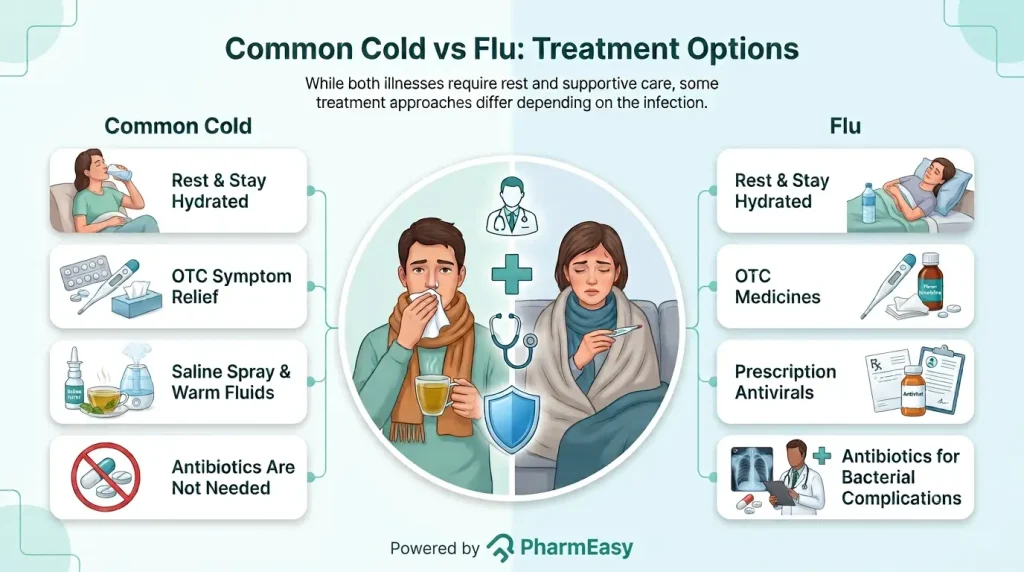
Although the common cold and the flu are caused by different viruses, the main management plan for both focuses on relieving symptoms while your immune system clears the infection. However, there might be some differences in certain medications.
Most colds improve on their own within a few days2. Management aims to relieve symptoms and may include:
Many people with the flu recover with rest, fluids, and over-the-counter medicines to manage fever and body aches. However, people with severe illness or those at high risk of complications may benefit from prescription antiviral medications. Prescription antiviral medicines may reduce symptom duration and the risk of certain complications, particularly when started within 48 hours of symptom onset. They may also be beneficial when started later in some people with severe illness or those at high risk of complications. . As with the common cold, antibiotics are not recommended unless a bacterial infection (such as secondary bacterial pneumonia) develops as a complication3.
Several laboratory tests are available to detect influenza viruses. These include rapid antigen tests, molecular tests such as RT-PCR, and viral culture in selected situations. A flu test is a quick test that looks for influenza viruses in a sample collected from your nose or throat, usually with a soft swab. These tests could be of different types. Some common examples include direct antigen detection, virus isolation, or detection of influenza-specific RNA by reverse transcriptase-polymerase chain reaction (RT-PCR)1.
A doctor may recommend a flu test if your symptoms strongly suggest influenza, especially during flu season, or if the results could help guide their treatment plan. Testing may also be considered if you1:
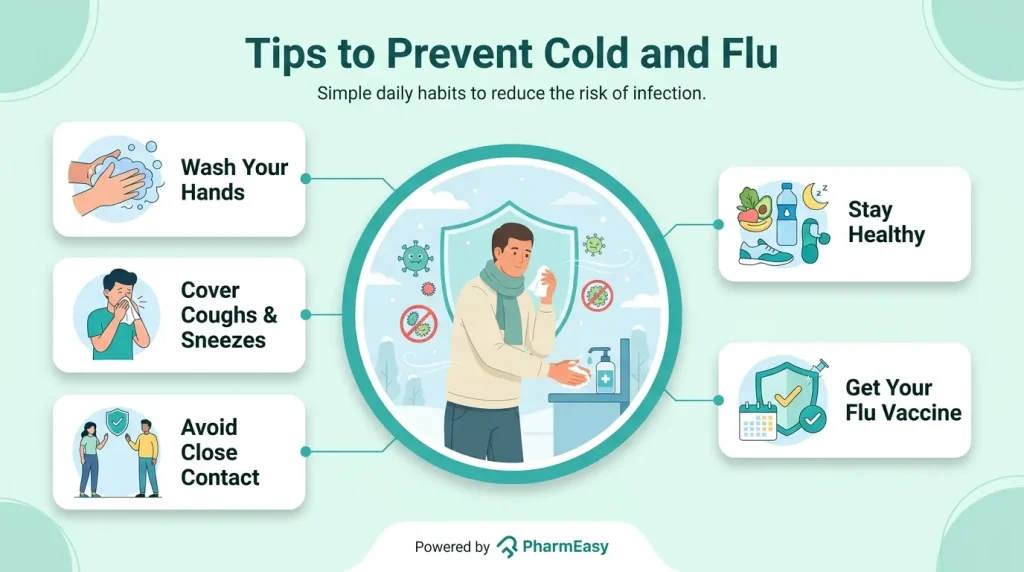
While it’s not always possible to avoid these infections, a few of the simple habits mentioned below can significantly reduce your risk of getting sick or spreading illness to others1,10.
Let us clear up some of the most common myths about the common cold vs the flu with evidence-based facts.
| Myth | Fact |
| Cold weather causes colds or the flu | Cold weather itself doesn’t make you sick. These illnesses are caused by viruses that spread more easily when people spend more time indoors in close contact with infected people as in the winter season1,8. |
| Antibiotics can be used in a cold or the flu | Antibiotics only work against bacterial infections. Since colds and the flu are caused by viruses, antibiotics are not effective unless a bacterial infection develops as a complication3,10. |
| The flu is just a bad cold | The flu is a different illness caused by a different virus that usually starts suddenly and is more likely to cause high fever, severe body aches, and complications in some people5. |
| The flu vaccine could give you the flu | Flu vaccines cannot cause influenza. Some people may experience mild, short-lived side effects, such as soreness at the injection site or a low-grade fever, as the immune system responds to the vaccine11. |
Also Read: Fever (High Temperature): Causes, Stages, Treatments, and Red Flags
Most colds and mild cases of flu improve with rest, fluids, and supportive care. However, some symptoms may indicate a more serious illness or complication and should be evaluated by a doctor.
You should seek medical advice if you or your child experience7,10.
You should also consider seeing a doctor if you are at high risk of complications. These include older adults, young children, pregnant women, or people with chronic medical conditions or weakened immune systems1.
Also Read: What is Influenza (Flu) & Its Types
Although the common cold and the flu share many symptoms, they are different health issues caused by different viruses. In general, a cold is usually milder and develops gradually, while the flu tends to come on suddenly and can cause more severe symptoms and complications. Therefore, recognising the differences can help you manage your symptoms appropriately, know when to seek medical care, and take steps to protect yourself and those around you.
In addition to these, simple measures, such as practicing good hand hygiene, staying home when you’re sick, and getting the annual flu vaccine, can go a long way in reducing your risk of infection.
Also Read: Types of Fever: Stages, Symptoms, Management Tips & More
Although this is not common, it could be possible to be infected with viruses that cause the common cold and the flu at the same time (in rare cases). This may make symptoms more severe or prolong recovery.
A cold usually develops gradually and mainly causes a runny nose, sneezing, and a mild cough. The flu often starts suddenly with a high fever, body aches, extreme tiredness, and sometimes vomiting or diarrhoea5,6,7. Consider consulting a doctor if your child has severe symptoms or you are concerned.
During the monsoon, high humidity and seasonal changes may contribute to increased circulation of respiratory viruses12. In addition to this, during the monsoon, people often spend more time indoors in close contact with others, making it easier for viruses to spread from an infected person to a non-infected person13.
A common cold cannot turn into the flu because they are caused by different viruses5. However, it could be possible to recover from one infection and then catch the other.
Influenza triggers a stronger immune response than the viruses that usually cause the common cold6. This widespread inflammation is why the flu is more likely to cause significant muscle aches, chills, and fatigue.
Wash your hands regularly, avoid close contact with sick individuals, cover coughs and sneezes, clean frequently touched surfaces, maintain a healthy lifestyle, and get the annual flu vaccine to reduce your risk of influenza1,10.
Fever can occur with many viral and bacterial infections, not just influenza9. While a high fever is very common with the flu, some people with influenza may not develop a fever.
1. Influenza (seasonal). Accessed July 8, 2026. Available from: https://www.who.int/news-room/fact-sheets/detail/influenza-(seasonal)
2. Pappas DE, Hendley JO. The Common Cold. Princ Pract Pediatr Infect Dis. Published online 2008:203-206. doi:10.1016/B978-0-7020-3468-8.50034-1 Available from: https://pmc.ncbi.nlm.nih.gov/articles/PMC7152197/
3. Kyokha Ameen Y. Seasonal Influenza: A Narrative Review of Epidemiology, Clinical Features, and Preventive Strategies. Cureus. 17(10):e95336. doi:10.7759/cureus.95336 Available from: https://pubmed.ncbi.nlm.nih.gov/41287674/
4. STRAUSS JH, STRAUSS EG. Overview of Viruses and Virus Infection. Viruses Hum Dis. Published online 2008:1-33. doi:10.1016/B978-0-12-373741-0.50004-0 Available from: https://pmc.ncbi.nlm.nih.gov/articles/PMC7149408/
5. CDC. Cold Versus Flu. Influenza (Flu). June 10, 2026. Accessed July 8, 2026. Available from: https://www.cdc.gov/flu/about/coldflu.html
6. Eccles R. Understanding the symptoms of the common cold and influenza. Lancet Infect Dis. 2005;5(11):718-725. doi:10.1016/S1473-3099(05)70270-X Available from: https://pubmed.ncbi.nlm.nih.gov/16253889/
7. CDC. Signs and Symptoms of Flu. Influenza (Flu). July 22, 2025. Accessed July 8, 2026. Available from: https://www.cdc.gov/flu/signs-symptoms/index.html
8. CDC. About Common Cold. Common Cold. February 19, 2026. Accessed July 8, 2026. Available from: https://www.cdc.gov/common-cold/about/index.html
9. Overview: Fever in children – InformedHealth.org – NCBI Bookshelf. Accessed July 8, 2026. Available from: https://www.ncbi.nlm.nih.gov/books/NBK279455/
10. How to treat the common cold at home: MedlinePlus Medical Encyclopedia. Accessed July 8, 2026. Available from: https://medlineplus.gov/ency/patientinstructions/000466.htm
11. Key Facts About Seasonal Flu Vaccine | Influenza (Flu) | CDC. Accessed July 8, 2026. Available from: https://www.cdc.gov/flu/vaccines/keyfacts.html
12. Humidity and respiratory virus transmission in tropical and temperate settings – PMC. Accessed July 8, 2026. Available from: https://pmc.ncbi.nlm.nih.gov/articles/PMC9507187/
13. Home alone? Effect of weather-induced behaviour on spread of SARS-CoV-2 in Germany – PMC. Accessed July 8, 2026. Available from: https://pmc.ncbi.nlm.nih.gov/articles/PMC8012168/
Disclaimer: The information provided here is for educational/awareness purposes only and is not intended to be a substitute for medical treatment by a healthcare professional and should not be relied upon to diagnose or treat any medical condition. The reader should consult a registered medical practitioner to determine the appropriateness of the information and before consuming any medication. PharmEasy does not provide any guarantee or warranty (express or implied) regarding the accuracy, adequacy, completeness, legality, reliability or usefulness of the information; and disclaims any liability arising thereof.
Links and product recommendations in the information provided here are advertisements of third-party products available on the website. PharmEasy does not make any representation on the accuracy or suitability of such products/services. Advertisements do not influence the editorial decisions or content. The information in this blog is subject to change without notice. The authors and administrators reserve the right to modify, add, or remove content without notification. It is your responsibility to review this disclaimer regularly for any changes.
 1
1 
Comments

Leave your comment...
You may also like

























Comments