




High Alkaline Phosphatase (ALP) in Pregnancy: Causes, Symptoms, Diagnosis and Treatment
By Dr. Charmi Shah +2 more

Medically reviewed by Dr. Charmi Shah
Last updated: Oct 16, 2026 Published on: Aug 19, 2026


Get,

to manage your symptom
Get your,

4 Cr+ families
benefitted

OTP sent to 9988776655



You’ve successfully subscribed to receive
doctor-approved tips on
Whatsapp

Get ready to feel your best.


Register to Avail the Offer
Send OTPBy continuing, you agree with our Privacy Policy and Terms and Conditions
Hi There,
Sign up on PharmEasy now!!


Trusted by 4 crore+ families

OTP sent to 9988776655
You have unlocked 25% off on medicines


Code: NU25

By Dr. Charmi Shah +2 more
Table of Contents
Has it ever happened that during a routine prenatal check-up, you glanced through your blood test report and noticed that your alkaline phosphatase (ALP) level was higher than the normal range?
We understand that seeing an abnormal test result during pregnancy can be worrying, but in many cases, a rise in ALP is a normal part of pregnancy. It normally happens as your body supports your baby’s growth and development. However, sometimes elevated ALP levels may be linked to an underlying condition that requires medical attention1,2.

This article explains why ALP can rise during pregnancy, when a high result may need closer review, what symptoms to watch for, how doctors usually investigate it, and what management may involve.
ALP is an enzyme that is found in several tissues of the body, especially the liver, bones, intestines, kidneys, and placenta. ALP is one of the blood markers doctors use to get clues about liver, bone, and pregnancy-related changes3.
During pregnancy, the placenta makes its own form of ALP. As the placenta grows, more of this ALP enters the mother’s bloodstream. This rise is usually most noticeable in the second and third trimesters4,5. Because ALP can also come from the liver and bones, doctors do not interpret the high level on its own. They look at your pregnancy stage, symptoms, and other blood test results before deciding whether more tests are needed2.
ALP levels normally increase as pregnancy progresses. Therefore, ALP levels that would be considered high in non-pregnant adults may be completely normal during pregnancy6,7.
| Group | Typical ALP Range (U/L) |
| Non-Pregnant Adults | 35 to 100 |
| Pregnant women | 20 to 270 |
Note: Reference ranges differ between laboratories and may also differ by trimester. Your doctor will compare your result with your stage of pregnancy, your symptoms, and other tests included in the routine liver function test panel, such as bilirubin, aspartate aminotransferase (AST), alanine aminotransferase (ALT), gamma-glutamyltransferase (GGT), and sometimes bile acids.
As a general rule, a mild or moderate rise in ALP late in pregnancy is often expected. A result that is rising very quickly, is much higher than expected for the trimester, or appears with symptoms such as itching, jaundice, severe headache, vision changes, abdominal pain, high blood pressure, or reduced baby movements should be discussed promptly with a doctor.
The common causes of high ALP during pregnancy include:
Other related causes may include:
Note: There is no specific ALP level that can reliably predict pregnancy complications or indicate that delivery is needed.
High ALP itself usually does not cause symptoms. If symptoms are present, they are more likely to come from the condition causing the ALP rise. Possible symptoms include2:
High ALP during pregnancy is usually detected through an ALP blood test. This test measures the level of ALP in your blood and helps determine whether the increase is a normal pregnancy-related change or a sign of an underlying condition2.
If the result is higher than expected, your doctor may order additional tests to understand where the ALP is coming from. These may include liver tests, bilirubin, GGT, bile acid testing if itching suggests ICP, vitamin D or calcium tests if a bone cause is suspected, blood pressure checks, urine testing for protein, and ultrasound or foetal monitoring when there are concerns about the baby’s growth or well-being.
An increase in ALP alone does not need treatment or extra monitoring of the baby. Many pregnant people do not need treatment because the rise is expected and related to the placenta. If tests suggest another cause, your doctor will treat that condition rather than the ALP level itself. Management may include:
Important: Do not try to lower ALP on your own or stop any medicine without medical advice. The safest next step is to ask your doctor whether your ALP level fits your stage of pregnancy and whether any follow-up tests are needed.
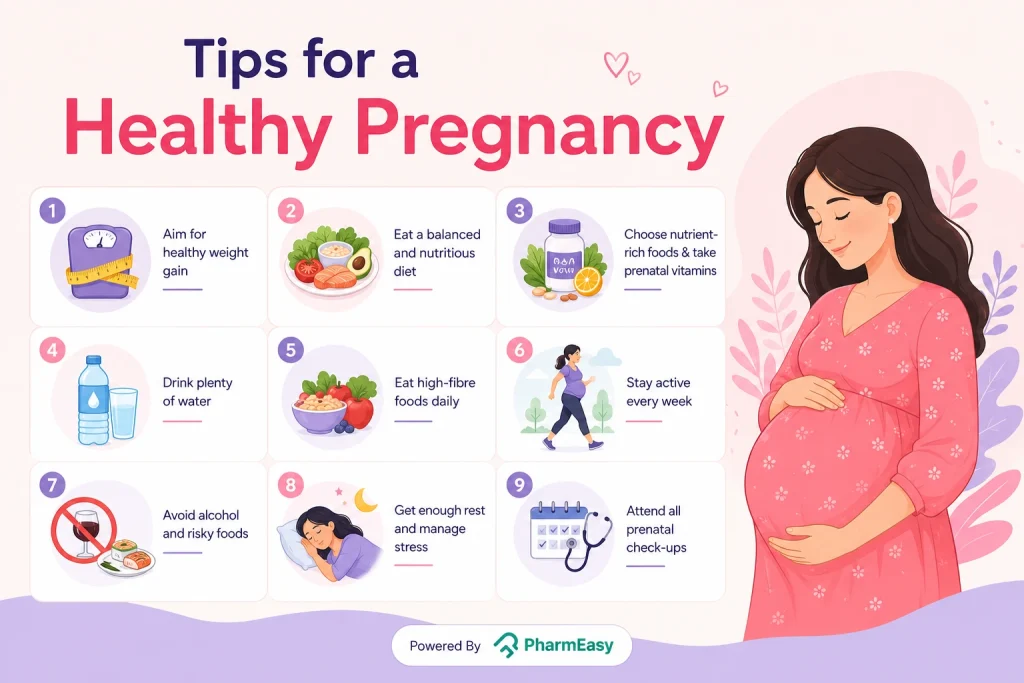
While high ALP in pregnancy is often a normal part of pregnancy, following a healthy lifestyle can support your overall well-being and your baby’s development. Here are some simple tips to help you have a healthy pregnancy13:
Also Read: Anaemia In Pregnancy: Types, Symptoms, Causes, Diagnosis and Treatment
You should contact your doctor promptly if a high ALP result comes with symptoms that may suggest a liver, bone, or pregnancy-related problem. Seek urgent care if you notice any of the following2,14:
Note: Even if you do not have any symptoms, attend all your scheduled prenatal appointments and discuss any abnormal blood test results with your doctor.
Also Read: Complete Pregnancy Test List Trimester-By-Trimester for Indian Mothers
If your ALP is high during pregnancy, especially in the later months, it is often a normal change caused by the growing placenta. A high ALP level alone does not mean that the placenta is not working properly, and it does not by itself indicate a pregnancy complication or the need for early delivery. However, ALP can also increase due to liver or bone problems, certain medicines, or other pregnancy-related conditions. Your doctor will consider your symptoms and other test results to understand what the raised ALP level means.
Regular prenatal check-ups, timely blood tests, and immediate attention to any warning symptoms can help ensure the health of both you and your baby. If you have concerns about your ALP levels or your pregnancy, speak with your doctor for appropriate advice and care.
Usually, no. A higher ALP level is often a normal pregnancy change because the placenta makes ALP as it grows. However, if ALP is very high or rising quickly, your doctor may check whether another issue is present, such as a liver condition or a placenta-related pregnancy complication. In those situations, the underlying condition, not the ALP level itself, may affect the baby and may need closer monitoring6.
ALP commonly rises during pregnancy, especially in the second and third trimesters, because the placenta is growing and producing more ALP1,4,5. The amount of increase varies from person to person, so two healthy pregnant people may have different ALP results.
Yes. Liver conditions such as ICP, hepatitis, or blockage in the bile ducts can raise ALP2,8. Doctors usually look at ALP together with other liver tests, such as AST, ALT, bilirubin, GGT, and sometimes bile acids, especially if there is itching, jaundice, dark urine, pale stools, or pain in the upper right side of the abdomen.
There is no particular ALP level that is dangerous for everyone during pregnancy. ALP is expected to be higher than usual, especially later in pregnancy6. Doctors pay closer attention when the level is much higher than expected, rises quickly, or appears with symptoms or abnormal results in other tests.
ALP usually falls after delivery as the pregnancy-related placental source is removed. In many people, it returns to the pre-pregnancy range within about 6 to 12 weeks, but the timing can vary4. Your doctor may repeat the blood test after birth if the level was very high, if symptoms continue, or if another cause is suspected.
1. Ferro B, Marques I, Paixão J, Almeida M do C. Incidental Finding of Extreme Elevation of Serum Alkaline Phosphatase in Pregnancy. Cureus. 13(8):e17211. doi:10.7759/cureus.17211 https://pubmed.ncbi.nlm.nih.gov/34540438/
2. Alkaline Phosphatase: MedlinePlus Medical Test. Accessed August 5, 2026. https://medlineplus.gov/lab-tests/alkaline-phosphatase/
3. Sharma U, Pal D, Prasad R. Alkaline Phosphatase: An Overview. Indian J Clin Biochem. 2014;29(3):269-278. doi:10.1007/s12291-013-0408-y https://pubmed.ncbi.nlm.nih.gov/24966474/
4. Connolly CT, Grubman O, Al-Ibraheemi Z, Kushner T. A Case of Markedly Elevated Isolated Alkaline Phosphatase in the Third Trimester of Pregnancy. Case Rep Obstet Gynecol. 2022;2022:1611304. doi:10.1155/2022/1611304 https://europepmc.org/article/med/35531126
5. Ranganath L, Taylor W, John L, Alfirevic Z. Biochemical diagnosis of placental infarction/damage: acutely rising alkaline phosphatase. Ann Clin Biochem. 2008;45(3):335-338. doi:10.1258/acb.2007.007098 https://pubmed.ncbi.nlm.nih.gov/18482929/
6. Stanley Z, Vignes K, Marcum M. Extreme elevations of alkaline phosphatase in pregnancy: A case report. Case Rep Womens Health. 2020;27:e00214. doi:10.1016/j.crwh.2020.e00214 https://pubmed.ncbi.nlm.nih.gov/32461917/
7. Reference Ranges During Pregnancy. Pathology laboratories NHS. Accessed August 12, 2026. https://pathlabs.rlbuht.nhs.uk/chempregranges.htm
8. Dajti E, Bruni A, Barbara G, Azzaroli F. Diagnostic Approach to Elevated Liver Function Tests during Pregnancy: A Pragmatic Narrative Review. J Pers Med. 2023;13(9):1388. doi:10.3390/jpm13091388 https://pubmed.ncbi.nlm.nih.gov/37763154/
9. Minz P, Oroan A, Kujur A, Paswan DK, Nag AR. Effects of anticonvulsant drug on liver enzymes among children in a tribal state of India: A longitudinal study. J Family Med Prim Care. 2023;12(7):1394-1398. doi:10.4103/jfmpc.jfmpc_2307_22 https://pubmed.ncbi.nlm.nih.gov/37649745/
10. Crites K, Shanks AL, Maines J. Pregnancy Intrahepatic Cholestasis. In: StatPearls. StatPearls Publishing; 2026. Accessed August 5, 2026. http://www.ncbi.nlm.nih.gov/books/NBK551503/
11. Rajab HA. The Effect of Vitamin D Level on Parathyroid Hormone and Alkaline Phosphatase. Diagnostics. 2022;12(11):2828. doi:10.3390/diagnostics12112828 https://pubmed.ncbi.nlm.nih.gov/36428888/
12. Cluver C, Novikova N, Koopmans CM, West HM. Planned early delivery versus expectant management for hypertensive disorders from 34 weeks gestation to term. Cochrane Database Syst Rev. 2017;1(1). doi:10.1002/14651858.CD009273.pub2 https://pubmed.ncbi.nlm.nih.gov/28106904/
13. Health Tips for Pregnant Women – NIDDK. National Institute of Diabetes and Digestive and Kidney Diseases. Accessed August 5, 2026. https://www.niddk.nih.gov/health-information/weight-management/healthy-eating-physical-activity-for-life/health-tips-for-pregnant-women
14. Urgent Maternal Warning Signs and Symptoms. CDC. February 18, 2026. Accessed August 5, 2026. https://www.cdc.gov/hearher/maternal-warning-signs/index.html
Disclaimer: The information provided here is for educational/awareness purposes only and is not intended to be a substitute for medical treatment by a healthcare professional and should not be relied upon to diagnose or treat any medical condition. The reader should consult a registered medical practitioner to determine the appropriateness of the information and before consuming any medication. PharmEasy does not provide any guarantee or warranty (express or implied) regarding the accuracy, adequacy, completeness, legality, reliability or usefulness of the information; and disclaims any liability arising thereof.
Links and product recommendations in the information provided here are advertisements of third-party products available on the website. PharmEasy does not make any representation on the accuracy or suitability of such products/services. Advertisements do not influence the editorial decisions or content. The information in this blog is subject to change without notice. The authors and administrators reserve the right to modify, add, or remove content without notification. It is your responsibility to review this disclaimer regularly for any changes.


Comments

Leave your comment...
You may also like

























Comments