Get,

Free Doctor Tips

to manage your symptom

Get your,

FREE Doctor Tips Now!!

4 Cr+ families

benefitted

Enter your Phone Number

+91

|

Enter a valid mobile number

Send OTP

Verify your mobile number

OTP sent to 9988776655

CONGRATULATIONS!!!

You’ve successfully subscribed to receive

doctor-approved tips on Whatsapp


Get ready to feel your best.

Hi There,

Download the PharmEasy App now!!

AND AVAIL

AD FREE reading experience
Get 25% OFF on medicines
Banner Image

Register to Avail the Offer

Send OTP

By continuing, you agree with our Privacy Policy and Terms and Conditions

Success Banner Image
Verify your mobile number

OTP sent to 9988776655

Comments

Subscribe
Notify of
guest
0 Comments
Inline Feedbacks
View all comments

Leave your comment here

Your email address will not be published. Required fields are marked *

25% OFF on medicines

Collect your coupon before the offer ends!!!

COLLECT

Anti Mullerian Hormone (AMH): What Is It, Normal Range & How to Increase AMH Levels

By Dr. Akash N. Shah +2 more

Join Health Talk by PharmEasy on WhatsApp

Introduction

Many people consider age when it comes to fertility, but there is an additional key factor that might provide valuable insights anti-mullerian hormone (AMH). AMH is important in evaluating the ovarian reserve and can assist doctors in determining reproductive potential of the individual1. This article explores everything you need to know about AMH, including what it is, its normal range, and what low and high AMH levels mean.
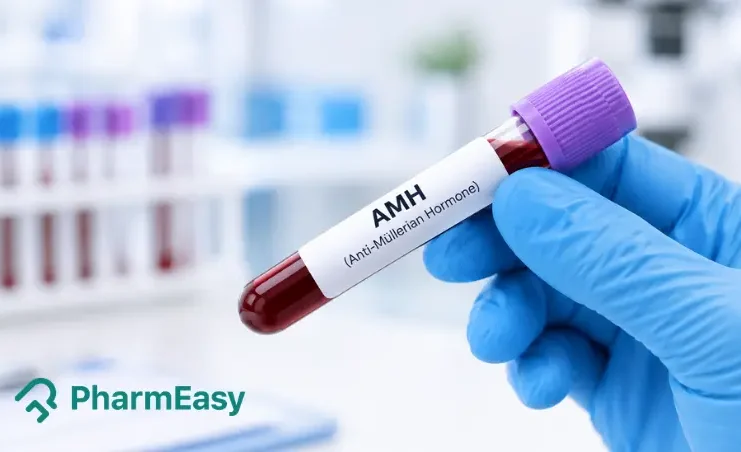
Anti Mullerian Hormone

What Is Anti-Mullerian Hormone (AMH)?

Anti-mullerian hormone (AMH) is a hormone that plays an important role in reproductive development and ovarian function. In women, it is produced by small growing follicles (tiny fluid-filled sacs) in the ovaries that contain immature eggs. The amount of AMH in the blood can indirectly help the experts estimate the size of ovarian follicular pool, which is why it is widely employed as an indicator of ovarian reserve.

Advertisement

In men, AMH is produced by the Sertoli cells in the testes from their foetal development stage through childhood. It contributes to the normal development of the male reproductive system before birth. However, after puberty, its levels decrease in men as the sertoli cells mature1.

Did You Know?

  • AMH levels are high in males in childhood, while in females, AMH levels peak after puberty1.
  • AMH levels are seen to be high in women with polycystic ovarian syndrome (PCOS) due to the presence of a larger number of small ovarian follicles.
  • AMH may also be used as a tumour marker for certain types of tumors, to help diagnose and monitor certain ovarian tumours2.

The Role of AMH

AMH and its assessment has many different functions in the human body, including the following:

  • Helps Assess Ovarian Reserve: AMH level can be used to assess the number of growing follicles in the ovaries. Higher AMH levels often suggest a greater ovarian reserve, while lower levels may indicate a smaller reserve1.
  • Regulates Follicle Growth: AMH helps to modulate follicular development, as AMH helps regulate early follicular recruitment and reduces sensitivity of developing follicles to FSH3.
  • Supports Normal Male Reproductive Development: AMH helps prevent the development of female reproductive structures during male foetal development.
  • Allows Normal Female Reproductive Development: In female foetuses, the absence or very low levels of AMH allow the normal development ofmullerian structures1.

Benefits of Healthy AMH Levels

The benefits associated with healthy AMH levels include:

  • Supports Better Reproductive Planning: Knowing that AMH levels are within the expected range might help women make informed decisions about family planning and when to seek fertility advice if needed.
  • Provides an estimate About Ovarian Health: AMH levels in the normal range may indicate that ovarian function is age-appropriate, although they do not represent egg quality or guarantee fertility1.
  • Supports Diagnosis in Suspected Case of PCOS: AMH testing can support the diagnosis of conditions such as polycystic ovary syndrome (PCOS), a condition which can affect fertility1, when combined with symptoms, ultrasound findings, and other hormone tests.
  • Supports Fertility Evaluation: AMH can help doctors estimate how the ovaries may respond to fertility treatments such as In-vitro fertilisation (IVF)1.

What Happens When AMH Levels Are Low or High?

Both low and high AMH levels can provide important information on reproductive health. Here’s what each may indicate:

Low AMH Levels

Low AMH levels often indicate that a woman’s ovaries have fewer eggs than expected for her age. The possible causes include:

Advertisement
  • Reduced ovarian reserve
  • Ageing/menopause (when combined with other symptoms)

The potential implications of low AMH level:

  • Lower response to fertility medications (in women undergoing treatment with medicines for fertility)
  • Difficulty conceiving
  • Poor development of male genital organs in a male foetus1

High AMH Levels

High AMH levels often indicate a larger number of developing follicles. it can also be associated with:

  • Larger ovarian reserve
  • Increased likelihood of PCOS
  • Certain types of Ovarian tumour/cancer
  • Greater ovarian stimulatiom response to fertility medications during IVF1
  • Increased risk of ovarian hyperstimulation syndrome (OHSS), a condition in which ovaries become swollen and painful after responding too strongly to fertility medications (very high AMH levels may be a marker for this condition)4

AMH Test: How Is It Done?

The AMH test is a simple blood test that requires no special preparation. Here is how it is done:

  • A trained paramedic will collect a small blood sample from a vein in your arm.
  • The test can usually be performed on any day of the menstrual cycle, however there are some variations throughout the mestrual cycle5.
  • The blood is collected into a test tube or vial and then sent to a laboratory for analysis.
  • You may experience some minor discomfort when the needle is inserted or removed during blood collection.
  • The doctor might interpret the results based on one’s age, medical history, fertility goals, and other test results rather than relying on the AMH value alone1.

Anti Mullerian Hormone Normal Range

AMH levels are commonly interpreted as follows:

  • Low AMH: May indicate a low ovarian reserve, meaning fewer eggs remain in the ovaries5. It does not necessarily mean you cannot become pregnant.
  • Normal AMH: May suggest an age-appropriate ovarian reserve However, it does not reflect egg quality or guarantee fertility1,5.
  • High AMH: May indicate a high ovarian reserve and is commonly seen in women with PCOS5.

Note: The AMH reference range may differ slightly across laboratories, testing methods, and age groups. The doctor will interpret the AMH results based on one’s age, medical history, symptoms, and the results of other tests.

How to Increase AMH Levels?

Adopting healthy lifestyle habits may support overall reproductive health and ovarian function. Although these habits may not directly increase anti-mullerian hormone levels, they can help support overall fertility. Here are some ways to support ovarian health and fertility:

  • Eat a nutrient-rich diet that includes fruits, vegetables, whole grains, lean protein, healthy fats, and antioxidant-rich foods.
  • Maintain a healthy body weight because being underweight or overweight might harm reproductive health.
  • Avoid smoking and limit alcohol, as both may negatively affect ovarian function and fertility6.
  • Manage stress through activities such as yoga, meditation, or deep breathing, which can support overall well-being6,7.
  • Treat underlying medical conditions, such as PCOS, with appropriate medical guidance to support overall reproductive health5.

Note: There is no proven natural approach for increasing AMH levels. These lifestyle changes benefit general reproductive health and fertility, although they may not significantly affect AMH levels, which normally decrease with age.

When to Consult a Doctor?

Consult a doctor if you have:

  • Been trying to conceive for 12 months (or 6 months if aged 35 or older) with no results (especially if AMH levels are low)1,8.
  • Been diagnosed with PCOS or are suspected to have it due to having symptoms such as irregular periods increased hair growth on the chest, face, etc. acne/pimples darkening of skin over back of neck, armpits and groin, and weight gain.
  • Received an abnormal AMH test result and want guidance on what it means for you1.
  • Symptoms of menopause, such as irregular, short or longer periods, problems with sleeping, mood changes, and vaginal dryness1,9.
  • Symptoms such as pelvic pain, abnormal vaginal bleeding, and difficulty in eating, particularly in women1,10.

Note: The above mentioned scenarios do not indicate a direct test for AMH level, those might indicate the need to consult a doctor.

Conclusion

Anti-Mullerian hormone (AMH) is a valuable marker for assessing ovarian reserve and is commonly used as a part of fertility evaluation however, it does not provide a complete picture of fertility. Understanding AMH levels can help support informed decisions about reproductive health and family planning. In cases you have fertility concerns or abnormal AMH test results, consulting a doctor is important for comprehensive evaluation and appropriate guidance.

Also Read: What Does Oxytocin Do? Everything You Need to Know About the Love Hormone

Frequently Asked Questions (FAQs)

What is a good AMH level to get pregnant?

There is no single good AMH level that guarantees pregnancy. AMH level reflects ovarian reserve. For conception in an otherwise healthy female, there are other factors which play an important role, like age, egg quality, reproductive health, sperm health of partner.

Does low AMH mean infertility?

No. A low AMH level does not mean infertility. It simply suggests a reduced ovarian reserve, meaning fewer eggs remain in the ovaries. While a low AMH level may be associated with reduced fertility in some individuals, it does not determine the ability to conceive1, as factors such as egg quality, age, and overall reproductive health also play an important role in fertility.

Can high AMH levels indicate PCOS?

Yes. High AMH levels may be linked to PCOS, as women with PCOS typically have a greater number of tiny ovarian follicles that produce AMH. However, a high AMH level alone cannot diagnose PCOS and it should be interpreted along with symptoms and other examination findings1.

At what age do AMH levels decline in women?

AMH level varies across the lifespan and generally reaches its highest levels in early adulthood, around 20–25 years, afterwards it gradually declins with age11.

How to increase AMH level naturally?

There is no proven, natural method for increasing AMH levels. However, living a healthy lifestyle, which includes eating a balanced diet, exercising regularly, maintaining a healthy weight, quitting smoking, and managing stress can benefit overall reproductive health and fertility6.

References

  1. Anti-Müllerian Hormone Test. 2023. doi: https://medlineplus.gov/lab-tests/anti-mullerian-hormone-test/
  2. Kruszyńska A, Słowińska-Srzednicka J. Anti-Müllerian hormone (AMH) as a good predictor of time of menopause. pm. 2017;2:47-50. doi:10.5114/pm.2017.68591. https://pubmed.ncbi.nlm.nih.gov/28721129/
  3. Gruijters MJG, Visser JA, Durlinger ALL, Themmen APN. Anti-Müllerian hormone and its role in ovarian function. Molecular and Cellular Endocrinology. 2003;211(1-2):85-90. doi:10.1016/j.mce.2003.09.024. https://pubmed.ncbi.nlm.nih.gov/14656480/
  4. Sun B, Ma Y, Li L, et al. Factors Associated with Ovarian Hyperstimulation Syndrome (OHSS) Severity in Women With Polycystic Ovary Syndrome Undergoing IVF/ICSI. Front Endocrinol. 2021;11:615957. doi:10.3389/fendo.2020.615957. https://pubmed.ncbi.nlm.nih.gov/33542709/
  5. Anti–Müllerian Hormone (AMH) Test. 2026. doi: https://www.plymouthhospitals.nhs.uk/display-pil/pil-antimllerian-hormone-amh-test-5585/
  6. Donato M, Capalbo A, Morizio E, et al. The Role of Lifestyle Intervention in Female Fertility: A Modifiable Factor for Preconception Health. Nutrients. 2025;17(13):2101. doi:10.3390/nu17132101. https://pubmed.ncbi.nlm.nih.gov/40647206/
  7. Relaxation techniques for stress. 2024. doi: https://medlineplus.gov/ency/patientinstructions/000874.htm
  8. Infertility. 2026. doi: https://womenshealth.gov/a-z-topics/infertility
  9. Menopause. 2026. doi: https://medlineplus.gov/menopause.html
  10. Symptoms of Ovarian Cancer. 2025. doi: https://www.cdc.gov/ovarian-cancer/symptoms/index.html
  11. Lie Fong S, Visser JA, Welt CK, et al. Serum Anti-Müllerian Hormone Levels in Healthy Females: A Nomogram Ranging from Infancy to Adulthood. The Journal of Clinical Endocrinology & Metabolism. 2012;97(12):4650-4655. doi:10.1210/jc.2012-1440. https://pubmed.ncbi.nlm.nih.gov/22993032/

Disclaimer: The information provided here is for educational/awareness purposes only and is not intended to be a substitute for medical treatment by a healthcare professional and should not be relied upon to diagnose or treat any medical condition. The reader should consult a registered medical practitioner to determine the appropriateness of the information and before consuming any medication. PharmEasy does not provide any guarantee or warranty (express or implied) regarding the accuracy, adequacy, completeness, legality, reliability or usefulness of the information; and disclaims any liability arising thereof.

Links and product recommendations in the information provided here are advertisements of third-party products available on the website. PharmEasy does not make any representation on the accuracy or suitability of such products/services. Advertisements do not influence the editorial decisions or content. The information in this blog is subject to change without notice. The authors and administrators reserve the right to modify, add, or remove content without notification. It is your responsibility to review this disclaimer regularly for any changes.

Advertisement

Comments

Leave your comment...