



What Does Oxytocin Do? Everything You Need to Know About the Love Hormone
By Dr. Akash N. Shah +2 more

Medically reviewed by Dr. Akash N. Shah
Last updated: Oct 16, 2026 Published on: Jul 21, 2026


Get,

to manage your symptom
Get your,

4 Cr+ families
benefitted

OTP sent to 9988776655



You’ve successfully subscribed to receive
doctor-approved tips on
Whatsapp

Get ready to feel your best.


Register to Avail the Offer
Send OTPBy continuing, you agree with our Privacy Policy and Terms and Conditions
Hi There,
Sign up on PharmEasy now!!


Trusted by 4 crore+ families

OTP sent to 9988776655
You have unlocked 25% off on medicines


Code: NU25

By Dr. Akash N. Shah +2 more
Table of Contents
Why do simple hugs feel so comforting? One of the key hormones responsible is oxytocin, commonly referred to as the “love hormone”. This hormone influences various social as well as non-social behaviours in humans. This blog will cover its role in the body, effects in men and women, benefits, and tips to naturally increase oxytocin1.
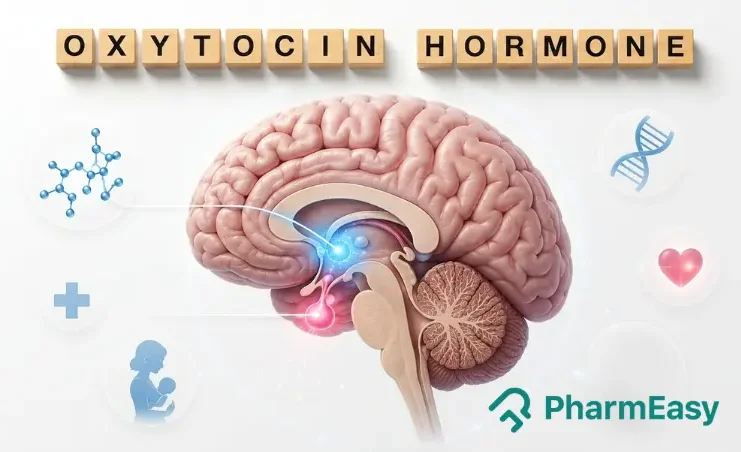
Oxytocin is a hormone (chemical messenger) that is widely known for its role in breastfeeding and childbirth. Oxytocin is synthesised by the hypothalamus of the brain (primarily) and is then transported to and released into the bloodstream by another part of the brain known as the posterior pituitary. It is often referred to as the “love hormone” because it is known to support social bonding and feelings of attachment1.
Did You Know?
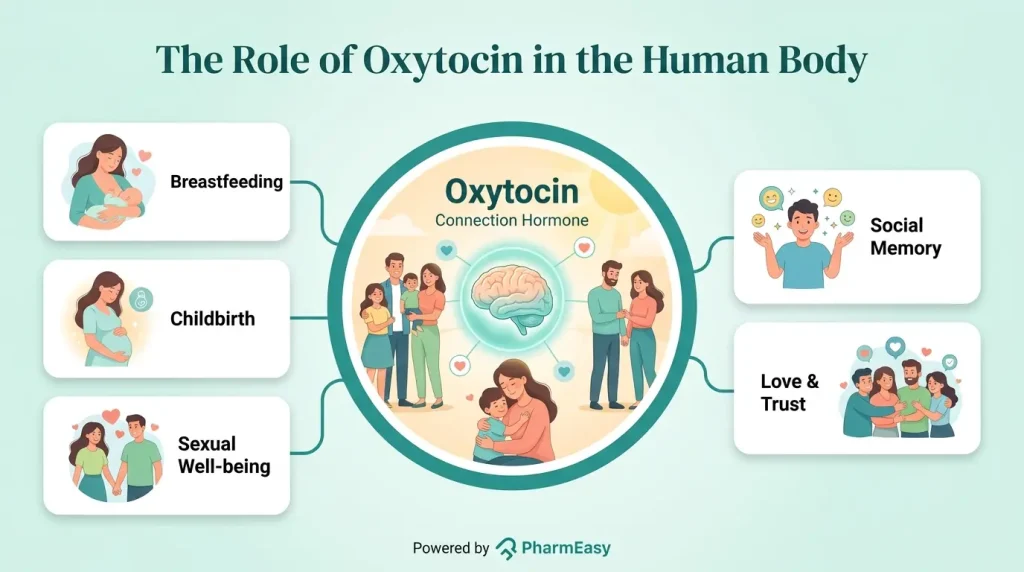
Oxytocin hormone plays a wide variety of functions throughout the body, including:
Although oxytocin is usually considered a “female hormone”, it plays a key role in male reproduction. The love hormone in males plays a role in sperm release and probably supports normal prostate function (a male reproductive organ). It also is responsible for sexual arousal in men1,4.
In women, oxytocin helps the onset and progress of uterine contractions during labour. Furthermore, it facilitates breastfeeding after the baby is born. Lastly, the female love hormone increases vaginal lubrication and feelings of arousal in women.
A key difference between oxytocin’s effects in males vs females is that in females, it is primarily responsible for breastfeeding and labour, whereas in males, it supports reproductive functions. A similarity in both males and females is that it contributes to sexual arousal and social attachment1.
Oxytocin is known to facilitate the following:
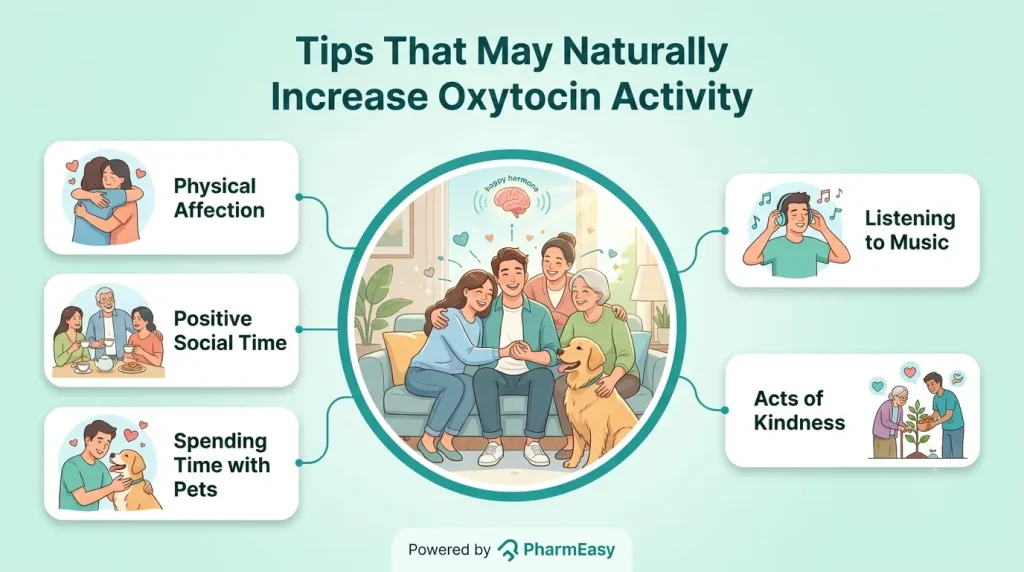
Some social and positive experiences are associated with increased oxytocin release or activity, although the effects vary between individuals and situations2:
Also Read: High Prolactin Levels (Hyperprolactinemia): Causes, Symptoms, Diagnosis, and Treatment
In conclusion, oxytocin has diverse functions, both physiological and emotional. It plays a very important role during childbirth and breastfeeding. It is also associated with social bonding and positive feelings. Massage, hugs, and sexual activity may lead to an increase in oxytocin levels. Its role demonstrates how connected hormones are to both our physical as well as mental well-being1,5.
Yes, oxytocin may improve your mood and reduce your stress and anxiety2.
Chronic stress, social isolation, and reduced positive social interactions may be associated with lower oxytocin activity1.
Certain acts like good physical and social interactions, playing with pets, and listening to music may help with better regulation of oxytocin2.
There is no evidence of any food that can trigger oxytocin2.
Oxytocin is called as a love hormone because it facilitates feelings of bonding, trust, and attachment in humans1.
1. Lee HJ, Macbeth AH, Pagani JH, Scott Young W. Oxytocin: The great facilitator of life. Prog Neurobiol. 2009;88(2):127-151. doi:10.1016/j.pneurobio.2009.04.001 https://pmc.ncbi.nlm.nih.gov/articles/PMC2689929/
2. Resources CG. How to Increase Your “Feel-Good” Hormones and Neurochemicals | HR Life & Work Connections. March 16, 2025. Accessed July 1, 2026. https://lifework.arizona.edu/news/2025/how-increase-your-feel-good-hormones-and-neurochemicals
3. Oxytocin. Accessed July 1, 2026. https://vivo.colostate.edu/hbooks/pathphys/endocrine/hypopit/oxytocin.html
4. Thackare H, Nicholson HD, Whittington K. Oxytocin—its role in male reproduction and new potential therapeutic uses. Hum Reprod Update. 2006;12(4):437-448. doi:10.1093/humupd/dmk002 https://pubmed.ncbi.nlm.nih.gov/16436468/
5. Oxytocin: The love hormone. Harvard Health. July 20, 2021. Accessed July 1, 2026. https://www.health.harvard.edu/mind-and-mood/oxytocin-the-love-hormone
Disclaimer: The information provided here is for educational/awareness purposes only and is not intended to be a substitute for medical treatment by a healthcare professional and should not be relied upon to diagnose or treat any medical condition. The reader should consult a registered medical practitioner to determine the appropriateness of the information and before consuming any medication. PharmEasy does not provide any guarantee or warranty (express or implied) regarding the accuracy, adequacy, completeness, legality, reliability or usefulness of the information; and disclaims any liability arising thereof.
Links and product recommendations in the information provided here are advertisements of third-party products available on the website. PharmEasy does not make any representation on the accuracy or suitability of such products/services. Advertisements do not influence the editorial decisions or content. The information in this blog is subject to change without notice. The authors and administrators reserve the right to modify, add, or remove content without notification. It is your responsibility to review this disclaimer regularly for any changes.


Comments

Leave your comment...
You may also like






Comments