




Female Infertility: Causes, Symptoms, Treatment and More
By Dr. Charmi Shah +2 more

Medically reviewed by Dr. Charmi Shah
Last updated: Sep 15, 2026 Published on: May 6, 2026


Get,

to manage your symptom
Get your,

4 Cr+ families
benefitted

OTP sent to 9988776655



You’ve successfully subscribed to receive
doctor-approved tips on
Whatsapp

Get ready to feel your best.


Register to Avail the Offer
Send OTPBy continuing, you agree with our Privacy Policy and Terms and Conditions
Hi There,
Sign up on PharmEasy now!!


Trusted by 4 crore+ families

OTP sent to 9988776655
You have unlocked 25% off on medicines


Code: NU25

By Dr. Charmi Shah +2 more
Table of Contents
For couples, the journey to parenthood begins with hope and excitement. But sometimes when months pass without a positive pregnancy test, that hope slowly turns into worry, confusion, and even frustration. If this is how you feel, you’re not alone. Difficulty conceiving (for both men and women) is more common than most people realise.
Female infertility refers to the inability to get pregnant despite trying regularly. It could result from a variety of factors, ranging from hormonal imbalances to structural problems or underlying medical conditions. The reassuring part is that infertility is often manageable with early evaluation and timely intervention with the right medical support1,2.
In this blog, we will walk you through everything you need to know about female infertility, from common female infertility causes to available management options and when to seek medical help, allowing you to make well-informed choices about your reproductive health.
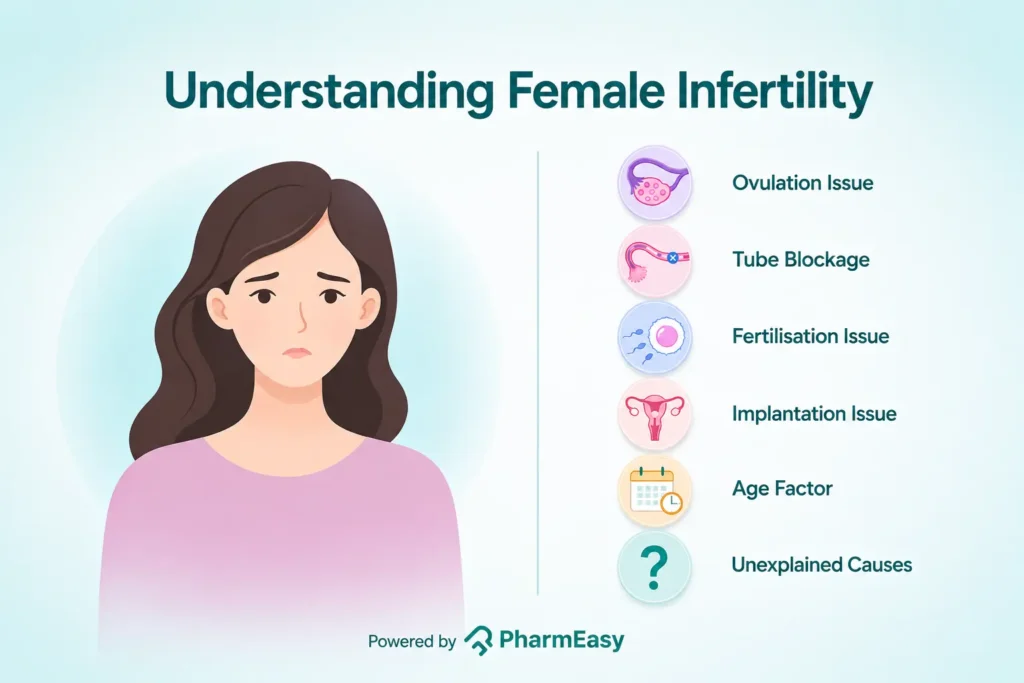
To better understand female infertility, let’s first understand how a pregnancy occurs. Each month, a woman’s ovaries release an egg (ovulation), which travels through the fallopian tube, where it may be fertilised by sperm. The fertilised egg then moves to the uterus, where it may implant and grow into a pregnancy3. For a pregnancy to occur, all these steps need to work together smoothly. A problem at any stage may make it more difficult to conceive (get pregnant).
Doctors usually define female infertility as not being able to conceive after one year of unprotected intercourse (or after 6 months for women above 35 years of age). Repeated miscarriages can also be considered a form of infertility1.
Infertility may be more common than many people think. Around 85% of couples conceive within a year, and the chances of getting pregnant each month are typically 15–20%. However, about 15% of couples worldwide face infertility, with female factors contributing to nearly half of these cases2.
Types of infertility in females are generally based on whether a woman has been pregnant before4:
Female infertility can occur when any step in the reproductive process is disrupted. This may happen if the ovaries do not produce healthy eggs, if the egg cannot travel from the ovaries to the uterus, or if a fertilised egg fails to implant properly in the uterine lining. In some cases, even after implantation, the embryo may not survive or develop normally5.The most common reasons for female infertility include:
The reproductive process is controlled by hormones regulated by the hypothalamus and pituitary glands (glands that are located in the brain and control many body functions). Any imbalance in this system can disrupt ovulation (release of a mature egg from the ovary). Conditions such as pituitary tumours or hypopituitarism (inadequate hormone production by the pituitary gland) can interfere with normal hormone levels and fertility3.
Problems with the ovaries can affect egg production or release. These may include2,4:
Damage or blockage in the fallopian tubes can prevent the egg and sperm from meeting. This is often caused by untreated sexually transmitted infections (STIs), complications from unsafe abortions, postpartum infections, or previous abdominal or pelvic surgeries3. Additionally, tubal damage may also occur due to genital tuberculosis (TB), which can cause scarring and blockage of the fallopian tubes6.
Conditions affecting the uterus can interfere with implantation of the fertilised egg or pregnancy. These may include3:
Note: In some cases, no clear cause may be identified. This is known as unexplained infertility2.
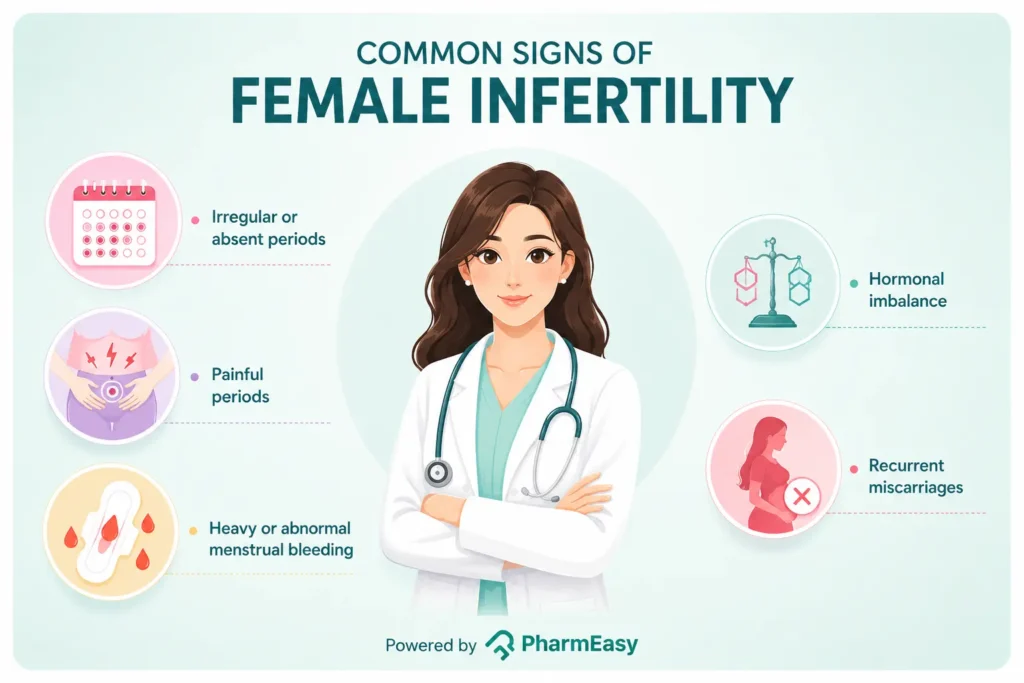
In many cases, infertility may not have any obvious symptoms. The only sign is difficulty in getting pregnant despite regular, unprotected intercourse. However, certain female infertility symptoms or signs can point toward underlying issues affecting fertility. Common signs and symptoms of female infertility include:
Certain factors can increase a woman’s risk of infertility by affecting ovulation, egg quality, or overall reproductive health. These risk factors may not directly cause infertility but can significantly reduce the chances of conception. Common risk factors include:
Diagnosis of infertility in females usually involves a combination of blood tests, imaging studies, and ovulation assessments to identify the underlying cause. These tests help evaluate hormone levels, ovarian function, and the structure of reproductive organs. Common diagnostic tests include:
A range of blood tests is used to evaluate hormonal balance and detect underlying conditions5,12,13:
Note: Your doctor may also suggest blood test packages that include parameters to check female reproductive health.
Also Read: What Is Ovulation? Understanding The Ovulation Process and Symptoms
Female infertility treatment depends on the underlying cause, age, and overall health. In many cases, a combination of approaches is used to improve the chances of conception. All of these options will be based on your doctor’s advice2:
Changes in lifestyle, such as weight management and quitting smoking, alcohol use, or recreational drug use can help preserve fertility. According to a recent study, lifestyle changes, including a weight loss of about 5–10%, can restore ovulation in 50–60% of obese women with PCOS.
Medications are often the first-line options, especially for women with ovulation disorders. They help stimulate ovulation and correct hormonal imbalances. Antibiotics may also be prescribed if infections are present.
When medications alone are not effective, assisted reproductive techniques may be recommended. These include:
Note: IUI is usually tried first in selected cases, while IVF is recommended when other treatments fail or in more complex conditions. However, success rates for both depend on factors such as age and ovarian reserve.
Also Read: IVF (In Vitro Fertilization): What is It, Procedure, Steps, Side Effects & More
Surgery may be needed to correct structural abnormalities that interfere with fertility. Procedures such as hysteroscopy or laparoscopy can help treat conditions like fibroids, endometriosis, or uterine abnormalities. Tubal surgeries may also be performed to restore normal function in selected cases.
Advanced options like the use of donor eggs or genetic testing of embryos can be considered in specific cases, especially when ovarian reserve is low or with increasing age.
While not all female infertility causes can be prevented, adopting healthy habits can support reproductive health and improve the chances of conception. Some options include15:
Note: Egg freezing (oocyte cryopreservation) allows women to preserve their eggs for future use. It is useful for those who wish to delay pregnancy or are undergoing medical treatments that may affect fertility. However, success rates are generally better when eggs are frozen at a younger age16.
Knowing when to seek medical help is important for early diagnosis and better outcomes. You should consider seeing a doctor if1,2,5:
Also Read: HIV Cure: Is it possible? Know the Symptoms and Treatment Options
Female infertility is a complex but common condition that can arise from a variety of factors, including hormonal imbalances, structural issues, lifestyle influences, and underlying medical conditions. While it can feel overwhelming, understanding female infertility causes, symptoms, and available diagnostic options is the first step toward effective management.
The encouraging part is that many cases of infertility are manageable, with a range of options (from medications and lifestyle modifications to advanced techniques like IVF) that could help improve fertility. Early evaluation, timely intervention, and a personalised approach to care can make a significant difference in infertility treatment.
Ovulation is just one part of conception. Pregnancy may still not happen due to issues like blocked fallopian tubes, poor egg quality, sperm-related factors, or problems with implantation2,5.
Ashwagandha may help reduce stress, but there is no strong evidence for its role in improving female fertility17. Therefore, it should never replace medical treatment.
Many causes are treatable or manageable, depending on the underlying issue2,4. Your doctor will help you with the right treatment based on your medical history.
In some cases, yes. Certain genetic and chromosomal conditions (such as Turner syndrome, fragile X premutation, and structural chromosomal abnormalities) may affect ovarian function and fertility2. However, not all infertility is genetic, and many causes may be unrelated to inherited factors.
There is no strong evidence that normal cell phone use causes female infertility18. However, limiting excessive exposure to radiation may still be considered a good precaution.
Typhoid itself usually does not cause infertility. However, severe or untreated infections may rarely lead to complications that could affect overall health19.
Stress alone may not directly cause infertility, but it can affect hormones and ovulation, making it harder to conceive15. So, managing stress may help improve overall fertility.
1. Female Infertility. Accessed April 29, 2026. https://medlineplus.gov/femaleinfertility.html
2. Adebisi OY, Singh M, Tobler KJ. Female Infertility. In: StatPearls. StatPearls Publishing; 2026. Accessed April 29, 2026. http://www.ncbi.nlm.nih.gov/books/NBK556033/
3. The menstrual cycle. Accessed May 1, 2026. https://womenshealth.gov/pregnancy/menstrual-cycle
4. Infertility. Accessed April 29, 2026. https://www.who.int/news-room/fact-sheets/detail/infertility
5. Infertility: MedlinePlus Medical Encyclopedia. Accessed April 29, 2026. https://medlineplus.gov/ency/article/001191.htm
6. Genital tuberculosis in females – PMC. Accessed April 30, 2026. https://pmc.ncbi.nlm.nih.gov/articles/PMC5663156/
7. Attia GM, Alharbi OA, Aljohani RM. The Impact of Irregular Menstruation on Health: A Review of the Literature. Cureus. 15(11):e49146. doi:10.7759/cureus.49146 https://pmc.ncbi.nlm.nih.gov/articles/PMC10733621/
8. Harada T. Dysmenorrhea and Endometriosis in Young Women. Yonago Acta Med. 2013;56(4):81-84. https://pubmed.ncbi.nlm.nih.gov/24574576/
9. Uimari O, Subramaniam KS, Vollenhoven B, Tapmeier TT. Uterine Fibroids (Leiomyomata) and Heavy Menstrual Bleeding. Front Reprod Health. 2022;4:818243. doi:10.3389/frph.2022.818243 https://pubmed.ncbi.nlm.nih.gov/36303616/
10. Witchel SF, Oberfield SE, Peña AS. Polycystic Ovary Syndrome: Pathophysiology, Presentation, and Treatment With Emphasis on Adolescent Girls. J Endocr Soc. 2019;3(8):1545-1573. doi:10.1210/js.2019-00078 https://pubmed.ncbi.nlm.nih.gov/31384717/
11. Jain M, Carlson K, Singh M. Environmental Toxins and Infertility. In: StatPearls. StatPearls Publishing; 2026. Accessed April 29, 2026. http://www.ncbi.nlm.nih.gov/books/NBK576379/
12. Seckin B, Turkcapar F, Ozaksit G. Elevated day 3 FSH/LH ratio: a marker to predict IVF outcome in young and older women. J Assist Reprod Genet. 2012;29(3):231-236. doi:10.1007/s10815-011-9695-5 https://pubmed.ncbi.nlm.nih.gov/22183503/
13. Hendriks DJ, Mol BWJ, Bancsi LFJMM, Velde ER te, Broekmans FJM. The clomiphene citrate challenge test for the prediction of poor ovarian response and nonpregnancy in patients undergoing in vitro fertilization: a systematic review. Fertil Steril. 2006;86(4):807-818. doi:10.1016/j.fertnstert.2006.03.033 https://pubmed.ncbi.nlm.nih.gov/16962116/
14. Arvis P, Rongières C, Pirrello O, Lehert P. Reliability of AMH and AFC measurements and their correlation: a large multicenter study. J Assist Reprod Genet. 2022;39(5):1045-1053. doi:10.1007/s10815-022-02449-5 https://pubmed.ncbi.nlm.nih.gov/35243569/
15. Sharma R, Biedenharn KR, Fedor JM, Agarwal A. Lifestyle factors and reproductive health: taking control of your fertility. Reprod Biol Endocrinol RBE. 2013;11:66. doi:10.1186/1477-7827-11-66 https://pmc.ncbi.nlm.nih.gov/articles/PMC10135990/
16. Petropanagos A. Reproductive ‘Choice’ and Egg Freezing. Cancer Treat Res. 2010;156:223-235. doi:10.1007/978-1-4419-6518-9_17 https://pmc.ncbi.nlm.nih.gov/articles/PMC3086489/
17. Vani I, Muralidhar G, Rao BS. A prospective, randomized, double-blind, placebo-controlled study on efficacy and safety of Ashwagandha root extract (Withania somnifera) for managing menopausal symptoms in women. Front Reprod Health. 7:1647721. doi:10.3389/frph.2025.1647721 https://pubmed.ncbi.nlm.nih.gov/41561822/
18. Merhi ZO. Challenging cell phone impact on reproduction: A Review. J Assist Reprod Genet. 2012;29(4):293-297. doi:10.1007/s10815-012-9722-1 https://pmc.ncbi.nlm.nih.gov/articles/PMC3309987/
19. Marchello CS, Birkhold M, Crump JA. Complications and mortality of typhoid fever: A global systematic review and meta-analysis. J Infect. 2020;81(6):902-910. doi:10.1016/j.jinf.2020.10.030 https://pubmed.ncbi.nlm.nih.gov/33144193/
Disclaimer: The information provided here is for educational/awareness purposes only and is not intended to be a substitute for medical treatment by a healthcare professional and should not be relied upon to diagnose or treat any medical condition. The reader should consult a registered medical practitioner to determine the appropriateness of the information and before consuming any medication. PharmEasy does not provide any guarantee or warranty (express or implied) regarding the accuracy, adequacy, completeness, legality, reliability or usefulness of the information; and disclaims any liability arising thereof.
Links and product recommendations in the information provided here are advertisements of third-party products available on the website. PharmEasy does not make any representation on the accuracy or suitability of such products/services. Advertisements do not influence the editorial decisions or content. The information in this blog is subject to change without notice. The authors and administrators reserve the right to modify, add, or remove content without notification. It is your responsibility to review this disclaimer regularly for any changes.


Comments

Leave your comment...
You may also like

























Comments