



Could Yellow Eyes Be Serious? Causes, Symptoms & Treatment Guide
By Dr. Poonam Rai +2 more

Medically reviewed by Dr. Poonam Rai
Last updated: Sep 8, 2026 Published on: Jul 31, 2026


Get,

to manage your symptom
Get your,

4 Cr+ families
benefitted

OTP sent to 9988776655



You’ve successfully subscribed to receive
doctor-approved tips on
Whatsapp

Get ready to feel your best.


Register to Avail the Offer
Send OTPBy continuing, you agree with our Privacy Policy and Terms and Conditions
Hi There,
Sign up on PharmEasy now!!


Trusted by 4 crore+ families

OTP sent to 9988776655
You have unlocked 25% off on medicines


Code: NU25

By Dr. Poonam Rai +2 more
Table of Contents
Have you ever looked in the mirror and wondered, Why are my eyes yellow? Although a yellowish tint can sometimes be caused by minor eye-surface changes, yellowing of the whites of the eyes can also signal jaundice or another underlying condition that needs medical attention1. In this article, we discuss what yellow eyes mean, possible causes, diagnosis, treatment options, and when to consult a doctor.

Yellow eyes refer to yellowish discolouration of the white part of the eye (the sclera). This is most often due to a build-up of bilirubin, a yellow pigment produced when old red blood cells break down. Normally, the liver processes bilirubin so the body can remove it. If this process is disrupted, bilirubin can accumulate in the blood, causing the eyes and skin to turn yellow, a condition known as jaundice.
It is important to note that not every yellow-looking eye is caused by jaundice. Some people may notice a small yellow patch on the eye surface due to a usually harmless condition called a pinguecula (a small yellowish growth on the eye surface)2. In addition, long-term or severe eye allergies can also make the eyes look yellow or discoloured by causing changes on the eye’s surface. Unlike jaundice, this does not cause the white part of the eye to become truly yellow. However, when the white part of the eye appears yellow overall, jaundice is more likely and should be medically evaluated3.
Yellow eyes can result from several underlying causes. Common reasons include:
Symptoms that occur with yellow eyes depend on the underlying cause. They may include:
Note: The symptoms of yellow eyes vary depending on the underlying condition. You may experience some, all, or none of the symptoms listed above. Consult a doctor for an accurate diagnosis if you notice yellowing of the eyes.
Treatment for yellow eyes depends on the underlying cause, so doctors first try to identify what is causing the jaundice or discolouration. Common diagnostic steps include:
People often search for how to cure yellow eyes. However, yellow eyes are not treated as a separate condition; treatment focuses on the underlying cause. A doctor may recommend one or more of the following options.
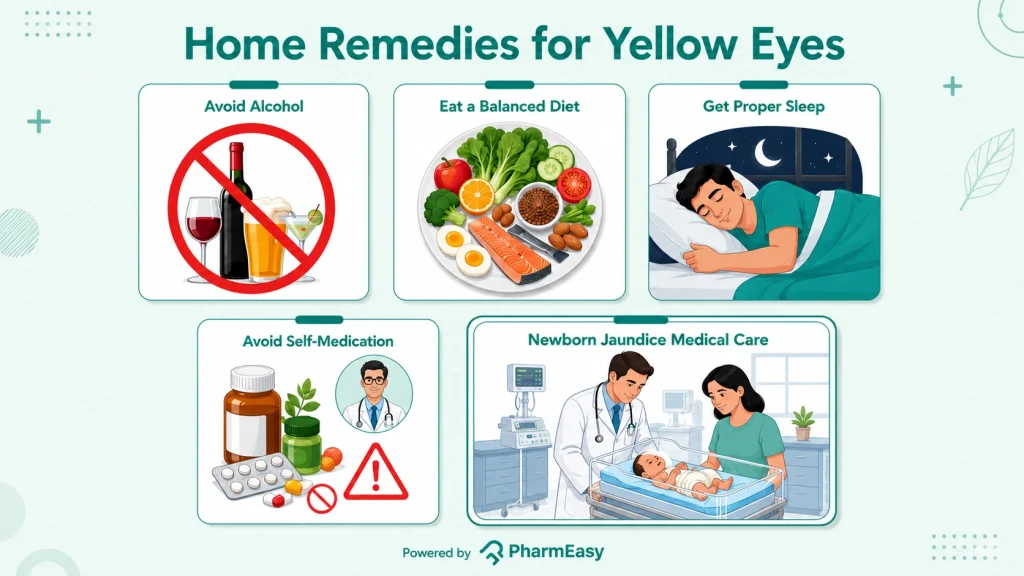
Home remedies cannot treat yellow eyes directly. However, healthy lifestyle habits may support liver health and recovery when used alongside medical care recommended by a doctor.
Note: Since yellow eyes are often a sign of an underlying medical condition, they should not be ignored. The steps above may support general liver health, but they cannot diagnose or treat the cause of yellow eyes. Consult a doctor if yellowing appears alone or with other symptoms.
Also Read: Effective Home Remedies For Red Eyes
Consult a doctor promptly if you notice yellowing of your eyes, especially if it occurs with severe abdominal pain, high fever or chills, persistent vomiting, dark-coloured urine, pale or clay-coloured stools, unexplained weight loss, confusion, excessive sleepiness, difficulty staying awake, or sudden yellowing without a known cause1,5,7,10,12. Babies should also be checked if jaundice is severe, appears within the first day of life, worsens, or persists longer than expected4,5.
Also Read: Struggling with Dry Eyes? Causes, Symptoms, Treatments & Prevention
Yellow eyes usually occur because of an underlying cause. Although a small yellow patch on the eye surface may be harmless, yellowing of the whites of the eyes can indicate jaundice due to liver disease, blood disorders, bile duct obstruction, medicines, or other conditions that require medical attention. Early diagnosis and treatment of the cause can help prevent complications. If you notice yellowing in your eyes, especially with other concerning symptoms, seek medical advice promptly.
Yellow eyes do not usually mean dehydration. True yellowing of the whites of the eyes in adults is generally caused by bilirubin build-up, which may indicate a liver, gallbladder, bile duct, or blood disorder. A doctor should evaluate the cause1,5.
Slight yellowing of the eyes is not considered normal and should not be ignored. A small yellow patch may be caused by a harmless growth called a pinguecula, which is often linked to sun exposure, wind, or dust2. However, if the white of the eye appears yellow overall, it may indicate an underlying medical condition that requires medical evaluation1,5.
Yellow eyes usually improve only when the underlying cause is treated. Do not try to treat yellow eyes at home without medical advice. Consult a doctor promptly for diagnosis and appropriate treatment5.
Yes, yellow eyes can turn white again if the underlying health condition is treated5. However, recovery depends on the specific condition and how early treatment is started.
There is no eye colour that is considered medically unhealthy. However, yellow eyes are not normal and should not be ignored, as they may indicate an underlying medical condition1,5.
Lack of sleep is not known to directly cause yellow eyes. Yellowing of the eyes usually occurs due to increased bilirubin levels in the blood caused by an underlying medical condition1,5. However, getting enough sleep is important for overall liver health, and long-term poor sleep may increase the risk of liver problems21.
1. Jaundice. 2025. Available from: https://medlineplus.gov/jaundice.html
2. What Is a pinguecula and a pterygium (surfer’s eye)? 2026. Available from: https://www.aao.org/eye-health/diseases/pinguecula-pterygium
3. Why Are the Whites of My Eyes Discolored? – American Academy of Ophthalmology. Available from: https://www.aao.org/eye-health/tips-prevention/discolored-sclera-whites-of-my-eyes-turn-yellow
4. Jaundice in babies. Available from: https://www.betterhealth.vic.gov.au/health/healthyliving/jaundice-in-babies
5. Recognizing Jaundice. 2022. Available from: https://newsinhealth.nih.gov/2022/10/recognizing-jaundice
6. Navarro VJ, Khan I, Björnsson E, Seeff LB, Serrano J, Hoofnagle JH. Liver injury from herbal and dietary supplements. Hepatology. 2017;65(1):363-373. doi:10.1002/hep.28813. Available from: https://pubmed.ncbi.nlm.nih.gov/27677775/
7. Symptoms & Causes of Pancreatitis. 2017. Available from: https://www.niddk.nih.gov/health-information/digestive-diseases/pancreatitis/symptoms-causes
8. Memon N, Weinberger BI, Hegyi T, Aleksunes LM. Inherited disorders of bilirubin clearance. Pediatr Res. 2016;79(3):378-386. doi:10.1038/pr.2015.247. Available from: https://pubmed.ncbi.nlm.nih.gov/26595536/
9. Taher M, Aminondin S ‘Aisyah, Nasir NA, et al. Sickle cell disease: understanding pathophysiology, clinical features and advances in gene therapy approaches. Front Pharmacol. 2025;16:1630994. doi:10.3389/fphar.2025.1630994. Available from: https://pmc.ncbi.nlm.nih.gov/articles/PMC12411783/
10. Gan C, Yuan Y, Shen H, et al. Liver diseases: epidemiology, causes, trends and predictions. Sig Transduct Target Ther. 2025;10(1):33. doi:10.1038/s41392-024-02072-z. Available from: https://www.researchgate.net/publication/388722704_Liver_diseases_epidemiology_causes_trends_and_predictions
11. Bile duct obstruction. 2024. Available from: https://medlineplus.gov/ency/article/000263.htm
12. Sickle cell disease: Symptoms. 2024. Available from: https://www.nhlbi.nih.gov/health/sickle-cell-disease/symptoms
13. Bilirubin Blood Test. 2024. Available from: https://medlineplus.gov/lab-tests/bilirubin-blood-test/
14. Liver Function Tests. 2023. Available from: https://medlineplus.gov/lab-tests/liver-function-tests/
15. Complete Blood Count (CBC). 2024. Available from: https://medlineplus.gov/lab-tests/complete-blood-count-cbc/
16. Sickle cell disease: Diagnosis. 2024.Available from: https://www.nhlbi.nih.gov/health/sickle-cell-disease/diagnosis
17. David S, Hamilton JP. Drug-induced Liver Injury. US Gastroenterol Hepatol Rev. 2010;6:73-80. Available from: https://pmc.ncbi.nlm.nih.gov/articles/PMC3160634/
18. 13 Ways to a Healthy Liver. 2021. Available from: https://liverfoundation.org/resource-center/blog/healthy-liver-tips/
19. Salih FM. Can sunlight replace phototherapy units in the treatment of neonatal jaundice? An in vitro study. Photoderm Photoimm Photomed. 2001;17(6):272-277. doi:10.1034/j.1600-0781.2001.170605.x. Available from: https://www.researchgate.net/publication/409239744_Can_sunlight_replace_phototherapy_units_in_the_treatment_of_neonatal_jaundice_An_in_vitro_study
20. Deenin W, Malakul W, Boonsong T, Phoungpetchara I, Tunsophon S. Papaya improves non-alcoholic fatty liver disease in obese rats by attenuating oxidative stress, inflammation and lipogenic gene expression. WJH. 2021;13(3):315-327. doi:10.4254/wjh.v13.i3.315. Available from: https://pmc.ncbi.nlm.nih.gov/articles/PMC8006076/
21. Machado MV. The Beauty Sleep to Keep a Healthy Liver. IJMS. 2025;26(23):11322. doi:10.3390/ijms262311322. Available from: https://www.researchgate.net/publication/397902952_The_Beauty_Sleep_to_Keep_a_Healthy_Liver
Disclaimer: The information provided here is for educational/awareness purposes only and is not intended to be a substitute for medical treatment by a healthcare professional and should not be relied upon to diagnose or treat any medical condition. The reader should consult a registered medical practitioner to determine the appropriateness of the information and before consuming any medication. PharmEasy does not provide any guarantee or warranty (express or implied) regarding the accuracy, adequacy, completeness, legality, reliability or usefulness of the information; and disclaims any liability arising thereof.
Links and product recommendations in the information provided here are advertisements of third-party products available on the website. PharmEasy does not make any representation on the accuracy or suitability of such products/services. Advertisements do not influence the editorial decisions or content. The information in this blog is subject to change without notice. The authors and administrators reserve the right to modify, add, or remove content without notification. It is your responsibility to review this disclaimer regularly for any changes.
 1
1 
Comments

Leave your comment...
You may also like























Comments