




Jaundice in Newborns: Causes, Symptoms, Treatment & Prevention
By Dr. Sarthak Soni +2 more

Medically reviewed by Dr. Avinav Gupta
Last updated: Sep 16, 2026 Published on: Mar 23, 2026


Get,

to manage your symptom
Get your,

4 Cr+ families
benefitted

OTP sent to 9988776655



You’ve successfully subscribed to receive
doctor-approved tips on
Whatsapp

Get ready to feel your best.


Register to Avail the Offer
Send OTPBy continuing, you agree with our Privacy Policy and Terms and Conditions
Hi There,
Sign up on PharmEasy now!!


Trusted by 4 crore+ families

OTP sent to 9988776655
You have unlocked 25% off on medicines


Code: NU25

By Dr. Sarthak Soni +2 more
Table of Contents
Jaundice in newborns happens when the level of bilirubin in the baby’s blood becomes high. Bilirubin is a yellow substance formed when old red blood cells break down and are replaced. The liver usually converts bilirubin into a form that can be removed from the body through stool. When bilirubin builds up, it can cause the baby’s skin and the white part of the eyes to appear yellow1.
In newborn babies, this can happen because they have a higher number of red blood cells which break down more often. At the same time, a newborn’s liver is still developing and may not remove bilirubin efficiently during the first few days after birth. As the baby grows, the liver becomes stronger and works better. By around two weeks of age, it usually removes bilirubin more effectively, and the jaundice often improves on its own2.
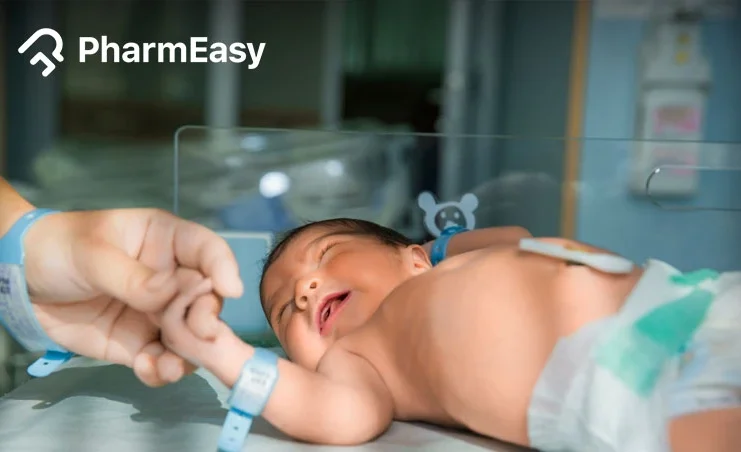
About 60% of babies born after 37 weeks of pregnancy and around 80% of babies born before 37 weeks develop jaundice during the first week after birth. In most cases, newborn jaundice is not very harmful, although it is commonly seen in many babies after birth3.
In this blog, we will understand what jaundice in newborns is, along with its causes, symptoms, treatment, and prevention.
The word “jaundice” comes from jaune, which is a French word meaning yellow. In newborn babies, jaundice refers to a yellow color that appears on the skin and the whites of the eyes. In some cases, this yellow colour may also be noticed inside the mouth or other mucous membranes. This change in colour happens when a substance called bilirubin builds up in the baby’s blood and tissues.
Bilirubin forms when the body breaks down heme, a part of haemoglobin in red blood cells. Old or damaged cells release heme, which first turns into biliverdin and then into bilirubin.
At this stage, the bilirubin formed is called unconjugated bilirubin. This form does not dissolve well in water, so it cannot move freely in the bloodstream. Instead, it attaches to a protein called albumin, which carries it through the blood to the liver.
In the liver, bilirubin goes through a process called conjugation, where it is changed into a water-soluble form known as conjugated bilirubin. The liver sends conjugated bilirubin into bile, it travels through the intestines, and leaves in stool. However, a small amount may be reabsorbed in the intestine and return to the bloodstream.
When bilirubin is not removed efficiently and begins to accumulate in the blood, it gets deposited in the skin and eyes, causing the yellow discoloration known as neonatal jaundice (jaundice in newborns)4.
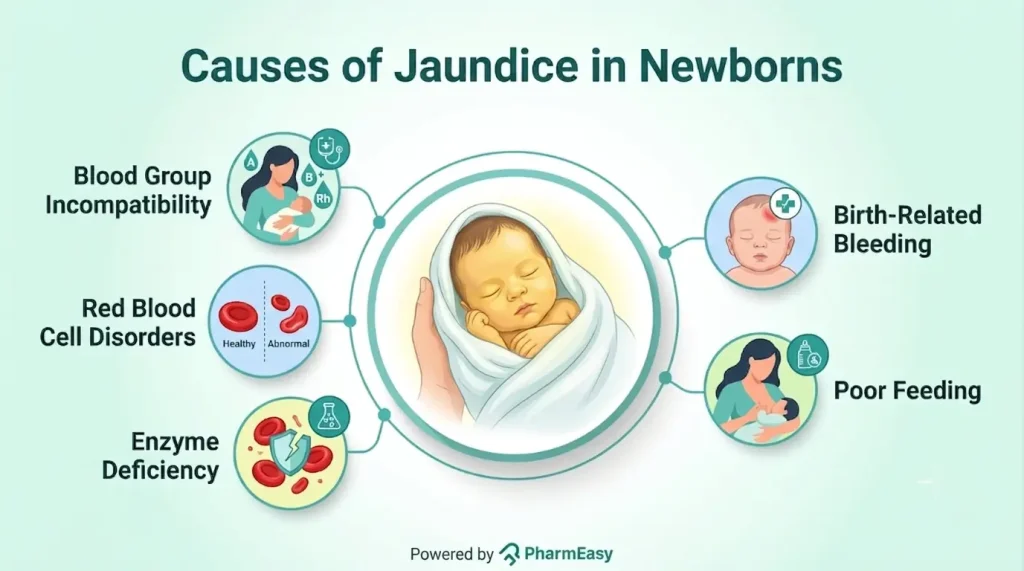
Jaundice in newborn babies can happen due to different medical conditions that increase the amount of bilirubin in the blood or reduce its removal from the body. Some of the common causes of jaundice in newborns are listed below.
These conditions increase bilirubin levels and contribute to the development of jaundice in newborn babies.
Jaundice in newborns is mainly noticed through changes in the baby’s skin and behaviour. It happens when bilirubin builds up in the baby’s blood. Parents and doctors often look for visible signs on the skin, eyes, and feeding pattern to identify jaundice early4,5.
Common Symptoms of Jaundice in Newborns
If these symptoms appear, doctors may perform further tests to confirm jaundice and find the cause. Early recognition helps ensure proper care for the newborn.
Jaundice in Newborns can be divided into different types based on how bilirubin is present in the baby’s body. The two main types are unconjugated hyperbilirubinemia and conjugated hyperbilirubinemia.
This is the most common type of jaundice seen in newborn babies. It occurs when bilirubin has not yet been processed by the liver into a form that can dissolve in water. This type may be physiological jaundice, which is a normal condition that appears after the first day of life and usually disappears within a few weeks. It may also be pathological jaundice, which occurs when bilirubin levels rise too quickly due to conditions such as red blood cell breakdown or enzyme defects.
Conjugated hyperbilirubinemia occurs when bilirubin has already been processed by the liver but cannot be properly removed through bile. This may happen when there are problems affecting the liver or the bile ducts. Conditions such as infections, genetic liver diseases, or blockage of bile flow like biliary atresia can lead to this type of jaundice. This form of jaundice is usually abnormal and needs medical evaluation and treatment.
These types of jaundice in newborns help identify what the possible cause of jaundice may be, and based on this, doctors can decide the most appropriate treatment4.
Not all newborn jaundice is the same. Doctors broadly divide it into two kinds based on when it appears and what causes it, and the timing of onset is one of the most important clues15.
| Feature | Physiological Jaundice | Pathological Jaundice |
| Time of onset | After 24 hours (usually 2–3 days) | Within the first 24 hours, or appearing late and persisting |
| Cause | Immature liver, normal in newborns | Underlying condition (blood incompatibility, infection, enzyme defects, bile duct problems) |
| Bilirubin pattern | Rises gradually, stays within the expected range | Rises rapidly or reaches very high levels |
| Duration | Resolves in 1–2 weeks | May persist beyond 2 weeks or worsen |
| Need for medical evaluation | Usually only monitoring | Always needs prompt medical assessment |
Note: Any jaundice noticed in the first 24 hours of a baby’s life should be treated as a medical emergency and assessed by a doctor immediately.
While only a doctor can confirm and measure jaundice, parents can do a simple visual check at home to spot early signs between medical visits.
Note: This home check is only a basic observation and cannot replace a proper medical assessment. It is not a way to measure bilirubin levels. If you notice any yellowing or have any concerns about your baby, always consult a healthcare professional promptly.
Jaundice levels in newborns are measured by checking the amount of bilirubin in the baby’s blood. One common screening method uses a device called a transcutaneous bilirubinometer. This small device is placed on the baby’s chest or forehead and uses light to estimate bilirubin levels through the skin. The test is quick and painless but provides only an approximate result. If the reading is high, doctors confirm it with a serum bilirubin blood test, which measures the exact bilirubin level using a small blood sample taken from the baby’s heel, hand, or arm5.
In most newborns, bilirubin levels are about 1–3 mg/dL at birth6. Jaundice in newborns is generally defined when bilirubin levels rise above 5 mg/dL. In some babies, levels may increase up to 12 mg/dL, which may still occur in normal newborn jaundice. Babies with several risk factors may develop a stronger form of physiologic jaundice, where bilirubin levels may rise to 17 mg/dL7.
Very high bilirubin levels can cause unconjucated bilirun to get deposited in the brain tissues leading to neurological complications, a condition known as Kernicterus. Although, it is a matter of concern when bilirubin levels exceed 25 mg/dL in healthy full-term newborns, or 20 mg/dL in babaies with haemolysis (a condition in which red blood cells break down faster than normal), doctors usually assess bilirubin levels in relation to the baby’s age in hours and clinical risk factors. Higher levels, especially if they appear early or rise quickly, may require closer monitoring or treatment7.
If the conjugated bilirubin level is above 1 mg/dL if total bilirubin below 5 mg/dL, or more than 20% of the total level if total bilirubin above 5mg/dl, doctors may investigate further because it can sometimes indicate liver disease or blockage of the bile ducts8. Additional blood or urine tests may be done if an underlying condition is suspected5.
Bilirubin levels are interpreted according to the baby’s age in hours, since levels normally rise during the first days after birth and gradually decrease as the liver matures. The American Academy of Paediatrics (AAP) provides hour-specific ranges divided into three risk zones:
Because of this, the same jaundice levels in newborns can mean different things depending on whether the baby is 24 hours old or 72 hours old. Doctors always interpret levels in the context of the baby’s exact age in hours7.
Kernicterus is a rare but serious form of brain damage that can occur when bilirubin levels become extremely high and are not treated in time. Recognising the early warning signs of severe jaundice can help parents seek urgent care before complications develop16.
Seek immediate medical attention if a jaundiced baby shows any of the following:
These symptoms may indicate dangerously high bilirubin levels and require emergency medical care without delay. Early treatment can prevent permanent damage, so never wait to see if these signs improve on their own.
Newborn jaundice is common and usually follows a predictable timeline. In the womb, unconjugated bilirubin (UCB) is cleared by the mother’s placenta, keeping foetal bilirubin low (1–3 mg/dL in cord blood).
After birth:
Pathological jaundice is suspected if it appears within 24–36 hours, rises rapidly, persists >14 days, or is associated with illness, abnormal bilirubin types, or other clinical signs. Doctors evaluate timing, bilirubin levels, and risk factors to guide treatment and prevent complications9.
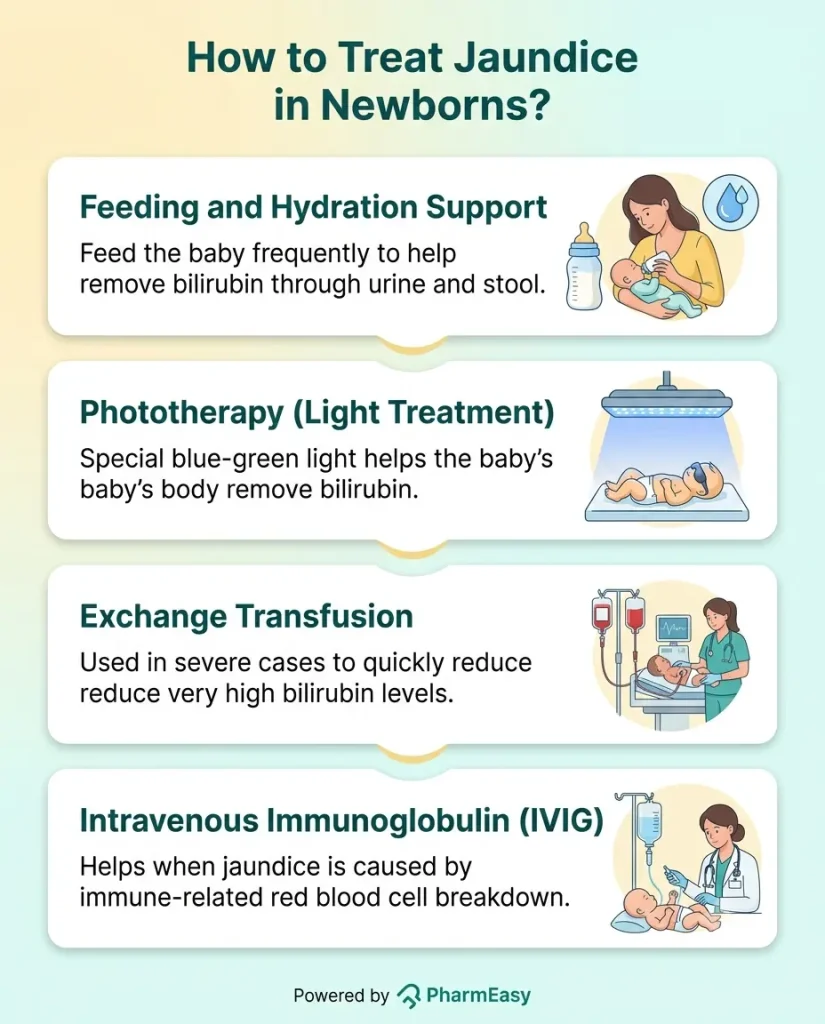
Most newborns with jaundice do not need treatment, but if bilirubin levels become too high or rise quickly, medical care is required. Depending on the baby’s age, bilirubin level, and overall health, the treatment is decided.
The management of jaundice in newborns focus on lowering bilirubin levels safely and preventing complications while supporting the baby’s feeding and hydration.
Parents often ask whether there is a single bilirubin number that decides when treatment is needed. In reality, there is no one-size-fits-all value. The level at which phototherapy is started differs from baby to baby17.
Doctors decide based on a combination of factors:
To make this decision accurately, doctors use age-specific bilirubin charts, such as the Bhutani nomogram and the American Academy of Pediatrics (AAP) guidelines. These charts plot the baby’s bilirubin level against their exact age in hours to see which risk zone they fall into and whether treatment is needed.
This is why the same bilirubin reading can be perfectly safe for one baby but require phototherapy in another. Always rely on your doctor’s interpretation rather than comparing numbers on your own.
As treatment begins, doctors look for certain changes that show the baby is improving and bilirubin levels are coming down.
These signs together show that the baby is recovering well, even if the yellow colour takes some time to fully disappear5,10.
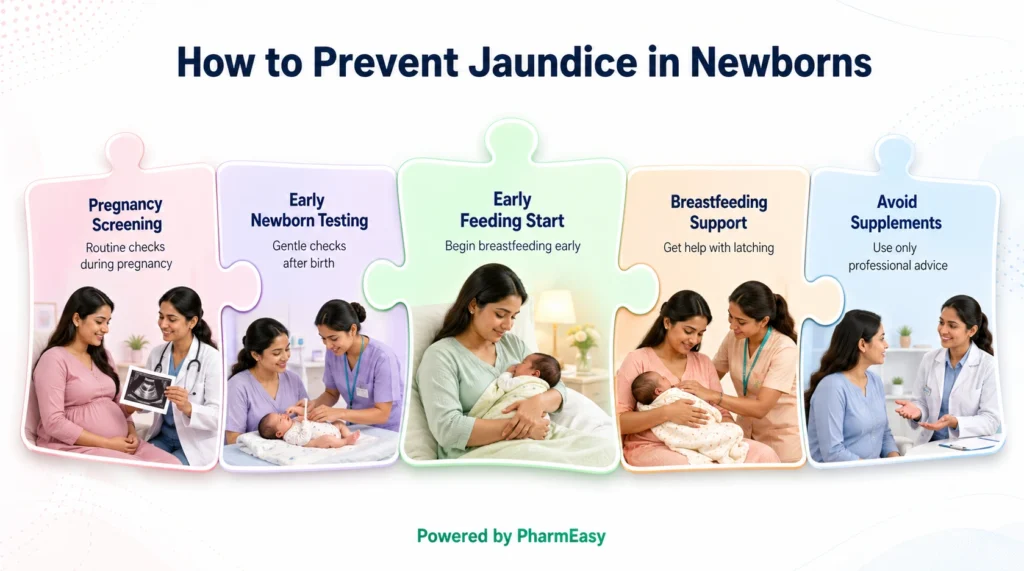
Preventing newborn jaundice focuses on early identification of risk factors and ensuring proper care right from pregnancy and the first few days after birth.
Early screening, good feeding practices, and close monitoring are key to reducing the risk of jaundice and ensuring a healthy recovery for the newborn.
These two conditions sound similar and are often confused, but they are different. Both are linked to breastfeeding, yet they have different causes and timing and clinical features.
| Feature | Breastfeeding Jaundice | Breast-Milk Jaundice |
| Cause | Inadequate milk intake in the first week | Natural factors in breast milk in a healthy, feeding baby |
| Typical timing | First week of life | After the first week, may persist for weeks |
| Clinical features | Often with poor feeding, weight loss, fewer wet diapers,signs of dehydration | Baby feeds well, gains weight, otherwise healthy |
| Management | Improve feeding support, latch, and frequency | Usually continue breastfeeding with monitoring |
In both situations, breastfeeding should usually continue unless your doctor advises otherwise. A doctor can confirm the type and rule out other causes if jaundice is prolonged.
Newborn babies should be checked by a doctor in the first few days to look for signs of jaundice and ensure safe recovery.
Even though jaundice is usually mild in healthy babies, timely medical checks help prevent serious complications1.
Also Read: Typhoid in Kids: Symptoms, Causes, Treatment & Prevention Guide
A bilirubin test helps doctors measure how high a baby’s bilirubin level is and decide whether treatment or close monitoring is needed. Parents should be aware of situations where testing becomes important. A bilirubin test may be advised if20:
Testing gives doctors a clear picture of the severity and helps them decide whether monitoring, phototherapy, or further evaluation is required. When in doubt, it is always safer to have the baby checked.
Also Read: A Complete Guide to Baby Vaccination: Schedule, Common Concerns & More
Jaundice in newborns is very common and mostly not serious. It happens when bilirubin builds up because the baby’s liver is still immature. It usually appears in the first few days and often goes away in 1–2 weeks. Doctors check bilirubin levels based on the baby’s age in hours. Most babies recover with feeding and phototherapy, but early detection helps prevent serious complications.
Also Read: Rickets in Children: Causes, Symptoms, Types & Treatment
For newborns, breast milk is the main nutrition source. Jaundice may occur more in breastfed babies if intake is low due to poor latch or delayed milk flow. Feeding 8 to 12 times daily improves milk supply and helps lower bilirubin levels effectively12.
Breastfed babies may have jaundice for a longer duration. This is often related to normal newborn feeding patterns in the early days or harmless factors in breast milk. With proper feeding and monitoring, most babies continue breastfeeding safely without any problems7.
Sunlight may help reduce bilirubin levels in newborns. However, it is not recommended because safe exposure is difficult and may cause sunburn. Filtered sunlight is used only in special settings where proper medical care is not available11.
Newborn jaundice is usually mild and improves within one to two weeks without treatment. However, very high bilirubin levels can damage the brain (kernicterus) and may lead to hearing loss if not treated early1.
Breast milk is ideal for babies with jaundice. Feed 8–12 times daily to improve milk supply and lower bilirubin12. Mothers should eat protein, iron, calcium, iodine, and vitamin-rich foods, stay hydrated, avoid crash diets, and seek help if breastfeeding problems occur early13.
If a baby still has jaundice at 6 weeks, it is called prolonged jaundice and needs medical checkup. Doctors will test bilirubin levels. It may be breast milk jaundice, but other conditions like thyroid or liver problems must be checked14.
1. Newborn jaundice: MedlinePlus Medical Encyclopedia. Accessed March 17, 2026. Available from: https://medlineplus.gov/ency/article/001559.htm
2. Newborn jaundice. nhs.uk. October 19, 2017. Accessed March 17, 2026. Available from: https://www.nhs.uk/conditions/jaundice-newborn/
3. Neonatal Jaundice. University Hospital Southampton NHS Foundation Trust; 2024. Available from: https://www.uhs.nhs.uk/Media/UHS-website-2019/Patientinformation/Neonatal/Neonatal-jaundice-3680-PIL.pdf
4. Neonatal Jaundice – StatPearls – NCBI Bookshelf. Accessed March 17, 2026. Available from: https://www.ncbi.nlm.nih.gov/books/NBK532930/#!po=1.00000
5. Jaundice in newborns | Children’s Health Queensland. Accessed March 17, 2026. Available from: https://www.childrens.health.qld.gov.au/health-a-to-z/jaundice
6. Bandi C, Vanaki R, Badakali AV, Pol RR, Yelamali B. Predictive Value of Total Serum Bilirubin within 6 Hour of Birth for the Development of Hyperbilirubinemia After 72 hours of Birth. J Clin Diagn Res JCDR. 2016;10(9):SC01-SC04. doi:10.7860/JCDR/2016/16314.8460. Available from: https://pubmed.ncbi.nlm.nih.gov/27790538/
7. Hyperbilirubinemia in the Term Newborn | AAFP. Accessed March 17, 2026. Available from: https://www.aafp.org/pubs/afp/issues/2002/0215/p599.html
8. Fawaz R, Baumann U, Ekong U, et al. Guideline for the Evaluation of Cholestatic Jaundice in Infants: Joint Recommendations of the North American Society for Pediatric Gastroenterology, Hepatology, and Nutrition and the European Society for Pediatric Gastroenterology, Hepatology, and Nutrition. J Pediatr Gastroenterol Nutr. 2017;64(1):154-168. doi:10.1097/MPG.0000000000001334. Available from: https://pubmed.ncbi.nlm.nih.gov/27429428/
9. Gupta PK. Bilirubin metabolism & pathophysiology of neonatal jaundice. IP Int J Med Paediatr Oncol. 2025;9(3):83-86. doi:10.18231/j.ijmpo.2023.017. Available from: https://ijmpo.com/archive/volume/9/issue/3/article/8348
10. Management of Hyperbilirubinemia in the Newborn Infant 35 or More Weeks of Gestation | Pediatrics | American Academy of Pediatrics. Accessed March 17, 2026. Available from: https://publications.aap.org/pediatrics/article/114/1/297/64771/Management-of-Hyperbilirubinemia-in-the-Newborn
11. Clinical Practice Guideline Revision: Management of Hyperbilirubinemia in the Newborn Infant 35 or More Weeks of Gestation | Pediatrics | American Academy of Pediatrics. Accessed March 17, 2026. Available from: https://publications.aap.org/pediatrics/article/150/3/e2022058859/188726/Clinical-Practice-Guideline-Revision-Management-of
12. Jaundice in Newborns – HealthyChildren.org. Accessed March 17, 2026. Available from: https://www.healthychildren.org/English/ages-stages/baby/Pages/Jaundice.aspx?_gl=1*1d9m5lc*_ga*MjgxNDM5MTE1LjE3NzAzMDg4MzM.*_ga_FD9D3XZVQQ*czE3NzM3MDU2ODIkbzMkZzAkdDE3NzM3MDU2ODIkajYwJGwwJGgw
13. Services D of H& H. Breastfeeding and your diet. Accessed March 17, 2026. Avaolable from: http://www.betterhealth.vic.gov.au/health/healthyliving/breastfeeding-and-your-diet
14. Hyperbilirubinemia in Newborns: Updated Guidelines From the AAP | AAFP. Accessed March 17, 2026. Available from: https://www.aafp.org/pubs/afp/issues/2023/0600/practice-guidelines-hyperbilirubinemia-newborns.html
15. Ansong-Assoku B, Adnan M, Daley SF, et al. Neonatal Jaundice. [Updated 2024 Feb 12]. In: StatPearls [Internet]. Treasure Island (FL): StatPearls Publishing; 2026 Jan-. Available from: https://www.ncbi.nlm.nih.gov/books/NBK532930/
16. Reddy DK, Pandey S. Kernicterus. [Updated 2023 Jun 25]. In: StatPearls [Internet]. Treasure Island (FL): StatPearls Publishing; 2026 Jan-. Available from: https://www.ncbi.nlm.nih.gov/books/NBK559120/
17. Rathod DG, Muneer H, Masood S. Phototherapy. [Updated 2023 Feb 16]. In: StatPearls [Internet]. Treasure Island (FL): StatPearls Publishing; 2026 Jan-. Available from: https://www.ncbi.nlm.nih.gov/books/NBK563140/
18. Centers for Disease Control and Prevention. Jaundice and breastfeeding [Internet]. Atlanta (GA): CDC; [cited 2026 Jun 22]. Available from: https://www.cdc.gov/breastfeeding-special-circumstances/hcp/illnesses-conditions/jaundice.html
19. Bratton S, Cantu RM, Stern M. Breast Milk Jaundice. [Updated 2023 Jan 17]. In: StatPearls [Internet]. Treasure Island (FL): StatPearls Publishing; 2026 Jan-. Available from: https://www.ncbi.nlm.nih.gov/books/NBK537334/
20. National Library of Medicine (US). Bilirubin blood test [Internet]. Bethesda (MD): MedlinePlus; [cited 2026 Jun 22]. Available from: https://medlineplus.gov/lab-tests/bilirubin-blood-test/
Disclaimer: The information provided here is for educational/awareness purposes only and is not intended to be a substitute for medical treatment by a healthcare professional and should not be relied upon to diagnose or treat any medical condition. The reader should consult a registered medical practitioner to determine the appropriateness of the information and before consuming any medication. PharmEasy does not provide any guarantee or warranty (express or implied) regarding the accuracy, adequacy, completeness, legality, reliability or usefulness of the information; and disclaims any liability arising thereof.
Links and product recommendations in the information provided here are advertisements of third-party products available on the website. PharmEasy does not make any representation on the accuracy or suitability of such products/services. Advertisements do not influence the editorial decisions or content. The information in this blog is subject to change without notice. The authors and administrators reserve the right to modify, add, or remove content without notification. It is your responsibility to review this disclaimer regularly for any changes.


Comments

Leave your comment...
You may also like





















Comments