




High-Sensitivity Troponin I (hs-Trop I) Test: What It Is, Normal Range, Meaning & Why It Matters
By Dr. Vishesh Bharucha +2 more

Medically reviewed by Dr. Vishesh Bharucha
Last updated: Sep 25, 2026 Published on: Aug 20, 2026


Get,

to manage your symptom
Get your,

4 Cr+ families
benefitted

OTP sent to 9988776655



You’ve successfully subscribed to receive
doctor-approved tips on
Whatsapp

Get ready to feel your best.


Register to Avail the Offer
Send OTPBy continuing, you agree with our Privacy Policy and Terms and Conditions
Hi There,
Sign up on PharmEasy now!!


Trusted by 4 crore+ families

OTP sent to 9988776655
You have unlocked 25% off on medicines


Code: NU25

By Dr. Vishesh Bharucha +2 more
Table of Contents
Chest pain does not always mean a heart attack. Many people with heart muscle injury may have no chest pain, while chest pain can also have non-cardiac causes, such as muscle, digestive, or lung problems. In such situations, a simple blood test, such as the high-sensitivity troponin I test, can provide valuable clues, helping doctors quickly determine whether the heart has been damaged and guide timely treatment.
The high-sensitivity troponin I test can be used to assess the individual for a heart attack, as the test can detect heart-specific proteins in the bloodstream quickly1.
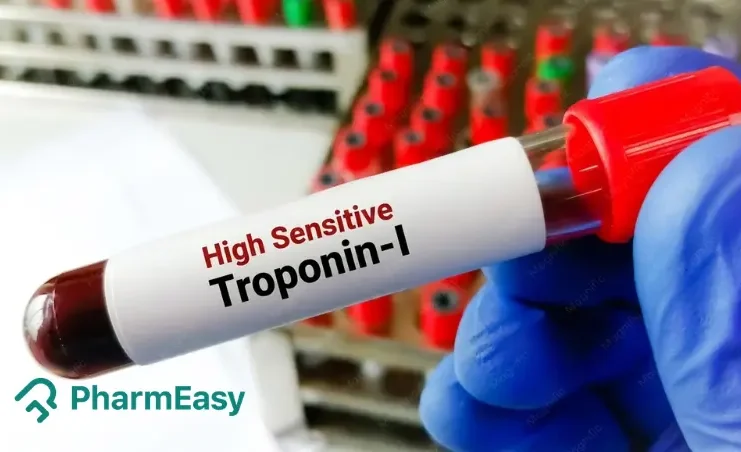
In this article, we’ll explain what is troponin test, how it works, the troponin normal range, what the results mean, who may need the test, and why it plays an important role in assessing heart health.
Cardiac troponin I (cTnI) is a special form of protein found only in heart muscle cells. It differs from other types of troponin found in the body and can be identified on laboratory tests, making troponin I one of the most reliable and accurate markers of heart muscle damage2. When the heart muscle is injured, such as during a heart attack, troponin I is released into the bloodstream and can be used for early diagnosis and treatment of heart conditions.
The high-sensitivity troponin I (hs-cTnI) test is a blood test that measures very small amounts of cardiac troponin I (a protein released when the heart muscle is injured). It is mainly used when doctors suspect acute coronary syndrome (ACS), including a heart attack, or other heart muscle injury. When compared with conventional troponin tests, hs-cTnI can detect very low levels of troponin and may detect heart muscle injury earlier (depending on when the injury occurred)3.
However, a high hs-cTnI level does not always mean a heart attack. Troponin I is specific to heart muscle, but levels can also rise with conditions such as myocarditis, heart failure, pulmonary embolism, severe infection (sepsis), kidney disease, and very fast heart rhythms4.
Troponin is a group of three proteins, troponin I (TnI), troponin C (TnC), and troponin T (TnT). These proteins work together to regulate muscle contractions. Of these, troponin I and troponin T may be used as markers to detect heart muscle damage5.
High-sensitivity troponin I (hs-cTnI) tests can detect extremely small amounts of cardiac troponin I (cTnI) in the blood. This increased sensitivity allows small changes in troponin levels to be identified and may help rule out a heart attack sooner after the onset of acute chest pain. It also helps people with normal troponin levels to be discharged earlier.
A single high troponin level indicates heart muscle injury, but it does not necessarily mean a heart attack. To diagnose an acute myocardial infarction (AMI), doctors look for a rise or fall in troponin levels, along with other evidence of reduced blood flow to the heart, such as symptoms, ECG changes, imaging findings, or angiographic findings.
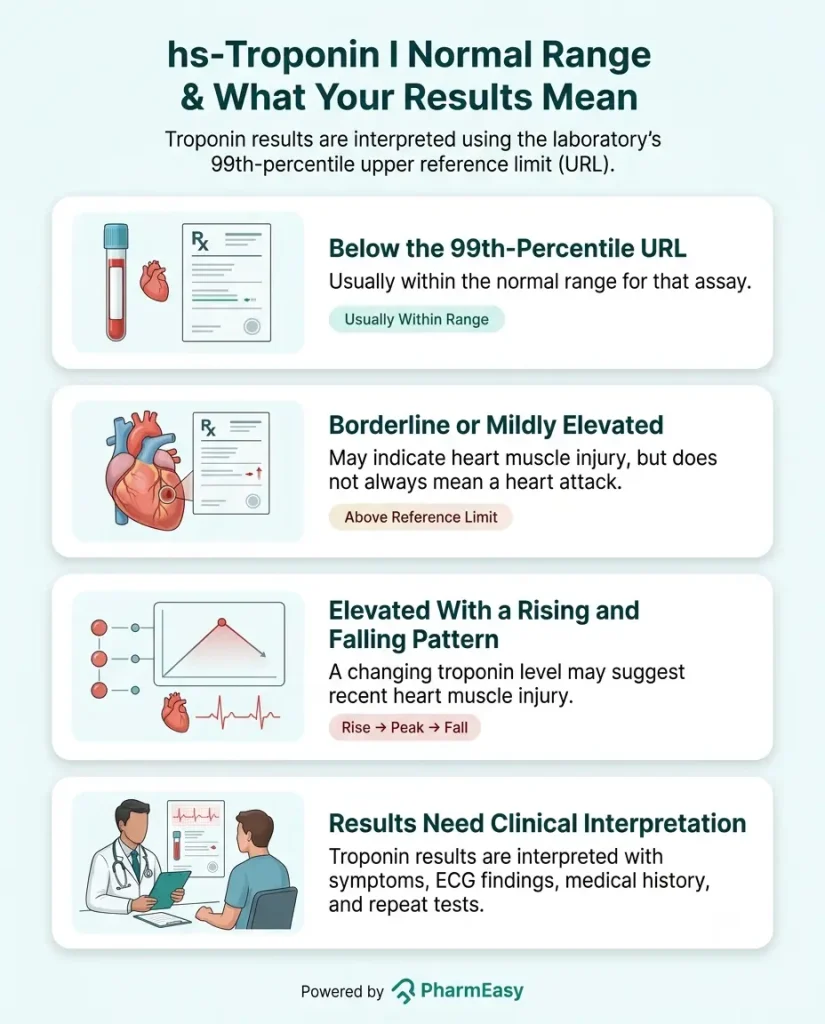
Because different laboratories use different testing methods (assays), there is no single normal value for everyone. Instead, each laboratory interprets the result using its own 99th-percentile upper reference limit (URL), which is different in men and women9.
Examples of sex-specific 99th-percentile upper reference limits used by different hs-cTnI assays are shown below.
| Manufacturer9 | Assay9 | 99th centile (ng/l) – Males9 | 99th centile (ng/l) – Females9 |
| Abbott Diagnostics | Alinity i STAT hs-cTnI | 34.2 | 15.6 |
| Beckman Coulter | Access hs-cTnI | 19.8 | 11.6 |
| bioMérieux | VIDAS hs-cTnI | 25 | 11 |
| Ortho Clinical Diagnostics | VITROS hs-cTnI | 12 | 9 |
| Quidel | TriageTrue hs-cTnI | 25.7 | 14.4 |
| Siemens Healthcare | ADVIA Centaur hs-cTnI | 57.27 | 36.99 |
The results could conclude:
Also Read: Triglycerides vs Cholesterol: Levels, Differences, and How to Reduce It
A troponin I test is not a routine screening test. It is mainly used when doctors suspect an acute myocardial infarction (heart attack) or other acute heart muscle injury. A troponin I test is usually recommended in individuals with:
The troponin I test involves collecting a small blood sample from a vein in your arm using a sterile needle. You may experience a slight prick or stinging sensation when the needle is inserted or removed. The entire procedure is quick and typically takes less than 5 minutes.
The test does not require any special preparation. It is important to tell your healthcare professional if you are taking vitamin B7 (biotin) supplements, as they can lower troponin levels1.
Turnaround time for a troponin test can vary depending on the laboratory, hospital, and type of test used. Results may sometimes be available within a short time, but some laboratories may take longer. The high-sensitivity troponin I test result is interpreted along with the individual’s symptoms, medical history, and ECG results. Rapid testing options are also available through the troponin I rapid test9.
You should consult a doctor if you experience symptoms suggestive of heart attack or other serious heart condition, such as:
These symptoms require emergency medical assistance. In these situations, a high-sensitivity troponin I test is used as part of emergency evaluation rather than as a routine test.
Also Read: Hemolysis: Meaning, Causes, Types, Symptoms, Diagnosis & Treatment
The high-sensitivity troponin I (hs-cTnI) test is one of the most accurate blood tests for detecting heart muscle injury, and it can detect even small changes in troponin levels. It is usually interpreted along with the individual’s symptoms, ECG report, and medical history and helps doctors diagnose or rule out serious heart conditions quickly and take timely decisions for treatment. This is useful when early diagnosis and treatment are essential, for example, in patients who visit the emergency room.
High troponin I levels indicate that the heart muscle has been injured. Although a heart attack is one of the most common cause of high troponin levels, they may also be caused by conditions such as heart failure, pulmonary embolism, or chronic kidney disease1.
Yes. High-sensitivity troponin I (hs-cTnI) tests can detect much smaller amounts of troponin than older tests and can identify heart muscle injury earlier. This allows doctors to diagnose or rule out a heart attack more quickly in patients with chest pain, especially when time is of essence, for example, in the emergency department10.
No, fasting is not required before a high-sensitivity troponin I test. A healthcare professional collects a blood sample from a vein in your arm using a small needle. Biotin supplements may interfere with the test results; therefore, if you are taking biotin supplements, inform your doctor before the test1.
Yes, troponin can be high without a heart attack. Some conditions in which troponin can be elevated include heart muscle inflammation, heart failure, sepsis, strenuous exercise, chest injuries, blood clots in the lungs, chronic kidney disease, irregular heartbeat, or severe COVID infection.
Disclaimer: The information provided here is for educational/awareness purposes only and is not intended to be a substitute for medical treatment by a healthcare professional and should not be relied upon to diagnose or treat any medical condition. The reader should consult a registered medical practitioner to determine the appropriateness of the information and before consuming any medication. PharmEasy does not provide any guarantee or warranty (express or implied) regarding the accuracy, adequacy, completeness, legality, reliability or usefulness of the information; and disclaims any liability arising thereof.
Links and product recommendations in the information provided here are advertisements of third-party products available on the website. PharmEasy does not make any representation on the accuracy or suitability of such products/services. Advertisements do not influence the editorial decisions or content. The information in this blog is subject to change without notice. The authors and administrators reserve the right to modify, add, or remove content without notification. It is your responsibility to review this disclaimer regularly for any changes.


Comments

Leave your comment...
You may also like
























Comments