



Oral Semaglutide vs Injection: Which Option Is Right for You?
By Dr. Akash N. Shah +2 more

Medically reviewed by Dr. Akash N. Shah
Last updated: Sep 3, 2026 Published on: Aug 19, 2026


Get,

to manage your symptom
Get your,

4 Cr+ families
benefitted

OTP sent to 9988776655



You’ve successfully subscribed to receive
doctor-approved tips on
Whatsapp

Get ready to feel your best.


Register to Avail the Offer
Send OTPBy continuing, you agree with our Privacy Policy and Terms and Conditions
Hi There,
Sign up on PharmEasy now!!


Trusted by 4 crore+ families

OTP sent to 9988776655
You have unlocked 25% off on medicines


Code: NU25

By Dr. Akash N. Shah +2 more
Table of Contents
Choosing between oral and injectable semaglutide can be confusing, whether you are using it to manage type 2 diabetes, support weight management, or reduce certain heart-related risks1. This article simplifies the main differences to help you discuss the best option with your healthcare professional.
Semaglutide is a medicine that mimics GLP-1, a hormone the body naturally produces. It helps lower high blood sugar, slows how quickly food leaves the stomach, and reduces appetite. Semaglutide is available as tablets and injections, and the right choice depends on its approved use, dose, side effects, cost, and what fits your daily routine1.

Understanding the differences between oral and injectable semaglutide can help you ask clearer questions and make a more informed decision with your doctor.

Answer a few quick questions to check eligibility.
Your response has been submitted.
Our team will contact you shortly.
Semaglutide belongs to a group of medicines called GLP-1 receptor agonists. In simpler terms, it mimics a natural hormone that helps the body release insulin when blood sugar is high. It also slows stomach emptying, which can help some people feel full sooner1,2.
Your doctor may prescribe semaglutide in the following cases2:
Both tablets and injections contain semaglutide as active molecule, but they are administered differently and may not be used for the same approved purpose or dose. The main differences are listed below1,3.
| Features | Oral Semaglutide | Injectable Semaglutide |
| Route | Tablet taken by mouth | Subcutaneous injection (injection under the skin) |
| Frequency of dose | Once daily | Once weekly |
| Strength of the formulation | Available as 3, 7 and 14mg tablets | Available as prefilled multidose injection pens as well as single dose prefilled injections |
| Starting dose | 3 mg for 30 days, as advised by the doctor | 0.25 mg for 4 weeks, as advised by the doctor |
| Maintenance dose | 7 mg or 14 mg, as advised by the doctor | 0.5 mg or 1 mg, as advised by the doctor. Higher doses may be used as per individual responses and treatment goals. |
| Effectiveness | Food, drinks, and other medicines can reduce how much medicine is absorbed if the tablet is not taken exactly as directed | Absorption is more predictable because the medicine is injected under the skin |
| Convenience | Needle-free, but it must be taken every day on an empty stomach | Requires injection only once a week |
| Cost | Cost may vary by brand, dose, pharmacy, location, insurance or discount coverage, and availability | |
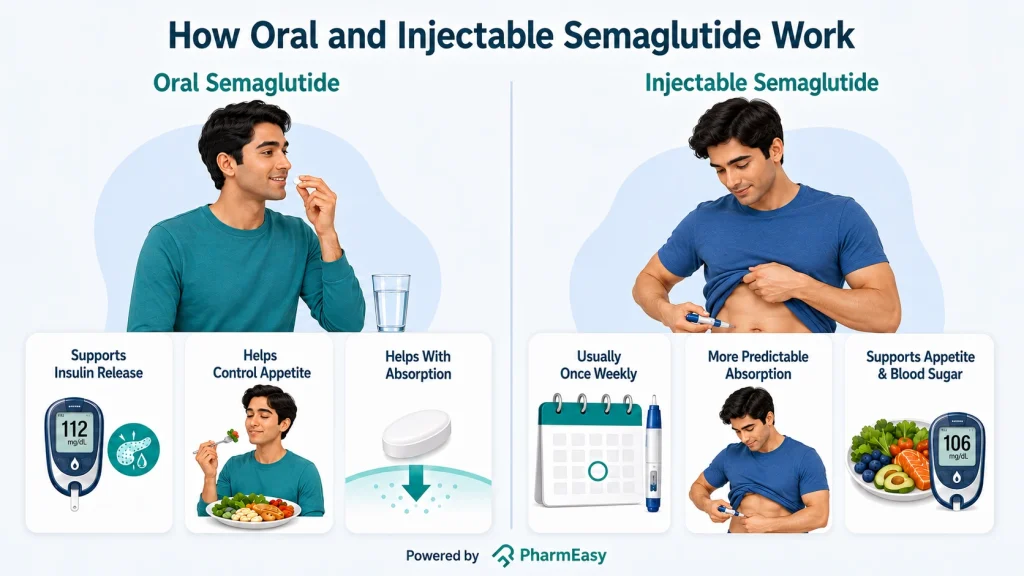
Oral and injectable semaglutide work similarly once the medicine is in the body. However, different products may have different approved uses and doses. Your healthcare professional can confirm which form is appropriate for your needs.
Both forms can help lower blood sugar in people with type 2 diabetes, and some semaglutide products may also support weight management . Both injectable and oral semaglutide effectively lower HbA1c. Injectable semaglutide may produce greater HbA1c reduction at commonly used doses, but direct comparisons between the two formulations are limited. Weight changes can vary from person to person. Oral semaglutide must be taken at least 30 minutes before food, drinks, or other oral medicines, while injectable semaglutide does not have this same timing requirement8.
The most effective choice is not the same for everyone. It depends on the reason you are taking semaglutide, the dose prescribed, how well you tolerate side effects, and whether you can follow the dosing instructions. If you prefer tablets and can take them correctly every morning, oral semaglutide may be suitable. If you prefer once-weekly dosing and are comfortable with injections, injectable semaglutide may be a better fit. However, more often the prescribing doctor decides which one of these two is a better option depending on treatment targets8.
The better option depends on your health goals, medical history, daily routine, and comfort with tablets or injections. Oral semaglutide may be a good choice if you want to avoid injections and can take a tablet correctly every morning. Injectable semaglutide may be more practical if you prefer once-weekly dosing and are comfortable using an injection pen. Before choosing, talk with your healthcare professional about your blood sugar goals, weight goals, other medicines, side effects, pregnancy plans, kidney problems, gallbladder problems, symptoms of pancreatitis such as severe stomach pain, and any personal or family history of certain thyroid cancers1,8.
Also Read: Wegovy (Semaglutide): How It Works, Who It’s For & What to Expect
Both oral and injectable semaglutide can be useful options when prescribed for the right person and purpose. The tablet avoids injections but must be taken carefully every day. The injection is usually taken once a week and is absorbed more predictably. There is no one-size-fits-all answer. The safest and most effective choice should be made with your healthcare professional, based on your medical needs, treatment goals, side effects, and ability to follow the dosing instructions.
The active medicine is the same, but the body absorbs it differently. Oral semaglutide is taken once daily and must be taken on an empty stomach with water, followed by a wait of at least 30 minutes before food, drinks, or other oral medicines. Injectable semaglutide is usually taken once weekly8,9.
Yes, oral semaglutide may help some people lose weight by reducing appetite and slowing stomach emptying. It should be used only as prescribed and alongside the lifestyle plan recommended by your healthcare professional5.
It may take several days to weeks of regular use and appropriate dose escalation before one can see appreciable changes in blood sugar or weight. Taking it exactly as directed is important because food, drinks, and other medicines can reduce absorption1,10.
Oral semaglutide can be used long-term when it is prescribed and monitored by a doctor. Report side effects such as severe stomach pain, ongoing vomiting, dehydration, or symptoms of gallbladder problems promptly11.
Injectable semaglutide may offer more predictable absorption and, in some studies, greater blood sugar improvement. However, the best choice depends on your reason for taking it, the dose, side effects, cost, and which option you can use consistently8.
1. Kommu S, Whitfield P. Semaglutide. In: StatPearls. StatPearls Publishing; 2026. Accessed July 29, 2026. http://www.ncbi.nlm.nih.gov/books/NBK603723/
2. Semaglutide: MedlinePlus Drug Information. Accessed July 29, 2026. https://medlineplus.gov/druginfo/meds/a619057.html
3. Pillarisetti L, Agrawal DK. Semaglutide: Double-edged Sword with Risks and Benefits. Arch Intern Med Res. 2025;8(1):1-13. doi:10.26502/aimr.0189 https://pmc.ncbi.nlm.nih.gov/articles/PMC11790292/
4. Rasmussen MF. The development of oral semaglutide, an oral GLP-1 analogue, for the treatment of type 2 diabetes. Diabetol Int. 2020;11(2):76-86. doi:10.1007/s13340-019-00423-8 https://pubmed.ncbi.nlm.nih.gov/32206477/
5. Kim HS, Jung CH. Oral Semaglutide, the First Ingestible Glucagon-Like Peptide-1 Receptor Agonist: Could It Be a Magic Bullet for Type 2 Diabetes? Int J Mol Sci. 2021;22(18):9936. doi:10.3390/ijms22189936 https://www.researchgate.net/publication/354613000_Oral_Semaglutide_the_First_Ingestible_Glucagon-Like_Peptide-1_Receptor_Agonist_Could_It_Be_a_Magic_Bullet_for_Type_2_Diabetes
6. Solis-Herrera C, Kane MP, Triplitt C. Current Understanding of Sodium N-(8-[2-Hydroxylbenzoyl] Amino) Caprylate (SNAC) as an Absorption Enhancer: The Oral Semaglutide Experience. Clin Diabetes Publ Am Diabetes Assoc. 2024;42(1):74-86. doi:10.2337/cd22-0118 https://pubmed.ncbi.nlm.nih.gov/38230324/
7. Fornes A, Huff J, Pritchard RI, Godfrey M. Once-Weekly Semaglutide for Weight Management: A Clinical Review. J Pharm Technol JPT Off Publ Assoc Pharm Tech. 2022;38(4):239-246. doi:10.1177/87551225221092681 https://pmc.ncbi.nlm.nih.gov/articles/PMC9272494/
8. Karedath J, Nall S, Kaur M, et al. Comparative Effectiveness and Safety of Oral Versus Subcutaneous Semaglutide in Type 2 Diabetes Mellitus: A Systematic Review and Meta-Analysis. Cureus. 17(4):e82497. doi:10.7759/cureus.82497 https://pubmed.ncbi.nlm.nih.gov/40385819/
9. Gallwitz B, Giorgino F. Clinical Perspectives on the Use of Subcutaneous and Oral Formulations of Semaglutide. Front Endocrinol. 2021;12:645507. doi:10.3389/fendo.2021.645507 https://pubmed.ncbi.nlm.nih.gov/34267725/
10. Palazzi S, Sentinelli F, Zugaro A, et al. Real-World Analysis of Short-Term Effectiveness of Oral Semaglutide: Impact on Glycometabolic Control and Cardiovascular Risk. Pharmaceuticals. 2025;18(6):856. doi:10.3390/ph18060856 https://pubmed.ncbi.nlm.nih.gov/40573252/
11. Andersen A, Knop FK, Vilsbøll T. A Pharmacological and Clinical Overview of Oral Semaglutide for the Treatment of Type 2 Diabetes. Drugs. 2021;81(9):1003-1030. doi:10.1007/s40265-021-01499-w https://pubmed.ncbi.nlm.nih.gov/33964002/
Disclaimer: The information provided here is for educational/awareness purposes only and is not intended to be a substitute for medical treatment by a healthcare professional and should not be relied upon to diagnose or treat any medical condition. The reader should consult a registered medical practitioner to determine the appropriateness of the information and before consuming any medication. PharmEasy does not provide any guarantee or warranty (express or implied) regarding the accuracy, adequacy, completeness, legality, reliability or usefulness of the information; and disclaims any liability arising thereof.
Links and product recommendations in the information provided here are advertisements of third-party products available on the website. PharmEasy does not make any representation on the accuracy or suitability of such products/services. Advertisements do not influence the editorial decisions or content. The information in this blog is subject to change without notice. The authors and administrators reserve the right to modify, add, or remove content without notification. It is your responsibility to review this disclaimer regularly for any changes.


Comments

Leave your comment...
You may also like





















Comments