




Hepatitis B: What It Is, Causes, Symptoms & Treatment
By Dr. Vishesh Bharucha +2 more

Medically reviewed by Dr. Vishesh Bharucha
Last updated: Aug 28, 2026 Published on: May 12, 2026


Get,

to manage your symptom
Get your,

4 Cr+ families
benefitted

OTP sent to 9988776655



You’ve successfully subscribed to receive
doctor-approved tips on
Whatsapp

Get ready to feel your best.


Register to Avail the Offer
Send OTPBy continuing, you agree with our Privacy Policy and Terms and Conditions
Hi There,
Sign up on PharmEasy now!!


Trusted by 4 crore+ families

OTP sent to 9988776655
You have unlocked 25% off on medicines


Code: NU25

By Dr. Vishesh Bharucha +2 more
Table of Contents
Have you ever felt very tired for many days or noticed your eyes looking a little yellow? These can be Hepatitis B symptoms1. Hepatitis B is a liver infection caused by the Hepatitis B virus (HBV). This virus can make the liver swollen and affect how it works2.
One tricky thing about Hepatitis B is that many people do not feel sick at all in the beginning. Some people may not have any symptoms for a long time, even for many years. But when symptoms do appear, they can include feeling tired, fever, stomach pain, loss of appetite, dark urine, or yellow skin and eyes1.
In India, about 29.8 million people were living with Hepatitis B in 2022, showing a significant health burden in the country3.
If Hepatitis B becomes long-term, it can lead to serious liver problems like chronic liver disease (long-lasting liver damage), cirrhosis (serious scarring of the liver), liver failure and hepatocellular carcinoma (a type of liver cancer)4. That is why it is important to learn about it early.
In this blog, you will understand what is Hepatitis B, how it spreads, its symptoms, treatment, and ways to prevent it.
Hepatitis B is a viral infection mainly affecting the liver. It is caused by the Hepatitis B virus and spread through infected blood and body fluids like semen and vaginal secretions. After entering the body, the virus reaches the liver and infects its cells. The infection does not cause symptoms immediately. It may take 30–180 days for signs to appear, and many people may not notice any signs or symptoms in the early stage.
During infection, the body’s immune system tries to remove the infected liver cells by attacking them. Special immune cells called cytotoxic T lymphocyte cells help in destroying these infected liver cells. This can also lead to inflammation and damage in the liver. In some cases, the virus may continue to stay in the body and slowly affect liver health over time4.
Hepatitis B infection can be of two main types: acute and chronic. These types of Hepatitis B infection are based on how long the virus stays in the body and how it affects the liver5.
This is a short-term infection where the virus stays in the body for a limited time and then clears. It can last for a few weeks and sometimes up to 6 months. Doctors often identify this stage when a marker for hepatitis B called HBsAg, is present in the body for less than 6 months4. Most healthy adults and children above 5 years get rid of infection naturally and recover completely5. During this stage, the liver may show changes like damage to liver cells and inflammation due to infection4.
This is a long-term infection where the virus stays in the body for a longer time. This type is usually identified when the HBsAg marker stays in the body for longer than 6 months. The chance of this happening is higher in infants and young children. About 90% of infants, 25–50% of young children, and 5% of adults may develop this type5. If the inflammation continues for many years, it can lead to liver scarring (fibrosis), severe liver scarring (cirrhosis), and liver cancer (hepatocellular carcinoma)4.
Hepatitis B spreads mainly through direct exposure to infected blood and body fluids in different every day or medical situations6. The most common Hepatitis B causes include:
Note that the virus spreads through direct contact with infected fluids, not through casual contact like touching,talking4, hugging, kissing, coughing, sneezing, breastfeeding (if nipples are not cracked or bleeding and the infant is vaccinated), or sharing food and drinks7.
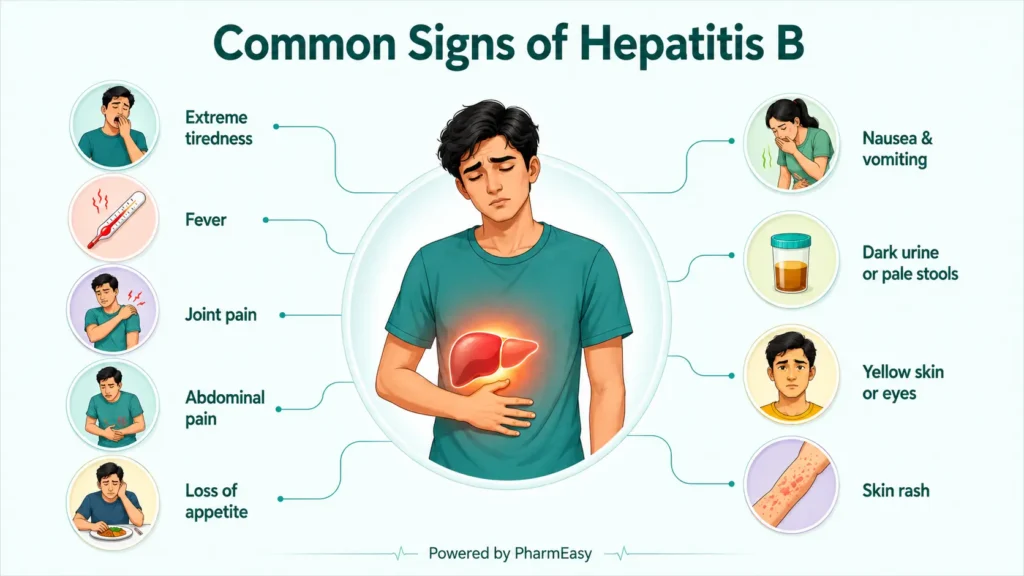
Many people may not have any Hepatitis B symptoms, especially in the early stage of infection1. When symptoms do appear, they usually develop after an incubation period of 30–180 days following exposure to the virus5. Common symptoms of Hepatitis B include:
Because Hepatitis B symptoms may be mild or absent, early detection is important, and the diagnosis is confirmed using blood tests such as HBsAg and other hepatitis B serologic markers4,5.
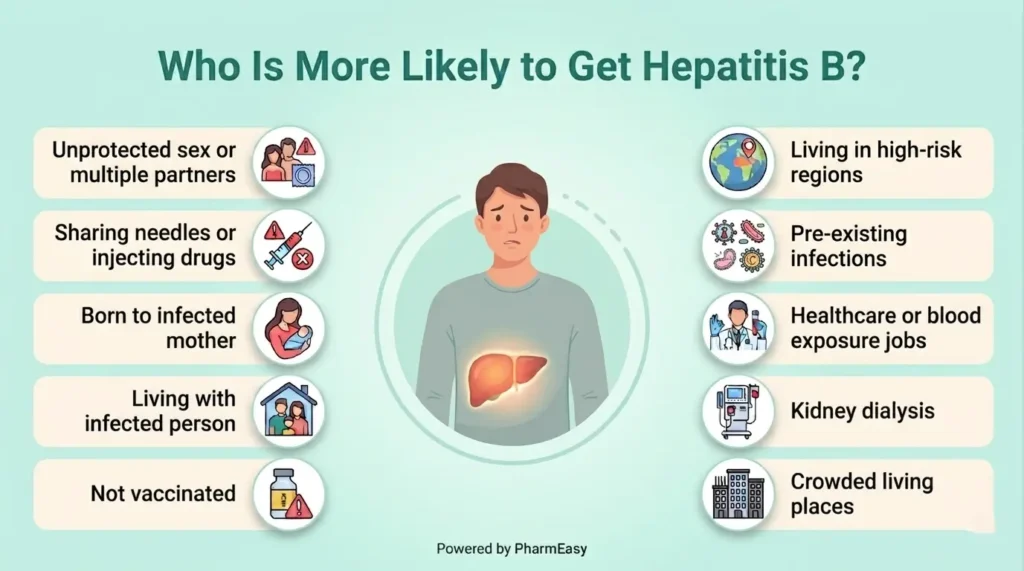
Risk factors are situations or behaviours that increase the chance of coming into contact with the virus. These do not cause the infection directly but make exposure more likely5.
Factors that increase the risk include:
These factors increase risk because they raise the chances of contact with infected blood or body fluids5. Reducing exposure and following safety measures can help lower this risk6.
Hepatitis B may lead to serious complications. These complications can affect how the liver works and may become severe over time. Some important complications include:
These complications can become life-threatening as the disease progresses. Patients with hepatitis B should be monitored closely for these risks.
Hepatitis B is diagnosed using a combination of medical history, physical examination, blood tests, and sometimes imaging tests as explained below:4
Blood tests are used to detect hepatitis B markers such as HBsAg and other antibodies. Together, these tests help doctors understand whether the infection is new (acute) or long-term (chronic), how active the virus is, and whether Hepatitis B treatment is needed4,5. Blood tests can also show if a person is immune due to vaccination or past infection5.
Elastography measures liver stiffness to detect scarring (fibrosis)11.
In some cases, a liver biopsy may be done if more detailed information is needed5.
These tests together help confirm Hepatitis B and understand whether the infection is acute or chronic and how much the liver is affected4,5.
For broader screening of related infections and sexually transmitted conditions, comprehensive profiles such as an STD panel may also be used, which can include Hepatitis B testing as part of a wider evaluation. You can learn more about this combined testing package here.
Treatment of hepatitis B depends on whether the infection is acute (short-term) or chronic (long-term) and how severe the liver damage is. Doctors choose treatment after checking symptoms, blood tests, and liver condition4,12 Here are some Hepatitis B treatment options, based on the type and severity of infection:
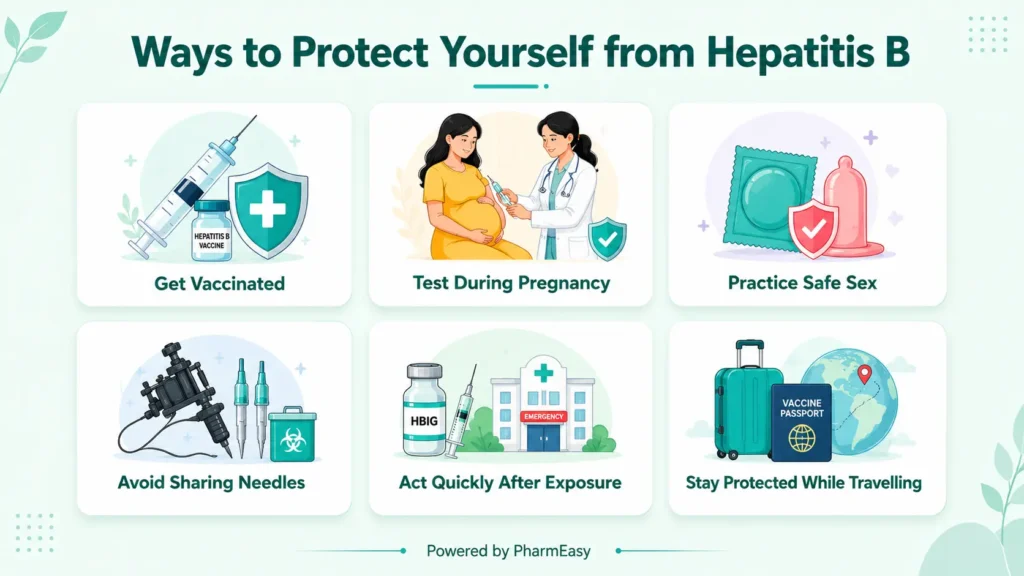
Hepatitis B prevention mainly focuses on vaccination and reducing contact with infected blood and body fluids5,13. Here are some ways to prevent hepatitis B infection:
Hepatitis B prevention is important because it can cause serious long-term liver problems, but vaccination and safe practices can greatly reduce the risk of infection and protect both individuals and families effectively.
You should see a doctor in the following situations if you suspect hepatitis B or are at risk of infection5:
Seeing a doctor early helps with proper testing, diagnosis, and monitoring of liver health, and it can reduce the risk of serious complications5.
Also Read: Liver Fibrosis: What Is It, Causes, Symptoms & Treatment
Hepatitis B is a serious liver infection, but it can be prevented in many cases. Getting vaccinated is the most important step because it protects the body from the virus. Early testing also helps find the infection before it damages the liver. Many people may not feel sick in the beginning, so regular check-ups are important. A healthy lifestyle like eating well, avoiding alcohol, and following safe practices can also protect the liver. With awareness, early detection and appropriate medical care, the risk of severe outcomes from hepatitis B can be greatly reduced.
You cannot flush out hepatitis B like a toxin. Hepatitis B is a viral infection that spreads through infected blood and body fluids. In acute cases, the virus may go away on its own, and most healthy adults recover without developing long-term infection. Chronic hepatitis B is long-lasting and needs medical care and regular monitoring to protect the liver5.
Hepatitis B is a viral infection that can affect the liver and cause inflammation and damage. It may be short-term or long-term, and in some people, it can lead to cirrhosis, liver failure, or liver cancer, even without early symptoms. Some people feel normal, but damage can slowly develop and worsen over time5.
Hepatitis B is not a hereditary disease. It is caused by a virus and spreads mainly through blood, body fluids, or from an infected mother to baby during birth. It is not passed through genes from parents to children in any way ever17.
Hepatitis B is not a hereditary disease. It is caused by a virus and spreads mainly through blood, body fluids, or from an infected mother to baby during birth. It is not passed through genes from parents to children in any way ever17.
HIV and hepatitis B are not the same disease. HIV weakens the body’s immune system, while hepatitis B mainly infects and damages the liver. Both can spread through blood and body fluids like unprotected sex or needle sharing. However, they are different viruses, and sometimes people can be infected with both at the same time18.
Yes, hepatitis B can cause cancer. Hepatitis B is a major cause of liver cancer (hepatocellular carcinoma) because long-term infection can damage liver cells, lead to scarring (cirrhosis), and slowly increase cancer risk. Regular check-ups and treatment help reduce this risk significantly19.
Yes, hepatitis B can affect pregnancy. The virus can spread from an infected mother to the baby during birth through blood and body fluids. This risk is higher if the mother has active infection. However, giving the baby hepatitis B vaccine and immunoglobulin soon after birth greatly reduces the chance of infection20.
1. Hepatitis B Basics | Hepatitis B | CDC. Accessed May 5, 2026. https://www.cdc.gov/hepatitis-b/about/index.html
2. Hepatitis B Basic Information | HHS.gov. Accessed May 5, 2026. https://www.hhs.gov/hepatitis/learn-about-viral-hepatitis/hepatitis-b-basics/index.html
3. Swaroop S, Shalimar, Acharya SK. Hepatitis B virus prevalence in India: A wake-up call for action. Indian J Gastroenterol. 2025;44(5):585-587. doi:10.1007/s12664-025-01804-5 https://link.springer.com/article/10.1007/s12664-025-01804-5
4. Tripathi N, Mousa OY. Hepatitis B. In: StatPearls [Internet]. StatPearls Publishing; 2023. Accessed May 5, 2026. https://www.ncbi.nlm.nih.gov/books/NBK555945/
5. Hepatitis B – NIDDK. Accessed May 5, 2026. https://www.niddk.nih.gov/health-information/liver-disease/viral-hepatitis/hepatitis-b
6. World Health Organisation. Hepatitis B. Accessed May 5, 2026. https://www.who.int/news-room/fact-sheets/detail/hepatitis-b
7. Guvenir M, Arikan A. Hepatitis B Virus: From Diagnosis to Treatment. Pol J Microbiol. 2020;69(4):391-399. doi:10.33073/pjm-2020-044 https://pubmed.ncbi.nlm.nih.gov/33574867/
8. Bernal W, Wendon J. Acute Liver Failure. N Engl J Med. 2013;369(26):2525-2534. doi:10.1056/NEJMra1208937 https://pubmed.ncbi.nlm.nih.gov/24369077/
9. Gustot T, Stadlbauer V, Laleman W, Alessandria C, Thursz M. Transition to decompensation and acute-on-chronic liver failure: Role of predisposing factors and precipitating events. J Hepatol. 2021;75:S36-S48. doi:10.1016/j.jhep.2020.12.005 https://pubmed.ncbi.nlm.nih.gov/34039491/
10. Papatheodoridis GV, Lekakis V, Voulgaris T, et al. Hepatitis B virus reactivation associated with new classes of immunosuppressants and immunomodulators: A systematic review, meta-analysis, and expert opinion. J Hepatol. 2022;77(6):1670-1689. doi:10.1016/j.jhep.2022.07.003 https://pubmed.ncbi.nlm.nih.gov/35850281/
11. Cornberg M, Sandmann L, Jaroszewicz J, et al. EASL Clinical Practice Guidelines on the management of hepatitis B virus infection. J Hepatol. 2025;83(2):502-583. doi:10.1016/j.jhep.2025.03.018 https://www.journal-of-hepatology.eu/article/S0168-8278(25)00174-6/fulltext
12. CDC. Treatment of Hepatitis B. Hepatitis B. February 14, 2025. Accessed May 5, 2026. https://www.cdc.gov/hepatitis-b/treatment/index.html
13. CDC. Hepatitis B Prevention and Control. Hepatitis B. September 24, 2025. Accessed May 5, 2026. https://www.cdc.gov/hepatitis-b/prevention/index.html
14. Viral Hepatitis – STI Treatment Guidelines. February 27, 2023. Accessed May 8, 2026. https://www.cdc.gov/std/treatment-guidelines/hbv.htm
15. A Comprehensive Immunization Strategy to Eliminate Transmission of Hepatitis B Virus Infection in the United States </P><P>Recommendations of the Advisory Committee on Immunization Practices (ACIP) Part 1: Immunization of Infants, Children, and Adolescents. Accessed May 8, 2026. https://www.cdc.gov/mmwr/preview/mmwrhtml/rr5416a1.htm
16. Appendix C: Postexposure Prophylaxis of Persons with Discrete Identifiable Exposures to Hepatitis B Virus (HBV). Accessed May 8, 2026. https://www.cdc.gov/mmwr/preview/mmwrhtml/rr5416a4.htm
17. Patel A, Dossaji Z, Gupta K, et al. The Epidemiology, Transmission, Genotypes, Replication, Serologic and Nucleic Acid Testing, Immunotolerance, and Reactivation of Hepatitis B Virus. Gastro Hep Adv. 2024;3(2):139-150. doi:10.1016/j.gastha.2023.10.008 https://pubmed.ncbi.nlm.nih.gov/39129942/
18. CDC. HIV and Viral Hepatitis. June 2016. Accessed May 5, 2026. https://stacks.cdc.gov/view/cdc/48584
19. Hepatitis B and Liver Cancer HBF Fact Sheet. Accessed May 5, 2026. https://www.hepb.org/assets/Uploads/Hepatitis-B-and-Liver-Cancer-HBF-Fact-Sheet2.pdf
20. Tran TT. Hepatitis B virus in pregnancy. Clin Liver Dis. 2013;2(1):29-33. doi:10.1002/cld.159 https://pmc.ncbi.nlm.nih.gov/articles/PMC6448610/
Disclaimer: The information provided here is for educational/awareness purposes only and is not intended to be a substitute for medical treatment by a healthcare professional and should not be relied upon to diagnose or treat any medical condition. The reader should consult a registered medical practitioner to determine the appropriateness of the information and before consuming any medication. PharmEasy does not provide any guarantee or warranty (express or implied) regarding the accuracy, adequacy, completeness, legality, reliability or usefulness of the information; and disclaims any liability arising thereof.
Links and product recommendations in the information provided here are advertisements of third-party products available on the website. PharmEasy does not make any representation on the accuracy or suitability of such products/services. Advertisements do not influence the editorial decisions or content. The information in this blog is subject to change without notice. The authors and administrators reserve the right to modify, add, or remove content without notification. It is your responsibility to review this disclaimer regularly for any changes.


Comments

Leave your comment...
You may also like

























Comments