




ESR Level in Cancer Patients: Normal Range, Causes, Diagnosis & Treatment
By Dr. Vishesh Bharucha +2 more

Medically reviewed by Dr. Vishesh Bharucha
Last updated: Oct 9, 2026 Published on: Oct 9, 2026


Get,

to manage your symptom
Get your,

4 Cr+ families
benefitted

OTP sent to 9988776655



You’ve successfully subscribed to receive
doctor-approved tips on
Whatsapp

Get ready to feel your best.


Register to Avail the Offer
Send OTPBy continuing, you agree with our Privacy Policy and Terms and Conditions
Hi There,
Sign up on PharmEasy now!!


Trusted by 4 crore+ families

OTP sent to 9988776655
You have unlocked 25% off on medicines


Code: NU25

By Dr. Vishesh Bharucha +2 more
Table of Contents
Do you see an elevated ESR (erythrocyte sedimentation rate) in your blood test report, and do you worry that maybe it could be cancer? Elevated ESR might make you feel worried; however, having high ESR is not always a sign of cancer. ESR is a test that shows the presence of inflammation in the body, and it can be high due to infections, autoimmune diseases, anaemia, and some forms of cancer1.
In this article we will discuss the normal ESR levels, how they change in cancer patients and their role ESR in cancer management. We will also check what else can cause a high ESR and situations where you need to consult your physician.
The ESR test is a blood test that measures how quickly red blood cells settle at the bottom of a tube in one hour. During inflammation, certain proteins in the blood make red blood cells stick together in stacks. This causes them to settle faster, resulting in a higher ESR.
Main things to know about ESR
There is no single normal ESR range that applies to everyone. ESR values can vary depending on age, sex, pregnancy, anaemia, and the laboratory method used. Therefore, your result should be compared with the reference range provided by the laboratory on your report.
For adults, commonly used reference ranges with the Westergren method are3:
Important points to note:
The relationship between ESR and cancer is non-specific. Elevated ESR levels may be seen in patients with some types of malignancies and in some cases, it may be associated with more advanced disease3,4. However, a normal ESR also does not completely exclude cancer.
ESR is a non-specific marker of inflammation and cannot be used alone to diagnose cancer. Increased ESR can also occur due to infections, autoimmune disorders, anaemia and other inflammatory conditions. Therefore, an abnormal ESR result should be interpreted together with the patient’s symptoms, medical history and other diagnostic investigations.
Note: ESR alone cannot be used to diagnose cancer, as it is an inflammatory marker rather than a cancer-specific test. Therefore, there is no single ESR Level for cancer that can independently confirm cancer diagnosis.
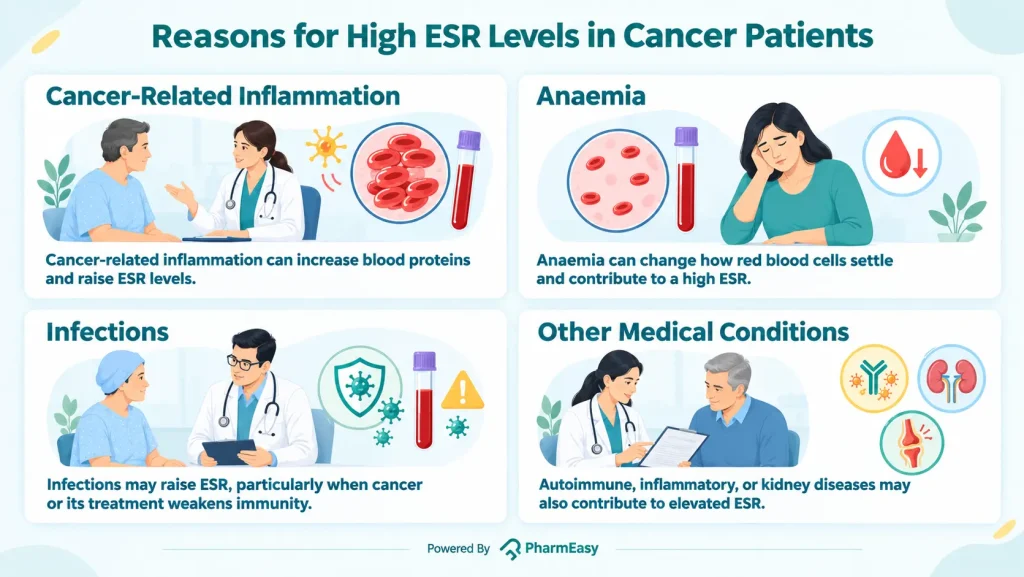
In a person with cancer, a high ESR may be caused by the cancer itself or by other conditions occurring alongside cancer.
The possible causes of elevated ESR in cancer patients include3,4:
Various cancers have been associated with high ESR values through studies; however, these should not be considered as diagnostic values, since ESR values depend on the individual, type of cancer, stages of cancer and other illnesses that may be present.
Most commonly, high ESR levels are reported in some types of blood cancers. Cancers like Multiple Myeloma produce massive amounts of abnormal antibodies or proteins that can greatly increase red blood cell sticking together, leading to very high ESR levels. A reading above 100 mm/hour indicates a highly elevated value which may be seen in multiple myeloma, lymphoma or metastatic cancer (cancer that has spread to distant organs)3,5.
Note: An increased ESR does not indicate the presence of cancer. Age, sex, anaemia and other medical conditions may alter the ESR value in individuals; hence the value must always be interpreted considering other findings and symptoms of the patient.
Some of the ways ESR may be relevant in the evaluation and management of patients with cancer are discussed below1,4:
Note that the ESR test is not specific for cancer and cannot detect any kind of cancer by itself. Rather, it can be used as part of a general health assessment to identify inflammatory activity in the body and determine if further testing is necessary. Discuss the results of your ESR test with your doctor.
Changes in ESR may provide additional information about inflammation and disease activity in some people with cancer. It may have the following role:
Hence, ESR may be used as an additional laboratory finding, along with clinical assessment, imaging and other in some cancers, but it is not routinely used to monitor cancer progression or treatment response.
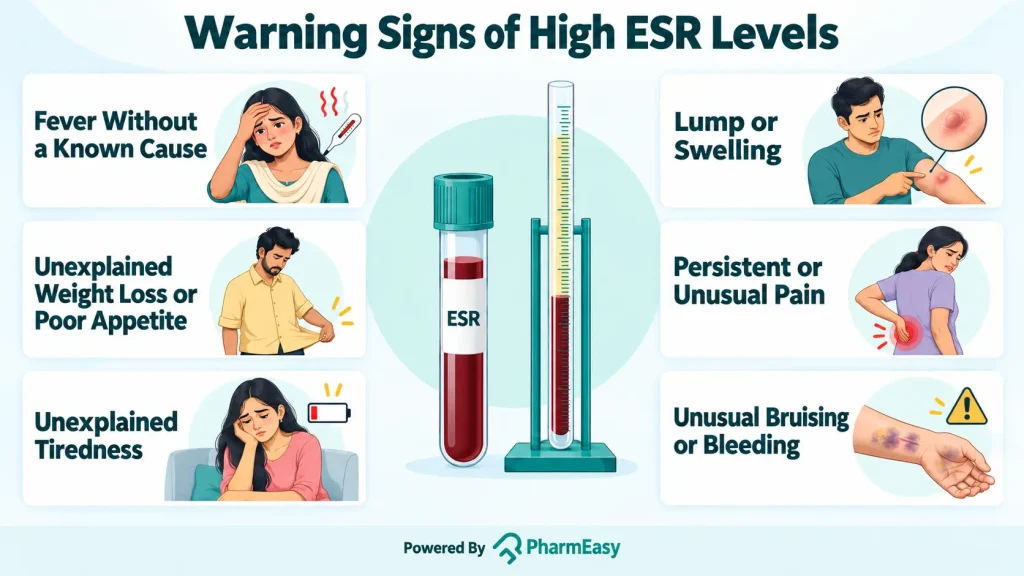
There are no specific symptoms associated with a high ESR test result on its own. It is usually an indicator of an underlying medical condition. Since ESR results are non-specific, the symptoms that are associated with it may be more significant for determining what is causing it.
The following symptoms, if accompanied by a high ESR result, may indicate that further investigation is necessary6,7:
These symptoms do not always mean cancer. They may be due to many other conditions1.
Also Read: What Level of Eosinophils Indicates Cancer?
Discuss your ESR result with your doctor if:
A high ESR does not indicate cancer on its own. Your doctor may recommend further tests to identify the underlying cause based on your symptoms, medical history and other test results1.
Although a high ESR can be worrying, it does not necessarily mean cancer. High ESR levels can occur due to infections, inflammation, anaemia and other health conditions, as well as some cancers. In cancer, ESR may provide additional information about inflammation and, in some types of cancer, may have prognostic value. However, ESR cannot diagnose cancer or determine its stage or severity on its own. Doctors interpret ESR results along with other tests, symptoms and clinical findings. If your ESR remains high or you have ongoing symptoms that concern you, it is best to consult your doctor.
There is no ESR level that means a person has cancer. ESR may be higher in some people with cancer because cancer can cause inflammation, but ESR can also increase because of infections, autoimmune conditions and other health problems. Therefore, an ESR result on its own cannot diagnose cancer8.
Yes, a person with cancer can have a normal ESR. ESR is a non-specific blood test, and a normal result does not rule out cancer. Similarly, an abnormal ESR does not necessarily mean that cancer is present. Doctors use ESR alongside symptoms, medical history and other investigations when assessing a patient4.
No, ESR is not a test used to screen for or detect cancer early. It can be raised in some people with cancer, but it is not specific enough to identify cancer. Cancer screening uses specific tests depending on the type of cancer, such as mammograms, cervical screening, bowel screening or low-dose CT scans etc for people who meet the relevant criteria9.
ESR may decrease after cancer treatment if the inflammation that caused the raised ESR improves. However, a falling ESR does not necessarily mean that cancer is responding to treatment, and a persistently high ESR does not automatically mean treatment failure10. Therefore, doctors use ESR along with other tests and clinical findings to assess a person’s condition/improvement.
1. Erythrocyte Sedimentation Rate (ESR): MedlinePlus Medical Test. Accessed September 6, 2026. https://medlineplus.gov/lab-tests/erythrocyte-sedimentation-rate-esr/
2. Tests and Procedures Used to Diagnose Cancer – NCI. March 9, 2015. Accessed September 7, 2026. https://www.cancer.gov/about-cancer/diagnosis-staging/diagnosis
3. Tishkowski K, Zubair M. Erythrocyte Sedimentation Rate. In: StatPearls. StatPearls Publishing; 2026. Accessed September 7, 2026. http://www.ncbi.nlm.nih.gov/books/NBK557485/
4. Abdollahi O, Vosoughi T, Talebi A, Karimpourian H, Rastegar M, Farhadi E. Investigation of ESR Values in the Diagnosis of Malignancies: A Cross‐Sectional Study. Health Sci Rep. 2025;8(9):e71208. doi:10.1002/hsr2.71208 https://pubmed.ncbi.nlm.nih.gov/40918030/
5. Jette B. Kornum, Dóra K. Farkas, Claus Sværke, Marianne T. Severinsen, Reimar W. Thomsen, Henrik T. Sørensen; Cancer Risk and Prognosis after a Hospital Contact for an Elevated Erythrocyte Sedimentation Rate. Cancer Epidemiol Biomarkers Prev 1 January 2019; 28 (1): 225–232. https://aacrjournals.org/cebp/article/28/1/225/71639/Cancer-Risk-and-Prognosis-after-a-Hospital-Contact
6. ESR: MedlinePlus Medical Encyclopedia. Accessed September 7, 2026. https://medlineplus.gov/ency/article/003638.htm
7. Cancer. nhs.uk. May 30, 2025. Accessed September 7, 2026. https://www.nhs.uk/conditions/cancer/
8. Australia H. Erythrocyte sedimentation rate (ESR) blood test explained. July 7, 2025. Accessed September 7, 2026. https://www.healthdirect.gov.au/erythrocyte-sedimentation-rate-ESR-test
9. CDC. Cancer Screening Tests. Cancer. February 6, 2025. Accessed September 7, 2026. https://www.cdc.gov/cancer/prevention/screening.html
10. Bień E, Balcerska A. [Clinical significance of erythrocyte sedimentation rate, C-reactive protein and serum lactate dehydrogenase levels in the diagnosis, prognosis and treatment monitoring of children suffering from cancer]. Med Wieku Rozwoj. 2004;8(4 Pt 2):1081-1089. https://pubmed.ncbi.nlm.nih.gov/15951603/
Disclaimer: The information provided here is for educational/awareness purposes only and is not intended to be a substitute for medical treatment by a healthcare professional and should not be relied upon to diagnose or treat any medical condition. The reader should consult a registered medical practitioner to determine the appropriateness of the information and before consuming any medication. PharmEasy does not provide any guarantee or warranty (express or implied) regarding the accuracy, adequacy, completeness, legality, reliability or usefulness of the information; and disclaims any liability arising thereof.
Links and product recommendations in the information provided here are advertisements of third-party products available on the website. PharmEasy does not make any representation on the accuracy or suitability of such products/services. Advertisements do not influence the editorial decisions or content. The information in this blog is subject to change without notice. The authors and administrators reserve the right to modify, add, or remove content without notification. It is your responsibility to review this disclaimer regularly for any changes.


Comments

Leave your comment...
You may also like
























Comments