



Vaccination: What It Is, How It Works, and Why It Matters
By Dr. Avinav Gupta +2 more

Medically reviewed by Dr. Avinav Gupta
Last updated: Oct 16, 2026 Published on: Jun 18, 2026


Get,

to manage your symptom
Get your,

4 Cr+ families
benefitted

OTP sent to 9988776655



You’ve successfully subscribed to receive
doctor-approved tips on
Whatsapp

Get ready to feel your best.


Register to Avail the Offer
Send OTPBy continuing, you agree with our Privacy Policy and Terms and Conditions
Hi There,
Sign up on PharmEasy now!!


Trusted by 4 crore+ families

OTP sent to 9988776655
You have unlocked 25% off on medicines


Code: NU25

By Dr. Avinav Gupta +2 more
Table of Contents
Vaccines protect against illness, reduce complications, and save millions of lives every year1. However, many people are still not completely aware of why vaccines are so important. While most people know that vaccines protect against diseases, they may not fully understand how they work or why some vaccines are recommended throughout life.
So, if you’ve ever wondered, ‘what is a vaccine?’ this blog will help answer that question while explaining how vaccines work, the different types available, why are vaccines important, and why staying up to date with recommended vaccinations is important for people of all ages.
Vaccination is a safe and effective way to protect both individuals and communities from infectious diseases2. It involves administering a vaccine (a weakened, inactivated, or harmless part of a germs ) that helps the body’s immune system recognise and fight the specific germ. It works by preparing the immune system in advance. This helps reduce the risk of developing serious illness if a person is exposed to the disease in the future3.
Vaccination is done to help prevent infectious diseases before they occur. It trains the body’s immune system to recognise harmful germs and respond quickly if they enter the body3. Vaccines help reduce the risk of severe illness, complications, hospitalisation, and death caused by infectious diseases. They also help avoid the spread of infections within communities, protecting people who may be more vulnerable to disease4.
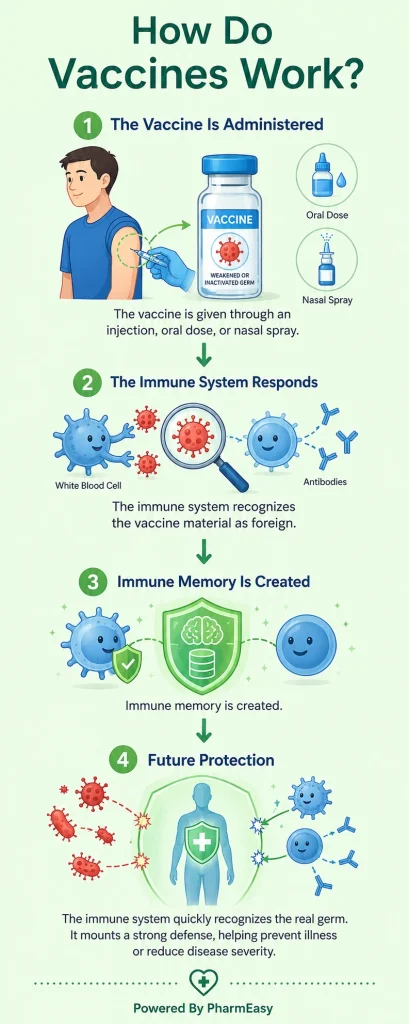
Vaccines work by teaching the immune system how to recognise and fight harmful germs. The process can be explained in a few simple steps:
Vaccines are developed using different methods to help the immune system recognise and fight disease-causing germs. The main types of vaccines include:
Note: Different vaccines work in different ways, but all aim to train the immune system to recognise and respond more effectively to specific infectious diseases.
Vaccination is important because it helps protect individuals and communities from serious infectious diseases. Some of the key benefits of vaccines include:
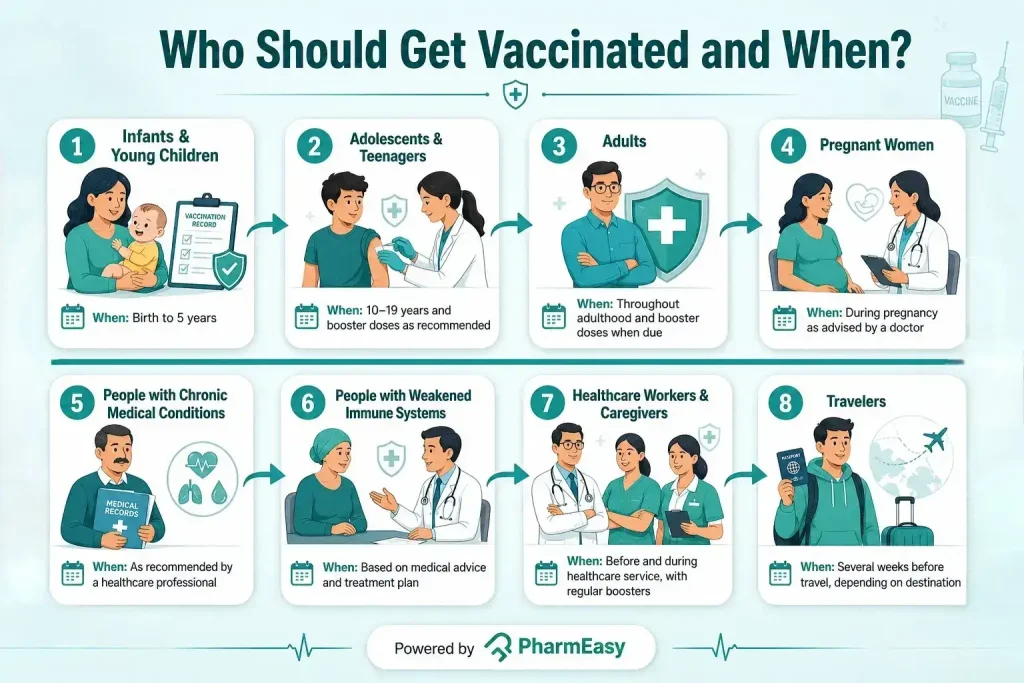
Vaccination is recommended for people of all ages to help protect against infectious diseases. So, following the recommended immunisation schedule and receiving vaccines at the appropriate time helps ensure the best possible protection. Common recommendations include11,12:
Important: The vaccines mentioned above are only examples. Not everyone needs the same vaccines at the same time. Your vaccination needs may depend on your age, health condition, lifestyle, occupation, and travel plans. Always consult your doctor and follow the recommended vaccination schedule to ensure you receive the appropriate vaccines at the right time.
Choosing not to get vaccinated can increase the risk of contacting and spreading infectious diseases. While the level of risk varies depending on the disease and the individual’s health status, some potential consequences include:
Note: While not every unvaccinated person will become seriously ill, vaccination remains one of the safest and most effective ways to reduce the risk of many infectious diseases and their complications.
Despite the proven benefits of vaccines, several myths and misconceptions continue to circulate. Therefore, understanding the facts behind these common claims can help people make informed decisions about vaccination and better protect their health.
| Myth | Fact |
| Vaccines can cause the disease they are meant to prevent. | Most vaccines do not contain live disease-causing germs and cannot cause the disease. They help the immune system build protection safely5. |
| Vaccines are only for children. | Vaccination is important throughout life. Adolescents, adults, older adults, and pregnant women may also need recommended vaccines and booster doses11,12. |
| If a disease is rare, vaccination is no longer necessary. | Diseases can return if vaccination rates decline3. Therefore, continued vaccination helps avoid outbreaks and protects communities. |
| Healthy people do not need vaccines. | Even healthy individuals can become infected and spread diseases to others. Vaccination helps protect both the individual and the community2,3. |
| Vaccines overload or weaken the immune system. | Vaccines use only a small portion of the immune system’s capacity. The immune system safely handles vaccines while continuing to protect against other infections3,5. |
| Vaccines contain harmful ingredients. | Vaccine ingredients are carefully tested for safety and quality before approval and are used in very small amounts to ensure effectiveness and stability15. |
| Vaccines provide protection immediately. | It usually takes days to weeks after vaccination for the body to develop a protective immune response5. |
| Childhood vaccination is enough to provide protection throughout life. Vaccines cause autism. | While true for some vaccines, some others require booster doses later in life because immunity can decrease over time. Boosters help maintain long-term protection5. Extensive scientific research has found no evidence that vaccines cause autism. Major health organisations worldwide continue to support vaccination as safe and effective. |
Vaccines should be received according to the recommended immunisation schedule and your doctor’s advice.
Vaccination may be recommended during infancy, adolescence, adulthood, pregnancy, before travel, or in individual with certain health conditions that increase the risk of infection. Booster doses may also be needed over time to maintain immunity11,12.
In most cases, vaccines can be received at any time of the day. There is generally no specific morning, afternoon, or evening time that is considered best for vaccination.
Note: Vaccination schedules vary based on factors such as age, health status, medical history, occupation, and travel plans. Always consult your doctor and follow the vaccination schedule recommended by national health authorities.
Vaccines are generally safe and effective. However, they can sometimes cause side effects.
Some of the common side effects after vaccination include16:
Other, less common vaccine side effects include16:
Note: Most people experience either no side effects or only mild, short-lived symptoms after vaccination. The benefits of vaccination generally outweigh the risk of side effects. Always consult your doctor if you have concerns about vaccine safety or possible reactions.
Also Read: Dengue Vaccine in India: Approval, Eligibility, Safety & Effectiveness
You should seek medical attention if you experience17:
Important: Vaccines are safe for most people. However, some individuals may not be able to receive certain vaccines, including those who have had a severe allergic reaction (anaphylaxis) to a previous vaccine dose or one of its ingredients. People with weakened immune systems due to certain medical conditions or treatments may not be eligible for some vaccines. If you are unsure whether a vaccine is suitable for you or your child, consult your doctor for guidance18.
Also Read: Everything You Need to Know About the Hepatitis A Vaccine
Vaccination is one of the most effective ways to protect individuals and communities from infectious diseases. They help the immune system recognise and fight harmful germs, and reduce the risk of illness, serious complications, and disease outbreaks.
If you have questions about which vaccines are right for you or your family, consult your doctor and follow the recommended immunisation schedule.
Vaccines undergo extensive testing and continuous safety monitoring before and after approval. They are considered safe for children and play an important role in protecting them from serious infectious diseases2,15.
We need vaccines because they help the immune system recognise and fight harmful germs before they cause illness. They also help to reduce the risk of infection, serious complications, hospitalisation, and the spread of disease within communities2,5,19.
No, vaccines do not prevent every disease. However, they are highly effective at protecting against many serious infectious diseases and can significantly reduce the severity of illness if infection occurs5,11.
Yes, it is possible, because no vaccine provides 100% protection. In some cases, vaccinated individuals may still become infected, but vaccines often help to reduce the severity of symptoms and lower the risk of complications5.
Missing a vaccine dose does not usually mean the entire vaccination series needs to be restarted. In many cases, a catch-up schedule can be used. Consult your doctor to determine the appropriate timing for missed doses.
1. Why vaccines matter: understanding the broader health, economic, and child development benefits of routine vaccination – PMC. Accessed June 15, 2026. https://pmc.ncbi.nlm.nih.gov/articles/PMC7482790/
2. Hussain S. Immunization and Vaccination. Psychiatry Pandemics. Published online May 16, 2019:153-177. doi:10.1007/978-3-030-15346-5_13. https://pmc.ncbi.nlm.nih.gov/articles/PMC11901362/
3. Ginglen JG, Doyle MQ. Immunization. In: StatPearls. StatPearls Publishing; 2026. Accessed June 15, 2026. http://www.ncbi.nlm.nih.gov/books/NBK459331/
4. Laupèze B, Del Giudice G, Doherty MT, Van der Most R. Vaccination as a preventative measure contributing to immune fitness. NPJ Vaccines. 2021;6:93. doi:10.1038/s41541-021-00354-z. https://pubmed.ncbi.nlm.nih.gov/34315886/
5. CDC. Explaining How Vaccines Work. Vaccines & Immunizations. May 7, 2026. Accessed June 15, 2026. https://www.cdc.gov/vaccines/basics/explaining-how-vaccines-work.html
6. Policy (OIDP) O of ID and H. Vaccine Types. April 27, 2021. Accessed June 15, 2026. https://www.hhs.gov/immunization/basics/types/index.html
7. Combination Vaccines – PMC. Accessed June 15, 2026. https://pmc.ncbi.nlm.nih.gov/articles/PMC3068581/
8. Bruxvoort KJ, Bahakel H, Martin JM, et al. Inclusion of Women, Children, the Elderly, and Individuals With Underlying Medical Conditions: Prioritizing Vulnerable Populations in Clinical Research. Clin Infect Dis Off Publ Infect Dis Soc Am. 2025;81(Suppl 2):S78-S88. doi:10.1093/cid/ciaf408. https://pmc.ncbi.nlm.nih.gov/articles/PMC12513348/
9. Jung H, Albarracín D. Concerns for others increases the likelihood of vaccination against influenza and COVID-19 more in sparsely rather than densely populated areas. Proc Natl Acad Sci U S A. 2021;118(1):e2007538118. doi:10.1073/pnas.2007538118. https://pubmed.ncbi.nlm.nih.gov/33443183/
10. Benefits of vaccination. January 17, 2024. Accessed June 15, 2026. https://vaccination-info.europa.eu/en/about-vaccines/benefits-vaccination
11. CDC. Vaccines by Age. Vaccines & Immunizations. June 9, 2025. Accessed June 15, 2026. https://www.cdc.gov/vaccines/by-age/index.html
12. CDC. What Vaccines are Recommended for You. Vaccine Information for Adults. December 12, 2025. Accessed June 15, 2026. https://www.cdc.gov/vaccines-adults/recommended-vaccines/index.html
13. Shaw D. The Side Effects of Not Being Vaccinated: Individual Risk and Vaccine Hesitancy Nationalism. J Bioethical Inq. 2022;19(1):7-10. doi:10.1007/s11673-021-10141-z. https://pmc.ncbi.nlm.nih.gov/articles/PMC8611634/
14. Field RI. Vaccine Declinations Present New Challenges for Public Health. Pharm Ther. 2008;33(9):542-543. https://pmc.ncbi.nlm.nih.gov/articles/PMC2730125/
15. What’s in a vaccine? Accessed June 15, 2026. https://www.who.int/news-room/feature-stories/detail/how-are-vaccines-developed
16. CDC. Possible Side Effects from Vaccines. Vaccines & Immunizations. October 2, 2024. Accessed June 16, 2026. https://www.cdc.gov/vaccines/basics/possible-side-effects.html
17. Anaphylaxis. nhs.uk. October 20, 2017. Accessed June 16, 2026. https://www.nhs.uk/conditions/anaphylaxis/
18. Why vaccination is important and the safest way to protect yourself – NHS. Accessed June 16, 2026. https://www.nhs.uk/vaccinations/why-vaccination-is-important-and-the-safest-way-to-protect-yourself/
19. Why vaccination is important and the safest way to protect yourself. nhs.uk. March 6, 2024. Accessed June 16, 2026. https://www.nhs.uk/vaccinations/why-vaccination-is-important-and-the-safest-way-to-protect-yourself/
Disclaimer: The information provided here is for educational/awareness purposes only and is not intended to be a substitute for medical treatment by a healthcare professional and should not be relied upon to diagnose or treat any medical condition. The reader should consult a registered medical practitioner to determine the appropriateness of the information and before consuming any medication. PharmEasy does not provide any guarantee or warranty (express or implied) regarding the accuracy, adequacy, completeness, legality, reliability or usefulness of the information; and disclaims any liability arising thereof.
Links and product recommendations in the information provided here are advertisements of third-party products available on the website. PharmEasy does not make any representation on the accuracy or suitability of such products/services. Advertisements do not influence the editorial decisions or content. The information in this blog is subject to change without notice. The authors and administrators reserve the right to modify, add, or remove content without notification. It is your responsibility to review this disclaimer regularly for any changes.


Comments

Leave your comment...
You may also like


















Comments