




Dengue Vaccine in India: Approval, Eligibility, Safety & Effectiveness
By Dr. Avinav Gupta +2 more

Medically reviewed by Dr. Avinav Gupta
Last updated: Oct 16, 2026 Published on: Jul 30, 2026


Get,

to manage your symptom
Get your,

4 Cr+ families
benefitted

OTP sent to 9988776655



You’ve successfully subscribed to receive
doctor-approved tips on
Whatsapp

Get ready to feel your best.


Register to Avail the Offer
Send OTPBy continuing, you agree with our Privacy Policy and Terms and Conditions
Hi There,
Sign up on PharmEasy now!!


Trusted by 4 crore+ families

OTP sent to 9988776655
You have unlocked 25% off on medicines


Code: NU25

By Dr. Avinav Gupta +2 more
Table of Contents
Dengue is a major mosquito-borne disease in India, with seasonal outbreaks placing a significant burden on public health1. as cases continue to rise, there is growing interest in effective preventive measures, including vaccination. However, developing a dengue vaccine has been challenging because the disease is caused by four different dengue virus serotypes, all of which need to be addressed for effective protection1,2.
In recent years, important progress has been made in dengue vaccine development. This blog explores the current status of dengue vaccines in India, including their approval, eligibility, safety, and effectiveness.

Vaccines for dengue have been developed, and some are approved for use in several countries. However, unlike many routine vaccines, dengue vaccines are not universally recommended because their safety and effectiveness can depend on factors such as a person’s age and whether they have had a previous dengue infection. As a result, countries adopt different vaccination policies based on local disease patterns and available evidence3,4.
Developing a dengue vaccine has been particularly challenging because dengue is caused by four different virus serotypes (DENV-1, DENV-2, DENV-3, and DENV-4). Infection with one serotype provides long-term protection only against that specific type, while a later infection with another serotype may increase the risk of severe dengue through a process called antibody-dependent enhancement (ADE). Therefore, an effective vaccine must provide balanced protection against all four serotypes without increasing the risk of severe disease5,6.
Despite these challenges, global research has made significant progress.
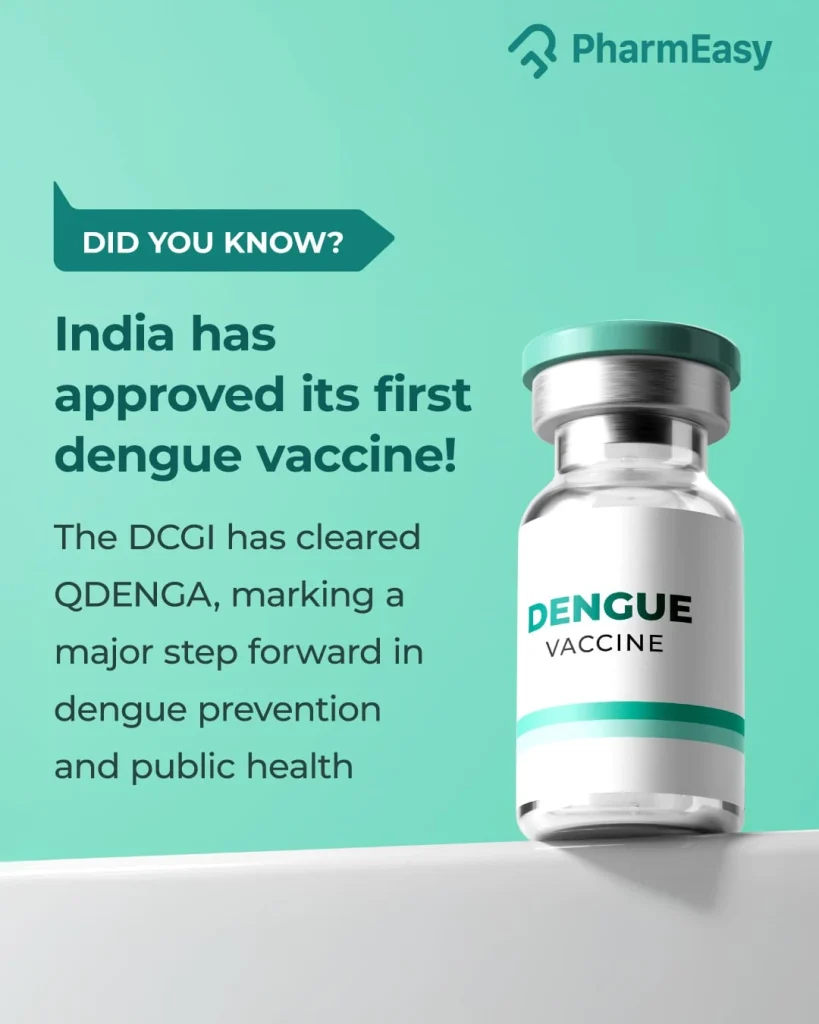
If you are looking for the name of the dengue vaccine approved in India , it is Qdenga, the first dengue vaccine approved in India8.
Qdenga is a live, weakened vaccine that helps protect against all four types of the dengue virus. It was developed using recombinant DNA technology, a method that allows scientists to safely modify the virus so it can stimulate the immune system without causing dengue in healthy individuals. The vaccine is manufactured using Vero cells, supplied as a freeze-dried powder, and is mixed with a liquid before being given as an injection under the skin (subcutaneous injection)8.
The main features of this dengue fever vaccine in India are outlined in the table below8.
| Feature | Details |
| Vaccine name | Qdenga® (TAK-003) |
| Manufacturer | Developed by Takeda GmbH, Germany Imported in India by Takeda Biopharmaceuticals India Pvt. Ltd. |
| Regulatory authority | Central Drugs Standard Control Organisation (CDSCO) |
| Approval date | July 2026 |
| Approval status | Approved under the Drugs and Cosmetics Act (1940) and the Drugs Rules (1945) |
| Approved age group | Individuals 4 to 60 years |
Note: Although Qdenga has received regulatory approval, dengue vaccination is not yet part of India’s Universal Immunisation Programme (UIP). The vaccine is expected to be available initially through the private healthcare sector.
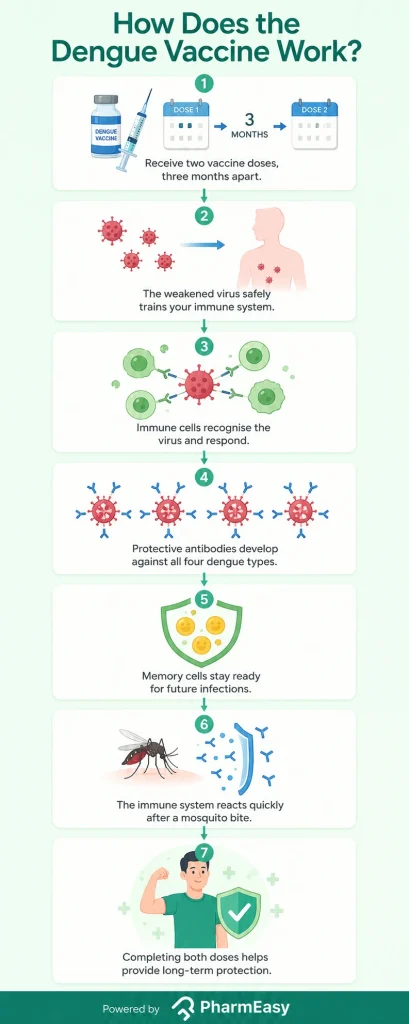
Qdenga is a live attenuated tetravalent vaccine. This means that it contains weakened versions of all four dengue virus serotypes (DENV-1, DENV-2, DENV-3, and DENV-4)9.
This dengue fever vaccine helps the immune system build protection against dengue without causing the disease. It works through the following steps9,11:
According to the World Health Organization (WHO), Qdenga is recommended primarily for use in areas where dengue transmission is high, and the disease poses a significant public health burden. Eligibility is based on factors such as age, local dengue transmission, and certain medical conditions.
The following individuals may be eligible for Qdenga8:
Qdenga should not be administered to9:
The Qdenga dengue fever vaccine is administered as a two-dose primary vaccination series. Completing both doses is essential to achieve the recommended level of protection against dengue. Here is what to expect8,9:
| Schedule Component | Recommendation for Qdenga |
| Number of doses | 2 doses |
| Dose volume | 0.5 mL per dose |
| Route of administration | Subcutaneous (under the skin) injection |
| Dose 1 | Given on the chosen vaccination date (Day 0) |
| Dose 2 | Administered 3 months after the first dose |
| Minimum interval between doses | 3 months |
| Booster dose | No booster dose is currently recommended. |
Note: According to the WHO, the interval between doses should not be shortened, and if the second dose is delayed, the vaccination series does not need to be restarted9.
Qdenga vaccine provides protection against dengue. Its approval is based on a large global clinical development programme that evaluated the vaccine’s safety, immunogenicity (ability to trigger an immune response), and efficacy. Key evidence supporting the effectiveness of Qdenga includes8:
More than 24 million doses of Qdenga have been administered globally. Ongoing post-marketing monitoring has continued to show a favourable safety profile, with no new major safety concerns reported8. overall , most people tolerate Qdenga well. If side effects occur, they are usually mild to moderate, begin within 1 to 2 days after vaccination, and resolve within 1 to 3 days. Common side effects include12:
Other less common side effects include12:
Important: Most side effects after Qdenga are mild and resolve within a few days. However, seek immediate medical attention if you experience symptoms of a severe allergic reaction, such as difficulty breathing, swelling of the face, lips, tongue, or throat, severe rash or hives, dizziness, or fainting12. Although these reactions are very rare, prompt treatment is essential.
Although vaccination can help reduce the risk of dengue in eligible individuals, preventing mosquito bites remains the most effective way to avoid infection. Follow these simple preventive measures13:
Also Read: Natural Home Remedies for Dengue
The approval of Qdenga marks an important step forward in India’s efforts to reduce the burden of dengue. While the vaccine offers protection against dengue, particularly against severe disease and hospitalisation in eligible individuals, it is not a substitute for mosquito control and bite prevention.
Following the recommended vaccination schedule, staying informed about eligibility, and continuing preventive measures such as using insect repellents and eliminating mosquito breeding sites remain essential. Together, vaccination and mosquito control provide the best strategy for reducing the impact of dengue in India.
Qdenga is the first dengue vaccine approved in India. It is designed to protect against all four dengue virus serotypes and is given as two doses, three months apart8,9.
The new 4-serotype (tetravalent) dengue vaccine is Qdenga. It is a live attenuated vaccine that helps the immune system develop protection against DENV-1, DENV-2, DENV-3, and DENV-48.
The dengue vaccine is not recommended for everyone. The WHO currently recommends the routine use of Qdenga mainly in areas with high dengue transmission and for specific age groups. It is also not suitable for certain individuals, such as pregnant women, breastfeeding women, and people with weakened immune systems9.
Yes, Dengvaxia is considered safe when used according to approved recommendations. It is recommended only for individuals with a confirmed previous dengue infection, as its use in people who have never had dengue may increase the risk of severe disease after a future infection3.
Available evidence suggests that protection may persist for several years after completing the two-dose schedule, although research is still ongoing to determine the exact duration of long-term protection14. At present, no booster dose is recommended.
1. Pescador Ruschel MA, Panda PK, Farmer A. Dengue fever. StatPearls. Accessed July 23, 2026.2026. https://www.ncbi.nlm.nih.gov/books/NBK430732/
2. Mutheneni SR, Morse AP, Caminade C, Upadhyayula SM. Dengue burden in India: recent trends and importance of climatic parameters. Emerg Microbes Infect. 2017;6(8):e70. doi:10.1038/emi.2017.57. https://pubmed.ncbi.nlm.nih.gov/28790459/
3. About a Dengue Vaccine. CDC. May 15, 2025. Accessed July 23, 2026. https://www.cdc.gov/dengue/vaccine/index.html
4. Kant R, Singh A, Ali AB, Nagre S, Ganguly NK, Rana R. Dengue vaccine effectiveness and safety: a systematic analysis of recent clinical trial data. Virol J. 2025;22:384. doi:10.1186/s12985-025-02937-x. https://pubmed.ncbi.nlm.nih.gov/41287091/
5. Anumanthan G, Sahay B, Mergia A. Current Dengue Virus Vaccine Developments and Future Directions. Viruses. 2025;17(2):212. doi:10.3390/v17020212. https://pubmed.ncbi.nlm.nih.gov/40006967/
6. Aynekulu Mersha DG, van der Sterren I, van Leeuwen LPM, et al. The role of antibody-dependent enhancement in dengue vaccination. Trop Dis Travel Med Vaccines. 2024;10:22. doi:10.1186/s40794-024-00231-2. https://pubmed.ncbi.nlm.nih.gov/39482727/
7. Lee MF, Long CM, Poh CL. Current status of the development of dengue vaccines. Vaccine X. 2025;22:100604. doi:10.1016/j.jvacx.2024.100604. https://pubmed.ncbi.nlm.nih.gov/39830640/
8. CDSCO Approves India’s First Dengue Vaccine, Strengthening National Dengue Prevention Efforts. Ministry of Health and Family Welfare. Accessed July 23, 2026. https://www.pib.gov.in/www.pib.gov.in/Pressreleaseshare.aspx?PRID=2286883
9. Vaccines and immunization: Dengue. CDC. Accessed July 23, 2026. https://www.who.int/news-room/questions-and-answers/item/dengue-vaccines
10. How do vaccines work? World Health Organization. Accessed July 23, 2026. https://www.who.int/news-room/feature-stories/detail/how-do-vaccines-work
11. Explaining How Vaccines Work. CDC. May 7, 2026. Accessed July 23, 2026. https://www.cdc.gov/vaccines/basics/explaining-how-vaccines-work.html
12. Qdenga, INN-Dengue tetravalent vaccine (live, attenuated). European Medicines Agency. Accessed July 23, 2026. https://www.ema.europa.eu/en/documents/product-information/qdenga-epar-product-information_en.pdf
13. Preventing Dengue. CDC. May 29, 2025. Accessed July 23, 2026. https://www.cdc.gov/dengue/prevention/index.html
14. Takeda. Phase III, Double-Blind, Randomized, Placebo-Controlled Trial to Investigate the Efficacy, Safety and Immunogenicity of a Tetravalent Dengue Vaccine (TDV) Administered Subcutaneously in Healthy Children Aged 4 – 16 Years Old. Clinicaltrials.gov; 2025. Accessed July 23, 2026. https://clinicaltrials.gov/study/NCT02747927
Disclaimer: The information provided here is for educational/awareness purposes only and is not intended to be a substitute for medical treatment by a healthcare professional and should not be relied upon to diagnose or treat any medical condition. The reader should consult a registered medical practitioner to determine the appropriateness of the information and before consuming any medication. PharmEasy does not provide any guarantee or warranty (express or implied) regarding the accuracy, adequacy, completeness, legality, reliability or usefulness of the information; and disclaims any liability arising thereof.
Links and product recommendations in the information provided here are advertisements of third-party products available on the website. PharmEasy does not make any representation on the accuracy or suitability of such products/services. Advertisements do not influence the editorial decisions or content. The information in this blog is subject to change without notice. The authors and administrators reserve the right to modify, add, or remove content without notification. It is your responsibility to review this disclaimer regularly for any changes.


Comments

Leave your comment...
You may also like

























Comments