
Introduction
Why does my fever keep coming back? is a common question, especially during the monsoon season when infections are more prevalent.
This can be frustrating and sometimes worrying, especially when you are unsure why it keeps happening. In many cases, this may be a sign that the underlying cause has not completely resolved1.
In this blog, we will explore why fever keeps coming back, common causes in monsoon season, warning signs to watch for, and what you can do to support recovery.
Advertisement
What Does Recurring Fever Mean?
Recurring fever meaning, a fever that goes away and then returns after a period of normal temperature, often indicate an underlying infection or other medical conditions. These repeated fever episodes which may occur over days or weeks, not only affect the physical health but can also cause immense mental distress2,3.
It is important to understand that while occasional fluctuations in body temperature can be normal during recovery, repeated episodes of fever should not be ignored, especially if they persist or are accompanied by other concerning symptoms.
Recurring Fever in Children vs Adults
Recurring fever is most commonly caused by an unresolved infection, although non-infectious conditions can also be responsible. Some common causes include2,3,4,5:
- Viral infections: These infections are caused by viruses. Common examples include the common cold, influenza (flu), and other upper respiratory tract infections.
- Bacterial infections: These infections are caused by bacteria. Common examples include tuberculosis, tonsillitis, pneumonia, gastrointestinal and urinary tract infections (UTIs).
- Autoinflammatory conditions: Certain long term conditions can cause persistent or recurrent fever. Examples include Familial Mediterranean fever and PFAPA syndrome (periodic fever, aphthous, pharyngitis, adenitis syndrome).
- Immune mediated diseases: Autoimmune conditions where the body’s immune system is hyperresponsive can also cause recurrent fevers along with other symptoms. Examples include rheumatoid arthritis, systemic lupus erythematosus (SLE) and ulcerative colitis.
- Cancers: Certain cancers like lymphoma or leukaemia (blood cancer) and tumours in HIV can cause recurrent fevers.
- Medications: Some individuals may develop fever as a side effect to certain medications. This is commonly referred to as drug-induced fever.
- Other causes: Fever may also occur in association with heat stroke or following vaccinations.
Fever due to the above-mentioned causes can occur at any age, but sometimes it may differ slightly between children and adults. For example4,5:
- Children: In children, recurrent infections are more common as their immune systems are still developing. However, some non-infectious causes such as cyclic fever syndromes may also be a cause of recurrent fevers in children2. Mild, transient fever may also occur following childhood vaccination.
- Adults: Unresolved viral and bacterial infections are common cause of recurring fever in adults as well, especially tuberculosis. However, fever in adults may also result from chronic inflammatory or autoimmune disorders (e.g., rheumatoid arthritis, inflammatory bowel disease), drug-induced reactions, malignancies (cancers), and heat-related illnesses.
As discussed above, infectious causes predominate across all age groups, but non-infectious causes are more commonly considered in adults, particularly when fever is prolonged, recurrent, or unexplained. However, these differences are not absolute. Many causes of recurring fever can affect both children and adults, and there is often overlap between age groups.
Important: Age can help guide the evaluation, but it does not determine the diagnosis. If fever keeps coming back, you should always be assessed in the context of an individual’s overall symptoms and medical history.
Advertisement
Common Causes of Recurring Fever During Monsoon
The monsoon season creates conditions that favour the spread of several infectious diseases. During monsoon, stagnant water can facilitate the breeding of mosquitoes leading to more frequent mosquito-borne infections. Moreover, higher humidity and food or water contamination can contribute to different types of infections6. Some common causes of fever in monsoon include:
- Flu: Seasonal viral illnesses, such as influenza and other respiratory infections, are common during the monsoon. Fever may fluctuate over several days and can be accompanied by fatigue, body aches, cough, or sore throat7,8.
- Dengue Fever: Dengue is a mosquito-borne viral infection that becomes more prevalent during the rainy season due to increased mosquito breeding. It typically causes high fever, severe headache, muscle and joint pain, nausea, and rash9.
- Malaria: Malaria is caused by parasites and is transmitted through mosquito bites. It often presents with cyclical fever episodes, chills, sweating, headache, and weakness10.
- Typhoid Fever: Typhoid is a bacterial infection that is spread through the consumption of contaminated food and water. It commonly causes prolonged fever, abdominal discomfort, weakness, and loss of appetite11.
- Leptospirosis: Leptospirosis is a bacterial infection that can occur after contact with water contaminated by animal urine. Symptoms may include fever, headache, muscle pain, and fatigue12.
- Gastrointestinal Infections: Contaminated food and water can also lead to bacterial or parasitic infections of stomach and intestines. These illnesses often cause fever along with diarrhoea, vomiting, and abdominal pain13.
Warning Signs of Recurring Fever
While most fevers improve with rest and appropriate management, some symptoms may indicate a more serious underlying condition and require immediate medical attention.
For Children
You should seek immediate medical attention if a child has a fever14:
- Is younger than 3 months of age
- Shows signs of dehydration/refuses to drink fluids/ reduced urine output.
- Has persistent vomiting
- Is unusually drowsy, difficult to wake, or unresponsive
- Has difficulty breathing
- Appears extremely distressed or inconsolable
For Adults
You should seek urgent medical care if a fever is accompanied by any of the following14:
- Severe headache
- Signs of dehydration, such as very little urine, severe dizziness, or inability to keep fluids down
- Sensitivity to bright light
- Bleeding from the gums, nose, vomit or stool.
- Unusual skin rash
- Stiff neck
- Persistent vomiting
- Confusion or disorientation
- Excessive drowsiness or difficulty staying awake
- Difficulty breathing
- Severe abdominal pain
- Hallucinations (brain tricks you into seeing, hearing, smelling, tasting, or feeling something that isn’t there)
- Seizures or muscle spasms
How Doctors Diagnose Recurring Fever?
Diagnosing a fever that keeps coming back begins with identifying the underlying cause. To do this, doctors typically review the pattern of fever episodes, associated symptoms, recent travel history, medical conditions, medications, and possible exposure to infections. Common diagnostic approaches include:
- Physical Examination: A thorough physical examination helps identify signs of infection, inflammation, or other clues that may point to the cause of the fever14.
- Blood Tests: Blood tests are often used to look for signs of infection or inflammation. These may include a complete blood count (CBC), inflammatory markers such as C-reactive protein (CRP) or erythrocyte sedimentation rate (ESR), and tests to assess organ function15.
- Urine Tests: Urine analysis and urine culture may be recommended when a urinary tract infection or kidney infection is suspected.
- Tests for Specific Infections: Depending on the symptoms and local disease patterns, doctors may recommend tests for infections such as dengue or other viral and bacterial illnesses9,15.
- Imaging Studies: Imaging tests may be used to identify hidden sources of infection that are not apparent during a physical examination15.
- Additional Investigations: If routine tests do not reveal a cause, further investigations may be needed to evaluate for autoimmune diseases, periodic fever syndromes, or other less common conditions.
Since fever during the monsoon season can have many possible causes. Therefore, if you are experiencing repeated episodes of fever, identifying the recurring fever reasons is important for proper guided treatment by a doctor.
Treatment Options for Recurring Fever
Managing a fever that keeps coming back depends on its underlying cause. Its effective management focuses on identifying and addressing the condition responsible for the repeated episodes. Common options include:
- Treating the Underlying Cause: Specific treatment may be required depending on the diagnosis. For example, conditions such as malaria, dengue, or other diseases may need targeted therapies prescribed by a doctor.
- Fever Reducing Medications: Antipyretic medications, such as paracetamol (acetaminophen), may help reduce fever and improve comfort14,15. These medications should be used according to your doctor’s advice only.
- Rest and Recovery: Getting adequate rest allows the body to direct energy toward fighting infection and healing. Also, avoiding strenuous physical activity may also help support recovery14.
- Adequate Hydration: Fever may increase fluid loss through sweating and could eventually lead to dehydration. Therefore, drinking plenty of water, oral rehydration solutions, soups, or other fluids can help maintain hydration during recovery14,16.
- Monitoring Symptoms: Keeping track of fever patterns and associated symptoms can help doctors assess whether treatment is working and determine if further evaluation is needed.
If a fever persists or recurs despite appropriate treatment of an identified infection, it may indicate an underlying non-infectious condition, such as an autoimmune or inflammatory disorder, malignancy, or another illness. In such cases, a detailed clinical evaluation and further diagnostic work up may be required to determine the underlying cause.
Note: It is important to avoid self-medicating, as inappropriate use may delay the diagnosis of the underlying condition. If you’re unsure what to do if fever keeps coming back, seek medical advice, especially if the fever is accompanied by warning signs (discussed in the earlier section).
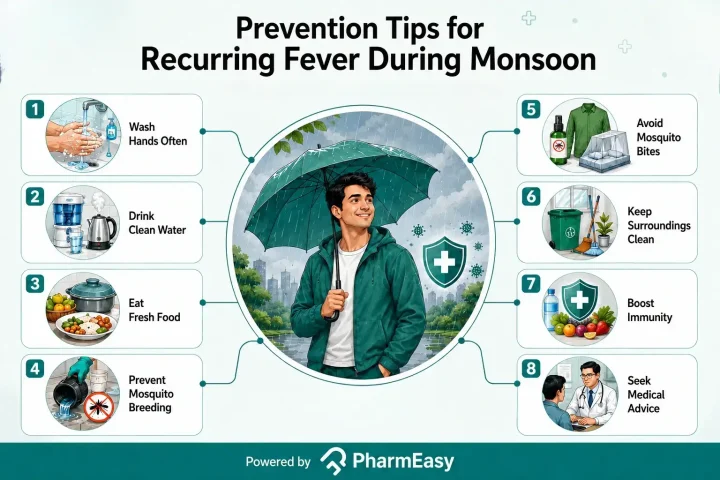
Prevention Tips for Recurring Fever During Monsoon
While not all causes of recurring fever can be avoided, adopting healthy habits during the monsoon season can help reduce the risk of infections that commonly cause fever. Some habits include:
- Maintain good hand hygiene: Clean your hands often using soap and water. This should be followed especially before eating and after using the restroom. If soap and water are not available, use an alcohol-based hand sanitiser17.
- Drink safe water: Consume clean, filtered, or boiled water to reduce the risk of waterborne infections (such as typhoid)11.
- Eat freshly prepared food: Avoid consuming food from unhygienic sources and ensure that meals are properly cooked and covered while storage to minimise the risk of foodborne illnesses11.
- Prevent mosquito breeding: Remove stagnant water from containers, coolers, and other areas around the home. This helps reduce the breeding of mosquitoes that can spread dengue and malaria9,10.
- Protect yourself from mosquito bites: Wear long-sleeved clothing, use mosquito repellents, and sleep under mosquito nets, when necessary, especially in areas with a high prevalence of mosquito-borne diseases9.
- Keep your surroundings clean: Maintain a clean living environment and ensure proper waste disposal to help prevent the spread of infections9,11.
- Support your immune health: Adequate sleep, regular physical activity, a balanced diet, and proper hydration can help support overall health and the body’s ability to fight infections14,18.
- Seek early medical advice: If fever persists, recurs frequently, or is accompanied by concerning symptoms, consult a doctor as soon as possible.
When to See a Doctor?
You should also contact your doctor if5:
- You feel unusually thirsty or are urinating less than normal.
- Your fever that lasts for more than 3 days or keeps returning despite treatment.
- Your urine appears darker than usual.
- You feel lightheaded, dizzy, or weak.
- You develop new or severe muscle cramps.
- Your symptoms worsen, or new symptoms appear.
- You develop a fever after recent international travel.
- You experience unexpected weight loss or night sweats.
You should also contact a doctor if you have an underlying medical condition that may increase your risk of complications. Seek medical advice if you have a fever and5:
- Have a weakened immune system or take medications that suppress immunity.
- Are currently undergoing or have recently finished treatment for cancer.
- Have received an organ transplant or are living with HIV.
- Have a chronic medical condition, such as lung disease, heart disease, diabetes, liver disease, kidney disease, or cystic fibrosis.
- Have a neurological disorder, such as multiple sclerosis, stroke, cerebral palsy, or muscular dystrophy.
- Have sickle cell disease.
- Are pregnant.
Also Read: Fever During Pregnancy: Causes, Risks, Symptoms, Treatment & Prevention
Conclusion
A fever that keeps coming back can be frustrating and concerning, especially when it seems to improve and then return. Although infections are a common cause, repeated fever episodes may occasionally be a sign of an underlying health problem.
Therefore, paying attention to accompanying symptoms, staying hydrated, following common preventive measures, and seeking timely medical advice can help ensure proper diagnosis and management (if needed). If a fever persists, recurs frequently, or is accompanied by warning signs, you should consult a doctor to identify the cause and support a safe recovery.
Also Read: Home Remedies For Viral Fever
Frequently Asked Questions (FAQs)
What is the 24-hour rule for fever?The 24-hour rule generally refers to monitoring whether a fever improves within 24 hours after treatment or supportive care19. If the fever persists, returns frequently, or is accompanied by concerning symptoms, medical evaluation may be needed.
Why is the fever coming again and again after taking medicine?Fever-reducing medicines can only temporarily lower body temperature. They do not help in treating the underlying cause20. If the infection or condition causing the fever has not resolved, the fever may return once the medication wears off.
Why does my fever keep coming back every night?Some infections can cause body temperature to rise at night21. If fever repeatedly occurs at night or continues for several days, you should consult a doctor for evaluation.
Does fever keep coming back in dengue?Dengue can sometimes follow a ‘saddleback’ pattern, where the fever improves for a short period and then returns22. However, not everyone with dengue experiences this pattern. If this pattern happens with you, you should consider seeing a doctor for further evaluation.
Why does fever keep coming back in a toddler?Toddlers are frequently exposed to viruses and other infections, which may lead to repeated episodes of fever2,3. In some cases, recurring fever could also be related to other underlying conditions and should be assessed by a doctor if it persists or occurs frequently.
Can stress cause recurring fever?In some cases, stress may contribute to a rise in body temperature or a low-grade fever23. However, recurring fever is more commonly caused by infections or other medical conditions. So, if your fever keeps coming back, it is important to consult a doctor to determine the underlying cause.
Can antibiotics stop a recurring fever?Not always. Antibiotics only work against bacterial infections and do not treat viral illnesses. The correct treatment depends on the underlying cause of the fever.
References
- Ames NJ, Peng C, Powers JH, et al. Beyond Intuition: Patient Fever Symptom Experience. J Pain Symptom Manage. 2013;46(6):10.1016/j.jpainsymman.2013.02.012. doi:10.1016/j.jpainsymman.2013.02.012. https://pmc.ncbi.nlm.nih.gov/articles/PMC6997236/
- Torreggiani S, Filocamo G, Esposito S. Recurrent Fever in Children. Int J Mol Sci. 2016;17(4):448. doi:10.3390/ijms17040448. https://pubmed.ncbi.nlm.nih.gov/27023528/
- Soon GS, Laxer RM. Approach to recurrent fever in childhood. Can Fam Physician. 2017;63(10):756-762. https://pubmed.ncbi.nlm.nih.gov/29025800/
- Services D of H& H. Fever. Accessed June 12, 2026. http://www.betterhealth.vic.gov.au/health/conditionsandtreatments/fever
- Fever in adults. NHS inform. Accessed June 11, 2026. https://www.nhsinform.scot/illnesses-and-conditions/infections-and-poisoning/fever-in-adults/
- Verma A, Satapathy P, Venugopal D, et al. Monsoon-driven dynamics of infectious diseases: Climatic determinants, outbreak patterns, and public health implications. Clin Infect Pract. 2025;28:100516. doi:10.1016/j.clinpr.2025.100516. https://www.sciencedirect.com/science/article/pii/S2590170225001116
- Belon L, Skidmore P, Mehra R, Walter E. Effect of a fever in viral infections the ‘Goldilocks’ phenomenon? World J Clin Cases. 2021;9(2):296-307. doi:10.12998/wjcc.v9.i2.296. https://pmc.ncbi.nlm.nih.gov/articles/PMC7812885/
- ARRUDA E, CINTRA OAL, HAYDEN FG. Respiratory Tract Viral Infections. Trop Infect Dis. Published online 2006:637-659. doi:10.1016/B978-0-443-06668-9.50064-8. https://pmc.ncbi.nlm.nih.gov/articles/PMC11283801/
- Dengue. Accessed June 11, 2026. https://www.who.int/news-room/fact-sheets/detail/dengue-and-severe-dengue
- Crutcher JM, Hoffman SL. Malaria. In: Baron S, ed. Medical Microbiology. 4th ed. University of Texas Medical Branch at Galveston; 1996. Accessed June 11, 2026. http://www.ncbi.nlm.nih.gov/books/NBK8584/
- Bhandari J, Thada PK, Hashmi MF, DeVos E. Typhoid Fever. In: StatPearls. StatPearls Publishing; 2026. Accessed June 11, 2026. http://www.ncbi.nlm.nih.gov/books/NBK557513/
- Haake DA, Levett PN. Leptospirosis in Humans. Curr Top Microbiol Immunol. 2015;387:65-97. doi:10.1007/978-3-662-45059-8_5. https://pubmed.ncbi.nlm.nih.gov/25388133/
- Graves NS. Acute Gastroenteritis. Prim Care. 2013;40(3):727-741. doi:10.1016/j.pop.2013.05.006. https://pubmed.ncbi.nlm.nih.gov/23958366/
- Australia H. Fever. June 2, 2026. Accessed June 11, 2026. https://www.healthdirect.gov.au/fever
- Balli S, Shumway KR, Sharan S. Physiology, Fever. In: StatPearls. StatPearls Publishing; 2026. Accessed June 11, 2026. http://www.ncbi.nlm.nih.gov/books/NBK562334/
- Popkin BM, D’Anci KE, Rosenberg IH. Water, Hydration and Health. Nutr Rev. 2010;68(8):439-458. doi:10.1111/j.1753-4887.2010.00304.x. https://pubmed.ncbi.nlm.nih.gov/20646222/
- About Handwashing | Clean Hands | CDC. Accessed June 11, 2026. https://www.cdc.gov/clean-hands/about/index.html
- Yadav M. Diet, Sleep and Exercise: The Keystones of Healthy Lifestyle for Medical Students. JNMA J Nepal Med Assoc. 2022;60(253):841-843. doi:10.31729/jnma.7355. https://pmc.ncbi.nlm.nih.gov/articles/PMC9794932/
- CDC. Preventing Spread of Respiratory Viruses When You’re Sick. Respiratory Illnesses. May 12, 2026. Accessed June 11, 2026. https://www.cdc.gov/respiratory-viruses/prevention/precautions-when-sick.html
- Paracetamol – uses, side effects and how to take it | healthdirect. Accessed June 11, 2026. https://www.healthdirect.gov.au/paracetamol
- Fever, Chills, and Night Sweats – Clinical Methods NCBI Bookshelf. Accessed June 11, 2026. https://www.ncbi.nlm.nih.gov/books/NBK324/
- Pescador Ruschel MA, Panda PK, Farmer A. Dengue Fever. In: StatPearls. StatPearls Publishing; 2026. Accessed June 11, 2026. http://www.ncbi.nlm.nih.gov/books/NBK430732/
- Oka T. Psychogenic fever: how psychological stress affects body temperature in the clinical population. Temp Multidiscip Biomed J. 2015;2(3):368-378. doi:10.1080/23328940.2015.1056907. https://pmc.ncbi.nlm.nih.gov/articles/PMC4843908/
Disclaimer: The information provided here is for educational/awareness purposes only and is not intended to be a substitute for medical treatment by a healthcare professional and should not be relied upon to diagnose or treat any medical condition. The reader should consult a registered medical practitioner to determine the appropriateness of the information and before consuming any medication. PharmEasy does not provide any guarantee or warranty (express or implied) regarding the accuracy, adequacy, completeness, legality, reliability or usefulness of the information and disclaims any liability arising thereof.
Links and product recommendations in the information provided here are advertisements of third-party products available on the website. PharmEasy does not make any representation on the accuracy or suitability of such products/services. Advertisements do not influence the editorial decisions or content. The information in this blog is subject to change without notice. The authors and administrators reserve the right to modify, add, or remove content without notification. It is your responsibility to review this disclaimer regularly for any changes.








































Comments