




H3N2 Influenza: Health Hazard Or Public Panic?
By Dr. Nikita Toshi +2 more

Medically reviewed by Dr. Avinav Gupta
Last updated: Oct 16, 2026 Published on: Mar 10, 2023


Get,

to manage your symptom
Get your,

4 Cr+ families
benefitted

OTP sent to 9988776655



You’ve successfully subscribed to receive
doctor-approved tips on
Whatsapp

Get ready to feel your best.


Register to Avail the Offer
Send OTPBy continuing, you agree with our Privacy Policy and Terms and Conditions
Hi There,
Sign up on PharmEasy now!!


Trusted by 4 crore+ families

OTP sent to 9988776655
You have unlocked 25% off on medicines


Code: NU25

By Dr. Nikita Toshi +2 more
Table of Contents
Recently, there has been recurring news in the media about the increasing cases of the H3N2 virus. It appears to be affecting a large portion of the population nationwide. The typical symptoms of H3N2 include prolonged cough, sneezing, weakness, fever, sore throat, and ear pain.

H3N2 is a viral infection that is usually self-limiting but requires management under medical supervision. Some cases may worsen and require hospitalisation. Therefore, experts emphasize the importance of careful monitoring and preventive measures.
Is the H3N2 virus dangerous? How can you detect this H3N2 influenza virus and stay protected? We have all the information you need.
So, let’s get started!
H3N2 is a subtype of influenza A and remains one of the common seasonal flu viruses circulating in India. Since the influenza waves observed after 2023, public health surveillance has continued to track seasonal influenza activity, including H3N2, particularly around the changing seasons1.
A few general points help put the current situation in perspective:
It is important to view H3N2 as a recurring seasonal illness rather than a cause for panic. Updated, region-specific data is monitored and reported by public health authorities, and the most current figures should be referred to from official sources rather than from unverified reports.
Prevention and treatment are closely linked to the early detection of disease, which is why it’s essential to familiarize yourself with the symptoms of H3N2 influenza.
Some common symptoms seen in H3N2 seasonal infection are below:
In H3N2 influenza viral infection, coughing can be quite severe, lasting up to two weeks. Although most people recover from the fever within a week, H3N2 influenza can cause serious illness and necessitate hospitalization in some individuals, and can be particularly dangerous for certain high-risk patients. That is why it is crucial to monitor the patient and seek expert help if the symptoms don’t recede or seem to worsen.
Hospitalisation may be needed for high-risk groups. So this is something to keep in mind if someone in your household with comorbidities such as asthma, COPD, obesity, heart or lung disorders is diagnosed with this infection.
One of the most talked-about symptoms of H3N2 infection is a cough that can persist for two to three weeks, or sometimes longer. Understanding why this happens can help reduce unnecessary worry2.
This prolonged cough can occur as a part of recovery and tends to settle gradually on its own. However, you should consult a doctor if the cough is worsening, is accompanied by breathlessness, chest pain, high fever that returns, or if you are coughing up blood, as these may suggest a complication or secondary infection that needs evaluation.
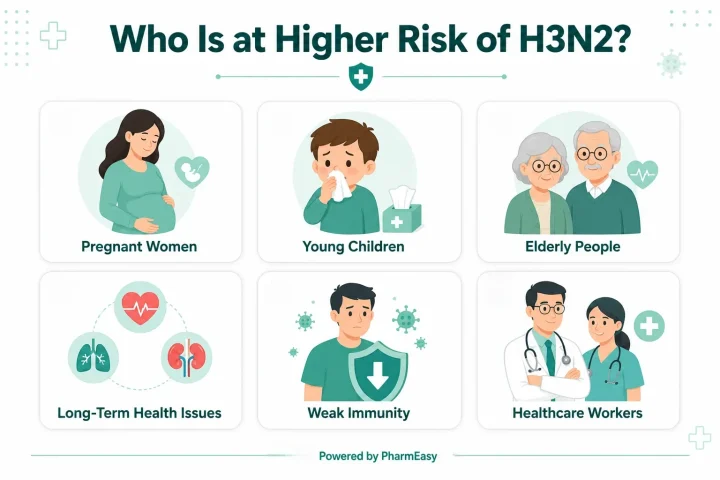
Certain high-risk groups are more susceptible to vulnerabilities than others. If you or your loved ones are in such groups, exercising caution is suggested:
The annual influenza vaccine also provides protection against H3N2 influenza, as well as other types of influenza A, such as H1N1, and certain strains of influenza B.
One annual shot can reduce the risk of severe infection and hospitalisation in everyone.
Discuss the annual flu vaccine with your doctor for yourself and your family.
The majority of H3N2 influenza cases are diagnosed clinically; however, during periods of low activity, infections with other respiratory viruses, such as COVID-19, respiratory syncytial virus, rhinovirus, and adenovirus, can also present as influenza-like illnesses, making clinically differentiating H3N2 influenza from other environmental pathogens a challenging task.
To determine the nature of the pathogen, a respiratory sample, along with a laboratory diagnostic test, will be necessary.
Tests that may be advised by your doctor-
Not everyone with flu-like symptoms needs a test, as many mild cases are managed based on symptoms alone. However, testing may be recommended in certain situations to guide care3.
Testing, particularly RT-PCR, may be advised when:
RT-PCR also plays a useful role in differentiating influenza (including H3N2) from COVID-19 and other respiratory infections, which can present with similar symptoms. This distinction can help doctors choose the most appropriate management approach.
The decision to test should be made by a doctor based on your symptoms and risk factors, rather than self-initiated.
Also Read: How Long Does a Flu Last and Ways to Manage Them
Do’s
Don’ts
Children spend long hours in close contact at school, which can make classrooms a setting where respiratory infections spread easily. A few simple practices can help reduce transmission4.
When Children Should Stay Home
How Schools Can Help Prevent Outbreaks
Early Symptom Monitoring in Classrooms
These measures help protect not only the children but also family members at home who may be more vulnerable.
Older adults and those in high-risk groups need extra care during the flu season, as they are more likely to develop complications from H3N2. Awareness and timely action can make a meaningful difference5.
Warning Signs Requiring Urgent Care
Seek medical attention promptly if any of the following occur:
Importance of Vaccination
Faster Escalation for High-Risk Individuals
When in doubt, it is always safer for high-risk individuals to consult a doctor sooner rather than later.
Simple everyday measures remain among the most effective ways to reduce the spread of H3N2. Use the checklist below as a practical guide.
Also Read: What Is Hantavirus? Symptoms, Causes, & Effective Prevention
Seasonal influenza, such as the H3N2 virus, can be challenging to contain, especially in densely populated regions, unless everyone maintains good respiratory hygiene at all times. To minimize your chances of infection, get vaccinated every year to maintain optimal vaccine efficacy. Spreading awareness of the do’s and don’ts among your loved ones, friends, colleagues, and educational institutions will also help protect others from contracting the infection.
Also Read: Influenza A: What is It, Causes, Symptoms, Treatment & Prevention
1. Allen JD, Ross TM. H3N2 influenza viruses in humans: Viral mechanisms, evolution, and evaluation. Hum Vaccin Immunother. 2018;14(8):1840-1847. doi: 10.1080/21645515.2018.1462639. Epub 2018 May 14. PMID: 29641358; PMCID: PMC6149781. Available from: https://pubmed.ncbi.nlm.nih.gov/29641358/
2. Priyanka, Khandia R, Chopra H, Choudhary OP, Bonilla-Aldana DK, Rodriguez-Morales AJ. The re-emergence of H3N2 influenza: An update on the risk and containment. New Microbes New Infect. 2023 Jun;53:101147. doi: 10.1016/j.nmni.2023.101147. Epub 2023 May 4. PMID: 37159614; PMCID: PMC10156635. Available from: https://pmc.ncbi.nlm.nih.gov/articles/PMC10156635/
3. Vemula SV, Zhao J, Liu J, Wang X, Biswas S, Hewlett I. Current Approaches for Diagnosis of Influenza Virus Infections in Humans. Viruses. 2016 Apr 12;8(4):96. doi: 10.3390/v8040096. PMID: 27077877; PMCID: PMC4848591. Available from: https://pmc.ncbi.nlm.nih.gov/articles/PMC4848591/
4. Centers for Disease Control and Prevention. Healthy Habits to Prevent Flu [Internet]. Atlanta (GA): 2025 Sep 3 [cited 2026 Jun 26]. Available from: https://www.cdc.gov/flu/prevention/actions-prevent-flu.html
5. Gaitonde DY, Moore FC, Morgan MK. Influenza: Diagnosis and Treatment. Am Fam Physician. 2019 Dec 15;100(12):751-758. PMID: 31845781. Available from: https://pubmed.ncbi.nlm.nih.gov/31845781/
Disclaimer: The information provided here is for educational/awareness purposes only and is not intended to be a substitute for medical treatment by a healthcare professional and should not be relied upon to diagnose or treat any medical condition. The reader should consult a registered medical practitioner to determine the appropriateness of the information and before consuming any medication. PharmEasy does not provide any guarantee or warranty (express or implied) regarding the accuracy, adequacy, completeness, legality, reliability or usefulness of the information; and disclaims any liability arising thereof.
Links and product recommendations in the information provided here are advertisements of third-party products available on the website. PharmEasy does not make any representation on the accuracy or suitability of such products/services. Advertisements do not influence the editorial decisions or content. The information in this blog is subject to change without notice. The authors and administrators reserve the right to modify, add, or remove content without notification. It is your responsibility to review this disclaimer regularly for any changes.
 28
28  2
2You may also like

























Comments