



How to Find Generic Medicine: A Complete Guide to Finding Generic Drugs Safely
By Dr. Ambika Dashrathrao Mamde +2 more

Medically reviewed by Dr. Ambika Dashrathrao Mamde
Last updated: Sep 11, 2026 Published on: Jul 17, 2026


Get,

to manage your symptom
Get your,

4 Cr+ families
benefitted

OTP sent to 9988776655



You’ve successfully subscribed to receive
doctor-approved tips on
Whatsapp

Get ready to feel your best.


Register to Avail the Offer
Send OTPBy continuing, you agree with our Privacy Policy and Terms and Conditions
Hi There,
Sign up on PharmEasy now!!


Trusted by 4 crore+ families

OTP sent to 9988776655
You have unlocked 25% off on medicines


Code: NU25

By Dr. Ambika Dashrathrao Mamde +2 more
Table of Contents
Finding a generic medicine means confirming that the alternative matches your prescription, and not simply choosing a different brand name.
Knowing how to identify a generic medicine helps you make informed decisions and avoid counterfeit or unsuitable products. This guide explains how to know generic medicine, where to find reliable information, and what to check before switching from a brand-name medicine.
People choose generic medicines for several reasons1,2:
Note: While generic medicines are an excellent option for most people, they should always be used under the guidance of a doctor, especially when switching from a brand-name medicine.
Brand-name companies invest in discovering, developing, and testing new medicines before approval. Generic manufacturers do not repeat those costly trials; once patent or exclusivity protection ends, they can produce approved generic versions1,3. That is why generic medicines usually cost less.
Generic manufacturers must still show that their medicine is bioequivalent to the brand-name medicine and meets the same standards for quality, safety, and effectiveness3.
If you take a brand-name medicine, use reliable sources to identify its generic equivalent.
The generic name is the official name of the active ingredient, while the brand name is assigned by the manufacturer4.
Use these reliable ways to find generic drugs:
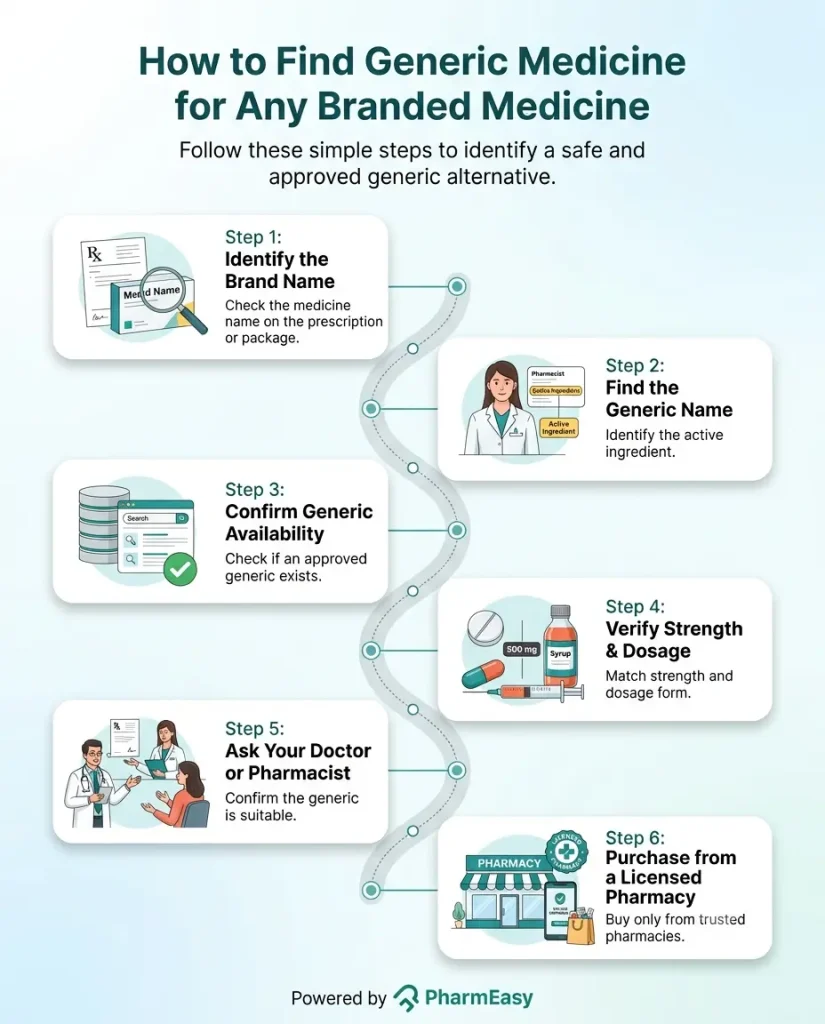
Follow these steps to choose the correct, approved generic alternative.
When selecting a generic medicine, match more than the name. Understand how these key factors could influence your generic medicine search3:
| Parameter | What Should Match? | Why It Matters |
| Active ingredient | The generic medicine should contain the same active ingredient as the brand-name medicine. | The active ingredient is responsible for the medicine’s therapeutic effect. |
| Strength | The amount of active ingredient (e.g., 250 mg, 500 mg) should be identical. | This ensures you receive the prescribed dose. |
| Dosage form | The medicine should be the same formulation type, such as a tablet, capsule, syrup, cream, or injection. | Different dosage forms may release or deliver the medicine differently. |
| Route of administration | It should be taken the same way (e.g., by mouth, injection, eye drops, topical application). | This ensures the medicine reaches the body as intended. |
| Therapeutic equivalence (Bioequivalence) | The generic should deliver the active ingredient at the same rate and to the same extent as the brand-name medicine. | This ensures the generic has the same clinical effect and safety profile. |
| Approved indication | The generic should be approved for the same medical condition(s) whenever applicable. | This ensures the generic is appropriate for your prescribed treatment. |
| Quality standards | The medicine should be approved by the relevant regulatory authority and manufactured according to Good Manufacturing Practices (GMP). | This helps confirm that the generic meets established standards for quality, safety, and performance. |
Note: Please keep in mind that approved generic medicines may differ from the brand-name medicine in:
These differences usually do not affect safety or effectiveness.
Also Read: Generic Medicine List in India: A Guide to Common Generic Medicines
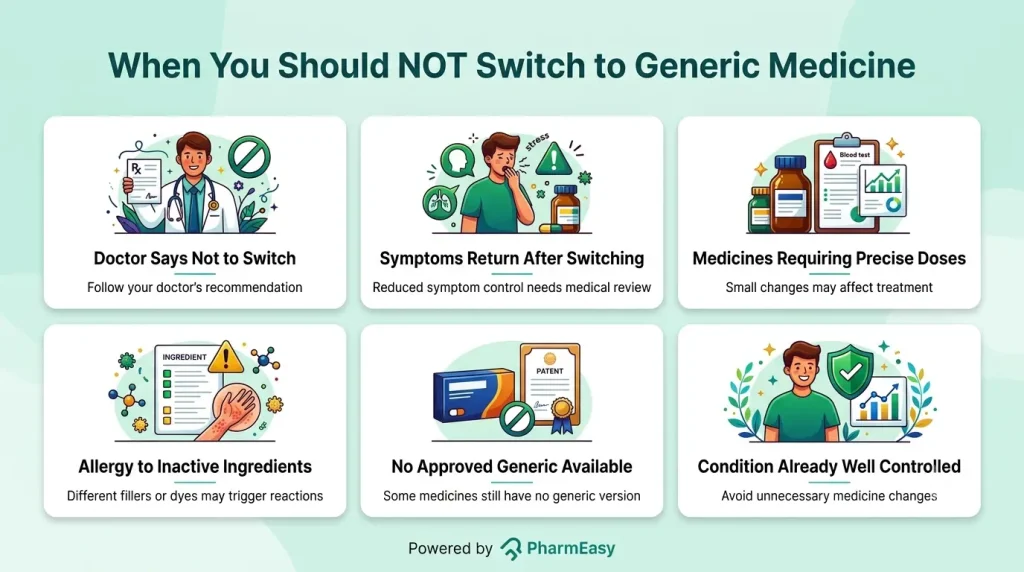
Do not switch in these situations unless your doctor advises it:
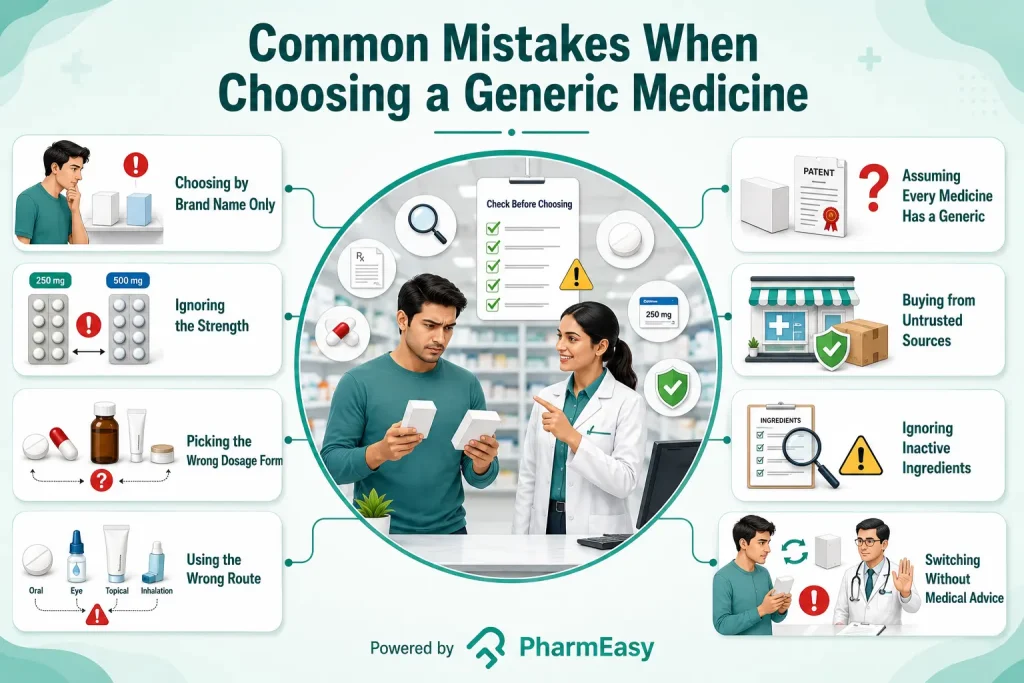
Avoid these common errors when choosing a generic medicine:
Also Read: Generic Medicines And How Safe Are They?
Consult your doctor or pharmacist if8,9.
Also Read: Understanding Generic Alternates: What They Are and How They Work
Before switching to a generic medicine, confirm that the active ingredient, strength, dosage form, route of administration, and clinical suitability match your prescription, and buy only from licensed pharmacies. Approved generics are generally as safe and effective as brand-name medicines, but you should consult your doctor or pharmacist first if you have a chronic condition or take medicines requiring close monitoring.
No, this may not always be possible. This is because a suitable substitute must match not only the active ingredient (salt) but also the strength, dosage form, and route of administration3. Some medicines, such as those with a narrow therapeutic index, should only be substituted under medical supervision8.
Approved generic medicines are considered as safe and effective as their brand-name counterparts because they contain the same active ingredient and meet the same quality and regulatory standards1. However, always consult your doctor or pharmacist before switching.
Medicines with a narrow therapeutic index, such as warfarin, phenytoin, carbamazepine, etc., require extra caution8. So, switching should only be done under the guidance of a doctor.
Yes, a pharmacist can help confirm whether a suitable generic equivalent is available, ensure it matches your prescription, and answer any questions about safe substitution.
Generic medicines available through Pradhan Mantri Bhartiya Janaushadhi Kendras (PMBJKs) have the same efficacy and therapeutic value as branded medicines. Each batch is tested in approved laboratories and supplied only after meeting the required quality standards, ensuring its quality, safety, and effectiveness10.
1. Generic Drug Facts. FDA. Published online June 2, 2026. Accessed July 10, 2026. Available from: https://www.fda.gov/drugs/generic-drugs/generic-drug-facts
2. Lalani HS, Hwang CS, Kesselheim AS, Rome BN. Strategies to Help Patients Navigate High Prescription Drug Costs. JAMA. 2024;332(20):1741-1749. doi:10.1001/jama.2024.17275 Available from: https://pubmed.ncbi.nlm.nih.gov/39432312/
3. Generic Drugs: Questions & Answers. FDA. Published online June 8, 2026. Accessed July 10, 2026. Available from: https://www.fda.gov/drugs/generic-drugs/generic-drugs-questions-answers
4. Jan Aushadhi products. Government of India. Accessed July 9, 2026. Available from: https://www.janaushadhi.gov.in/productportfolio/Product
5. Dunne S, Shannon B, Dunne C, Cullen W. A review of the differences and similarities between generic drugs and their originator counterparts, including economic benefits associated with usage of generic medicines, using Ireland as a case study. BMC Pharmacol Toxicol. 2013;14:1. doi:10.1186/2050-6511-14-1 Available from: https://pubmed.ncbi.nlm.nih.gov/23289757/
6. Roy V, Rana P. Prescribing generics: All in a name. Indian J Med Res. 2018;147(5):442-444. doi:10.4103/ijmr.IJMR_1940_17 Available from: https://pmc.ncbi.nlm.nih.gov/articles/PMC6094511/
7. Brand and Generic Medication Explained. American Thyroid Association. Accessed July 10, 2026. Available from: https://www.thyroid.org/brand-generic-medication/
8. Gozzo L, Caraci F, Drago F. Bioequivalence, Drugs with Narrow Therapeutic Index and the Phenomenon of Biocreep: A Critical Analysis of the System for Generic Substitution. Healthcare. 2022;10(8):1392. doi:10.3390/healthcare10081392 Available from: https://pmc.ncbi.nlm.nih.gov/articles/PMC9394341/
9. What are generic medicines? Healthdirect. Accessed July 10, 2026. Available from: https://www.healthdirect.gov.au/what-are-generic-medicines
10. Steps taken for Promotion of Generic Medicines. Ministry of Health and Family Welfare. Accessed July 10, 2026. Available from: https://www.pib.gov.in/PressReleaseIframePage.aspx?PRID=1947689®=48&lang=2
Disclaimer: The information provided here is for educational/awareness purposes only and is not intended to be a substitute for medical treatment by a healthcare professional and should not be relied upon to diagnose or treat any medical condition. The reader should consult a registered medical practitioner to determine the appropriateness of the information and before consuming any medication. PharmEasy does not provide any guarantee or warranty (express or implied) regarding the accuracy, adequacy, completeness, legality, reliability or usefulness of the information; and disclaims any liability arising thereof.
Links and product recommendations in the information provided here are advertisements of third-party products available on the website. PharmEasy does not make any representation on the accuracy or suitability of such products/services. Advertisements do not influence the editorial decisions or content. The information in this blog is subject to change without notice. The authors and administrators reserve the right to modify, add, or remove content without notification. It is your responsibility to review this disclaimer regularly for any changes.


Comments

Leave your comment...
You may also like























Comments