



Hyperandrogenism (Excess Androgen in Females): Symptoms, Causes, Diagnosis & Treatment
By Dr. Nisha Dahiya +2 more

Medically reviewed by Dr. Nisha Dahiya
Last updated: Aug 10, 2026 Published on: Aug 10, 2026


Get,

to manage your symptom
Get your,

4 Cr+ families
benefitted

OTP sent to 9988776655



You’ve successfully subscribed to receive
doctor-approved tips on
Whatsapp

Get ready to feel your best.


Register to Avail the Offer
Send OTPBy continuing, you agree with our Privacy Policy and Terms and Conditions
Hi There,
Sign up on PharmEasy now!!


Trusted by 4 crore+ families

OTP sent to 9988776655
You have unlocked 25% off on medicines


Code: NU25

By Dr. Nisha Dahiya +2 more
Table of Contents
Persistent acne, unwanted facial hair, and irregular periods may seem like separate problems bothering you, but they can all point to the same underlying issue. If you have been experiencing one or more of these symptoms, you may be asking yourself whether there is a deeper cause suggestive of a hormonal issue.
Hyperandrogenism means that the body has higher-than-usual levels or effects of androgens, a group of hormones that includes testosterone. Although androgens are often called “male hormones,” both men and women have them. In women and adolescent girls, too much androgen activity can lead to symptoms such as unwanted facial or body hair, acne, and irregular periods1.
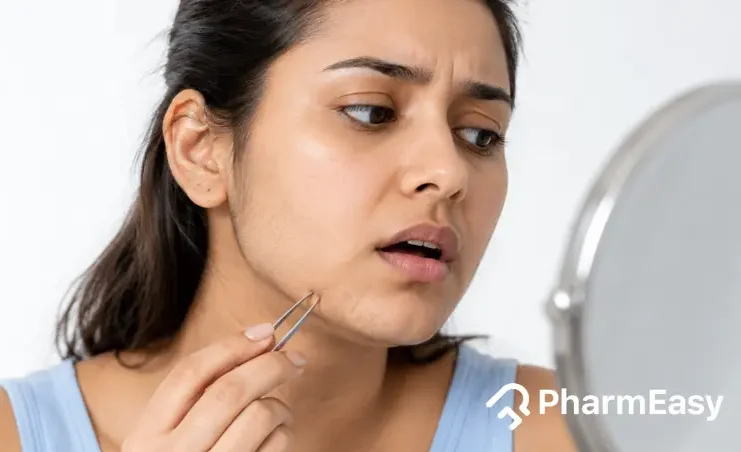
Understanding hyperandrogenism, its symptoms, causes, and treatment may help individuals in the early detection and effective management of this condition.
Hyperandrogenism occurs when androgen levels are higher than expected or when the body is especially sensitive to these hormones. The main androgen often measured is testosterone. In some tissues, testosterone can be changed into its active form called dihydrotestosterone (DHT).
The most common visible sign is hirsutism, which means extra coarse hair growth on the face or body in areas where hair is usually less noticeable in women. Polyendocrine metabolic ovarian syndrome (PMOS) is the most common cause. Treatment is important because symptoms such as unwanted hair growth, acne, and changes in periods can affect physical health, confidence, and quality of life1,2.
Women naturally make small amounts of androgens, mainly in the ovaries and adrenal glands. These hormones support normal reproductive health, muscle and bone strength, sexual desire, and general wellbeing1,3.
When androgen levels or effects become too high, symptoms may include unwanted facial or body hair, acne, oily skin, scalp hair thinning, irregular periods, or difficulty getting pregnant1,3. Sudden symptoms, such as a rapidly deepening voice or fast-growing hair, should be checked promptly by a doctor.
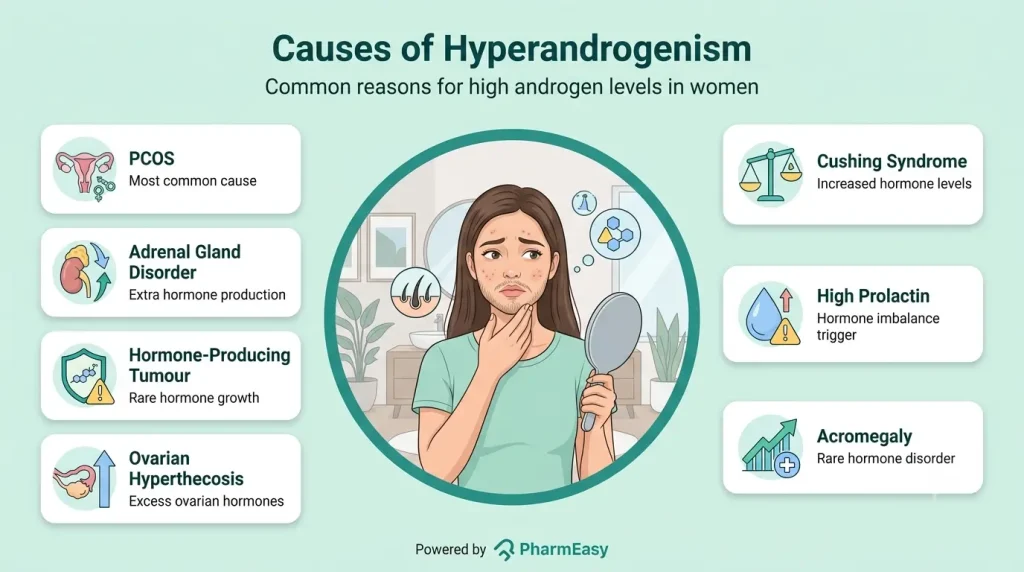
Hyperandrogenism can have several causes. PMOS is the most common cause, but less common hormone conditions, certain medicines, and rarely androgen-producing tumours can also be involved. Commonly considered causes include1:
Hyperandrogenism can affect the menstrual cycle, skin, hair, and reproductive health. Symptoms include:
Doctors diagnose hyperandrogenism by asking about symptoms and periods, doing a physical examination, and ordering blood tests. Imaging tests may be used when the doctor needs to look for a specific cause. Diagnosis may include:
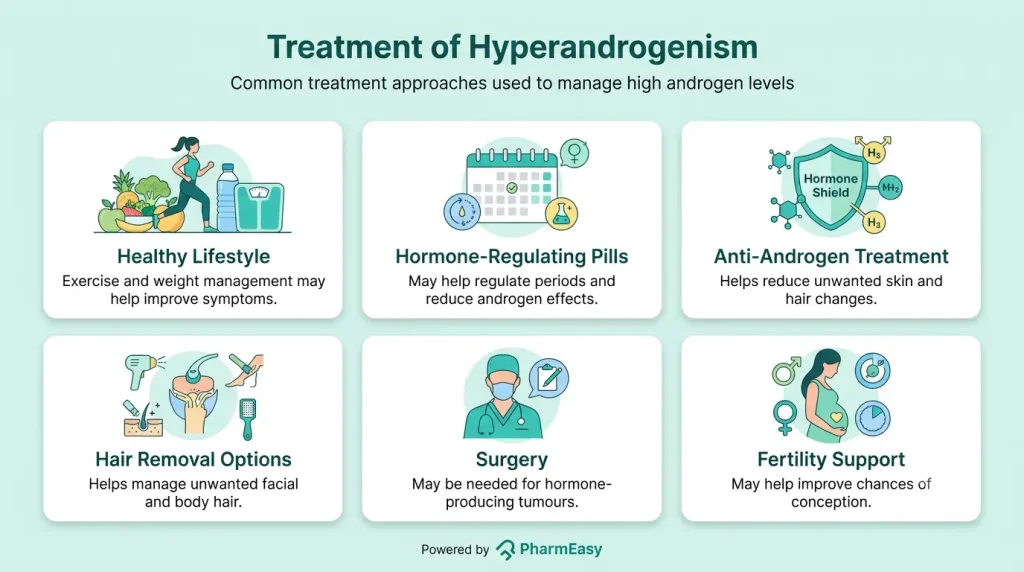
Treatment depends on the cause, the symptoms, overall health, and whether pregnancy is planned. Your doctor may suggest one or more options and will tailor the plan to your needs. Options may include:
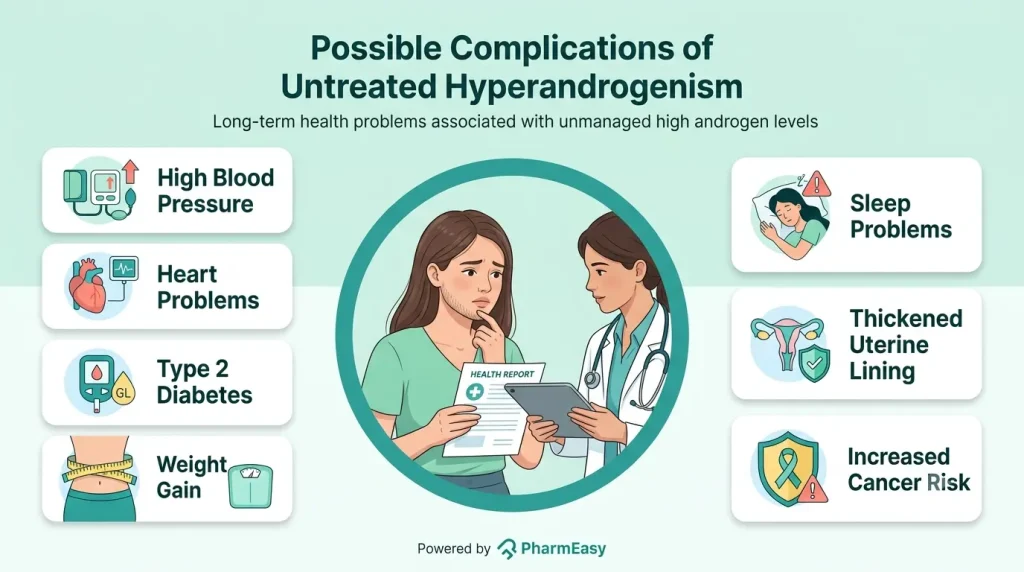
If hyperandrogenism is severe or continues for a long time without treatment, it may be linked with other health problems, especially when PMOS or insulin resistance is present. Possible concerns include10:
Hyperandrogenism cannot always be prevented. However, these habits may support hormone health and help manage symptoms or related risks11:
Consult your doctor if you have any of the following symptoms:1
Hyperandrogenism is a hormone-related condition that can affect the skin, hair, menstrual cycle, fertility, and overall health. Symptoms such as unwanted facial or body hair, persistent acne, hair thinning, or irregular periods can be upsetting, but early medical advice can help identify the cause and guide treatment. With the right care, which may include lifestyle measures, medicines, hair removal options, and regular follow-up, many people can manage symptoms and improve quality of life. If symptoms appear suddenly, worsen quickly, or interfere with daily life, speak with a doctor for proper assessment and advice.
Yes. Hyperandrogenism can affect fertility if it disrupts ovulation or causes irregular periods. Many people can still become pregnant with the right diagnosis and treatment1,2.
No. Although the extent of success with hyperandrogenism treatment varies depending on the underlying cause, the condition is not necessarily permanent. While some causes may require long-term treatment, symptoms can often be adequately managed with the appropriate treatment1.
No. PMOS and hyperandrogenism are related but not the same. PMOS is a common hormone condition that can cause high androgen levels or androgen-related symptoms. Hyperandrogenism can also happen for other reasons, so a doctor may need to check for other causes1.
Yes, hyperandrogenism can often be improved or controlled, depending on the cause. Treating conditions such as PCOS or other hormone disorders may lower androgen levels, reduce symptoms, and improve hormone balance2.
1. Sharma A, Welt CK. Practical Approach to Hyperandrogenism in Women. Med Clin North Am. 2021;105(6):1099-1116. doi:10.1016/j.mcna.2021.06.008 https://pubmed.ncbi.nlm.nih.gov/34688417/
2. Esquivel-Zuniga MR, Kirschner CK, McCartney CR, Solorzano CMB. Non-PCOS Hyperandrogenic Disorders in Adolescents. Semin Reprod Med. 2022;40(1-02):42-52. doi:10.1055/s-0041-1742259 https://pubmed.ncbi.nlm.nih.gov/35052005/
3. Bianchi VE, Bresciani E, Meanti R, Rizzi L, Omeljaniuk RJ, Torsello A. The role of androgens in women’s health and wellbeing. Pharmacol Res. 2021;171:105758. doi:10.1016/j.phrs.2021.105758 https://pubmed.ncbi.nlm.nih.gov/34242799/
4. Yildiz BO. Diagnosis of hyperandrogenism: clinical criteria. Best Pract Res Clin Endocrinol Metab. 2006;20(2):167-176. doi:10.1016/j.beem.2006.02.004 https://pubmed.ncbi.nlm.nih.gov/16772149/
5. Makrantonaki E, Zouboulis CC. [Hyperandrogenism, adrenal dysfunction, and hirsutism]. Hautarzt Z Dermatol Venerol Verwandte Geb. 2020;71(10):752-761. doi:10.1007/s00105-020-04677-1 https://pubmed.ncbi.nlm.nih.gov/32857168/
6. Rachoń D. Differential diagnosis of hyperandrogenism in women with polycystic ovary syndrome. Exp Clin Endocrinol Diabetes Off J Ger Soc Endocrinol Ger Diabetes Assoc. 2012;120(4):205-209. doi:10.1055/s-0031-1299765 https://pubmed.ncbi.nlm.nih.gov/22421986/
7. Stanczyk FZ. Diagnosis of hyperandrogenism: biochemical criteria. Best Pract Res Clin Endocrinol Metab. 2006;20(2):177-191. doi:10.1016/j.beem.2006.03.007 https://pubmed.ncbi.nlm.nih.gov/16772150/
8. Hock DL, Seifer DB. New treatments of hyperandrogenism and hirsutism. Obstet Gynecol Clin North Am. 2000;27(3):567-581, vi-vii. doi:10.1016/s0889-8545(05)70156-x https://pubmed.ncbi.nlm.nih.gov/10958004/
9. Moghetti P, Toscano V. Treatment of hirsutism and acne in hyperandrogenism. Best Pract Res Clin Endocrinol Metab. 2006;20(2):221-234. doi:10.1016/j.beem.2006.03.003 https://pubmed.ncbi.nlm.nih.gov/16772153/
10. Capatina C, Scafa-Udriste A, Ghinea A, Dumitrascu A, Poiana C. Multiple complications of severe hyperandrogenism in a postmenopausal woman. Endocr Abstr. Published online May 13, 2016. doi:10.1530/endoabs.41.EP653 https://www.academia.edu/55312221/Multiple_complications_of_severe_hyperandrogenism_in_a_postmenopausal_woman
11. Zapała B, Marszalec P, Piwowar M, Chmura O, Milewicz T. Reduction in the Free Androgen Index in Overweight Women After Sixty Days of a Low Glycemic Diet. Exp Clin Endocrinol Diabetes. 2024;132(1):6-14. doi:10.1055/a-2201-8618 https://pubmed.ncbi.nlm.nih.gov/38237611/
Disclaimer: The information provided here is for educational/awareness purposes only and is not intended to be a substitute for medical treatment by a healthcare professional and should not be relied upon to diagnose or treat any medical condition. The reader should consult a registered medical practitioner to determine the appropriateness of the information and before consuming any medication. PharmEasy does not provide any guarantee or warranty (express or implied) regarding the accuracy, adequacy, completeness, legality, reliability or usefulness of the information; and disclaims any liability arising thereof.
Links and product recommendations in the information provided here are advertisements of third-party products available on the website. PharmEasy does not make any representation on the accuracy or suitability of such products/services. Advertisements do not influence the editorial decisions or content. The information in this blog is subject to change without notice. The authors and administrators reserve the right to modify, add, or remove content without notification. It is your responsibility to review this disclaimer regularly for any changes.


Comments

Leave your comment...
You may also like















Comments