




Haemolytic Anaemia: Causes, Symptoms, Diagnosis, Treatment & More
By Dr. Ritika Singh +2 more

Medically reviewed by Dr. Ritika Singh
Last updated: Aug 17, 2026 Published on: Aug 17, 2026


Get,

to manage your symptom
Get your,

4 Cr+ families
benefitted

OTP sent to 9988776655



You’ve successfully subscribed to receive
doctor-approved tips on
Whatsapp

Get ready to feel your best.


Register to Avail the Offer
Send OTPBy continuing, you agree with our Privacy Policy and Terms and Conditions
Hi There,
Sign up on PharmEasy now!!


Trusted by 4 crore+ families

OTP sent to 9988776655
You have unlocked 25% off on medicines


Code: NU25

By Dr. Ritika Singh +2 more
Table of Contents
Feeling unusually tired, weak, pale, or short of breath even after resting can be worrying, especially when there is no clear reason. Sometimes, these symptoms may be linked to anaemia, a condition in which the blood cannot carry enough oxygen around the body1. Around 1.9 billion people worldwide are affected by anaemia2. This article explains haemolytic anaemia in simple terms, including its causes, symptoms, diagnosis, treatment, prevention, and when to seek medical help.
Anaemia means the body does not have enough healthy red blood cells (RBCs) to carry oxygen well. Haemolytic anaemia is a type of anaemia that happens when RBCs are destroyed faster than the bone marrow can make new ones. RBCs carry oxygen from the lungs to the rest of the body3. When too many RBCs break down too early, the body may not get enough oxygen. This can cause symptoms such as tiredness, weakness, dizziness, or shortness of breath4.
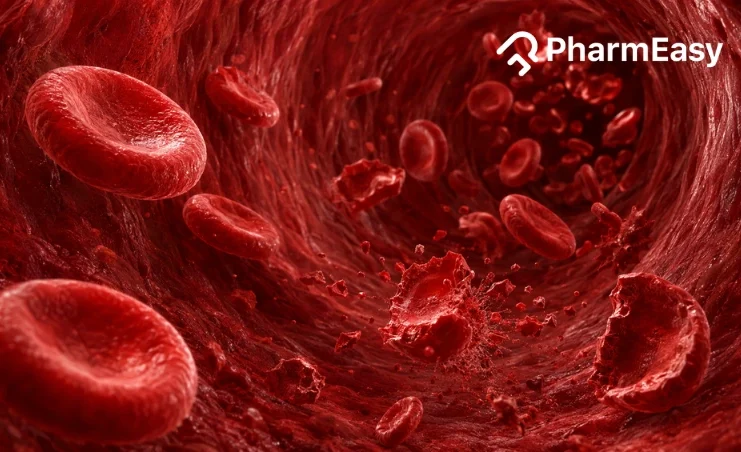
Haemolytic anaemia can start suddenly or develop slowly over time. Some people have mild symptoms, while others may need urgent care. The seriousness depends on the cause and how quickly RBCs are being destroyed5.
Haemolytic anaemia is usually grouped into two main types:
This type is present from birth and is passed down through families. It happens because of changes in genes that affect RBCs. Examples include:
Develops after birth. People are not born with it; instead, healthy RBCs are destroyed because of another medical condition or an external trigger.
Haemolytic disease of the newborn happens when a mother’s immune system produces antibodies against her baby’s red blood cells, usually because of a blood group mismatch between them (most often involving the Rh factor or ABO blood groups). These antibodies can cross the placenta and cause the baby’s RBCs to break down faster than normal, leading to anaemia and jaundice in the newborn25.
Doctors can often screen for this risk during pregnancy through routine blood group and antibody testing, and preventive treatment (such as Rh immunoglobulin) may be given to at-risk mothers to reduce the chance of this happening in future pregnancies. After birth, affected babies are monitored closely and may need treatment such as phototherapy or, in more severe cases, a blood transfusion.
The cause of haemolytic anaemia depends on whether it is inherited or develops later in life. Common causes and triggers include:
Mild haemolytic anaemia may not cause noticeable symptoms. When symptoms do occur, they may include:
Symptoms that indicate a more severe condition include:
For individuals with hereditary or acquired susceptibility, certain environmental triggers can rapidly induce a haemolytic crisis:
A doctor will ask about your symptoms, medical history, recent infections, medicines, blood transfusions, and any family history of blood disorders. They may also examine you for signs such as pale skin, yellowing of the eyes or skin, or an enlarged spleen. If haemolytic anaemia is suspected, blood and sometimes urine tests may be recommended. Common tests include:
Doctors may also recommend additional tests to find the exact cause. They may suggest tests such as urine tests, genetic tests, or bone marrow tests, if needed5.
Note: Not everyone with haemolytic anaemia needs all of these tests. Your doctor will recommend the tests based on your condition.
Treatment depends on the cause, how severe the anaemia is, and how quickly symptoms develop. A doctor may recommend one or more of the following:
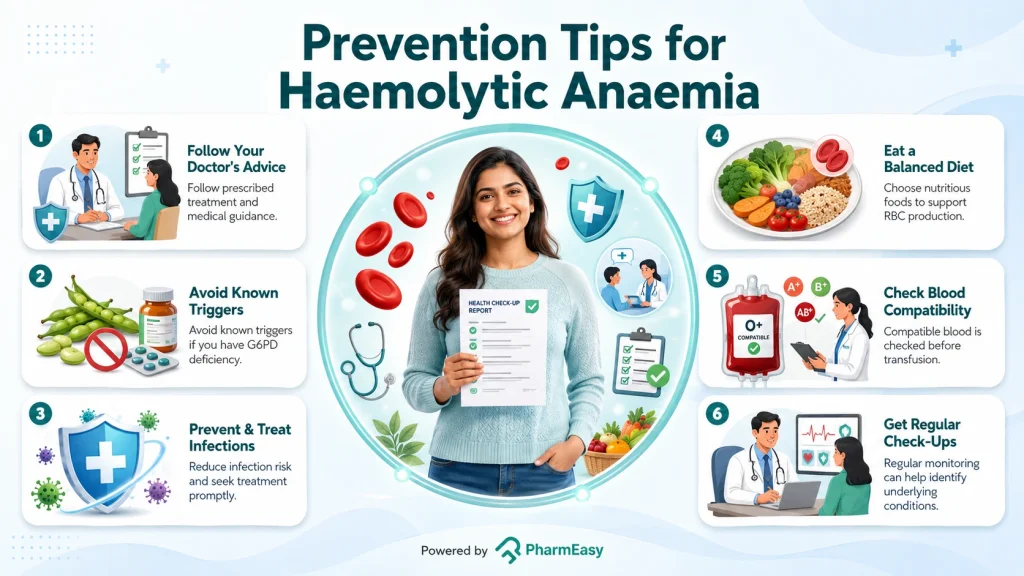
Not all causes of haemolytic anaemia can be prevented, especially inherited forms. However, some steps may reduce the risk of acquired haemolytic anaemia or help avoid complications.
See a doctor if you have ongoing tiredness, weakness, dizziness, headaches, trouble concentrating, or a sore tongue1,3. Seek medical help promptly if you have shortness of breath, yellowing of the skin or eyes, dark urine, severe abdominal pain, a fast or irregular heartbeat, or painful swelling of the hands or feet3,7. Early diagnosis and treatment can help prevent serious complications.
Also Read: High GGT Levels: Normal Range, Causes, Symptoms, Risks & Treatment
Haemolytic anaemia happens when RBCs are broken down faster than the body can replace them. It can have many causes, including inherited blood conditions, infections, medicines, immune system problems, or transfusion reactions. With the right diagnosis and treatment, many people can manage the condition well. If you notice symptoms such as persistent tiredness, yellowing of the skin or eyes, dark urine, or shortness of breath, speak with a doctor for proper evaluation and care.
Some cases of haemolytic anaemia improve or go away once the cause is treated or removed, such as an infection or a medicine that triggered it. Inherited forms usually do not go away completely and may need long-term care to control symptoms and prevent complications13.
Yes, thalassaemia is an inherited type of haemolytic anaemia in which the body makes less or abnormal haemoglobin. This causes RBCs to break down earlier than normal, leading to anaemia8.
Yes, G6PD deficiency can cause haemolytic anaemia. In people with this condition, RBCs can break down rapidly after exposure to certain medicines, infections, or foods such as fava beans10.
No, haemolytic anaemia is not a type of cancer. It is a blood disorder in which RBCs are destroyed faster than the body can replace them, although it can sometimes develop as a complication of certain blood cancers1,3.
Haemolytic anaemia can be genetic, but not all cases are inherited. Some people are born with inherited conditions such as sickle cell disease, thalassaemia, or G6PD deficiency, while others develop haemolytic anaemia later in life because of illnesses, medicines, or immune system problems3,7,8,10.
Yes, lupus can sometimes cause autoimmune haemolytic anaemia, a condition in which the immune system mistakenly attacks and destroys healthy RBCs. This can lead to anaemia and related symptoms such as tiredness and weakness3,11.
Iron deficiency does not usually cause haemolytic anaemia. Instead, it causes iron deficiency anaemia, which develops because the body cannot make enough healthy RBCs due to a lack of iron1.
In some cases, haemolytic anaemia can make urine look dark, reddish, or tea-coloured because haemoglobin is released when RBCs break down. However, visible blood in urine can have many other causes, so it should always be checked by a doctor18.
1. Anemia. MedlinePlus. 2026. Available from: https://medlineplus.gov/ency/article/000560.htm
2. Zheng W, Peng B, Wu Y, Gauan L, Wang S, Ning H. Global, regional, and national anemia burden among women of reproductive age (15–49 years) from 1990 to 2021: an analysis of the Global Burden of Disease Study 2021. Front Nutr. 2025;12:1588496. doi:10.3389/fnut.2025.1588496. Available from: https://pubmed.ncbi.nlm.nih.gov/40791240/
3. Hemolytic anemia. MedlinePlus. 2026. Available from: https://medlineplus.gov/ency/article/000571.htm
4. Anemia – What Is anemia? NIH. 2022. Available from: https://www.nhlbi.nih.gov/health/anemia
5. Anemia: Hemolytic anemia. NIH. 2022. Available from: https://www.nhlbi.nih.gov/health/anemia/hemolytic-anemia
6. Hall V, Vadakekut ES, Maines J, Avulakunta ID. Hemolytic disease of the fetus and newborn. In: StatPearls. StatPearls Publishing; 2025. Accessed August 7, 2026. http://www.ncbi.nlm.nih.gov/books/NBK557423/
7. Sickle cell disease. MedlinePlus. 2024. Available from: https://medlineplus.gov/sicklecelldisease.html
8. About thalassemia. CDC. 2024. Available from: https://www.cdc.gov/thalassemia/about/index.html
9. Hereditary spherocytosis. MedlinePlus. 2013. Available from: https://medlineplus.gov/genetics/condition/hereditary-spherocytosis/
10. Glucose-6-phosphate dehydrogenase deficiency. MedlinePlus. 2023. Available from: https://medlineplus.gov/genetics/condition/glucose-6-phosphate-dehydrogenase-deficiency/
11. Hill A, Hill QA. Autoimmune hemolytic anemia. Hematology. 2018;2018(1):382-389. doi:10.1182/asheducation-2018.1.382. Available from: https://ashpublications.org/hematology/article/2018/1/382/277583/Autoimmune-hemolytic-anemia
12. Chaudhary P, Maharjan N, Subedi B. Microangiopathic hemolytic anemia as the initial presentation of metastatic signet-ring cell carcinoma of the colon: A case report. Cureus. 2024;16(12):e76034. doi:10.7759/cureus.76034. Available from: https://pubmed.ncbi.nlm.nih.gov/39835047/
13. Hemolytic anemia. Harvard Health. 2025. Available from: https://www.health.harvard.edu/diseases-and-conditions/hemolytic-anemia
14. Reticulocyte count. MedlinePlus. 2026. Available from: https://medlineplus.gov/ency/article/003637.htm
15. Blood smear. Medline. 2024. Available from: https://medlineplus.gov/lab-tests/blood-smear/
16. Tripathi AK, Chuda R. Laboratory evaluation of immune hemolytic anemias. In: StatPearls. StatPearls Publishing; 2024. Accessed August 7, 2026. http://www.ncbi.nlm.nih.gov/books/NBK606096/
17. Jäger U, Barcellini W, Broome CM, et al. Diagnosis and treatment of autoimmune hemolytic anemia in adults: Recommendations from the first international consensus meeting. Blood Rev. 2020;41:100648. doi:10.1016/j.blre.2019.100648. Available from: https://pubmed.ncbi.nlm.nih.gov/31839434/
18. Urine – abnormal color. MedlinePlus. 2025. Available from: https://medlineplus.gov/ency/article/003139.htm
19. Sanofi. Sanofi’s rilzabrutinib designated breakthrough therapy in the US and orphan drug in Japan for the treatment of warm autoimmune hemolytic anemia [Internet]. Paris: Sanofi; 2026 Feb 9 [cited 2026 Aug 14]. Available from: https://www.sanofi.com/en/media-room/press-releases/2026/2026-02-09-06-00-00-3234232
20. Tamdin T, Rodgers GM. Advances in Complement Inhibition Therapies for Paroxysmal Nocturnal Hemoglobinuria and Autoimmune Hemolytic Disorders. J Blood Med. 2025 Nov 12;16:559-572. doi: 10.2147/JBM.S543272. PMID: 41255851; PMCID: PMC12620576. Available from: https://pmc.ncbi.nlm.nih.gov/articles/PMC12620576/
21. Killeen RB, Kaur A, Afzal M. Acute Anemia. [Updated 2025 Feb 26]. In: StatPearls [Internet]. Treasure Island (FL): StatPearls Publishing; 2026 Jan-. Available from: https://www.ncbi.nlm.nih.gov/books/NBK537232/
22. Bui A, Shah AP, Chae MY, Popard P, Telivala B. A Rare Case of Iron Overload in Hereditary Spherocytosis: A Case Report. Cureus. 2024 Jul 5;16(7):e63934. doi: 10.7759/cureus.63934. PMID: 39104991; PMCID: PMC11298700. Available from: https://pmc.ncbi.nlm.nih.gov/articles/PMC11298700/
23. Tripathi AK, Chuda R. Laboratory Evaluation of Immune Hemolytic Anemias. [Updated 2024 Jul 9]. In: StatPearls [Internet]. Treasure Island (FL): StatPearls Publishing; 2026 Jan-. Available from: https://www.ncbi.nlm.nih.gov/books/NBK606096/
24. MedlinePlus. Glucose-6-phosphate dehydrogenase deficiency [Internet]. Bethesda (MD): National Library of Medicine; [cited 2026 Aug 14]. Available from: https://medlineplus.gov/genetics/condition/glucose-6-phosphate-dehydrogenase-deficiency/
25. Hall V, Vadakekut ES, Maines J, et al. Hemolytic Disease of the Fetus and Newborn. [Updated 2025 Jan 22]. In: StatPearls [Internet]. Treasure Island (FL): StatPearls Publishing; 2026 Jan-. Available from: https://www.ncbi.nlm.nih.gov/books/NBK557423/
26. Jäger U, Barcellini W, Broome CM, Gertz MA, Hill A, Hill QA, et al. Diagnosis and treatment of autoimmune hemolytic anemia in adults: recommendations from the First International Consensus Meeting. Blood Rev. 2020;41:100648. doi:10.1016/j.blre.2019.100648. Available from: https://www.sciencedirect.com/science/article/abs/pii/S0268960X19301626?via%3Dihub
Disclaimer: The information provided here is for educational/awareness purposes only and is not intended to be a substitute for medical treatment by a healthcare professional and should not be relied upon to diagnose or treat any medical condition. The reader should consult a registered medical practitioner to determine the appropriateness of the information and before consuming any medication. PharmEasy does not provide any guarantee or warranty (express or implied) regarding the accuracy, adequacy, completeness, legality, reliability or usefulness of the information; and disclaims any liability arising thereof.
Links and product recommendations in the information provided here are advertisements of third-party products available on the website. PharmEasy does not make any representation on the accuracy or suitability of such products/services. Advertisements do not influence the editorial decisions or content. The information in this blog is subject to change without notice. The authors and administrators reserve the right to modify, add, or remove content without notification. It is your responsibility to review this disclaimer regularly for any changes.


Comments

Leave your comment...
You may also like

























Comments