




Chlamydia: Symptoms, Causes, Treatment and Prevention in Men and Women
By Dr. Charmi Shah +2 more

Medically reviewed by Dr. Charmi Shah
Last updated: Sep 9, 2026 Published on: Aug 4, 2026


Get,

to manage your symptom
Get your,

4 Cr+ families
benefitted

OTP sent to 9988776655



You’ve successfully subscribed to receive
doctor-approved tips on
Whatsapp

Get ready to feel your best.


Register to Avail the Offer
Send OTPBy continuing, you agree with our Privacy Policy and Terms and Conditions
Hi There,
Sign up on PharmEasy now!!


Trusted by 4 crore+ families

OTP sent to 9988776655
You have unlocked 25% off on medicines


Code: NU25

By Dr. Charmi Shah +2 more
Table of Contents
Many people find sexual health difficult to talk about, but noticing symptoms and getting regular check-ups can protect your health. Chlamydia is a common sexually transmitted infection (STI) that often causes mild symptoms or no symptoms at all. If it is not treated, it can lead to health problems. This article explains what chlamydia is, how it spreads, possible symptoms, risk factors, complications, diagnosis, treatment, and ways to reduce your risk.
Chlamydia is a bacterial infection caused by Chlamydia trachomatis. It is one of the most common STIs and can be cured with antibiotics1. It can affect both men and women2. Chlamydia can spread through vaginal, anal, or oral sex with a person who has the infection. It can also pass from the mother to the baby during childbirth1. Because many people have no symptoms, testing is the only reliable way to know if you have this infection.
Chlamydia infection often presents with no noticeable symptoms. When symptoms do appear, they may start about 1 to 3 weeks after exposure, although they can appear later. Symptoms may affect the genitals, rectum, throat, or eyes. Symptoms that can occur in anyone include1:
In men, chlamydia symptoms may involve the penis, urinary tract, or testicles. These symptoms can include:
These symptoms can affect comfort, sexual health, and urinary health. Testing is important because many men have no symptoms.
In women, chlamydia can affect the urinary and reproductive systems. Symptoms can include:
Chlamydia is caused by the bacterium Chlamydia trachomatis. It spreads when a person has sexual contact with someone who has the infection. Common routes include3:
Anyone sexually active can get chlamydia. The risk is higher in some situations, including4:
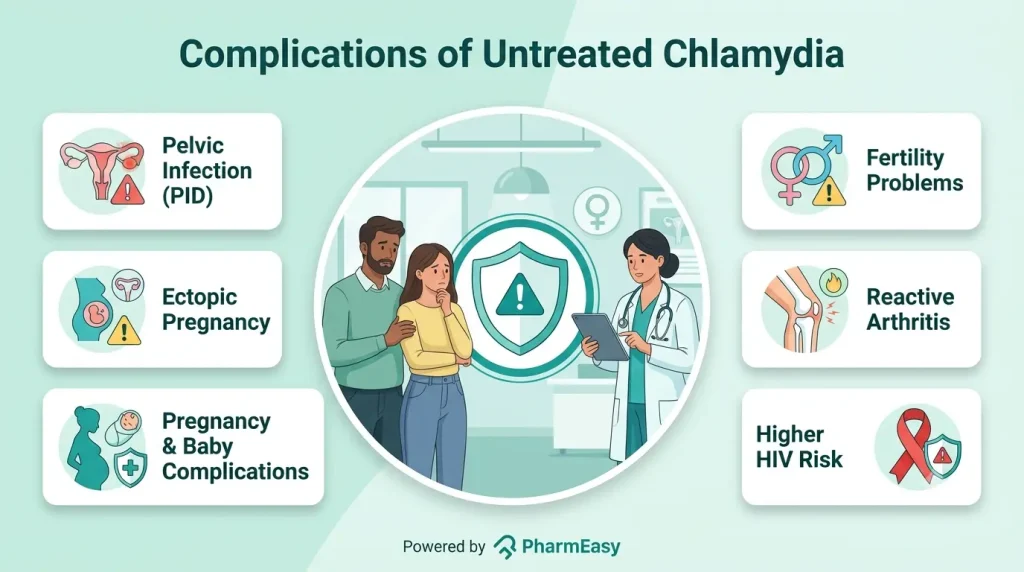
Many people with chlamydia have no symptoms. However, untreated infection can still cause complications in both men and women.
Chlamydia is usually diagnosed with a laboratory test on a urine sample or a swab from the area that may be infected, such as the vagina, cervix, penis, rectum, or throat. The best test depends on your symptoms, sexual history, and the area that may have been exposed10.
Your doctor or sexual health clinic can recommend the most appropriate test for you.
Chlamydia is treated with antibiotics. Treatment helps cure the infection, reduce the chance of passing it to others, and prevents complications. The antibiotic chosen depends on factors such as the site of infection, pregnancy, allergies, other health conditions, and local medical guidance. Treatment for men and women is usually similar, except in situations such as pregnancy. The following options are included in the WHO guidance for chlamydial infections12.
WHO STI treatment guidelines recommend one of the following options:
Other options may include tetracycline, erythromycin, or ofloxacin. Doxycycline, tetracycline, and ofloxacin are not recommended during pregnancy.
For chlamydia affecting the rectum or anus, WHO guidance prefers doxycycline 100 mg by mouth twice a day for 7 days.
WHO guidance recommends azithromycin as the preferred antibiotic in pregnancy. Amoxicillin is considered an acceptable alternative to azithromycin. Recommended doses include:
For newborn eye infection caused by chlamydia, WHO guidance recommends azithromycin 20 mg/kg/day by mouth, once daily for 3 days.
Treatment should also include a proper testing and management for recent sexual partners, because partners may have chlamydia even if they do not have symptoms.
Chlamydia is curable with antibiotics, but reinfection is possible. That is why retesting after about 3 months is often recommended.
For a personal treatment plan, speak with a doctor or sexual health clinic.
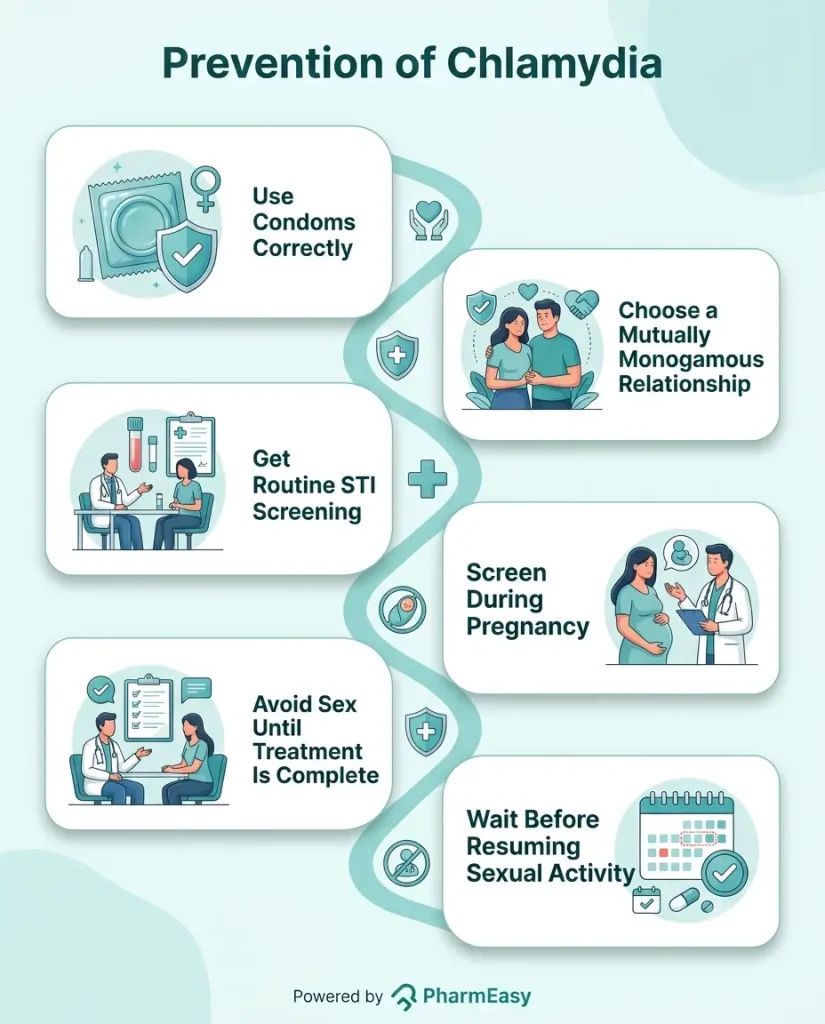
Preventing chlamydia focuses on lowering the chance of exposure and getting tested when needed.
This can help detect infection early and prevent spread. Screening during pregnancy can help avoid passing the infection to the baby15.
Also Read: Is HPV Herpes? Our Doctor Explains the Difference
See a doctor or visit a sexual health clinic if you or your partner has symptoms of chlamydia, if a partner has been diagnosed with an STI, or if you have had sex without a condom and are worried about infection. Pregnant people should ask about chlamydia testing. Regular testing is recommended for people at higher risk, including sexually active women aged 25 or below, older women with new or multiple sexual partners, people with a partner who has STI symptoms, and men who have sex with men3.
Chlamydia is a common STI caused by the bacterium Chlamydia trachomatis. It often causes no symptoms, so testing is important if you may have been exposed. If left untreated, chlamydia can affect reproductive and urinary health and may cause complications. The infection is curable with antibiotics, but treatment cannot always reverse damage that has already happened. If you are concerned about chlamydia, speak with a healthcare provider for testing and advice.
Chlamydia is usually not life-threatening and can be cured with antibiotics when treated early1. However, untreated infection can cause serious reproductive and urinary health problems.
Chlamydia is transmitted from an infected person to others by vaginal, anal or oral sex. It can also be transmitted from an infected mother to the baby during childbirth8.
No. Chlamydia and gonorrhoea are bacteria that cause STIs. Though the infections they cause show some similarities in symptoms, they are treated as separate diseases8.
Men may have discharge from the penis, pain or burning when passing urine, or pain and swelling in the testicles. Many men have no symptoms, so testing is the only way to know for sure1.
Many people with chlamydia do not have symptoms, so a partner may not know they have it. The word “clean” can be misleading; STI status can only be confirmed with testing1.
The exact infectious period is not always clear. Without treatment, chlamydia may last for months. After treatment, follow your doctor’s advice about when it is safe to have sex again4.
Yes. Chlamydia often causes no symptoms or only mild symptoms, so a person may not know they have it. If untreated, the infection may persist and can still be passed to others4.
1. Chlamydia. Accessed July 27, 2026. Available from: https://www.nj.gov/health/sti/information/chlamydia/
2. CDC. About Chlamydia. Chlamydia. February 23, 2026. Accessed July 27, 2026. Available from: https://www.cdc.gov/chlamydia/about/index.html
3. Chlamydia Infections. Accessed July 27, 2026. Available from: https://medlineplus.gov/chlamydiainfections.html
4. Chlamydia. Communicable Diseases Agency. Accessed July 27, 2026. Available from: https://www.cda.gov.sg/professionals/diseases/chlamydia/
5. Pelvic inflammatory disease (PID): MedlinePlus Medical Encyclopedia. Accessed July 27, 2026. Available from: https://medlineplus.gov/ency/article/000888.htm
6. Paavonen J, Lehtinen M. Chlamydial pelvic inflammatory disease. Hum Reprod Update. 1996 Nov-Dec;2(6):519-29. doi: 10.1093/humupd/2.6.519. PMID: 9111185. Available from: https://pubmed.ncbi.nlm.nih.gov/9111185/
7. Xia Q, Wang T, Xian J, et al. Relation of Chlamydia trachomatis infections to ectopic pregnancy. Medicine (Baltimore). 2020;99(1):e18489. doi:10.1097/MD.0000000000018489 Available from: https://pubmed.ncbi.nlm.nih.gov/31895782/
8. Mohseni M, Sung S, Rausch-Phung EA, Takov V. Chlamydia. In: StatPearls. StatPearls Publishing; 2026. Accessed July 27, 2026. Available from: http://www.ncbi.nlm.nih.gov/books/NBK537286/
9. Centre for Health Protection, Department of Health – Men’s Health Line – Chlamydia. Accessed July 27, 2026. Available from: https://www.chp.gov.hk/en/static/80030.html
10. Meyer T. Diagnostic Procedures to Detect Chlamydia trachomatis Infections. Microorganisms. 2016;4(3):25. doi:10.3390/microorganisms4030025 Available from: https://pubmed.ncbi.nlm.nih.gov/27681919/
11. Numazaki K. Serological Tests for Chlamydia trachomatis Infections. Clin Microbiol Rev. 1998;11(1):228-229. doi:10.1128/cmr.11.1.228 Available from: https://pmc.ncbi.nlm.nih.gov/articles/PMC116715/
12. RECOMMENDATIONS FOR TREATMENT OF CHLAMYDIAL INFECTIONS. In: WHO Guidelines for the Treatment of Chlamydia Trachomatis. World Health Organization; 2016. Accessed July 27, 2026. Available from: https://www.ncbi.nlm.nih.gov/books/NBK379708/
13. Chlamydial Infections – STI Treatment Guidelines. August 15, 2022. Accessed July 27, 2026. Available from: https://www.cdc.gov/std/treatment-guidelines/chlamydia.htm
14. Chlamydia. Communicable Diseases Agency. Accessed July 28, 2026. Available from: https://www.cda.gov.sg/public/diseases/chlamydia/
15. Chlamydia. Accessed July 27, 2026. Available from: https://www.who.int/news-room/fact-sheets/detail/chlamydia
Disclaimer: The information provided here is for educational/awareness purposes only and is not intended to be a substitute for medical treatment by a healthcare professional and should not be relied upon to diagnose or treat any medical condition. The reader should consult a registered medical practitioner to determine the appropriateness of the information and before consuming any medication. PharmEasy does not provide any guarantee or warranty (express or implied) regarding the accuracy, adequacy, completeness, legality, reliability or usefulness of the information; and disclaims any liability arising thereof.
Links and product recommendations in the information provided here are advertisements of third-party products available on the website. PharmEasy does not make any representation on the accuracy or suitability of such products/services. Advertisements do not influence the editorial decisions or content. The information in this blog is subject to change without notice. The authors and administrators reserve the right to modify, add, or remove content without notification. It is your responsibility to review this disclaimer regularly for any changes.


Comments

Leave your comment...
You may also like

























Comments