




Congenital Rubella Syndrome: Symptoms, Causes, Diagnosis, Treatment & Prevention
By Dr. Sarthak Soni +2 more

Medically reviewed by Dr. Sarthak Soni
Last updated: Sep 15, 2026 Published on: Aug 3, 2026


Get,

to manage your symptom
Get your,

4 Cr+ families
benefitted

OTP sent to 9988776655



You’ve successfully subscribed to receive
doctor-approved tips on
Whatsapp

Get ready to feel your best.


Register to Avail the Offer
Send OTPBy continuing, you agree with our Privacy Policy and Terms and Conditions
Hi There,
Sign up on PharmEasy now!!


Trusted by 4 crore+ families

OTP sent to 9988776655
You have unlocked 25% off on medicines


Code: NU25

By Dr. Sarthak Soni +2 more
Table of Contents
Rubella, often known as German measles, is usually a mild viral infection in adults, but it can seriously affect a developing baby during pregnancy1. In this article, we will discuss congenital rubella syndrome, including its symptoms, causes, diagnosis, treatment options, and prevention methods.

Congenital rubella syndrome (CRS) is a condition in which a baby develops multiple health problems after rubella virus infection during pregnancy. Rubella is a contagious disease that spreads through respiratory droplets. It mainly affects children and young adults. The infection can also pass from the mother to the developing baby through the placenta, especially if the mother becomes infected during the first few months of pregnancy1.
The infection can interfere with the normal development of the baby’s organs, leading to problems with the eyes, ears, heart, brain, and other parts of the body1. The severity of CRS depends on the stage of pregnancy at which infection occurs and how early the baby is exposed to the virus. If the mother is infected early in pregnancy, particularly during the first trimester, the baby is more likely to develop CRS2.
CRS occurs when the rubella virus passes from a pregnant woman to her developing baby during pregnancy, especially in the first trimester. The infection develops stepwise as shown below:
The main cause of CRS is infection with the rubella virus during pregnancy and passing of the virus to the developing baby. Factors that increase the risk of maternal infection include:
The symptoms of CRS can vary from one baby to another. Some symptoms are present at birth, while others appear later in life3. The most common CRS symptoms include:
CRS is usually diagnosed in the baby using more than one test or procedure. The following are the most common ones recommended by doctors:
Note: RT-PCR is most accurate when performed early in the baby’s life because the amount of virus decreases over time. If the test is negative but CRS is still suspected, the doctor may recommend further evaluation or repeat testing, if appropriate.
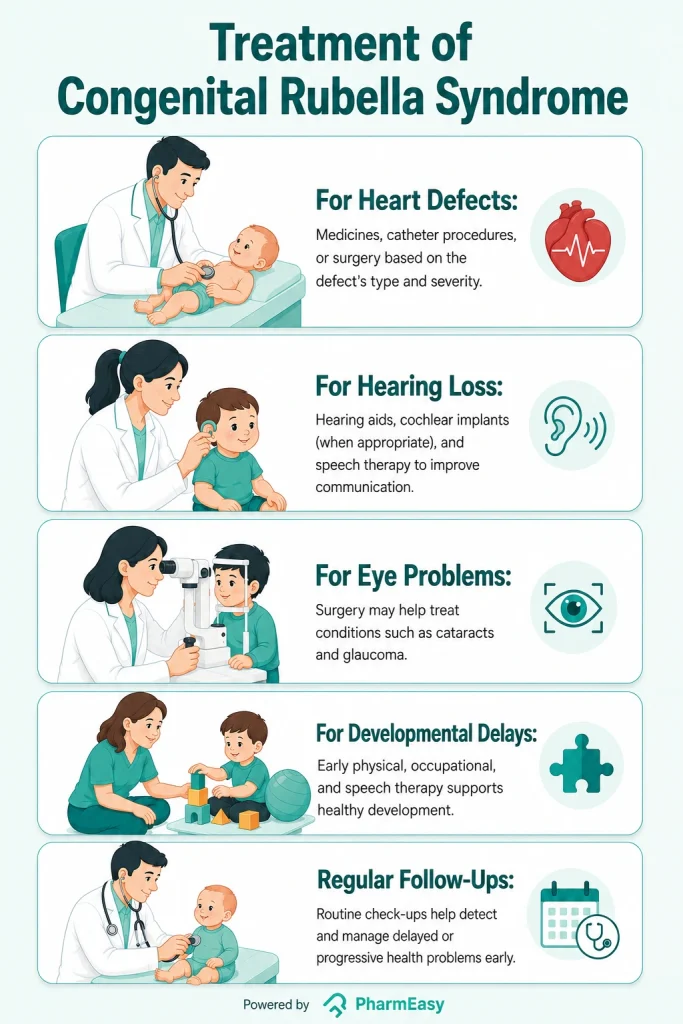
Because CRS has no cure9, treatment usually focuses on managing symptoms, preventing complications, and supporting healthy growth and development. The following are common CRS treatment approaches suggested by doctors for different conditions:
CRS can lead to several long-term health problems that affect the heart, eyes, ears, brain, and other organs, such as:
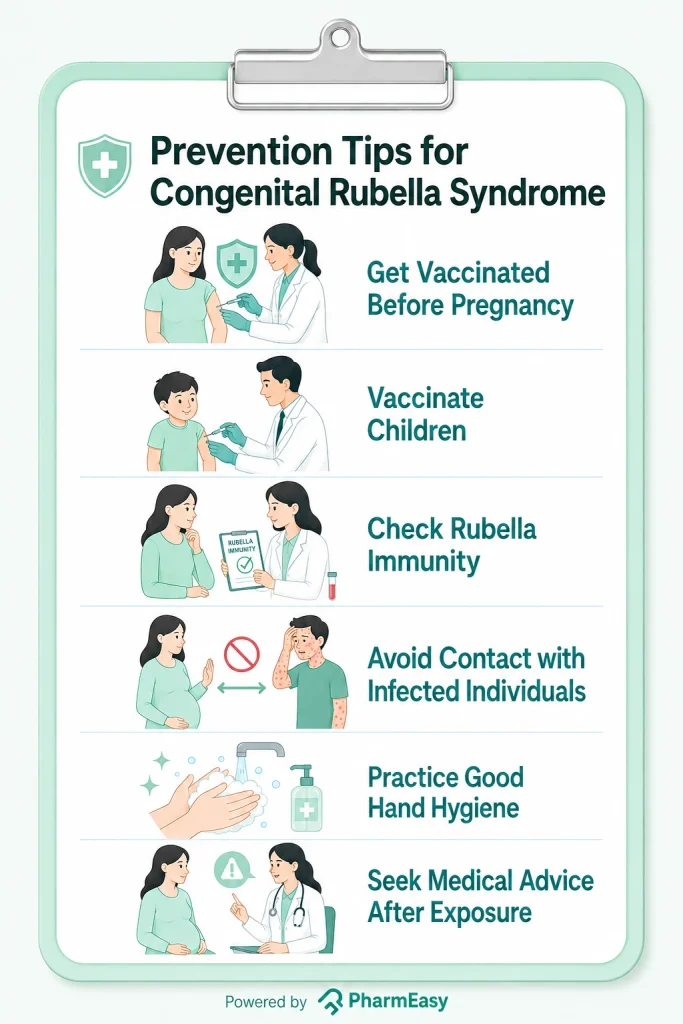
CRS is a preventable condition. The following measures can help reduce the risk:
Rubella vaccination is the best protection against rubella infection and CRS. It lowers the chance of infection in women of reproductive age and helps protect babies from rubella-related complications during pregnancy by supporting immunity against the virus1,14. Vaccine-induced immunity is usually lifelong14. Widespread vaccination can also reduce new cases and limit the spread of rubella, which helps prevent CRS.
Women who are not immune should receive the rubella vaccine before becoming pregnant1. The vaccine is not advised during pregnancy because it contains a live, weakened virus. It is recommended to wait at least 4 weeks after receiving the rubella vaccine before trying to conceive9.
Consult a doctor in the following situations:
Early medical evaluation can support timely diagnosis, management, and long-term care.
CRS is a preventable condition that can cause serious health problems in babies when a mother gets infected with rubella during pregnancy. Early diagnosis, regular monitoring, and supportive treatment can help manage complications and improve the child’s quality of life. Rubella vaccination before pregnancy remains the most effective way to prevent the infection in mothers and infants.
Yes, rubella can be dangerous during pregnancy because it can cause CRS if it crosses the placenta, especially in the first trimester. It may contribute to problems such as vision impairment, heart defects, and hearing loss3,5.
The rubella vaccination is usually given to children as part of the MMR vaccine; the first dose is administered at 9 months, the second dose at 15 months, and the third or booster dose between the ages of 4 and 6 years16. Before getting pregnant, women who are not immune should receive a vaccination1,9.
Yes, CRS can significantly affect hearing, and hearing loss is one of its most common complications3.
No, there is no scientific evidence that the rubella vaccine affects fertility. It helps protect against rubella infection and is recommended for women before pregnancy to prevent complications in the baby. However, women are advised to avoid becoming pregnant for at least 4 weeks after vaccination because the vaccine contains a live, weakened virus1,9.
1. Rubella. 2026. Available from: https://www.who.int/news-room/fact-sheets/detail/rubella
2. Congenital Rubella Syndrome (CRS). 2022. Available from: https://www.dshs.texas.gov/sites/default/files/IDCU/investigation/electronic/EAIDG/2022/Congenital-Rubella-Syndrome-CRS.pdf
3. Mawson AR, Croft AM. Rubella Virus Infection, the Congenital Rubella Syndrome, and the Link to Autism. IJERPH. 2019;16(19):3543. doi:10.3390/ijerph16193543. Available from: https://pmc.ncbi.nlm.nih.gov/articles/PMC6801530/
4. Rubella. 2020. Available from: https://www.nfid.org/infectious-disease/rubella/
5. Congenital rubella. 2025. Available from: https://medlineplus.gov/ency/article/001658.htm
6. Rubella, Congenital Syndrome (CRS) 2010 Case Definition. 2021. Available from: https://ndc.services.cdc.gov/case-definitions/rubella-congenital-syndrome-2010/
7. Chapter 15: Congenital Rubella Syndrome. 2026. Available from: https://www.cdc.gov/surv-manual/php/table-of-contents/chapter-15-congenital-rubella-syndrome.html
8. 5.1 Congenital Rubella Syndrome (CRS). 2020. Available from: https://archive.cdc.gov/www_cdc_gov/ncbddd/birthdefects/surveillancemanual/chapters/chapter-5/chapter5-1.html
9. Pregnancy and Rubella. 2025. Available from: https://www.cdc.gov/rubella/pregnancy/index.html
10. Congenital Heart Defects. 2025. Available from: https://medlineplus.gov/congenitalheartdefects.html
11. Chen MM, Oghalai JS. Diagnosis and Management of Congenital Sensorineural Hearing Loss. Curr Treat Options Peds. 2016;2(3):256-265. doi:10.1007/s40746-016-0056-6. Available from: https://pmc.ncbi.nlm.nih.gov/articles/PMC5222593/
12. Congenital Rubella Syndrome. 2026. Available from: https://eyewiki.org/Congenital_Rubella_Syndrome
13. Liu S, Zhu M, Yi C, Zeng D. Early rehabilitation interventions for global developmental delay in children: a narrative review. Front Pediatr. 2025;13:1576324. doi:10.3389/fped.2025.1576324. Available from: https://pmc.ncbi.nlm.nih.gov/articles/PMC12287077/
14. Leonor MC, Muriam Afzal, Mendez MD. Rubella. 2025. Available from: https://www.ncbi.nlm.nih.gov/books/NBK559040/
15. Prevention of congenital rubella syndrome. Paediatrics & Child Health. 1999;4(2):155-157. doi:10.1093/pch/4.2.155. Available from: https://academic.oup.com/pch/article-abstract/4/2/155/2655829
16. Rao M IS, Kasi SG, Dhir SK, et al. Indian academy of pediatrics (IAP) advisory committee on vaccines and immunization practices (ACVIP): Recommended immunization schedule (2023) and update on immunization for children aged 0 through 18 Years. 2024. Available from: https://indianpediatrics.net/epub012024/FTA-00592.pdf
Disclaimer: The information provided here is for educational/awareness purposes only and is not intended to be a substitute for medical treatment by a healthcare professional and should not be relied upon to diagnose or treat any medical condition. The reader should consult a registered medical practitioner to determine the appropriateness of the information and before consuming any medication. PharmEasy does not provide any guarantee or warranty (express or implied) regarding the accuracy, adequacy, completeness, legality, reliability or usefulness of the information; and disclaims any liability arising thereof.
Links and product recommendations in the information provided here are advertisements of third-party products available on the website. PharmEasy does not make any representation on the accuracy or suitability of such products/services. Advertisements do not influence the editorial decisions or content. The information in this blog is subject to change without notice. The authors and administrators reserve the right to modify, add, or remove content without notification. It is your responsibility to review this disclaimer regularly for any changes.


Comments

Leave your comment...
You may also like

























Comments