




Common Cancer Symptoms and Warning Signs in Women
By Dr. Charmi Shah +2 more

Medically reviewed by Dr. Charmi Shah
Last updated: Oct 16, 2026 Published on: Sep 7, 2026


Get,

to manage your symptom
Get your,

4 Cr+ families
benefitted

OTP sent to 9988776655



You’ve successfully subscribed to receive
doctor-approved tips on
Whatsapp

Get ready to feel your best.


Register to Avail the Offer
Send OTPBy continuing, you agree with our Privacy Policy and Terms and Conditions
Hi There,
Sign up on PharmEasy now!!


Trusted by 4 crore+ families

OTP sent to 9988776655
You have unlocked 25% off on medicines


Code: NU25

By Dr. Charmi Shah +2 more
Table of Contents
Sometimes you may notice an unusual change in your body, such as constant fatigue, unexplained bleeding, or a new lump1. While these symptoms can have many causes, some of these may be warning signs of cancer and should not be ignored if they persist. This article will discuss the most common cancer symptoms in women, the warning signs to watch for, and when it is important to seek medical advice.

To understand what are the symptoms of cancer in women, we first need to understand what cancer is and how it can affect the body.
Cancer is a broad term for a group of diseases in which abnormal cells grow uncontrollably and may affect nearby tissues or spread to other parts of the body2. Because cancer can develop in almost any part of the body, the symptoms can vary depending on the type and location of the cancer3.
Since men and women have some anatomical differences, certain cancers and their symptoms can be specific to women, particularly those involving the reproductive organs4. However, many symptoms are still common across both sexes and could occur with different types of cancer1.
Did You Know?
Although many cancer symptoms are similar in men and women, some symptoms may be different due to differences in anatomy or location of the cancer (e.g., cancers of the reproductive system). These include7:
Note: These symptoms do not always indicate cancer; however, if a symptom is new, persistent, or unusual for you, talk to your doctor.
Early symptoms of cancer in women may be subtle and similar to symptoms of many common health conditions. Some early symptoms of cancer in women may include1,8:
Below are the major cancers affecting women and symptoms commonly associated with them.
Cervical cancer begins in the cervix, the lower, narrow end of the uterus4. Common cervical cancer symptoms may include7,9:
Ovarian cancer begins in the ovaries, which are located on either side of the uterus. Some ovarian cancers can also begin in the fallopian tubes4. Common symptoms may include10:
Uterine cancer begins in the uterus, the pear-shaped organ in the pelvis where a baby develops during pregnancy4. Common symptoms may include11:
Vaginal cancer begins in the vagina, the hollow, tube-like passage connecting the lower part of the uterus to the outside of the body4. Common symptoms may include12:
Vulvar cancer begins in the vulva, the external part of the female genital organs4. Common symptoms may include13:
Symptoms of breast cancer include14:
Other cancers and their respective symptoms that are commonly seen in women include:
Cancer could occur in women of any age. However, the risk of developing many cancers generally increases with age20.
Although the symptoms themselves may not be different in younger and older women, the way symptoms are noticed may vary (see the table below).
| Aspect | Younger Women | Older Women |
| Cancer risk | Cancer is less common overall, but it can still occur at a younger age21. | The risk of many cancers generally increases with age20. |
| Bleeding pattern | Abnormal, heavy, prolonged, or irregular menstrual bleeding22. | Any vaginal bleeding occurring 12 months after menopause23. |
| How symptoms may be perceived | Symptoms may sometimes be mistaken for menstrual, hormonal, or reproductive problems. | Symptoms may sometimes be attributed to ageing or other existing health conditions. |
| Screening and awareness | Follow age-appropriate screening recommendations and be aware of personal and family risk factors24. | Staying up-to-date with recommended cancer screenings becomes increasingly important with age24. |
Important: Age should never be used as a reason to ignore a concerning symptom. Whether you are young or old, persistent, unusual, or unexplained changes in the body should be discussed with a doctor.
Cancer does not have a single cause. It develops when changes in cells cause them to grow and divide abnormally. These changes can result from a combination of genetic factors, environmental exposures, lifestyle factors, and certain infections. Common factors that can increase the risk of cancer include1,2:
Important: Having a risk factor does not mean that a person will develop cancer. Similarly, cancer may sometimes also occur in people without any obvious risk factors.
If cancer is suspected because of symptoms, a routine check-up, or a screening test, the doctor may recommend several tests to find out what is causing the changes1. The tests recommended depend on the type of cancer, symptoms, and a person’s overall health. Common diagnostic tests may involve:
Note: Once cancer is confirmed, further laboratory or imaging tests may be performed to determine how far it has spread and help doctors plan an appropriate management plan.
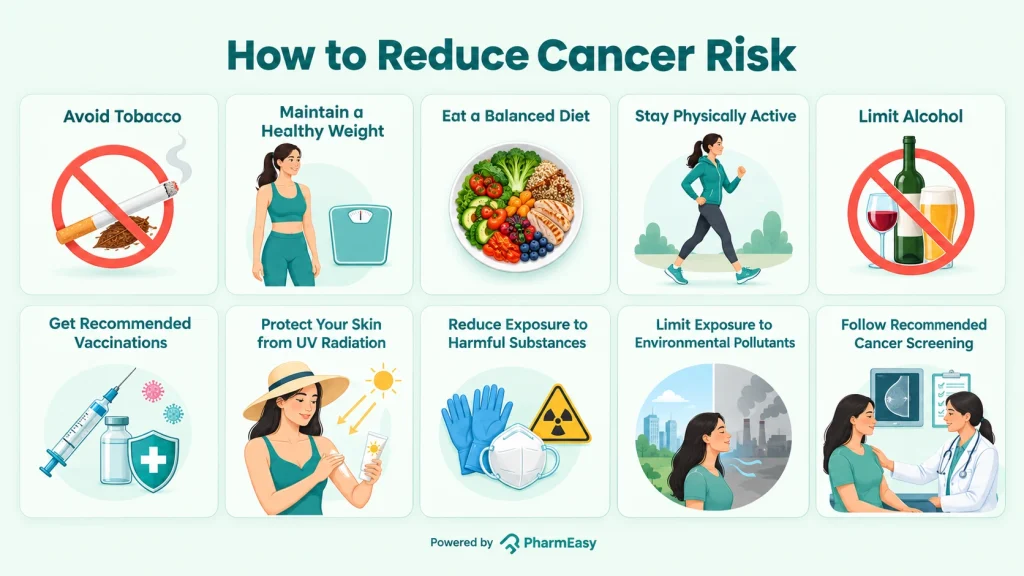
Many cancer risks can be reduced through healthy lifestyle choices, vaccination, and limiting exposure to known cancer-causing factors. Some important steps include:
Remember: The above-mentioned prevention steps cannot eliminate cancer risk completely, but may significantly reduce the risk of developing certain cancers and support overall health.
If you notice any new, unusual, or persistent changes in your body, it is important to get them checked. These include1:
Also Read: Early Warning Signs of Cancer You Should Know
Cancer symptoms in women may vary widely depending on the type of cancer. Although many of these symptoms may be caused by conditions that are not cancer, paying attention to new, unusual, persistent, or unexplained changes in your body can help ensure that potential problems are identified early.
To support early diagnosis and timely treatment, you should know the warning signs, follow recommended screening and prevention measures, and speak with a doctor when something does not feel right.
Unexplained or significant weight loss may sometimes be associated with cancer8. However, weight loss has many possible causes, so it is best to discuss this with a doctor.
Unusual vaginal bleeding may be a warning sign of cervical, uterine, vaginal, or other gynaecologic cancers. This includes bleeding between periods, unusually heavy or prolonged periods, bleeding after sex, or any vaginal bleeding after menopause9,13. Therefore, any unusual bleeding should be evaluated by a doctor.
Frequent bloating, particularly when accompanied by feeling full quickly, abdominal or pelvic pain, or changes in bowel or bladder habits, may be associated with ovarian cancer8,10. Since bloating is common and has many causes, persistent symptoms should be checked.
Any new lump, thickening, change in breast size or shape, nipple change, unusual discharge, or skin change should be assessed by a doctor, especially if the change is new or persists14.
A new or changing mole, unusual skin growth, or a sore that does not heal can be a warning sign of skin cancer. Therefore, changes in a mole’s size, shape, colour, or appearance, or a lesion that bleeds or repeatedly develops a crust, should be checked by a doctor17.
Any symptoms that are new, persistent, unexplained, or worsening should be evaluated by a doctor. These may include unusual bleeding, a new lump, unexplained weight loss, persistent fatigue or pain, ongoing bloating, changes in bowel or bladder habits, persistent cough, or unusual skin changes1,8. Also, remember that having these symptoms does not mean you have cancer, but getting concerning changes evaluated can help detect problems early.
1. Cancer – symptoms, causes, diagnosis and treatments. Healthdirect. May 6, 2026. Accessed August 26, 2026. https://www.healthdirect.gov.au/cancer
2. Cancer. World Health Organization. Accessed August 26, 2026. https://www.who.int/news-room/fact-sheets/detail/cancer
3. Koya AI, Ibrahim SA. Carcinogenesis. StatPearls. Accessed August 26, 2026. http://www.ncbi.nlm.nih.gov/books/NBK604463/
4. Gynecologic Cancers Basics. CDC. February 3, 2025. Accessed August 26, 2026. https://www.cdc.gov/gynecologic-cancer/about/index.html
5. Cancer Facts for Women. American Cancer Society. Accessed August 26, 2026. https://www.cancer.org/cancer/risk-prevention/understanding-cancer-risk/cancer-facts/cancer-facts-for-women.html
6. Four in ten cancer cases could be prevented globally. World Health Organization. Accessed August 26, 2026. https://www.iarc.who.int/news-events/four-in-ten-cancer-cases-could-be-prevented-globally
7. Symptoms of Gynecologic Cancers. CDC. September 5, 2024. Accessed August 26, 2026. https://www.cdc.gov/gynecologic-cancer/symptoms/index.html
8. Signs and Symptoms of Cancer. American Cancer Society. Accessed August 26, 2026. https://www.cancer.org/cancer/diagnosis-staging/signs-and-symptoms-of-cancer.html
9. Symptoms of cervical cancer. NHS. September 18, 2024. Accessed August 26, 2026. https://www.nhs.uk/conditions/cervical-cancer/symptoms/
10. Ovarian cancer – Symptoms. NHS. October 20, 2017. Accessed August 26, 2026. https://www.nhs.uk/conditions/ovarian-cancer/symptoms/
11. Womb (uterus) cancer – Symptoms. NHS. October 23, 2017. Accessed August 26, 2026. https://www.nhs.uk/conditions/womb-cancer/symptoms/
12. Symptoms of vaginal cancer. NHS. December 9, 2021. Accessed August 26, 2026. https://www.nhs.uk/conditions/vaginal-cancer/symptoms/
13. Symptoms of Vaginal and Vulvar Cancers. CDC. September 26, 2025. Accessed August 26, 2026. https://www.cdc.gov/vaginal-vulvar-cancers/symptoms/index.html
14. Breast Cancer. MedlinePlus. Accessed August 26, 2026. https://medlineplus.gov/breastcancer.html
15. Lung cancer – Symptoms. NHS. October 23, 2017. Accessed August 26, 2026. https://www.nhs.uk/conditions/lung-cancer/symptoms/
16. Symptoms of Colorectal Cancer. CDC. July 9, 2026. Accessed August 26, 2026. https://www.cdc.gov/colorectal-cancer/symptoms/index.html
17 Symptoms of Skin Cancer. CDC. July 6, 2026. Accessed August 26, 2026. https://www.cdc.gov/skin-cancer/symptoms/index.html
18. Thyroid cancer. MedlinePlus. Accessed August 26, 2026. https://medlineplus.gov/ency/article/001213.htm
19. Leukaemia – symptoms, causes, treatment and diagnosis. healthdirect. Accessed August 26, 2026. https://www.healthdirect.gov.au/leukaemia
20. Age and cancer. Cancer Research UK. Accessed August 26, 2026. https://www.cancerresearchuk.org/about-cancer/causes-of-cancer/age-and-cancer
21. André F, Rassy E, Achutti-Duso B, et al. The rising tides of cancers among young adults. ESMO Open. 2025;10(9):105553. doi:10.1016/j.esmoop.2025.105553. https://pmc.ncbi.nlm.nih.gov/articles/PMC12446525/
22. Leal CRV, Vannuccini S, Jain V, et al. Abnormal uterine bleeding: The well-known and the hidden face. J Endometr Uterine Disord. 2024;6:100071. doi:10.1016/j.jeud.2024.100071. https://www.sciencedirect.com/science/article/pii/S2949838424000136
23. Nigam P, Chauhan S, Natu N. Study on Endometrial Histopathology of Women with Postmenopausal Bleeding and Its Clinical Correlation. J Contemp Clin Pract. 2025;11:585-589. doi:10.61336/jccp/25-05-82. https://jccpractice.com/article/study-on-endometrial-histopathology-of-women-with-postmenopausal-bleeding-and-its-clinical-correlation-730/
24. Cancer and Women. CDC. November 14, 2024. Accessed August 26, 2026. https://www.cdc.gov/cancer/features/cancer-and-women.html
25. Tests and Procedures Used to Diagnose Cancer. NCI. March 9, 2015. Accessed August 26, 2026. https://www.cancer.gov/about-cancer/diagnosis-staging/diagnosis
26. Cancer Prevention Overview. NCI. June 22, 2009. Accessed August 26, 2026. https://www.cancer.gov/about-cancer/causes-prevention/patient-prevention-overview-pdq
Disclaimer: The information provided here is for educational/awareness purposes only and is not intended to be a substitute for medical treatment by a healthcare professional and should not be relied upon to diagnose or treat any medical condition. The reader should consult a registered medical practitioner to determine the appropriateness of the information and before consuming any medication. PharmEasy does not provide any guarantee or warranty (express or implied) regarding the accuracy, adequacy, completeness, legality, reliability or usefulness of the information; and disclaims any liability arising thereof.
Links and product recommendations in the information provided here are advertisements of third-party products available on the website. PharmEasy does not make any representation on the accuracy or suitability of such products/services. Advertisements do not influence the editorial decisions or content. The information in this blog is subject to change without notice. The authors and administrators reserve the right to modify, add, or remove content without notification. It is your responsibility to review this disclaimer regularly for any changes.


Comments

Leave your comment...
You may also like
























Comments