




Spinal Tuberculosis (Pott’s Disease): Symptoms, Treatment, Diagnosis & More
By Dr. Parth Mehta +2 more

Medically reviewed by Dr. Parth Mehta
Last updated: Sep 10, 2026 Published on: Jun 30, 2026


Get,

to manage your symptom
Get your,

4 Cr+ families
benefitted

OTP sent to 9988776655



You’ve successfully subscribed to receive
doctor-approved tips on
Whatsapp

Get ready to feel your best.


Register to Avail the Offer
Send OTPBy continuing, you agree with our Privacy Policy and Terms and Conditions
Hi There,
Sign up on PharmEasy now!!


Trusted by 4 crore+ families

OTP sent to 9988776655
You have unlocked 25% off on medicines


Code: NU25

By Dr. Parth Mehta +2 more
Table of Contents
Persistent back pain and neck stiffness are often blamed on muscle strain or poor posture in most of the cases, while sometimes these won’t be the real cause. Spinal tuberculosis, which is also known as Pott’s disease, is a condition which affects the spine. If left untreated, it can cause spinal abnormalities and other complications1. This blog will help in understanding the symptoms, causes, diagnosis, treatment options, and methods for managing Pott’s disease for better spinal health.

Spinal tuberculosis, also known as Pott’s disease, is a type of tuberculosis (TB) that affects the bones and disc of the spine1. It occurs when TB-causing bacteria travel from the lungs or another region of the body to the spine2. There are different stages of spinal tuberculosis; starting from early infection of spinal bone (vertebrae) that can spread to the surrounding tissues (intervertebral spaces) causing discomfort, pain and difficulty moving to significant destruction of vertebral bone causing structural abnormalities. In severe cases, it can affect the nerves, causing weakness or numbness3. Early diagnosis and treatment can help to avoid serious problems and protect spinal health1.
Spinal TB can cause mild to severe symptoms. The following are some of the spinal tuberculosis symptoms:
These symptoms usually occur along with other constitutional tuberculosis symptoms that include:
Pott’s disease is caused when the Mycobacterium tuberculosis bacteria spreads from the main site of infection to the spine4. In most cases, the bacteria are inhaled and infect the lungs, resulting in pulmonary tuberculosis5. From the lungs, the infection can then spread to the spine through the bloodstream.
In some cases, the bacteria may spread through blood from primary genitourinary infections also to reach the spine.
Once the bacteria reach the spine, they settle in the vertebrae, multiply, slowly infiltrate surrounding soft tissue and cause bone damage4.
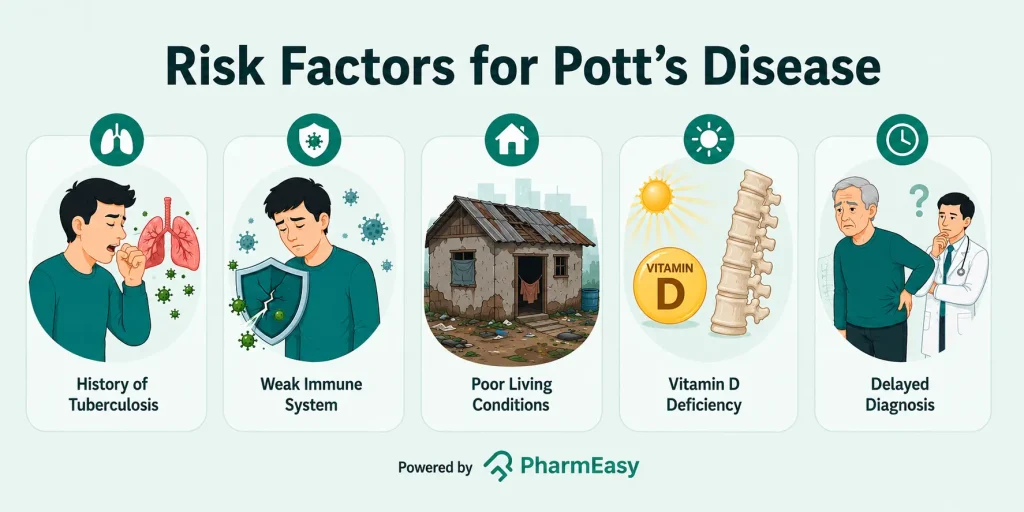
Although spinal tuberculosis causes are usually linked to the spread of infection from the lungs or other parts of the body, there are certain factors that can increase the risk of infection spreading to the spine. These include:
If Pott’s disease treatments are delayed, it can lead to several serious complications affecting the spine and nervous system.
Spinal tuberculosis diagnosis includes a combination of clinical evaluation and medical tests. The tests doctors usually perform include:
The goal of spinal tuberculosis treatment is to control the TB infection, alleviate symptoms, and avoid consequences like spinal injury and nerve involvement. The following are the usual treatment approaches recommended by the doctors:

This is the primary treatment for Pott’s disease. These drugs aid in the elimination of tuberculosis bacteria, stopping the spread of the infection, and preventing further spine damage. The treatment usually includes a combination of TB medicines (rifampin, isoniazid, ethambutol and pyrazinamide) for several months, with treatment typically lasting between 6 and 18 months depending on the condition10.

Supportive measures such as adequate rest, wearing a body cast or using plaster beds, and maintaining good nutrition can help support healing and reduce stress on the affected spine10,11. Once the infection is under control, physical therapy may be recommended to improve strength, flexibility, mobility, and overall spinal function1.
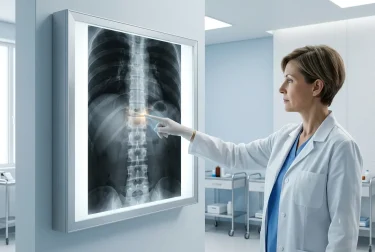
Surgeries may be recommended for the severe cases of spinal instability, major spinal deformity, massive abscesses, or spinal cord compression. It can assist to remove contaminated tissue, reduce nerve strain, and stabilise the spine10.
Also Read: Home Remedies For Back Pain By Dr. Siddharth Gupta
The following are some ways by which Pott’s disease can be prevented:
Consult a doctor for symptoms like prolonged back pain that does not improve with therapy, and especially if it is accompanied by fever, night sweats, unexplained weight loss, or increased weakness or numbness in your legs or arms2,4. Difficulty walking or any loss of bladder or bowel control should be treated as emergency warning symptoms1. Early medical intervention is critical for swiftly diagnosing the condition and avoiding major problems involving the spine and nerves.
Also Read: 5 Myths About Tuberculosis You Need to Know About
Spinal tuberculosis/Pott’s disease is a dangerous but manageable ailment if caught early. Recognising symptoms such as persistent back pain, stiffness, and neurological abnormalities at the appropriate time can make a significant difference in outcomes. Early detection and continued medical treatment can help avoid complications including spinal deformity and nerve damage. Following medical advice and taking the entire course of treatment is critical for successful recovery and long-term spinal health.
Also Read: Calf Strain: What It Is, Causes, Symptoms, and Recovery Tips
Yes, spinal TB (Pott’s disease) may usually be treated with early detection and a full course of anti-tuberculous drugs for several months. In some severe cases, further treatments such as surgery may be required to effectively manage the illness and avoid consequences1,11.
Most patients with Pott’s disease can live a normal life if diagnosed early and treated properly. However, if left undiagnosed or untreated, it can cause significant complications such as severe disability or permanent paralysis, making it hard to survive1.
Spinal tuberculosis itself is not contagious because it affects the spine of a person who already has TB of the lungs or other body parts2. However, TB bacteria can spread through the air by sneezing or coughing, if the person also has active lung TB12.
Some genetic susceptibility is reported for spinal tuberculosis4, however, there is no hereditary trend seen for the condition and further studies are needed to confirm this. The infection mainly occurs when the infection-causing bacteria reach the spines from the lungs or other body parts2.
Pott’s disease mainly affects the spine, so it does not directly involve the heart. However, in severe cases such as when spinal deformities like kyphosis occur, it can put pressure on the spinal cord and affect heart functioning2.
Yes, Pott’s disease can cause paralysis if the infection leads to severe spinal cord compression or nerve damage. However, early diagnosis and treatment can help avoid this1,2.
Yes, Pott’s disease can lead to scoliosis, a condition where the spine curves sideways instead of being straight. This occurs because infection and bone deterioration in the spine can result in an overall imbalance, impacting both front-to-back and side-to-side spinal alignment13.
Pott’s disease usually does not cause seizures on its own and it is also not considered as a Pott’s disease symptom. In rare cases, seizures may happen due to medication side effects, especially in people with mental health conditions or kidney problems2.
1. Spinal Tuberculosis: Rural India’s Hidden Epidemic. Available from: https://thespinefoundation.org/spinal-tuberculosis-hidden-epidemic/
2. Leowattana W, Leowattana P, Leowattana T. Tuberculosis of the spine. World J Orthop. 2023;14(5):275-293. doi:10.5312/wjo.v14.i5.275 Available from: https://pubmed.ncbi.nlm.nih.gov/37304201/
3. Öztürk AM, Yener C, Taşbakan Işikgöz M. CURRENT CONCEPTS ON SPINAL TUBERCULOSIS. jtss. 2020;31(1):60-63. doi:10.4274/jtss.galenos.2020.31 Available from: https://jtss.org/articles/current-concepts-on-spinal-tuberculosis/jtss.galenos.2020.31
4. Garg RK, Somvanshi DS. Spinal tuberculosis: A review. The Journal of Spinal Cord Medicine. 2011;34(5):440-454. doi:10.1179/2045772311Y.0000000023 Available from: https://pubmed.ncbi.nlm.nih.gov/22118251/
5. Pulmonary tuberculosis. 2024. Available from: https://medlineplus.gov/ency/article/000077.htm
6. Xue D, Chen X, Shao L, et al. Risk factors for the progression from pulmonary tuberculosis to spinal tuberculosis: a logistic regression analysis. J Orthop Surg Res. 2025;20(1):422. doi:10.1186/s13018-025-05848-3 Available from: https://pubmed.ncbi.nlm.nih.gov/40296147/
7. Glassman I, Nguyen K, Giess J, Alcantara C, Booth M, Venketaraman V. Pathogenesis, Diagnostic Challenges, and Risk Factors of Pott’s Disease. Clinics and Practice. 2023;13(1):155-165. doi:10.3390/clinpract13010014 Available from: https://pubmed.ncbi.nlm.nih.gov/36826156/
8. Tuberculosis Risk Factors. 2024. Available from: https://www.cdc.gov/tb/risk-factors/index.html
9. Tuberculosis Screening. 2026. Available from: https://medlineplus.gov/lab-tests/tuberculosis-screening/
10. Rasouli MR, Mirkoohi M, Vaccaro AR, Yarandi KK, Rahimi-Movaghar V. Spinal Tuberculosis: Diagnosis and Management. Asian Spine J. 2012;6(4):294. doi:10.4184/asj.2012.6.4.294 Available from: https://pubmed.ncbi.nlm.nih.gov/23275816/
11. Md. Shah Alam. Surgery for spinal tuberculosis: a multi-center experience of 582 cases. 2015;1(1):65. doi:10.3978/j.issn.2414-469X.2015.07.03 Available from: https://pubmed.ncbi.nlm.nih.gov/27683681/
12. Jo KW. Preventing the Transmission of Tuberculosis in Health Care Settings: Administrative Control. Tuberc Respir Dis. 2017;80(1):21. doi:10.4046/trd.2017.80.1.21 Available from: https://pubmed.ncbi.nlm.nih.gov/28119743/
13. Chen L, Liu C, Ye Z, et al. Multiple Spinal Tuberculosis with Severe Kyphosis: A Case Report. Front Surg. 2022;9:815514. doi:10.3389/fsurg.2022.815514 Available from: https://www.frontiersin.org/journals/surgery/articles/10.3389/fsurg.2022.815514/full
Disclaimer: The information provided here is for educational/awareness purposes only and is not intended to be a substitute for medical treatment by a healthcare professional and should not be relied upon to diagnose or treat any medical condition. The reader should consult a registered medical practitioner to determine the appropriateness of the information and before consuming any medication. PharmEasy does not provide any guarantee or warranty (express or implied) regarding the accuracy, adequacy, completeness, legality, reliability or usefulness of the information; and disclaims any liability arising thereof.
Links and product recommendations in the information provided here are advertisements of third-party products available on the website. PharmEasy does not make any representation on the accuracy or suitability of such products/services. Advertisements do not influence the editorial decisions or content. The information in this blog is subject to change without notice. The authors and administrators reserve the right to modify, add, or remove content without notification. It is your responsibility to review this disclaimer regularly for any changes.


Comments

Leave your comment...
You may also like
























Comments