




How to Store Insulin Safely During Travel: Tips, Precautions & Best Practices
By Dr. Amruta Prabhu +2 more

Medically reviewed by Dr. Amruta Prabhu
Last updated: Sep 15, 2026 Published on: Jun 30, 2026


Get,

to manage your symptom
Get your,

4 Cr+ families
benefitted

OTP sent to 9988776655



You’ve successfully subscribed to receive
doctor-approved tips on
Whatsapp

Get ready to feel your best.


Register to Avail the Offer
Send OTPBy continuing, you agree with our Privacy Policy and Terms and Conditions
Hi There,
Sign up on PharmEasy now!!


Trusted by 4 crore+ families

OTP sent to 9988776655
You have unlocked 25% off on medicines


Code: NU25

By Dr. Amruta Prabhu +2 more
Table of Contents
Travelling can be exciting, but for those who take insulin, it often brings a common worry: how to keep insulin safe during the journey. Long travel times, improper storage, and other conditions can all have an impact on how effectively insulin works1. This article explains why proper insulin storage is important when travelling and how to keep it safely in different conditions to stay healthy and stress-free.
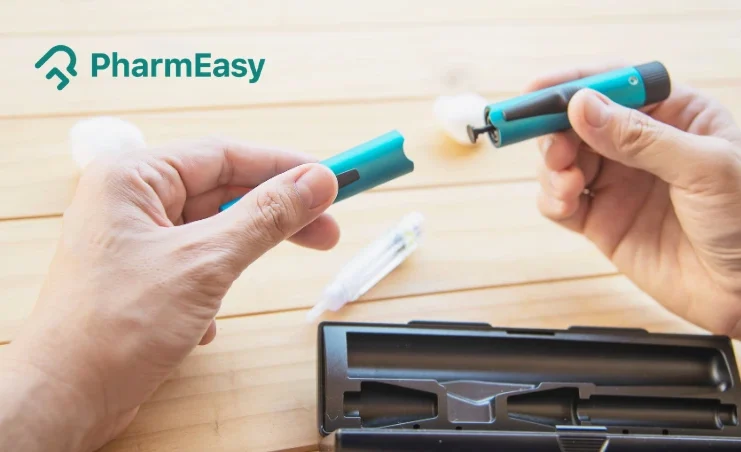
Insulin is one of the effective treatments that helps control blood sugar levels, and it needs to stay effective to work properly. During travel, it is especially important to store it correctly because it is very sensitive to temperature changes. Exposure to extreme heat or freezing conditions, such as in cars, on flights, or while carrying bags for long hours, can cause the breakdown of insulin and reduce its effectiveness1. Using insulin that has been damaged may lead to poor blood sugar control and increase the risk of diabetes-related complications2. So, maintaining the right temperature is essential to keep insulin safe and effective, and therefore, proper storage is important while travelling.
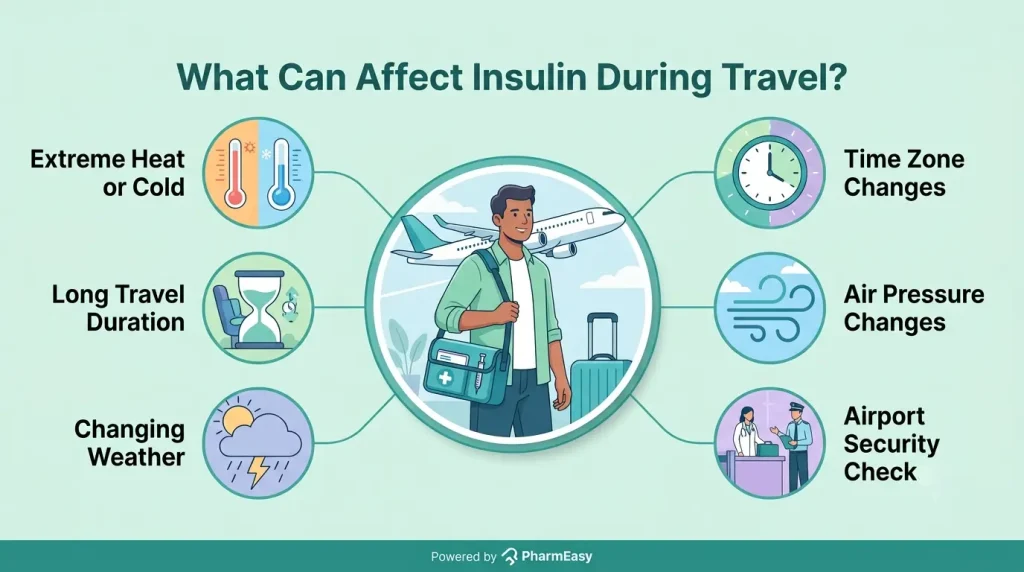
There are several factors that can affect insulin while travelling. Below are some common factors to be aware of:
Insulin works best when stored at an ideal temperature range. The ideal insulin storage temperature is 36°F to 46°F (2°C to 8°C), when it is kept in the refrigerator and not in use. Insulin in vials or containers can be kept at room temperature between 59°F and 86°F (15°C and 30°C) for up to 28 days, and it is still said to work properly. It may become less effective if exposed to temperatures above the recommended range or if it freezes2. Therefore, it is very important to store insulin in a proper way.
Here are some tips on how to carry insulin while travelling safely:
For extended journeys, periodically check that insulin is not becoming excessively hot or cold. It’s best to carry some additional supplies of insulin, needles, pens, a glucose monitoring device and also your prescription in case of delays or emergencies.
Note: Always check the product label or discuss with your healthcare provider for understanding the correct storage methods when switching between brands or types of insulin.
People often make mistakes when storing insulin while travelling. These should be avoided to maintain its effectiveness. The following are the most common ones:
If insulin has been exposed to excessive heat or freezing temperatures, firstly avoid using it immediately. Check whether it has any visible changes and review the storage recommendations provided by the manufacturer. If the insulin is suspected to have damage or any visible changes, it would be better to replace it with a fresh one7. In case it is used, monitor blood sugar levels closely and seek medical advice if readings become difficult to control2. However, it is better to replace questionable insulin rather than risk ineffective treatment.
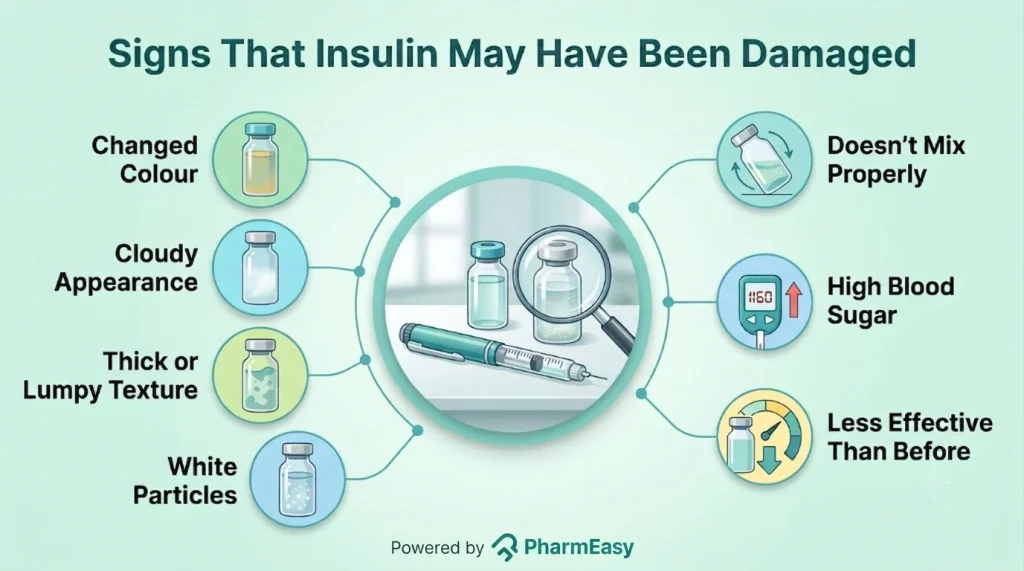
Damaged or spoiled insulin can change its appearance or quality. The following are some common signs that may indicate that insulin is damaged:
Also Read: What Are Endorphins? Understanding the Body’s Natural Pain-Relieving Hormone
Consult a doctor if insulin is suspected to have been damaged due to extreme temperatures or if there is uncertainty about whether it is still safe to use. Medical advice should also be sought if blood sugar levels remain high despite insulin use or if guidance is needed on storing insulin during a long or international trip1,2.
Also Read: A Complete Guide on Insulin Resistance Diet for Weight Loss
Proper insulin storage during travel is important for maintaining its effectiveness. Travellers can avoid insulin damage and maintain appropriate blood sugar levels by preserving it from excessive heat, freezing, and direct sunlight, as well as carrying it safely in hand luggage with adequate storage methods. With proper planning and care, insulin may be kept safe and reliable during the trip.
Insulin is not recommended to be packed in checked luggage because it may be exposed to extreme temperatures. It is best to carry it in hand luggage to keep it safe and effective5.
If insulin freezes, it gets damaged and fails to function properly. Even if it defrosts later, it should not be taken because it may not effectively control blood sugar levels. Frozen insulin should be discarded and replaced with a new one1,2.
Like water, insulin can start to freeze at around 0°C (32°F) or below. Freezing can damage it and make it ineffective. This is why it is recommended to store insulin at 2°C to 8°C (36°F to 46°F)1,2.
Most insulin can stay at room temperature (below about 25°C-30°C) for up to 28 days after opening. However, always check the specific product instructions2.
1. Chowdhury S, Chakraborty P. Errors of insulin therapy: Real-life experiences from developing world. J Family Med Prim Care. 2017;6(4):724. doi:10.4103/jfmpc.jfmpc_418_16 Available from: https://pubmed.ncbi.nlm.nih.gov/29564252/
2. Information Regarding Insulin Storage and Switching Between Products in an Emergency. 2017. Available from: https://www.fda.gov/drugs/emergency-preparedness-drugs/information-regarding-insulin-storage-and-switching-between-products-emergency
3. Pinsker JE, Becker E, Mahnke CB, Ching M, Larson NS, Roy D. Extensive clinical experience: a simple guide to basal insulin adjustments for long-distance travel. J Diabetes Metab Disord. 2013;12(1):59. doi:10.1186/2251-6581-12-59 Available from: https://pubmed.ncbi.nlm.nih.gov/24360506/
4. Department of Cardiology, Goksun State Hospital, Kahramanmaras-Turkey, Ugurlu M. Flight and diabetes. Anatolian J Cardiol. 2021;25(Supp1):S20-S23. doi:10.5152/AnatolJCardiol.2021.S108 Available from: https://pubmed.ncbi.nlm.nih.gov/34464295/
5. Storing and travelling with long-acting insulin. 2023. Available from: https://www.nhs.uk/medicines/insulin/long-acting-insulin/storing-and-travelling-with-long-acting-insulin/
6. Safe and effective use of insulin requires proper storage.2018. Available from: https://www.health.harvard.edu/blog/safe-and-effective-use-of-insulin-requires-proper-storage-2018120415486
7. Jacob JJ. Insulin storage guidance for patients with diabetes using insulin. Indian J Endocrinol Metab. 2023;27(3):189-194. doi:10.4103/ijem.ijem_92_23. PMID: 37292077; PMCID: PMC10245305 Available from: https://pmc.ncbi.nlm.nih.gov/articles/PMC10245305/
Disclaimer: The information provided here is for educational/awareness purposes only and is not intended to be a substitute for medical treatment by a healthcare professional and should not be relied upon to diagnose or treat any medical condition. The reader should consult a registered medical practitioner to determine the appropriateness of the information and before consuming any medication. PharmEasy does not provide any guarantee or warranty (express or implied) regarding the accuracy, adequacy, completeness, legality, reliability or usefulness of the information; and disclaims any liability arising thereof.
Links and product recommendations in the information provided here are advertisements of third-party products available on the website. PharmEasy does not make any representation on the accuracy or suitability of such products/services. Advertisements do not influence the editorial decisions or content. The information in this blog is subject to change without notice. The authors and administrators reserve the right to modify, add, or remove content without notification. It is your responsibility to review this disclaimer regularly for any changes.


Comments

Leave your comment...
You may also like
























Comments