




High GGT Levels: Normal Range, Causes, Symptoms, Risks & Treatment
By Dr. Vishesh Bharucha +2 more

Medically reviewed by Dr. Vishesh Bharucha
Last updated: Aug 20, 2026 Published on: Aug 12, 2026


Get,

to manage your symptom
Get your,

4 Cr+ families
benefitted

OTP sent to 9988776655



You’ve successfully subscribed to receive
doctor-approved tips on
Whatsapp

Get ready to feel your best.


Register to Avail the Offer
Send OTPBy continuing, you agree with our Privacy Policy and Terms and Conditions
Hi There,
Sign up on PharmEasy now!!


Trusted by 4 crore+ families

OTP sent to 9988776655
You have unlocked 25% off on medicines


Code: NU25

By Dr. Vishesh Bharucha +2 more
Table of Contents
Finding a high gamma-glutamyl transferase (GGT) level on a blood test can feel worrying, especially if you are not sure what it means. GGT is a liver-related enzyme that may rise when the liver or bile ducts are irritated or damaged. A high result does not diagnose a specific condition by itself, but it can help your doctor decide whether more tests are needed. This article explains what GGT is, what can raise it, possible symptoms and risks, treatment options, and when to seek medical advice.
GGT is an enzyme that is found in many tissues of the body, especially the liver and bile ducts. If liver or bile duct cells are damaged, GGT can leak into the blood, and the level may rise1.
Did you know?
The normal range for GGT can differ between laboratories and based on the assays. It can also vary based on the age or sex of the individual. Therefore, the reference range should not be representative of all laboratories, and priority should be given to the laboratory’s own reference range. Many reports list a range close to:
Your own laboratory report is the best guide because normal values can vary by age, sex, testing method, and laboratory. A result should be interpreted with your symptoms, medical history, medicines, alcohol use, and other liver test results3.
GGT can be widely distributed in the human body. However, high activity is seen in the liver, lining of bile ducts (biliary epithelium), kidney, pancreas, and some other tissues. Elevation of serum GGT is mainly seen in conditions affecting the liver and bile ducts. GGT elevation might not be a result of leakage from damaged cells in every case. Instead, it can also be due to reduced bile flow (cholestasis) and induction of GGT enzyme by certain drugs or alcohol intake. Detection of GGT level is commonly included in liver chemistry or liver enzyme panels; however, it cannot be considered a marker of liver function. Liver function is mainly represented by parameters such as albumin and International normalised ratio (INR), and excretory function of the liver by bilirubin.
There is no single GGT level that is “dangerous” for everyone. The level matters, but so do your symptoms, other liver tests, and medical history. In general, doctors look at how far the result is above the laboratory’s reference range:
A GGT test alone cannot identify the exact cause of a health problem. It is a clue that needs to be considered with other tests, such as alanine aminotransferase, aspartate aminotransferase, ALP, bilirubin, and sometimes imaging tests. Your healthcare provider can explain what your result means for you.
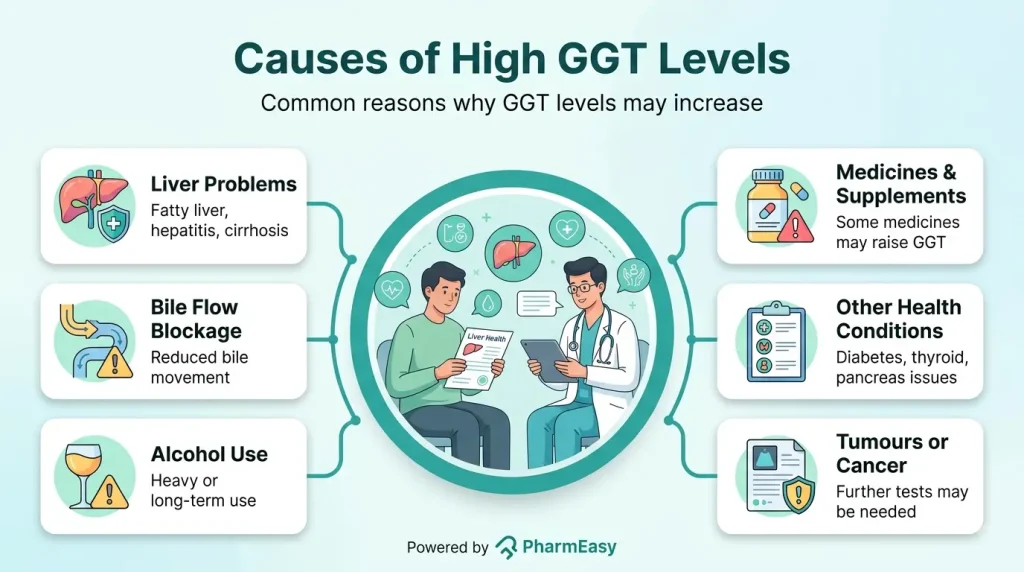
A high GGT level can be linked to liver or bile duct conditions, alcohol use, some medicines, and certain long-term health conditions. Common causes include6:
Elevated GGT can be seen associated with intake of alcohol, cholestasis, and certain drugs that are enzyme inducers. However, elevated GGT does not reflect the severity of liver damage.
High GGT itself usually does not cause symptoms. Symptoms, when present, come from the condition that is affecting the liver, bile ducts, or another organ. Possible symptoms include:
A persistently high GGT level may be linked with a higher chance of certain health problems, but GGT is usually a marker rather than the direct cause. It should be interpreted together with other test results and your overall health10.
GGT elevation is usually detected or measured from a test report rather than being diagnosed. The diagnosis focuses on the underlying cause that led to the elevation. GGT is usually checked with other liver tests. Doctors use the full pattern of results, your symptoms, your medical history, and sometimes imaging tests to understand what may be causing the high level11.
A single abnormal GGT result does not confirm a diagnosis. If your result is high, discuss it with your doctor, especially if you have symptoms or other abnormal liver tests.
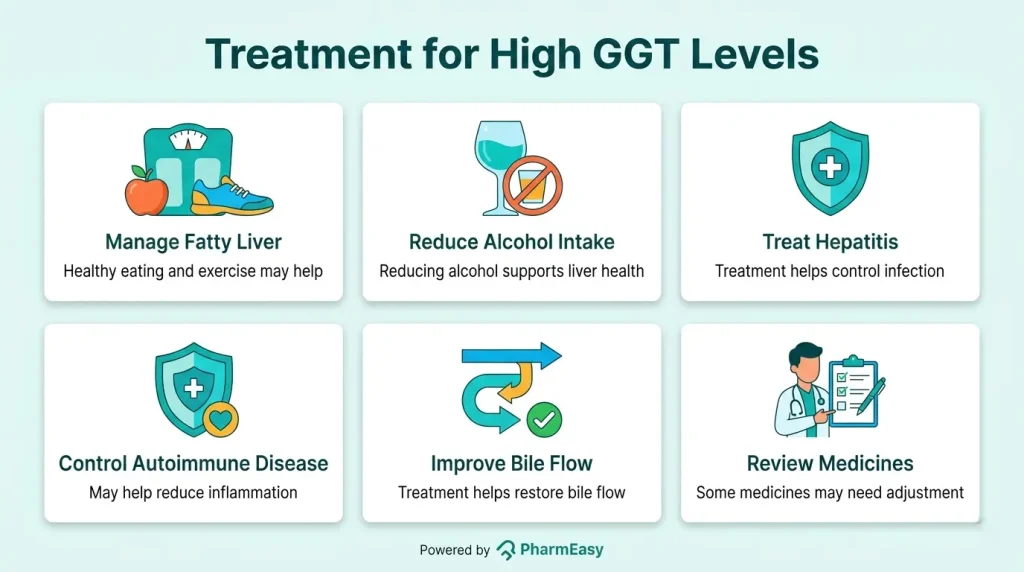
Treatment focuses on the cause of the high GGT level rather than the number itself. On the contrary, a decrease in GGT level after treatment may not mean that the treatment was successful. Your doctor may recommend one or more of the following, depending on the diagnosis13:
You may not be able to prevent every cause of high GGT, but these steps can support liver health and lower the risk of several related conditions:

If you drink, follow your doctor’s advice about safe limits. If you have liver disease, you may be advised to avoid alcohol completely. In advanced stages of liver disease, especially linked with the consumption of alcohol or liver cirrhosis or fibrosis, alcohol abstinence is advised instead of limiting the intake.

Gradual weight loss can reduce fat and inflammation in the liver for people with fatty liver disease14.

Choose fibre-rich foods, limit sugary drinks, and aim for regular physical activity as advised by your healthcare provider.

Tell your doctor about all medicines, supplements, and herbal products you take because some can affect the liver. However, the stoppage of medicines should not be based solely on GGT levels. Changes in medicines are only advised for those who might be associated with liver toxicity or enzyme induction. These changes can only be done under the supervision of a medical professional.

If you have cirrhosis, hepatitis, or another liver condition, regular monitoring helps detect changes early13.
Also Read: Liver Fibrosis: What Is It, Causes, Symptoms & Treatment
GGT is an enzyme found mainly in the liver and bile ducts. A high GGT level can suggest liver or bile duct irritation, but it does not diagnose a disease on its own. The most useful next step is to review the result with your doctor, who can compare it with your symptoms, medical history, medicines, alcohol use, and other test results. In many cases, treating the underlying cause and making liver-friendly lifestyle changes can help improve GGT levels over time.
If alcohol is the main cause, GGT may gradually fall after several weeks without alcohol15. If another condition is causing the rise, GGT may improve when that condition is treated.
There is no single alarming number for everyone. A result that is several times above the lab’s reference range, or a high result with symptoms such as jaundice, dark urine, pale stools, severe itching, or abdominal swelling, should be discussed promptly with a doctor4.
High GGT is not treated directly. It may return closer to normal when the cause is managed, such as reducing alcohol intake, treating hepatitis, improving fatty liver disease, or adjusting a medicine under medical supervision15.
No. GGT is an enzyme, not a disease. Fatty liver disease is one possible reason for a raised GGT, but other causes are also possible6.
Statins are the most common drugs that are used for the management of heart-related diseases. The common side effects associated with them are muscle dysfunction (myopathy) and elevation of some liver enzymes such as ALT or AST in the blood. However, there are rare cases of GGT elevation promoted by statins16.
Yes. Alcohol can increase GGT levels, especially with heavy or long-term drinking. If you are concerned about alcohol use, ask a healthcare professional for support15.
Dehydration is not a common cause of high GGT in people. High GGT is more often linked with liver disease, bile duct problems, alcohol use, certain medicines, or other health conditions17.
No. GGT can be seen as increased in many conditions, including liver cancers. However, it is not specific to cancer. It is mostly associated with liver diseases; however, it can also be seen in some other dysfunctions and alcoholism6.
Smoking has been linked with higher GGT levels in some studies. Smoking and alcohol together may have a stronger effect on liver-related test results18.
1. Kunutsor SK. Gamma-glutamyltransferase-friend or foe within? Liver Int Off J Int Assoc Study Liver. 2016;36(12):1723-1734. doi:10.1111/liv.13221 Available from: https://pubmed.ncbi.nlm.nih.gov/27512925/
2. Torrente MP, Freeman WM, Vrana KE. Protein biomarkers of alcohol abuse. Expert Rev Proteomics. 2012;9(4):425-436. doi:10.1586/epr.12.38 Available from: https://pubmed.ncbi.nlm.nih.gov/22967079/
3. Content – Health Encyclopedia – URochester Medicine. Accessed August 6, 2026. Available from: https://www.urmc.rochester.edu/encyclopedia/content?contenttypeid=167&contentid= gamma_glutamyl_transpeptidase
4. Vroon DH, Israili Z. Alkaline Phosphatase and Gamma Glutamyltransferase. In: Walker HK, Hall WD, Hurst JW, eds. Clinical Methods: The History, Physical, and Laboratory Examinations. 3rd ed. Butterworths; 1990. Accessed August 6, 2026. Available from: http://www.ncbi.nlm.nih.gov/books/NBK203/
5. Giannini EG, Testa R, Savarino V. Liver enzyme alteration: a guide for clinicians. CMAJ Can Med Assoc J. 2005;172(3):367-379. doi:10.1503/cmaj.1040752 Available from: https://pubmed.ncbi.nlm.nih.gov/15684121/
6. H.A. K. The Serum Gamma Glutamyl Transpeptidase – A Non invasive Diagnostic Bio Marker of Chronic Anicteric Non Alcoholic Liver Diseases. J Clin Diagn Res JCDR. 2013;7(4):691-694. doi:10.7860/JCDR/2013/5569.2883 Available from: https://pmc.ncbi.nlm.nih.gov/articles/PMC3644446/
7. Gamma-glutamyl Transferase (GGT) Test: MedlinePlus Medical Test. Accessed August 5, 2026. Available from: https://medlineplus.gov/lab-tests/gamma-glutamyl-transferase-ggt-test/
8. Symptoms & Causes of Cirrhosis – NIDDK. National Institute of Diabetes and Digestive and Kidney Diseases. Accessed August 5, 2026. Available from: https://www.niddk.nih.gov/health-information/liver-disease/cirrhosis/symptoms-causes
9. Cholestasis: MedlinePlus Medical Encyclopedia. Accessed August 5, 2026. Available from: https://medlineplus.gov/ency/article/000215.htm
10. Cho EJ, Jeong SM, Chung GE, et al. Gamma-glutamyl transferase and risk of all-cause and disease-specific mortality: a nationwide cohort study. Sci Rep. 2023;13:1751. doi:10.1038/s41598-022-25970-0 Available from: https://pubmed.ncbi.nlm.nih.gov/36720971/
11. Diagnosis of NAFLD & NASH – NIDDK. National Institute of Diabetes and Digestive and Kidney Diseases. Accessed August 5, 2026. Available from: https://www.niddk.nih.gov/health-information/liver-disease/nafld-nash/diagnosis
12. Liver Function Tests: MedlinePlus Medical Test. Accessed August 6, 2026. Available from: https://medlineplus.gov/lab-tests/liver-function-tests/
13. Treatment for Cirrhosis – NIDDK. National Institute of Diabetes and Digestive and Kidney Diseases. Accessed August 6, 2026. Available from: https://www.niddk.nih.gov/health-information/liver-disease/cirrhosis/treatment
14. Treatment for NAFLD & NASH – NIDDK. National Institute of Diabetes and Digestive and Kidney Diseases. Accessed August 6, 2026. Available from: https://www.niddk.nih.gov/health-information/liver-disease/nafld-nash/treatment
15. Horner F, Kellen JA, Kingstone E, Maharaj N, Malkin A. Dynamic changes of serum gamma-glutamyl transferase in chronic alcoholism. Enzyme. 1979;24(4):217-223. doi:10.1159/000458662 Available from: https://pubmed.ncbi.nlm.nih.gov/39748/
16. Xu Y, Wu Y. Atorvastatin associated with gamma glutamyl transpeptidase elevation in a hyperlipidemia patient: A case report and literature review. Medicine (Baltimore). 2020;99(40):e22572. doi:10.1097/MD.0000000000022572 Available from: https://pubmed.ncbi.nlm.nih.gov/33019469/
17. Sala G, Bronzo V, Boccardo A, et al. Assessing failure of transfer of passive immunity by gamma-glutamyl-transferase activity and serum refractometry in holstein-friesian calves affected by neonatal diarrhea. Vet Res Commun. 2023;47(4):2315-2321. doi:10.1007/s11259-023-10149-3 Available from: https://pubmed.ncbi.nlm.nih.gov/37314566/
18. Zhang Z, Ma L, Geng H, Bian Y. Effects of Smoking, and Drinking on Serum Gamma-Glutamyl Transferase Levels Using Physical Examination Data: A Cross-Sectional Study in Northwest China. Int J Gen Med. 2021;14:1301-1309. doi:10.2147/IJGM.S301900 Available from: https://pubmed.ncbi.nlm.nih.gov/33883928/
Disclaimer: The information provided here is for educational/awareness purposes only and is not intended to be a substitute for medical treatment by a healthcare professional and should not be relied upon to diagnose or treat any medical condition. The reader should consult a registered medical practitioner to determine the appropriateness of the information and before consuming any medication. PharmEasy does not provide any guarantee or warranty (express or implied) regarding the accuracy, adequacy, completeness, legality, reliability or usefulness of the information; and disclaims any liability arising thereof.
Links and product recommendations in the information provided here are advertisements of third-party products available on the website. PharmEasy does not make any representation on the accuracy or suitability of such products/services. Advertisements do not influence the editorial decisions or content. The information in this blog is subject to change without notice. The authors and administrators reserve the right to modify, add, or remove content without notification. It is your responsibility to review this disclaimer regularly for any changes.


Comments

Leave your comment...
You may also like
























Comments