



Congenital Adrenal Hyperplasia (CAH): Symptoms, Causes, Diagnosis, And More
By Dr. Nisha Dahiya +2 more

Medically reviewed by Dr. Nisha Dahiya
Last updated: Aug 12, 2026 Published on: Aug 6, 2026


Get,

to manage your symptom
Get your,

4 Cr+ families
benefitted

OTP sent to 9988776655



You’ve successfully subscribed to receive
doctor-approved tips on
Whatsapp

Get ready to feel your best.


Register to Avail the Offer
Send OTPBy continuing, you agree with our Privacy Policy and Terms and Conditions
Hi There,
Sign up on PharmEasy now!!


Trusted by 4 crore+ families

OTP sent to 9988776655
You have unlocked 25% off on medicines


Code: NU25

By Dr. Nisha Dahiya +2 more
Table of Contents
Every parent wants their child to grow healthier and happier. Attaining the expected height and weight for the child’s age is one of the small wins during any parenting journey, and a child showing unusual growth patterns can become a matter of huge concern. Altered growth during childhood might point to an underlying medical condition. Some rare health conditions like congenital adrenal hyperplasia (CAH) can affect normal development and may require early medical attention. In this article, we will cover what CAH is, its types, symptoms, causes, risk factors, complications, diagnosis, treatment and preventive tips.

Congenital adrenal hyperplasia (CAH) is a genetic condition in which the adrenal glands are increased in their sizes1. Since these glands are involved in producing hormones such as androgens (male sex hormones), cortisol, and aldosterone (a hormone that regulates salt levels in the body), the condition leads to an imbalance of these hormones. In most of the CAH cases, androgens are produced more when compared to the levels of the other two hormones remain low. This variation in hormones can affect the overall health, and specifically the growth and development of children due to high levels of sex hormones2.
Did You Know?
Congenital adrenal hyperplasia types can include classic CAH and non-classic CAH7:
Classic CAH is considered the rare and serious variant of CAH. Here, androgens are produced more, and the hormones like aldosterone and cortisol are produced less. It is mainly seen at birth or in infancy. The classic variant can again be subdivided into two based on the severity of the congenital adrenal hyperplasia symptoms.
Non-classic is the milder variant among congenital adrenal hyperplasia types. Here, more androgens are produced, along with sufficient production of aldosterone and cortisol. It is often seen in the late stages of childhood or early adulthood.
Congenital adrenal hyperplasia symptoms can be noticed at or a few days to weeks after birth or later in childhood. In any type of CAH, children or adults can face2:
The symptoms can vary based on the type and severity of CAH. Congenital adrenal hyperplasia symptoms of the classic variant can again be subdivided into symptoms in salt-wasting CAH and in simple virilizing (non-salt-wasting) CAH.
The salt-wasting type can be a medical emergency in some cases. Since too much sodium is lost through urine, symptoms such as a drop in blood pressure, reduced blood glucose, weight loss, difficulty feeding, loose stools or vomiting can appear within days or weeks of birth7,8. Symptoms related to increased androgens and reduced cortisol include8:
Most congenital adrenal hyperplasia symptoms seen in the non-classic variant are linked with increased androgens. In some people, symptoms might be mild, and the presence of the condition might not be recognised. The symptoms can include7,8:
Certain enzymes are needed for the adequate production of cortisol, aldosterone and androgens. Genetic mutations leading to abnormal functioning/deficiencies of these enzymes can impair the functioning of the adrenal gland in hormone production7,9. The commonly involved enzymes are9:
In cases of 21-OH enzyme deficiency, the normal mechanism of cortisol production is impaired. As a result, a substance named 17-OHP (17-hydroxy progesterone), which is considered the precursor of cortisol, is increased. This accumulated 17-OHP is used for the production of more androgens, leading to the symptoms of CAH10.
CAH is an autosomal recessive condition, which means when babies get two nonworking genes from their parents, this condition can result. Risk factors of getting this condition include9:
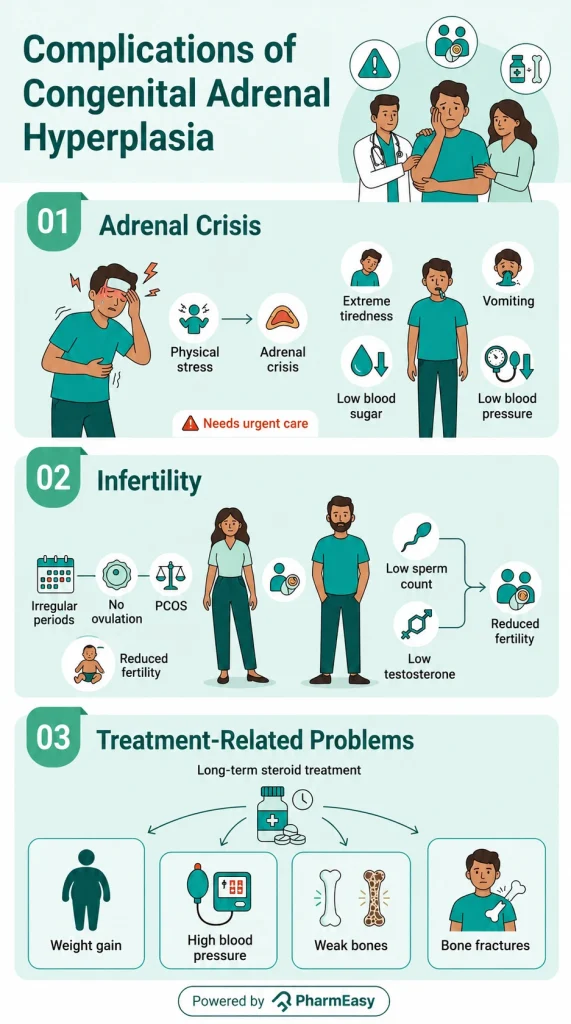
Complications of CAH depend on the type and severity affected, which include:
Also Read: Female Infertility: Causes, Symptoms, Treatment and More
Congenital adrenal hyperplasia diagnosis can range from physical evaluation of ambiguous sex organs, hormonal assessment and gene evaluations, which include4:
Congenital adrenal hyperplasia treatment targets replacing the deficient hormones, reducing androgen production and alleviating the symptoms. It can include hormone replacement therapies, medications, and surgery.
These are the available congenital adrenal hyperplasia treatment modalities. However, exact medicines and doses should only be followed under medical supervision.
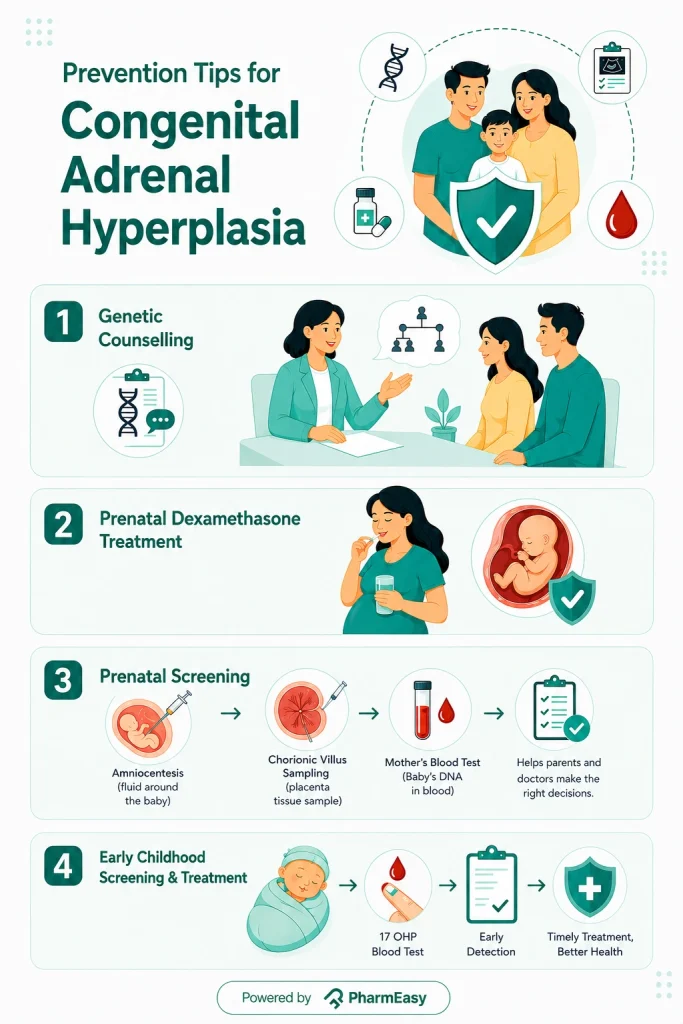
Since CAH is a congenital condition, exact preventive measures are not available. However, several measures can reduce the risk of having an affected child or ensure early diagnosis in affected infants.
Also Read: Congenital Rubella Syndrome: Symptoms, Causes, Diagnosis, Treatment & Prevention
CAH is a rare genetic condition that is caused by irregularities in the production of hormones by the adrenal glands. It can affect a child’s growth and development, along with some changes in the reproductive system. However, an early medical diagnosis can help in initiating congenital adrenal hyperplasia treatment at an early stage, thereby reducing the severity of the condition.
Congenital adrenal hyperplasia (CAH) results when adrenal glands make more androgens compared to cortisol and aldosterone. When you have CAH, it can affect your growth and development, including that of sex organs. If you are an adult, it can cause irregular periods, excessive facial and body hair in females, well-developed muscles and an enlarged penis in males and infertility in both2.
Symptoms can vary based on the type of CAH and age of the affected person. If you are experiencing symptoms like attaining puberty earlier than expected, short height in adulthood, unwanted face and body hair, severe acne, irregular periods in females and infertility, that might be due to CAH. Consulting a doctor is advised in this situation to obtain a proper diagnosis and start appropriate treatment as soon as possible7.
Yes. Congenital adrenal hyperplasia is a genetic condition in which a gene named CYP21A2 is involved in the production of hormones by the adrenal glands. It is an autosomal recessive condition, as both genes should be nonworking to result in the condition9.
Although both CAH and PMOS can show almost similar symptoms like excessive facial and body hair, severe acne and irregular periods in females, they are different conditions. CAH is a genetic disease caused by the abnormal production of hormones by the adrenal glands, whereas PMOS is a metabolic condition involving the ovaries. However, a complication seen in CAH, infertility, is considered the result of PCOS in women.
Yes. Congenital adrenal hyperplasia is a genetic condition in which a gene named CYP21A2 is involved in the production of hormones by the adrenal glands. It is an autosomal recessive condition, as both genes should be nonworking to result in the condition9.
With an early diagnosis and proper treatment plans, many people with CAH can have a healthy life. However, some children with the classic variant of CAH might develop diarrhoea, vomiting, dehydration, and weight loss, which might impair daily activities7.
In rare forms of CAH due to the deficiency of 11β-hydroxylase and 17-hydroxylase deficiency, hypertension can be seen in the affected people17. However, in most common form of CAH, a complication named adrenal crisis can occur which can include low blood pressure and blood glucose2.
Yes. Congenital adrenal hyperplasia is an autosomal recessive condition in which only if the two altered genes are inherited from the parents can the condition result in children. However, if anyone has one normal and one altered gene, they are considered carriers9.
1. Congenital Adrenal Hyperplasia (CAH) | Texas DSHS. Accessed July 28, 2026. https://www.dshs.texas.gov/newborn-screening-program/newborn-screening-parent-resources/congenital-adrenal-hyperplasia-cah
2. Australia H. Congenital adrenal hyperplasia. September 26, 2024. Accessed July 28, 2026. https://www.healthdirect.gov.au/congenital-adrenal-hyperplasia
3. 21-hydroxylase deficiency: MedlinePlus Genetics. Accessed August 2, 2026. https://medlineplus.gov/genetics/condition/21-hydroxylase-deficiency/
4. Yau M, Gujral J, New MI. Congenital Adrenal Hyperplasia: Diagnosis and Emergency Treatment. In: Feingold KR, Adler RA, Ahmed SF, et al., eds. Endotext. MDText.com, Inc.; 2000. Accessed July 29, 2026. http://www.ncbi.nlm.nih.gov/books/NBK279085/
5. What are the symptoms of congenital adrenal hyperplasia (CAH)? | NICHD – Eunice Kennedy Shriver National Institute of Child Health and Human Development. May 17, 2021. Accessed July 29, 2026. https://www.nichd.nih.gov/health/topics/cah/conditioninfo/symptoms
6. What are the treatments for congenital adrenal hyperplasia (CAH)? | NICHD – Eunice Kennedy Shriver National Institute of Child Health and Human Development. February 13, 2024. Accessed July 29, 2026. https://www.nichd.nih.gov/health/topics/cah/conditioninfo/treatments
7. Congenital adrenal hyperplasia: MedlinePlus Medical Encyclopedia. Accessed July 28, 2026. https://medlineplus.gov/ency/article/000411.htm
8. What are the symptoms of congenital adrenal hyperplasia (CAH)? | NICHD – Eunice Kennedy Shriver National Institute of Child Health and Human Development. May 17, 2021. Accessed July 29, 2026. https://www.nichd.nih.gov/health/topics/cah/conditioninfo/symptoms
9. Congenital Adrenal Hyperplasia | Newborn Screening. Accessed July 28, 2026. https://newbornscreening.hrsa.gov/conditions/congenital-adrenal-hyperplasia
10. 17-Hydroxyprogesterone: MedlinePlus Medical Test. Accessed August 2, 2026. https://medlineplus.gov/lab-tests/17-hydroxyprogesterone/
11. Nordenström A, Falhammar H. MANAGEMENT OF ENDOCRINE DISEASE: Diagnosis and management of the patient with non-classic CAH due to 21-hydroxylase deficiency. Eur J Endocrinol. 2019;180(3):R127-R145. doi:10.1530/EJE-18-0712 https://pubmed.ncbi.nlm.nih.gov/30566904/
12. Congenital Adrenal Hyperplasia (CAH). Accessed July 29, 2026. https://dhhr.wv.gov/ols/labs/Pages/CAH.aspx
13. Schröder MAM, Claahsen – van der Grinten HL. Novel treatments for congenital adrenal hyperplasia. Rev Endocr Metab Disord. 2022;23(3):631-645. doi:10.1007/s11154-022-09717-w https://pubmed.ncbi.nlm.nih.gov/35199280/
14. Commissioner O of the. FDA Approves New Treatment for Congenital Adrenal Hyperplasia. FDA. December 19, 2024. Accessed July 29, 2026. https://www.fda.gov/news-events/press-announcements/fda-approves-new-treatment-congenital-adrenal-hyperplasia
15. Kouri C, Costa FC, De MMC, et al. Oral Contraceptives: A Key to reducing androgen levels in women with classic CAH. Endocr Abstr. 2025;110. doi:10.1530/endoabs.110.P113 https://www.endocrine-abstracts.org/ea/0110/ea0110p113
16. Kim MS, Ryabets-Lienhard A, Geffner ME. Management of Congenital Adrenal Hyperplasia in Childhood. Curr Opin Endocrinol Diabetes Obes. 2012;19(6):483-488. doi:10.1097/MED.0b013e32835a1a1b https://pubmed.ncbi.nlm.nih.gov/23037928/
17. Pellegrini B, Bonaventura I, Hasenmajer V, et al. Adrenal causes of endocrine hypertension in childhood or adolescence. J Endocrinol Invest. 2025;48(11):2515-2545. doi:10.1007/s40618-025-02633-1 https://pmc.ncbi.nlm.nih.gov/articles/PMC12602608/
Disclaimer: The information provided here is for educational/awareness purposes only and is not intended to be a substitute for medical treatment by a healthcare professional and should not be relied upon to diagnose or treat any medical condition. The reader should consult a registered medical practitioner to determine the appropriateness of the information and before consuming any medication. PharmEasy does not provide any guarantee or warranty (express or implied) regarding the accuracy, adequacy, completeness, legality, reliability or usefulness of the information; and disclaims any liability arising thereof.
Links and product recommendations in the information provided here are advertisements of third-party products available on the website. PharmEasy does not make any representation on the accuracy or suitability of such products/services. Advertisements do not influence the editorial decisions or content. The information in this blog is subject to change without notice. The authors and administrators reserve the right to modify, add, or remove content without notification. It is your responsibility to review this disclaimer regularly for any changes.


Comments

Leave your comment...
You may also like

























Comments