




Insulin Injection Site Rotation: Common Mistakes, Best Practices for Better Absorption
By Dr. Akash N. Shah +2 more

Medically reviewed by Dr. Akash N. Shah
Last updated: Aug 12, 2026 Published on: Aug 5, 2026


Get,

to manage your symptom
Get your,

4 Cr+ families
benefitted

OTP sent to 9988776655



You’ve successfully subscribed to receive
doctor-approved tips on
Whatsapp

Get ready to feel your best.


Register to Avail the Offer
Send OTPBy continuing, you agree with our Privacy Policy and Terms and Conditions
Hi There,
Sign up on PharmEasy now!!


Trusted by 4 crore+ families

OTP sent to 9988776655
You have unlocked 25% off on medicines


Code: NU25

By Dr. Akash N. Shah +2 more
Table of Contents
If you have been taking insulin injection for a long time, you may prefer injecting into the same comfortable spot every time as it may seem easier and less painful. However, if you repeatedly inject insulin at the same site, it can cause lumps under your skin, called lipohypertrophy1. This common complication affects nearly 47% of people who use insulin worldwide2. Injecting into areas of lipohypertrophy is often less painful than injecting into healthy skin. As a result, many people continue using the same injection site3. Therefore, it is important to rotate injection sites regularly to keep your skin and underlying fat tissue healthy and ensure even absorption of insulin4. In this blog, we will discuss the common injection site rotation mistakes and best practices to improve insulin absorption and achieve better blood sugar control.

Injection site rotation is the process of systematically changing where you inject insulin each time to avoid using the same spot repeatedly. This involves moving to a new injection point within a single body area in a planned, structured pattern before eventually switching to an entirely different body region. For example, the abdomen is divided into four quadrants, and the thighs, upper arms, and buttocks are divided into two halves. One section is chosen for a particular period of time before moving to the next section in a clockwise or anticlockwise direction4.
Rotating injection sites is an important part of insulin therapy as it helps in the following ways:
Correctly practising injection site rotation helps keep the injection sites healthy, lowers the risk of developing lipohypertrophy, and helps prevent changes in insulin absorption associated with repeated injections into the same site4.
Experts recommend four main areas where insulin can be injected safely. Each injection site absorbs insulin at a different speed, so it is important to follow the recommended injection technique4,5.
People who take multiple insulin injections each day should follow a regular injection site rotation plan to reduce repeated injections into the same area. A systematic rotation pattern, such as moving clockwise between different sections of the same injection site, can make rotation easier and help keep track of previous injection sites6.
Keeping a record of injection sites can also be helpful, especially for people who inject insulin several times a day. Mobile applications, such as the Insulin Site Guide, allow users to record injection sites, identify overused areas, and support proper site rotation7.
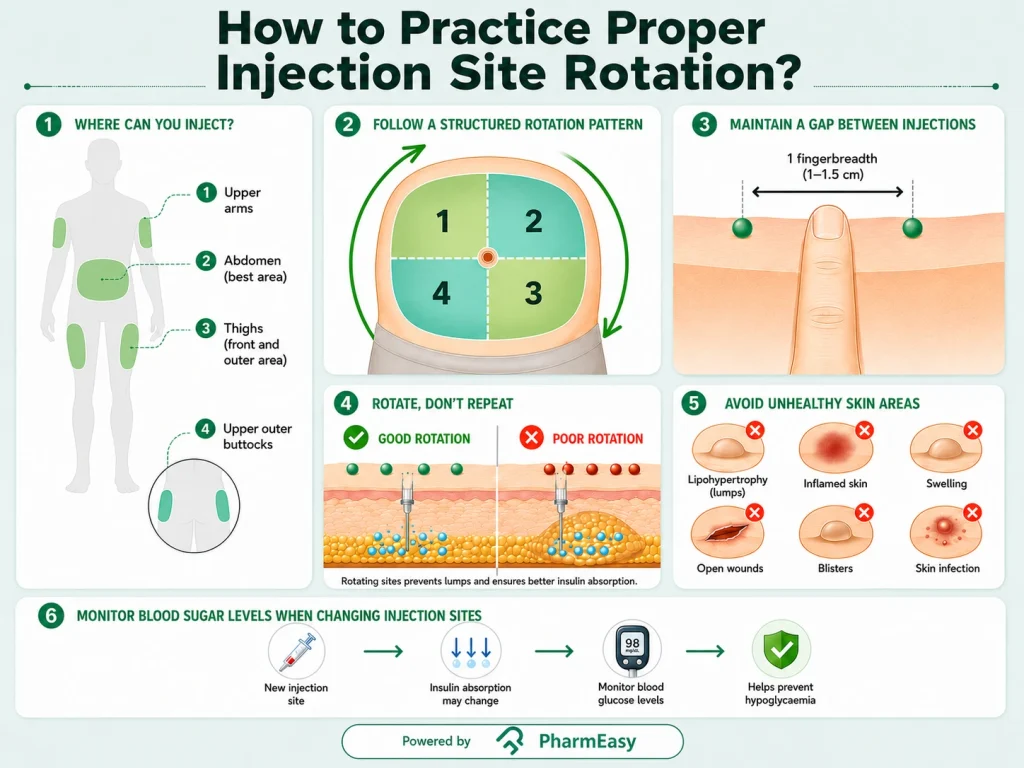
Here are some practical strategies to help ensure proper injection site rotation:
At least once a year, a healthcare professional, doctor, or nurse should review the injection site rotation technique4.
If you do not rotate injection sites, it can affect both the skin and the way insulin works in the body, causing:
People often continue injecting into lipohypertrophy because these areas become less painful over time, creating a cycle of repeated injections into the same site. Therefore, rotating injection sites regularly is important to help insulin absorb more predictably and support better blood sugar control4.
There are a few warning signs that may indicate you need to change the way you rotate your injection sites. Specifically, you need to watch out for:
If any of these signs are present, injection sites should be examined and proper injection site rotation should be practised to help improve insulin absorption and blood sugar control4.
Often because of a lack of awareness, insulin users can make the following mistakes that can affect insulin absorption, increase injection-related skin problems, and reduce the effectiveness of insulin therapy:
Avoiding these common mistakes and following the correct injection of insulin site rotation technique can help improve insulin absorption and support better blood sugar control.
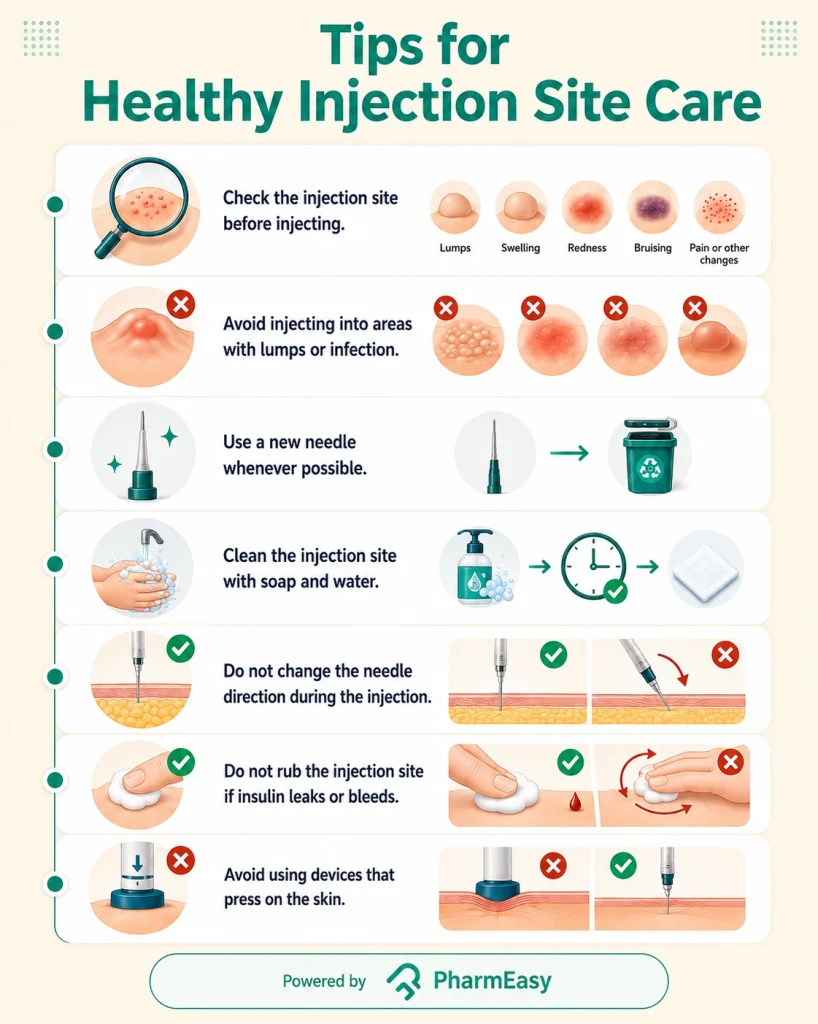
Here are some tips which help to give the right care for a healthy insulin injection site to reduce the risk of injection-related complications:
Following these simple injection site care practices can help reduce injection-related complications and improve insulin absorption.
Also Read: Common Insulin Mistakes to Avoid: Safe Use, Storage, Dosing & Management Tips
If any of the following signs are seen, it is better to consult a doctor for getting your injection site checked:
If these issues are addressed early, it helps to identify injection site problems and improve outcomes of insulin therapy.
Also Read: How to Store Insulin Safely During Travel: Tips, Precautions & Best Practices
For those using insulin, proper injection site rotation is very important. It helps maintain consistent insulin absorption, reduces the risk of injection site-related problems such as lipohypertrophy, and ensures optimal blood sugar control.
Insulin is absorbed fastest from the abdomen, at a moderate rate from the upper arm, and slowest from the thigh. Therefore, the abdomen is the preferred site when faster insulin absorption is needed5.
If insulin is injected into the same site repeatedly, it may cause inflammation, lipohypertrophy (fatty lumps under the skin), or scarring. This can also reduce how insulin is absorbed and may lead to high blood sugar after meals or sometimes low blood sugar5.
Insulin absorption may become slower when insulin is injected into the same spot again and again, where fatty lumps (lipohypertrophy) have formed. It may also be reduced when larger insulin doses are injected or when the insulin suspension is not mixed properly before injection5.
Yes. One study reported that following a proper injection site rotation plan may help reduce the size of fatty lumps (lipohypertrophy) by a 30–50% reduction in 3–6 months, along with improved blood sugar control10. However, injection into areas with lipohypertrophy should still be avoided until the area has healed completely or a healthcare professional advises that it is safe to use again6.
Yes. Reusing insulin needles can increase the risk of lipohypertrophy because repeated use makes the needle tip bent and damaged, causing greater tissue trauma with each injection. Repeatedly injecting into the same area further increases this risk4. Using a new needle for each injection and rotating injection sites regularly may help reduce this risk10.
1. Ehrmann D, Kulzer B, Wienbarg I, et al. Assessing Barriers and Adherence to Insulin Injection Technique in People With Diabetes: Development and Validation of New Assessment Tools. J Diabetes Sci Technol. 2024;18(6):1362-1369. doi:10.1177/19322968231175920 https://pubmed.ncbi.nlm.nih.gov/37209023/
2. Gentile S, Guarino G, Della Corte T, et al. Why Do So Many People with Type 2 Diabetes Who Take Insulin Have Lipohypertrophy? Fate or Educational Deficiencies? Diabetes Ther. 2023;14(1):179-191. doi:10.1007/s13300-022-01341-w https://pubmed.ncbi.nlm.nih.gov/36472805/
3. Tian T, Aaron RE, Huang J, et al. Lipohypertrophy and Insulin: An Update From the Diabetes Technology Society. J Diabetes Sci Technol. 2023;17(6):1711-1721. doi:10.1177/19322968231187661 https://pmc.ncbi.nlm.nih.gov/articles/PMC10658672/
4. Tandon N, Kalra S, Balhara YS, et al. Forum for injection technique and therapy expert recommendations, India: The Indian recommendations for best practice in insulin injection technique, 2017. Indian J Endocrinol Metab. 2017;21(4):600. doi:10.4103/ijem.IJEM_97_17 https://pubmed.ncbi.nlm.nih.gov/28670547/
5. Bahendeka S, Kaushik R, Swai AB, et al. EADSG Guidelines: Insulin Storage and Optimisation of Injection Technique in Diabetes Management. Diabetes Ther. 2019;10(2):341-366. doi:10.1007/s13300-019-0574-x https://pubmed.ncbi.nlm.nih.gov/30815830/
6. Hirsch LJ, Strauss KW. The Injection Technique Factor: What You Don’t Know or Teach Can Make a Difference. Clin Diabetes. 2019;37(3):227-233. doi:10.2337/cd18-0076 https://pubmed.ncbi.nlm.nih.gov/31371853/
7. Blanchard J, Ahmed S, Clark B, Sanchez Cotto L, Rangasamy S, Thompson B. Design and Testing of a Smartphone Application for Real-Time Tracking of CSII and CGM Site Rotation Compliance in Patients With Type 1 Diabetes. J Diabetes Sci Technol. 2024;18(4):937-945. doi:10.1177/19322968221145178 https://pmc.ncbi.nlm.nih.gov/articles/PMC11307221/
8. Blanco M, Hernández MT, Strauss KW, Amaya M. Prevalence and risk factors of lipohypertrophy in insulin-injecting patients with diabetes. Diabetes Metab. 2013;39(5):445-453. doi:10.1016/j.diabet.2013.05.006 https://pubmed.ncbi.nlm.nih.gov/23886784/
9. Site selection, site rotation and tips for injecting insulin – Diabetes Victoria. Accessed July 6, 2026. https://www.diabetesvic.org.au/insulin-injections-site-selection-site-rotation-and-tips-for-injecting-insulin/
10. Strauss K, Gols HD, Hannet I, Partanen T, Frid A. A pan‐European epidemiologic study of insulin injection technique in patients with diabetes. Pract Diabetes Int. 2002;19(3):71-76. doi:10.1002/pdi.314 https://www.researchgate.net/publication/229898186_A_pan-European_epidemiologic_study_of_insulin_injection_technique_in_patients_with_diabetes
Disclaimer: The information provided here is for educational/awareness purposes only and is not intended to be a substitute for medical treatment by a healthcare professional and should not be relied upon to diagnose or treat any medical condition. The reader should consult a registered medical practitioner to determine the appropriateness of the information and before consuming any medication. PharmEasy does not provide any guarantee or warranty (express or implied) regarding the accuracy, adequacy, completeness, legality, reliability or usefulness of the information; and disclaims any liability arising thereof.
Links and product recommendations in the information provided here are advertisements of third-party products available on the website. PharmEasy does not make any representation on the accuracy or suitability of such products/services. Advertisements do not influence the editorial decisions or content. The information in this blog is subject to change without notice. The authors and administrators reserve the right to modify, add, or remove content without notification. It is your responsibility to review this disclaimer regularly for any changes.


Comments

Leave your comment...
You may also like

























Comments